Finding a tick crawling on your dog or, worse, embedded in your own skin after a simple walk across the lawn is a visceral violation. The risk of Lyme disease and other tick-borne illnesses turns every rustle of grass into a potential hazard, and the spray you grab needs to deliver a reliable dead zone, not just a temporary deterrent.
I’m Emma — the founder and writer behind Baby Bangs. I’ve spent years analyzing pest control formulations, from synthetic pyrethroids to plant-based essential oil blends, to understand exactly which active ingredients and application methods truly create a barrier ticks cannot cross.
This guide breaks down the five strongest contenders on the market, comparing their active ingredients, residual duration, and safety profiles so you can confidently choose the best insecticide for ticks that fits your property and your family’s needs.
How To Choose The Best Insecticide For Ticks
Ticks are not like mosquitoes. A mosquito flies in, bites, and leaves. A tick climbs up a blade of grass, waits for a host, and latches on. That behavioral difference demands a specific type of insecticide: one that creates a durable, residual layer on vegetation rather than just a fog that vanishes in an hour. Here are the three factors that determine whether a product earns its spot.
Active Ingredient Class: Pyrethroid vs. Natural Oil
Synthetic pyrethroids like permethrin and bifenthrin are the gold standard for outdoor tick control because they bond to plant surfaces and remain active for weeks. Natural oil formulas — typically cedar oil, lemongrass oil, or peppermint oil — break down faster in sunlight and rain, requiring more frequent applications. The trade-off is that natural oils pose virtually zero risk to pets and beneficial insects once dry, making them the right call for yards with kids and dogs rolling in the grass daily.
Application Format: Hose-End Concentrate vs. Ready-to-Spray
A hose-end concentrate attaches to your garden hose and dilutes the product automatically as you spray. This format is ideal for covering 5,000 square feet or more without mixing buckets. Ready-to-spray bottles contain the concentrate plus a built-in sprayer head; you attach the hose and flip a switch. Both eliminate guesswork. Pump or trigger sprayers are better for targeted perimeter treatments around foundations and patios but become tedious for whole-lawn coverage.
Residual Duration and Rain Resistance
Check the label for the stated residual window. The best tick insecticides maintain a lethal barrier for 4 to 12 weeks. Rain can strip the residue, so products that claim rainfastness — meaning they resist wash-off after the spray dries — are a major advantage in humid or wet climates. Natural oil formulas typically last 1 to 4 weeks and may require reapplication after heavy downpours.
Quick Comparison
On smaller screens, swipe sideways to see the full table.
| Model | Category | Best For | Key Spec | Amazon |
|---|---|---|---|---|
| Cutter Backyard Bug Control | Hose-End Concentrate | Large yard, quick knock‑down | Up to 12 weeks residual | Amazon |
| Harris Flea and Tick Killer | Indoor Spray | Indoor baseboards & kennels | Odorless, non‑staining | Amazon |
| Durvet Permethrin EC 10% | Concentrate | DIY dilution, fabric treatment | 10% permethrin, economical | Amazon |
| Cedarcide YardSafe | Natural Ready‑to‑Spray | Pet/kid‑friendly yards | No waiting after spray | Amazon |
| Eco Defense Flea & Tick Spray | Natural Ready‑to‑Spray | Organic garden perimeter | Plant‑based, kills eggs/larvae | Amazon |
In‑Depth Reviews
1. Cutter Backyard Bug Control Spray Concentrate (3 Pack)

The Cutter Backyard Bug Control hits the sweet spot between power and ease. Each 32-ounce bottle attaches to a hose-end sprayer and covers 5,000 square feet with no mixing or measuring required. The synthetic pyrethroid formula kills ticks, mosquitoes, fleas, and listed ant species on contact and leaves a residual barrier that the manufacturer rates up to 12 weeks against house crickets and carpenter ants — though real-world reviews suggest tick and mosquito suppression holds strong for roughly 6 to 8 weeks in average weather.
The three-pack brings the per-bottle cost into a competitive range for anyone managing a half-acre lot. Application is straightforward: flip the switch on the sprayer, walk the perimeter, and let the spray dry. Multiple verified buyers note that following the label’s two-hour wait and subsequent watering-in step dramatically improves pet safety and residual longevity.
One trade-off is that heavy rain noticeably shortens the protective window. Reviewers in consistently wet climates report needing a re-spray after three or four weeks instead of the full 12-week period. Still, for sheer coverage speed and reliable tick kill, this concentrate delivers the most practical value for the average homeowner.
Why it’s great
- Treats 5,000 sq ft per bottle with zero mixing
- Three-pack handles a full season for most properties
- Works against mosquitoes, fleas, and ants simultaneously
Good to know
- Residual duration drops after heavy rain
- Requires a watering-in step for pet safety
- Not labeled for indoor use
2. Harris Flea and Tick Killer, Liquid Spray

The Harris Flea and Tick Killer is formulated for indoor application — baseboards, pet bedding areas, cracks, and crevices where ticks drop off a host and hide. The active ingredient (a synthetic pyrethroid) dries to an odorless, non-staining film that continues killing ticks and fleas for weeks after application. This makes it a strong complement to an outdoor barrier spray, handling the inside line of defense.
At a full gallon with the included extended trigger sprayer, the value is hard to beat for anyone managing a multi-pet household. Verified reviews consistently report seeing dead ticks and fleas within 45 minutes of spraying known problem spots. The formula is EPA-registered and labeled safe for use in homes with people and pets once the spray has dried completely.
The recurring complaint across customer reviews is the sprayer nozzle itself. Multiple users report it stops priming after partial use or fails to deliver a continuous stream, requiring manual pumping between every few sprays. The product inside works; the delivery hardware is the weak link. Decanting into a better sprayer solves the issue entirely.
Why it’s great
- Odorless and leaves no visible residue on fabrics
- EPA-registered for indoor use around pets and people
- Kills on contact and provides weeks of residual action
Good to know
- Included trigger sprayer is prone to failure
- Not labeled for broadcast lawn treatment
- Full gallon may be excessive for small apartments
3. Durvet Permethrin EC 10%

The Durvet Permethrin EC 10% is not a ready-to-use product — it is a concentrated emulsifiable liquid you mix yourself. At 10% permethrin, this 16-ounce bottle goes a long way. A common dilution is 1 ounce of concentrate to 20 ounces of water for treating clothing, gear, or small perimeter areas. For broad lawn application, you can mix roughly 1.5 ounces per gallon of water and apply with a pump sprayer.
This is the choice for anyone who wants maximum control over concentration and is comfortable measuring and mixing their own batches. Verified buyers report using it to treat dog bedding, fence lines, and even outdoor furniture with dramatic reductions in ticks, spiders, and mosquitoes. The product is labeled for both on-animal and premise use, but you must follow the label closely — permethrin at this concentration is toxic to cats and aquatic life if misapplied.
The most notable downside is collateral damage to beneficial insects. Several reviewers noted that spraying flowering plants or bushes resulted in dead bees and butterflies. This makes the concentrate better suited for perimeter barriers and non-flowering vegetation rather than blanket coverage over a pollinator garden.
Why it’s great
- Extremely economical — 16 oz makes many gallons of spray
- Effective on clothing (lasts up to 5 washes)
- Kills ticks, mosquitoes, spiders, and carpenter bees
Good to know
- Strong odor during application (fades when dry)
- Kills bees and beneficial insects on contact
- Must be kept away from cats and fish ponds
4. Cedarcide YardSafe
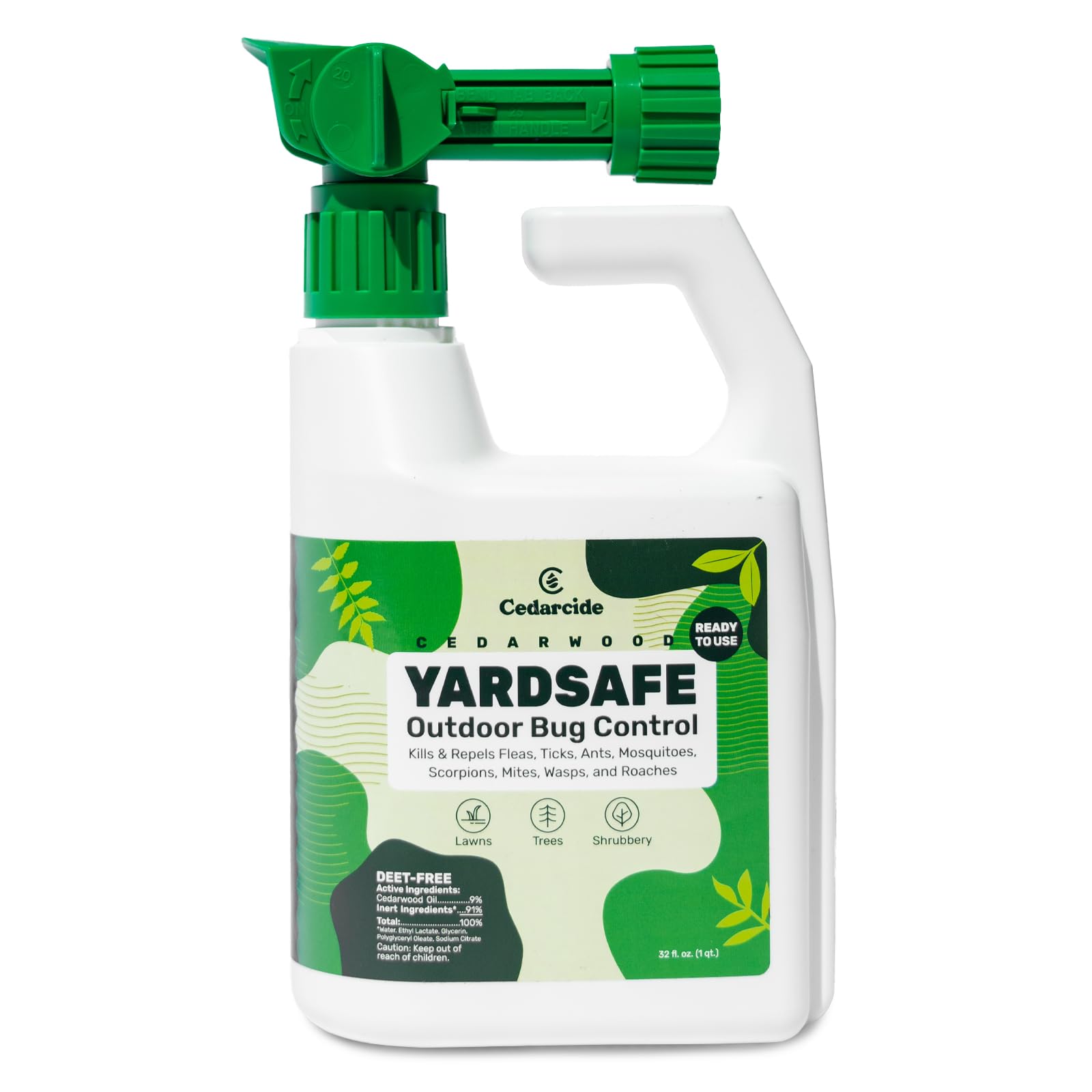
Cedarcide YardSafe uses a blend of cedar oil and lemongrass essential oil as the active insecticidal agents. The quart-sized bottle connects to a garden hose and treats the same 5,000-square-foot area as the synthetic competitors, but with a major practical advantage: zero waiting time. You spray and the yard is immediately safe for kids and pets to run through, because the essential oils degrade rapidly on contact with soil and UV light.
In terms of tick efficacy, reviews are split regionally. Users in the Midwest and Rocky Mountain states report near-total elimination of ticks and mosquitoes for two to four weeks per application. Users in the humid Southeast report that the natural formula fails to hold up against heavy tick pressure, especially after rain. The pleasant cedar scent is a consistent positive note across all feedback, as is the complete absence of chemical concerns for families.
The biggest practical limitation is the bottle size. A single quart covers 5,000 square feet, so larger properties will need multiple bottles per application. The natural oil breakdown means you will reapply every two to three weeks during peak tick season, which adds up in both cost and time compared to a longer-lasting synthetic alternative.
Why it’s great
- Immediate re-entry — no drying or waiting required
- Pleasant cedar-lemongrass scent, not chemical
- Safe around bees, butterflies, and fish ponds
Good to know
- Shorter residual window (2-4 weeks typical)
- Less effective in high-humidity, heavy pressure areas
- Bottle size requires multiple units for large yards
5. Eco Defense Flea, Tick, and Mosquito Spray for Yard

Eco Defense differentiates itself from other natural options by claiming activity against not only adult ticks and fleas but also their eggs and larvae. The ready-to-spray bottle connects directly to a hose and covers 5,000 square feet with a blend of plant-derived oils. The label emphasizes that it is safe around kids, pets, and plants — and there is no waiting period after application.
Customer feedback aligns with the mixed results typical of natural tick insecticides. Several users in moderate climates report that their dogs remained tick-free for the full month between applications. Others note that the spray noticeably reduced mosquitoes but did not eliminate them, and that tick control seems to require diligent monthly reapplication to maintain the barrier. The pleasant botanical scent is mentioned as a welcome departure from the chemical smell of synthetic alternatives.
Quality control appears to be the weakest thread. A small but recurring set of verified reviews mention receiving bottles with defective sprayer nozzles that would not maintain a spray pattern or failed to prime at all. The product itself works when the hardware functions correctly, but the inconsistency is worth noting if you need guaranteed performance on a single application pass.
Why it’s great
- Targets eggs and larvae in addition to adults
- Plant-based formula with no synthetic chemicals
- No re-entry waiting — safe for instant yard use
Good to know
- Some units arrive with defective spray nozzles
- Monthly reapplication cycle is essential
- Mosquito suppression is limited, not eradication
FAQ
Can I use a flea and tick spray on my lawn and also on my dog?
How long after spraying can I let my dog back on the treated grass?
Will a tick insecticide also kill bees and butterflies in my garden?
Final Thoughts: The Verdict
For most users, the insecticide for ticks winner is the Cutter Backyard Bug Control 3-Pack because it combines fast knock-down, weeks-long residual protection, and hose-end convenience at a per-season cost that undercuts almost every alternative. If you want zero chemical exposure and instant re-entry for kids and pets, grab the Cedarcide YardSafe. And for DIY dilution flexibility and the ability to treat clothing in addition to your yard, nothing beats the economy and potency of the Durvet Permethrin EC 10%.