Every second counts when a loved one with dementia, Alzheimer’s, or unsteady legs attempts to rise from a chair or bed without help. The right alert system buys you those precious seconds to prevent a hip fracture, a trip to the ER, or a wandering incident that ends in panic. Unlike generic motion detectors, dedicated chair alarms use specialized pressure pads, pull cords, or floor sensors to detect a shift in weight or an attempt to stand — triggering an immediate audible alert in a caregiver’s room.
I’m Emma — the founder and writer behind Baby Bangs. I’ve spent years analyzing the hardware specifications and caregiver feedback on fall prevention devices to understand which sensor types, decibel levels, and mounting systems actually hold up under real-world caregiving stress.
After evaluating dozens of models against real user reports, these five selections represent the most reliable, thoughtfully-engineered options for keeping seniors safe. This guide breaks down everything you need to confidently choose a chair alarm for elderly that fits your home or facility setup.
How To Choose The Best Chair Alarm For Elderly
A chair alarm is only as effective as its ability to detect movement without frustrating the caregiver with false alerts. The key is matching the sensor type to the person’s mobility level and the environment where it will be used. A patient who is fully bedridden needs a different approach than someone who can shuffle short distances unaided.
Sensor Type: Pressure Pad vs. Pull Cord vs. Motion Beam
Pressure pads sit under the mattress or chair cushion and trigger the alarm when weight is removed — ideal for seniors who are heavy sleepers or may not remember to clip on a cord. Pull-cord systems attach a magnet and cord to the patient’s clothing; the alarm sounds if the cord separates when they stand. Motion beam sensors (like the Nesthao model) sit on the floor and detect a leg swinging down. Choose pressure pads for reliable, 24/7 monitoring without requiring patient cooperation, and pull cords or motion beams for those who are more mobile and need a lighter setup.
Alarm Volume and Tamper Resistance
An alarm that’s too quiet won’t reach a caregiver in another room or on a different floor. Look for models that offer at least 80 dB, with premium options reaching 120 dB. For facilities with hard-of-hearing caregivers, a flashing LED light is a critical addition. Tamper-resistant resets — requiring a multi-press sequence or a tool — prevent a confused patient from silencing the alarm themselves and wandering off unnoticed.
Mounting and Portability
Caregiving rarely stays in one spot. Systems that offer U-bracket, wall-mount, and hook-and-loop options give you the flexibility to move the alarm from a bed to a wheelchair to a recliner without buying a second unit. If you plan to use the alarm in multiple rooms or on trips, prioritize models with a compact monitor and battery backup.
Quick Comparison
On smaller screens, swipe sideways to see the full table.
| Model | Category | Best For | Key Spec | Amazon |
|---|---|---|---|---|
| Secure Safety Solutions 45BSET-5 | Pressure Pad | Full bed & chair monitoring | 120 dB max; tamper-resistant 3-press reset | Amazon |
| Patient Aid PA502C | Pressure Pad | Chair & wheelchair use | 10″ x 15″ pad; 90 dB max; rubber casing | Amazon |
| Patient Aid B07H4SQ6PX | Pull Cord | Portable bed-to-chair transfer | Pull cord with magnet; 4 alert tones | Amazon |
| Nesthao KS-SF20R | Motion Sensor | Floor-level leg detection | 918 ft range; USB/battery dual power | Amazon |
| Secure Safety Solutions 14BSET-1Y | Pressure Pad | Simple, reliable in-room alert | 12″ x 30″ pad; 80 dB alarm | Amazon |
In‑Depth Reviews
1. Secure Safety Solutions Bed Exit Alarm (45BSET-5)
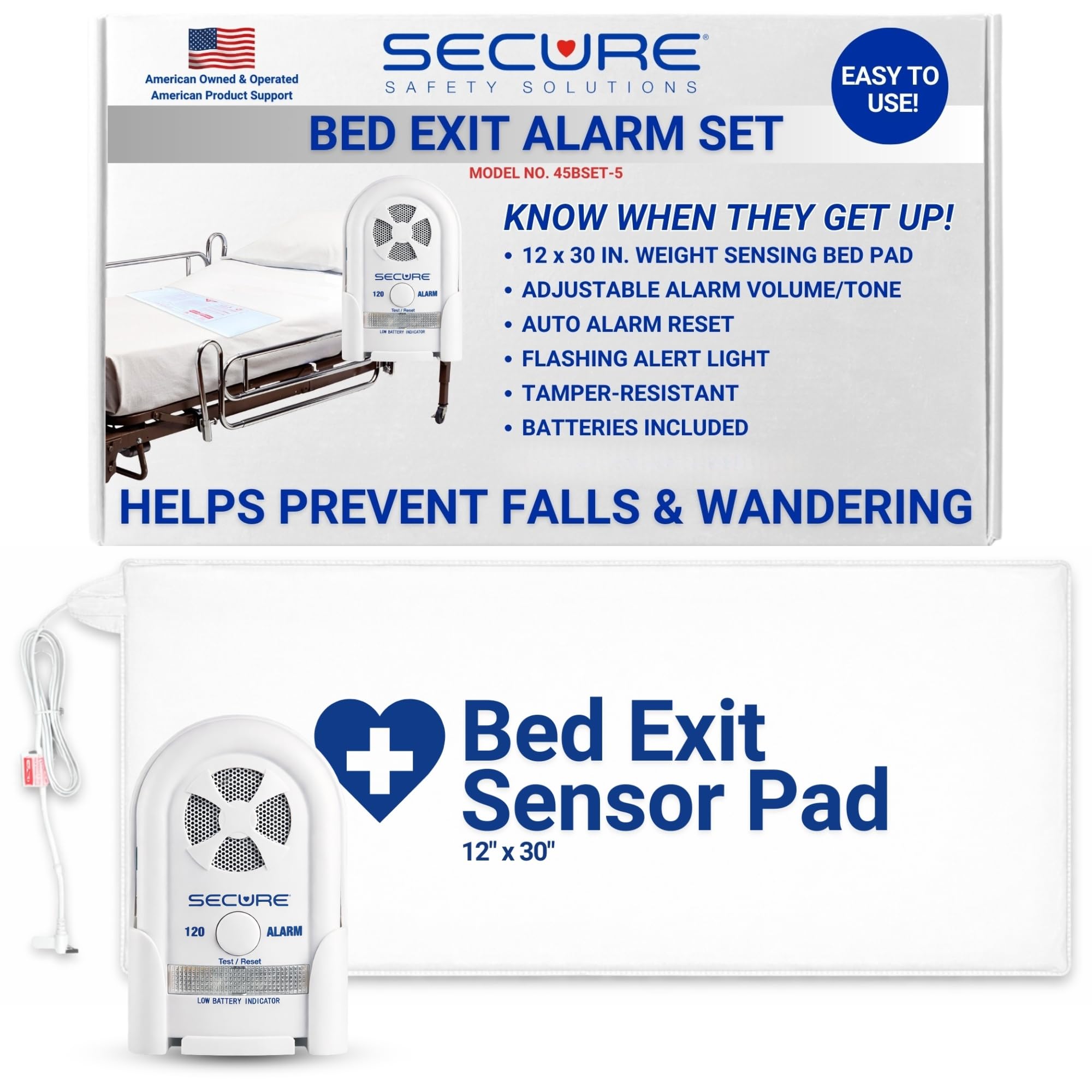
This is the most robust entry in the lineup, built for professional care environments that demand zero tolerance for patient override. The SUA-120 monitor delivers a startling 120 dB maximum — more than enough to reach a caregiver across a large facility or through multiple closed doors. The tamper-resistant three-press reset button is a standout feature: a confused senior cannot accidentally silence the alarm and wander off unattended.
The 12″ x 30″ pressure pad is ultrathin and waterproof, sliding under a bedsheet without disturbing sleep. A durable metal connecting pin replaces the flimsy plastic connectors found on cheaper pads, holding up to nightly repositioning. The monitor also offers dual alert tones and a flashing light, and it can integrate with nurse call systems via an optional cable — a class-above feature for assisted living settings.
Some users report the alarm can be tricky to silence reliably after several weeks of use, and the mounting bracket is made of a lightweight plastic that flexes when pressing the reset button. However, for caregivers who need a tamper-proof system with maximum volume and professional-grade reliability, this is the pick.
Why it’s great
- Loudest alarm at 120 dB with flashing light
- Tamper-resistant three-press reset prevents patient override
- Waterproof, latex-free pad with durable metal connector
- Nurse call system compatible for facility use
Good to know
- Plastic mounting bracket flexes when pressing reset
- Occasional reports of reliability issues after extended use
- Requires optional adapter for AC power
2. Patient Aid Chair Alarm (PA502C)
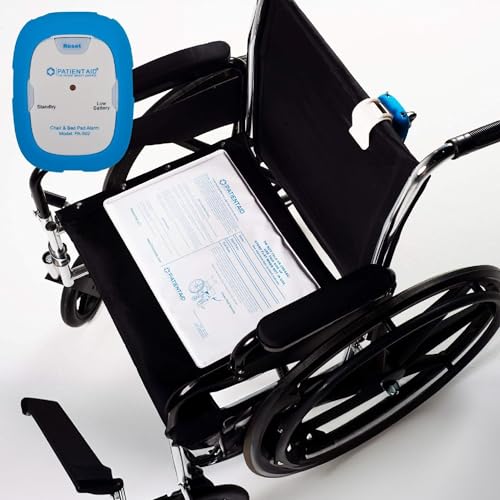
Tailored specifically for chair and wheelchair use, this wired pressure-pad system from Patient Aid is engineered to alert the moment a senior rises. The 10″ x 15″ pad is smaller than a full bed pad, making it easy to position under the buttocks or shoulders without bunching. The pad itself is tear-resistant, latex-free, and folds flat for storage — a thoughtful detail for caregivers who move it between a recliner and a dining chair.
The alarm monitor offers a choice between alarm or music tones at either 80 dB or 90 dB, with a test button that previews the ring for three seconds before installation. A removable rubber casing protects the unit from drops and bumps, which is a real advantage in active homes where the alarm might get knocked off a side table. The U-bracket and wall-mount system lets you place the monitor beyond the patient’s reach to prevent tampering.
One important limitation: the manufacturer warns against using this device on patients with pacemakers or defibrillators due to the magnet in the sensor. Additionally, the cord connecting the pad to the monitor is somewhat delicate — users with powered wheelchairs need to route it carefully to avoid pulling the cord out of the pad.
Why it’s great
- Designed specifically for chairs and wheelchairs
- Tear-resistant, foldable, easy-to-clean pad
- Rubber casing protects monitor from impacts
- Dual mounting options keep alarm out of patient’s reach
Good to know
- Not compatible with pacemaker or defibrillator patients
- Pad cord can be pulled out if caught on moving parts
- 90 dB maximum is lower than some competitors
3. Patient Aid Chair & Bed Alarm (B07H4SQ6PX)

For caregivers who need one alarm that moves between a bed, a chair, and even a car seat, this pull-cord model is the most flexible option. Instead of a pressure pad, the system uses a magnet and cord that clips to the patient’s clothing. When the patient stands, the magnet pulls away from the sensor and triggers the alarm. This design eliminates false alarms from incontinence or pad shifting — a common complaint with pressure-pad systems.
The unit offers four sound settings: low and high volume for a standard alarm, plus low and high for a musical chime. The high-volume setting is loud enough to be heard throughout a two-story home, according to multiple verified buyers. Setup takes seconds: insert the included 9V battery, attach the magnet, and clip the cord to the patient’s shirt or waistband. The robust ABS casing with a removable rubber cover provides genuine drop protection.
Because the alarm relies on the patient wearing the clip, it won’t work for someone who refuses to keep the cord attached. Some users also noted that the lowest volume setting is still fairly loud, which can be startling in a quiet room at night. But for a caregiver supervising a willing senior, this is a reliable, portable, and affordable solution.
Why it’s great
- No false alarms from incontinence or pad movement
- Four distinct alert tones with adjustable volume
- Three mounting options for bed, wall, or chair
- Quick set up with included battery and cord
Good to know
- Patient must wear the clip for the alarm to work
- Lowest volume may still be too loud for some
- Not ideal for unsupervised overnight use if clip is removed
4. Nesthao Upgraded Bed Sensor Alarm (KS-SF20R)

This motion-beam system takes a unique approach: instead of a pad or a clip, the sensor sits on the floor and detects when a patient’s leg swings down toward the ground. This eliminates the two biggest pain points of traditional chair alarms — the need to change wet pads and the risk of the patient detaching a pull cord. For caregivers of nonverbal or highly resistant seniors, this is a game-changing alternative.
The kit includes one motion sensor and one caregiver pager with an impressive 918-foot open-air range. The sensor runs on three AAA batteries and also accepts Micro USB power, giving you flexibility if batteries die overnight. The pager offers five volume levels and both LED and sound alerts, ensuring the caregiver can hear the alarm even if they’re in the garden or a basement workshop.
The trade-off is a more finicky setup. The motion sensor runs a 20-second self-test when powered on, and the wide detection beam may require cardboard blinders to narrow the field. Some users reported that the button on one unit failed, though the replacement worked perfectly. It’s a clever and effective design for the right situation, but it demands a bit more patience during installation.
Why it’s great
- No pads to change or clips to wear
- Very long 918 ft range between sensor and pager
- Dual power supply (battery and USB)
- Adjustable volume with five levels
Good to know
- Wide detection beam may need manual narrowing
- 20-second calibration delay on startup
- Occasional quality control issues reported
5. Secure Safety Solutions Bed Exit Alarm (14BSET-1Y)
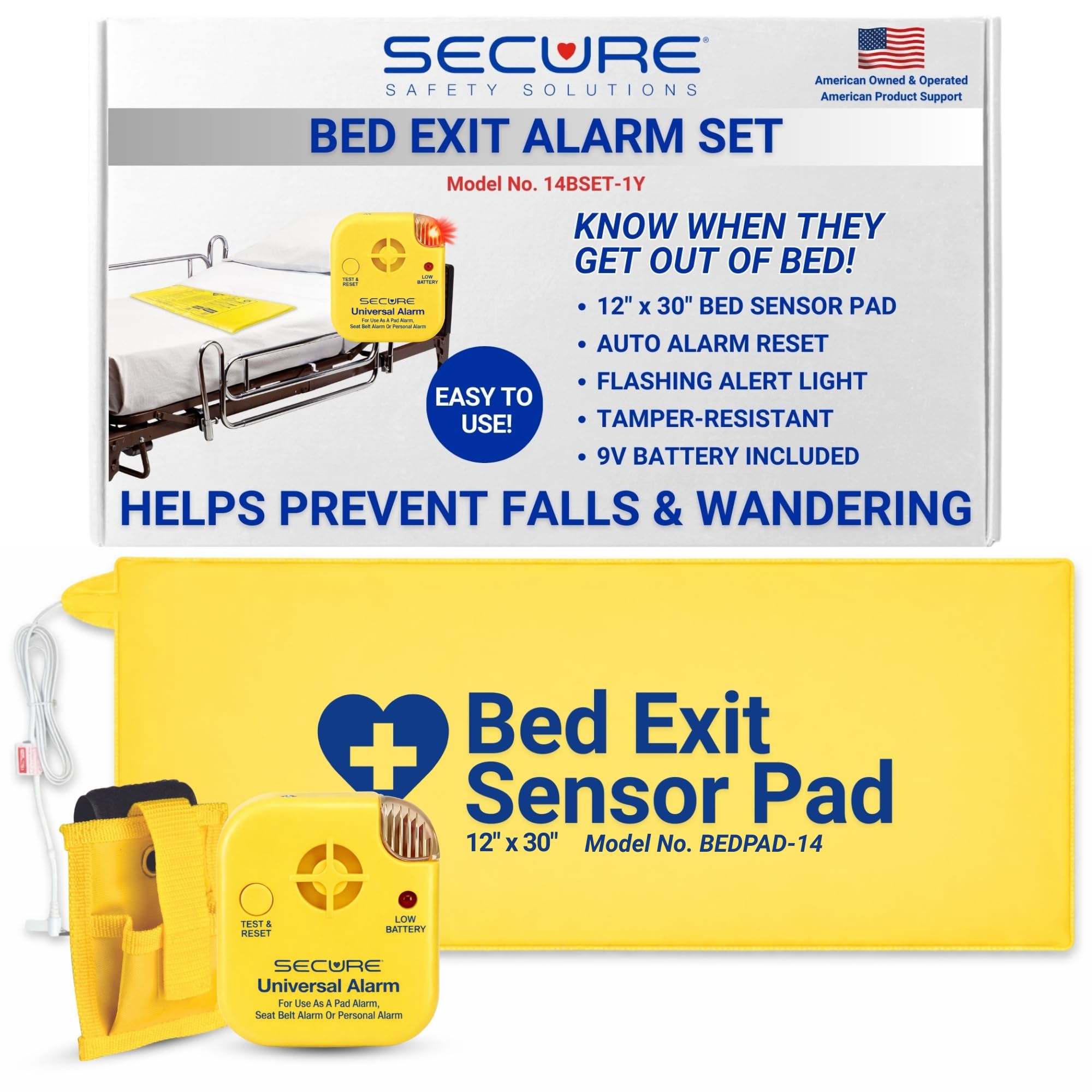
For caregivers who need a straightforward, no-frills pressure-pad alarm that simply works, this entry-level model from Secure Safety Solutions delivers reliable fall monitoring without complexity. The 12″ x 30″ pad sits under the bedsheet and activates the monitor when weight is removed, automatically resetting when the patient returns to bed. The 80 dB alarm is loud enough to be heard down a hallway or in an adjacent room, though it won’t carry through an entire large home.
What sets this unit apart is its manufacturer: Personal Safety Corporation has been supplying hospitals and nursing homes for over 35 years. The pad uses a metal connection pin rather than a plastic one, contributing to durability that outlasts typical consumer-grade products. The monitor can also convert to a personal pull-pin alarm if you purchase an optional cord set, giving you two monitoring modes in one device.
The trade-offs are noticeable. The alarm sound is a single high-pitched tone that may be uncomfortable for older caregivers to hear, and there is no silent deactivation option — the only way to stop the alarm is to move the patient back onto the pad. Additionally, the pad is somewhat sensitive; some users found that shifting in bed could trigger it prematurely. Despite these quirks, it’s an affordable and durable entry point for home care.
Why it’s great
- Trusted manufacturer with 35+ years in healthcare
- Simple automatic reset when patient returns to bed
- Durable metal connector pin for long life
- Can be converted to a pull-cord alarm
Good to know
- High-pitched tone may be hard on older ears
- No silent or visual deactivation option
- Pad can be overly sensitive to small movements
FAQ
How do I prevent my elderly parent from removing the alarm clip or pad?
Can I use a chair alarm with a patient who has a pacemaker?
Why does my pressure pad alarm go off when the patient shifts slightly in bed?
Final Thoughts: The Verdict
For most users, the chair alarm for elderly winner is the Secure Safety Solutions Bed Exit Alarm because it combines the highest decibel range (120 dB) with a tamper-proof reset and a durable waterproof pad that holds up in demanding care settings. If you need a dedicated chair solution with a smaller pad and protective casing, grab the Patient Aid PA502C. And for a lightweight, portable setup that moves between bed and chair without pad hassles, nothing beats the Patient Aid Pull Cord Alarm.