A camping air mattress that deflates by 3 a.m. or lets cold seep through from the ground below turns a weekend trip into a test of patience. The difference between tossing all night and waking refreshed comes down to three numbers: thickness, R-value, and the foam core inside. Most campers buy wrong because they focus on packed size first and spend the night paying for it.
I’m Emma — the founder and writer behind Baby Bangs. I’ve spent years analyzing outdoor sleep gear, comparing foam densities, valve engineering, and real-world insulation data from dozens of models across every price tier.
After hours of cross-referencing specs, customer durability reports, and side-by-side feature analysis, I’ve narrowed the field to the seven best options available. This guide breaks down everything you need to find the right camping air mattress for your specific sleep style and trip type.
How To Choose The Best Camping Air Mattress
Choosing a camping air mattress isn’t about finding the cheapest inflatable pad. It’s about matching thickness, insulation, and inflation method to how you actually camp — car camping, tent basecamps, or rooftop setups demand different features than short backpacking trips.
Thickness and Foam Core: The Real Comfort Factor
A pad that lets your hip touch the ground isn’t comfortable, no matter how plush the surface fabric feels. Look for at least 3 to 4 inches of total thickness with a foam core inside. Foam-filled pads resist bottoming out, hold insulation value better than air-only designs, and don’t lose support if a tiny leak develops. Pure air mattresses may pack smaller but they transfer every rock and root straight through to your spine.
R-Value: The Heat Retention Number
R-value measures thermal resistance. A pad rated below 4 is strictly three-season gear for warm nights. For fall camping, mountain trips, or any situation where ground temps dip below 50°F, aim for an R-value of 6 or higher. Pads with values above 9 exist, but they add weight and bulk — a trade worth making for winter campers but overkill for summer basecamp use.
Inflation System: Electric vs Self-Inflating vs Pump Sack
Built-in electric pumps with USB-C charging inflate a pad in under 90 seconds, making them ideal for car camping and families. Self-inflating foam pads use an open-cell core that expands when the valve opens, finishing with a few breaths or a pump sack to dial in firmness — quieter, more reliable, and no batteries to die at midnight. Pump sacks are compact and lightweight but require a learning curve to get efficient inflation.
Quick Comparison
On smaller screens, swipe sideways to see the full table.
| Model | Category | Best For | Key Spec | Amazon |
|---|---|---|---|---|
| Wise Owl Outfitters Self Inflating Pad | Self-Inflating Foam | Car camping, single sleepers | 4″ thick, built-in electric pump | Amazon |
| Hikenture Comfort Plus | Self-Inflating Foam | Four-season camping | 9.5 R-Value, 4″ memory foam | Amazon |
| OGERY Double Sleeping Pad | Electric Pump Foam | Couples, full-size comfort | 48.82″ wide, 9.5 R-Value | Amazon |
| Acacia 4″ (Single) | Self-Inflating Foam | Ultraportable, lightweight campers | Y-shaped foam, packs 60% smaller | Amazon |
| Acacia 4″ (Double) | Self-Inflating Foam | Two-person, heavy-duty support | 440 lb capacity, 4.3″ thick | Amazon |
| Therm-a-Rest LuxuryMap | Self-Inflating Foam | Side sleepers, year-round durability | Pressure-mapped foam, 6 R-Value | Amazon |
| Therm-a-Rest MondoKing 3D | Self-Inflating Foam | Maximum comfort, extreme cold | 7.0 R-Value, 4.25″ thick | Amazon |
In‑Depth Reviews
1. Wise Owl Outfitters Self Inflating Sleeping Pad with Electric Pump
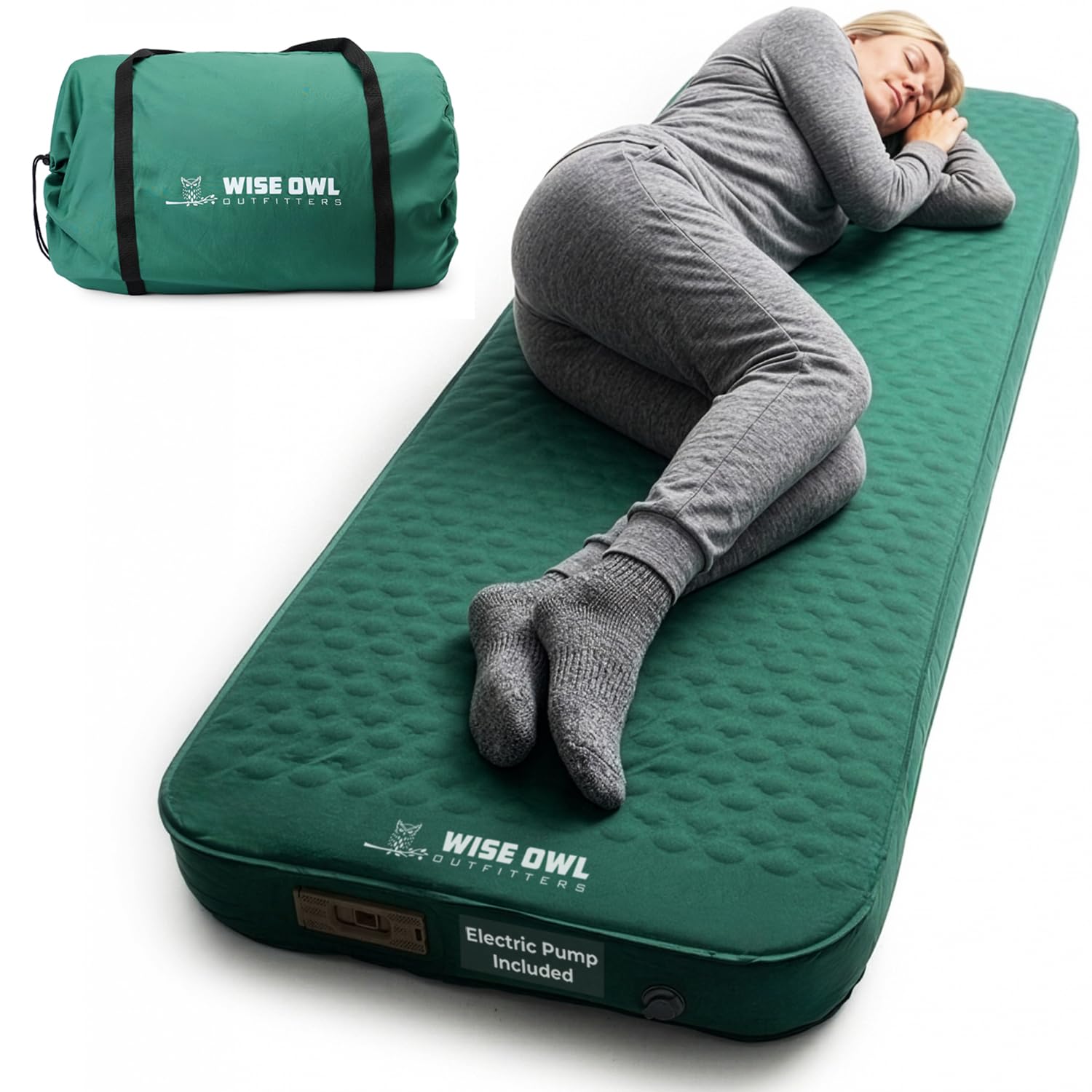
The Wise Owl Outfitters pad hits the sweet spot of comfort and convenience with a removable USB-C electric pump that fills the 4-inch foam core in roughly 90 seconds. That’s faster than any pump sack technique and removes the risk of manual inflation fatigue after a long drive. The foam layer prevents the dreaded hammock sag that pure air mattresses create when you shift weight to one side.
At 28 inches wide and 78 inches long, it fits most adults up to 200 pounds without bottoming out. The multi-layer construction uses polyester pongee top fabric with a spandex layer for stretch, reducing noise when you shift at night. Users consistently report zero air loss overnight — a critical failure point for cheaper air-only pads that slowly deflate as temperature drops.
The pump doubles as a deflator, making pack-up nearly as fast as setup. The included compression strap and carry bag keep the rolled pad manageable for trunk storage. Some campers note the 4-pound weight isn’t backpacking territory, but for car camping, SUV sleeping, or rooftop tent use, this is the most complete package available.
Why it’s great
- Integrated electric pump eliminates manual inflation work entirely
- 4-inch foam core provides genuine ground separation for side sleepers
- Holds air consistently through temperature drops overnight
Good to know
- 200-pound weight limit may feel restrictive for larger users
- Too heavy and bulky for backpacking trips
2. Hikenture Comfort Plus 4 Inch Self Inflating Sleeping Pad

An R-value of 9.5 puts the Hikenture Comfort Plus in a class of its own for thermal protection. Most camping pads top out around 6, meaning this pad actively blocks cold ground transfer in sub-freezing conditions where others fail. The memory foam fill adds cushion without the springy rebound that can make restless sleepers feel unstable.
The two-way patented valve handles self-inflation in several minutes, and the included pump sack allows fine-tuning firmness without bending over to blow air by mouth. At 80 inches long and 28 inches wide, it accommodates tall sleepers up to 6’3″ without heels hanging off the edge. The soft polyester top fabric remains quiet during movement — important for tent mates trying to sleep.
Users highlight that the foam retains loft overnight without requiring top-offs, and the 6.5-pound weight is reasonable for car camping or truck bed setups. The memory foam construction does compress larger than air-only pads when packed, but the carry bag’s wide opening makes stuffing straightforward. Not suitable for backpacking due to bulk, but winter car campers will appreciate the warmth margin.
Why it’s great
- Extreme 9.5 R-value insulates effectively in freezing temperatures
- Memory foam construction supports side and back sleepers equally
- Durable materials hold up to repeated setup and breakdown cycles
Good to know
- Packs larger than many competitors at 6.5 pounds
- Deflation requires some effort to roll out all air
3. OGERY Self Inflating Sleeping Pad with Electric Pump (Double)
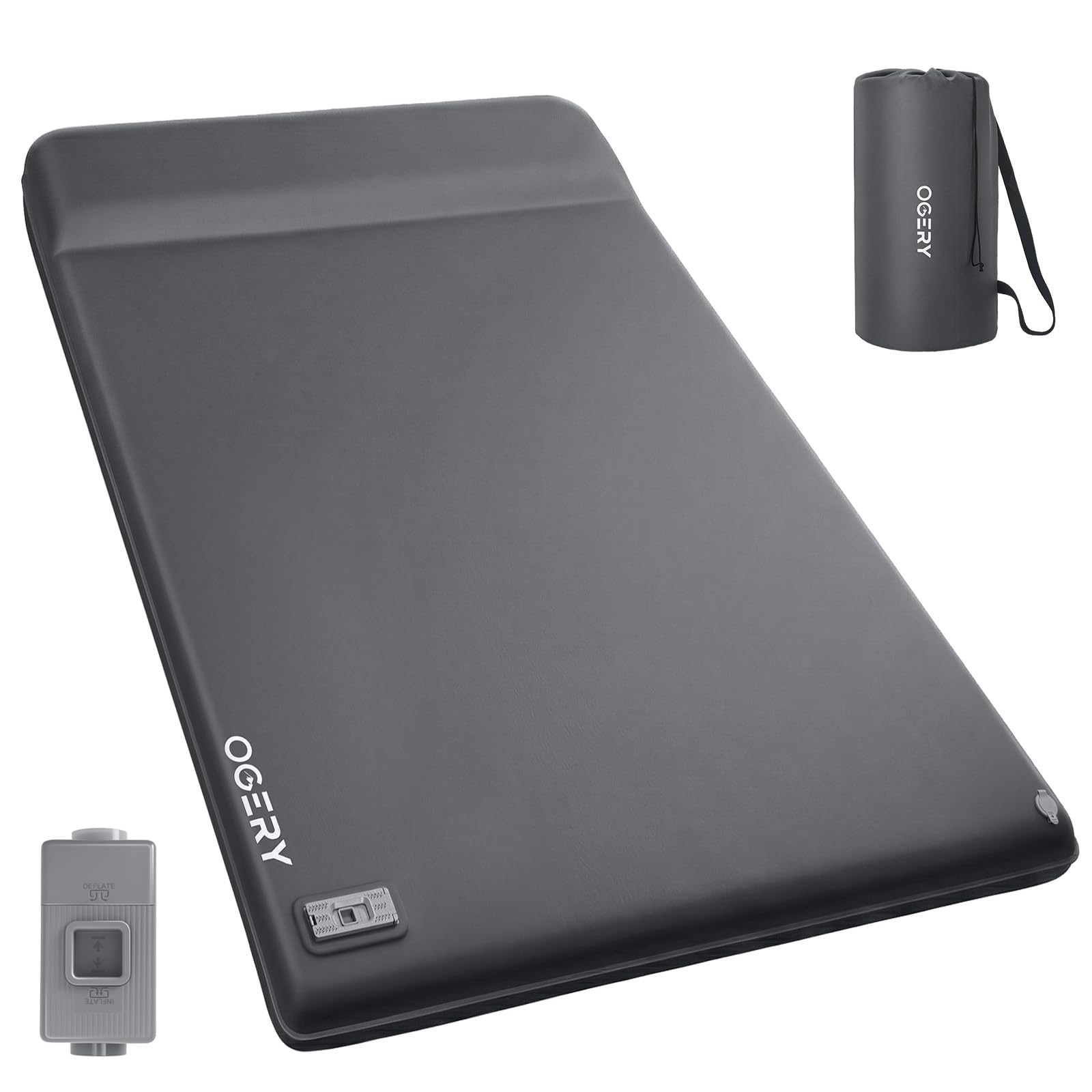
The OGERY double pad solves a persistent couple’s camping problem — one person rolling off a narrow twin pad. At nearly 49 inches wide, it provides a true full-size sleep surface for two adults. The built-in electric pump with 1200mAh battery inflates the 3.15-inch foam core in about 40 seconds, and a full charge handles up to seven inflation cycles for multi-night trips.
The integrated pillow eliminates the need to pack a separate camp pillow, saving trunk space. The 50D stretch knit fabric is noiseless, sweat-absorbing, and more tear-resistant than standard nylon. With an R-value of 9.5, this pad matches the Hikenture for cold-weather insulation but adds electric convenience that’s hard to beat for family car camping.
Some users note the hard plastic housing of the built-in pump can be felt when rolling onto that corner of the pad, and the valve switch requires precise positioning to avoid accidental deflation. At 13 pounds, this is strictly for vehicle-based camping — no one is carrying this to a backcountry site. For glamping, RV travel, or tent basecamps where weight doesn’t matter, the comfort payoff is substantial.
Why it’s great
- Full-width design keeps two sleepers comfortable without crowding
- Electric pump inflates in under a minute with USB-C rechargeability
- Exceptional 9.5 R-value works in all seasons
Good to know
- Pump housing creates a noticeable hard spot on one corner
- Heavy 13-pound packed weight limits use to car camping
4. Acacia 4″ Self Inflating Sleeping Pad (Single)

Acacia’s Y-shaped telescopic foam structure is a genuine innovation in packability. Traditional foam pads compress into a dense cylinder; this design reduces packed volume by roughly 60 percent, ending up at just 7 by 7 by 27 inches at 5.3 pounds. That’s small enough for motorcycle camping, rooftop tents with tight storage, or car trunks already loaded with gear.
The 4.3-inch thickness provides genuine ground separation, and the 30D elastic fabric with TPU coating resists punctures from sharp tent stakes or rocky ground beneath the tent floor. The two-way valve handles self-inflation reasonably well, though some users report a learning curve with the pump sack technique for final firmness adjustment. An R-value of 6 keeps you warm through three-season conditions but won’t cut deep winter nights.
Durability reports are mixed — some units develop intermittent leaks after repeated use, though the manufacturer support team has responded quickly with replacements in documented cases. The pump sack doubles as a carry bag, though the material is thinner than dedicated compression sacks. For campers who prioritize packed size without sacrificing foam support, this is the lightest option in the list.
Why it’s great
- Y-shaped foam compresses to roughly 60% less volume than standard foam pads
- 4.3-inch thickness provides above-average ground separation
- TPU coating adds meaningful puncture resistance for rough terrain
Good to know
- Intermittent leak issues reported in some production batches
- Pump sack fabric feels thin and requires careful handling
5. Acacia 4″ Self Inflating Sleeping Pad (Double)

The double-width Acacia uses the same Y-shaped telescopic foam as the single version but expands to 53 inches wide with a 440-pound combined weight capacity. That makes it one of the few camping pads that genuinely works for two larger adults or side sleepers who need room to spread out. The 80-inch length accommodates tall campers up to 6’6″ without toe-overhang.
Self-inflation through the two-way valve is effective, and the pump sack allows fine-tuning firmness for each partner’s preference. The polyester top fabric remains quiet and feels soft against skin. Like the single version, the R-value sits at 6 — sufficient for three-season use but not designed for winter camping without additional insulation underneath.
Some users report durability concerns similar to the single version, with sidewall bubbles appearing after extended use in rooftop tents. The manufacturer has consistently replaced defective units, but the need for replacement suggests the TPU coating could benefit from additional reinforcing. The pump sack doubles as a carry bag but limits how tightly you can compress the rolled pad for storage.
Why it’s great
- Generous 53-inch width serves two adults without crowding
- 440-pound capacity handles larger sleepers comfortably
- Y-shaped foam keeps packed size reasonable for a double pad
Good to know
- Occasional durability issues with sidewall seams on early batches
- Carry bag material feels thin for long-term compression
6. Therm-a-Rest LuxuryMap Self-Inflating Foam Camping Sleeping Pad

Therm-a-Rest brings four decades of pad engineering to the LuxuryMap, using pressure mapping technology to vary foam density across the pad. Hip and shoulder zones get softer foam for pressure relief, while torso and leg areas use firmer support to keep your spine aligned. The result is a pad that feels noticeably more tailored than uniform-foam competitors.
The TwinLock valve system offers separate ports for inflation and deflation, preventing air from rushing back in during pack-down. At 3 inches thick, it’s thinner than the other premium pads on this list, but the proprietary foam layering means most sleepers won’t feel the ground — side sleepers with broader hips may want to test thickness before committing. The R-value of 6 provides solid three-season warmth.
Several users note that the actual foam sleeping area measures about 3 inches narrower than the fabric edge on each side, so the effective width on the Large version is roughly 22 inches rather than 25. That’s worth measuring against your tent sleeping footprint. The PFAS-free DWR coating on the stuff sack is a welcome environmental upgrade, and US manufacturing means consistent quality control that budget brands often lack.
Why it’s great
- Pressure-mapped foam targets softer support at hips and shoulders
- TwinLock valves speed up inflation and prevent air return
- US-made with long-term durability reputation
Good to know
- Effective sleeping surface is narrower than the fabric dimensions
- 3-inch thickness may not be enough for some side sleepers
7. Therm-a-Rest MondoKing 3D Self-Inflating Camping Sleeping Pad

The MondoKing 3D is the closest thing to a home mattress you can pack in a car trunk. At 4.25 inches thick with Stratacore construction — a continuous thermal foam layer sandwiched between alternating ridges of air and foam — this pad delivers an R-value of 7.0 that handles genuine winter conditions. The 3D vertical sidewalls maximize every inch of the 80-by-30-inch sleep surface, preventing the roll-off feeling that curved pads create.
Two dedicated TwinLock valves and an included pump sack make inflation straightforward, though most users find the self-inflation gets you 80 percent there before needing final breaths. The stretch knit fabric surface feels like a bed sheet rather than tent gear, and the pad remains whisper-quiet during overnight movement. Weighing 5.5 pounds with a 26-by-10.3-inch packed size, it’s bulky but not unmanageable for vehicle-based trips.
A small number of units ship with valve defects, which Therm-a-Rest’s limited lifetime warranty covers. Some users note the pad slides on slick tent floors during restless sleep — a ground sheet or tent footprint helps. For car campers who prioritize sleep quality above all else and don’t mind the bulk, the MondoKing 3D is the most comfortable camping pad Therm-a-Rest has ever produced.
Why it’s great
- 7.0 R-value provides reliable insulation through freezing temperatures
- Vertical 3D sidewalls maximize usable sleep surface width
- Stretch knit fabric feels like a real mattress sheet
Good to know
- Large packed size requires significant trunk space
- Can slide on smooth tent floors without a ground sheet underneath
FAQ
Is a self-inflating camping pad better than a standard air mattress for tent camping?
What R-value do I need for winter camping in a tent?
How much packed weight should I expect from a good camping air mattress with foam?
Will a 4-inch thick camping pad fit in a standard two-person tent?
Final Thoughts: The Verdict
For most users, the camping air mattress winner is the Wise Owl Outfitters Self Inflating Pad because it combines true 4-inch foam support with a built-in electric pump that eliminates manual inflation hassle at a reasonable weight for car camping. If you need extreme cold-weather insulation, grab the Hikenture Comfort Plus. And for the absolute best sleep of your life in a tent, nothing beats the Therm-a-Rest MondoKing 3D.