The coronavirus primarily spreads through respiratory droplets and smaller aerosols that can linger in indoor air for hours. A portable air purifier equipped with a True HEPA filter is one of the few consumer tools proven to mechanically capture particles in the size range of virus-carrying aerosols, reducing the concentration of airborne viral load in a room.
I’m Emma — the founder and writer behind Baby Bangs. I’ve spent over 15 years analyzing indoor air quality hardware, filter efficiency ratings, and clean air delivery rates to separate the genuinely effective machines from the marketing noise.
This guide evaluates the filtration performance, CADR ratings, and coverage capabilities of nine leading models to help you identify the most effective air filters for covid mitigation in your home or office.
How To Choose The Best Air Filters For COVID
Selecting an air filter to reduce COVID transmission risk is fundamentally different from choosing one for general dust or pet dander. The SARS-CoV-2 virus travels inside droplets and aerosols typically ranging from 0.3 to 10 microns in size. Your filter’s ability to capture particles at the 0.3-micron point — the most penetrating particle size for HEPA media — determines its real-world virus removal efficacy.
True HEPA vs. HEPA-Type vs. HEPA-Like
Only filters certified as True HEPA (MERV 17 or equivalent standard) pass the 99.97% capture efficiency test at 0.3 microns. Labels like “HEPA-type,” “HEPA-grade,” or “HEPA-like” have no legal definition and often indicate a filter that cannot meet the standard. For COVID mitigation, any machine not carrying a verifiable True HEPA specification should be removed from consideration immediately.
Clean Air Delivery Rate (CADR) and Room Size
CADR measured in cubic feet per minute (CFM) tells you how quickly the unit can remove smoke, dust, and pollen from a given room size. For virus control, the relevant metric is achieving four air changes per hour (ACH). Divide the room’s cubic footage by four, then compare that number to the unit’s CADR for smoke (the most challenging particle type). A unit with CADR below 100 CFM is unlikely to deliver meaningful virus protection in any space larger than a small bedroom.
Secondary Technologies: UV-C and Ionizers
Some units pair HEPA filtration with UV-C light or ionizers. While UV-C can inactivate viruses on surfaces, its efficacy in moving airstreams is limited by dwell time and intensity. Ionizers produce ozone as a byproduct, which is a lung irritant — counterproductive when the goal is respiratory health. For COVID specifically, mechanical HEPA filtration is the gold standard; treat UV-C as a potential bonus and ionizers as a drawback.
Quick Comparison
On smaller screens, swipe sideways to see the full table.
| Model | Category | Best For | Key Spec | Amazon |
|---|---|---|---|---|
| Blueair Blue 3110 | Premium | Large open floor plans | HEPASilent + 3,385 sq ft coverage | Amazon |
| AirDoctor AD2000 | Premium | VOC and gas reduction | UltraHEPA captures 0.003 microns | Amazon |
| Coway Airmega 250 | Premium | Bedrooms and living rooms | 1,860 sq ft coverage in 60 min | Amazon |
| Nuwave Forever | Premium | Eliminating recurring filter costs | Washable 7-stage, 2,002 sq ft | Amazon |
| Trucozie T555 | Mid-Range | Homes with multiple pets | CADR 205 CFM, 3,000 sq ft | Amazon |
| GermGuardian AC4825W | Mid-Range | Budget True HEPA with UV-C | True HEPA, 743 sq ft coverage | Amazon |
| Levoit Core 300-P | Mid-Range | Medium bedrooms and offices | CADR 143 CFM (smoke) | Amazon |
| Levoit Core 200S-P | Budget-Friendly | Small bedrooms and dorms | 140 sq ft, 27 dB sleep mode | Amazon |
| DBFIT AP300 | Budget-Friendly | Dual-intake budget pick | Dual H13 HEPA, 3,000 sq ft | Amazon |
In‑Depth Reviews
1. Blueair Blue 3110
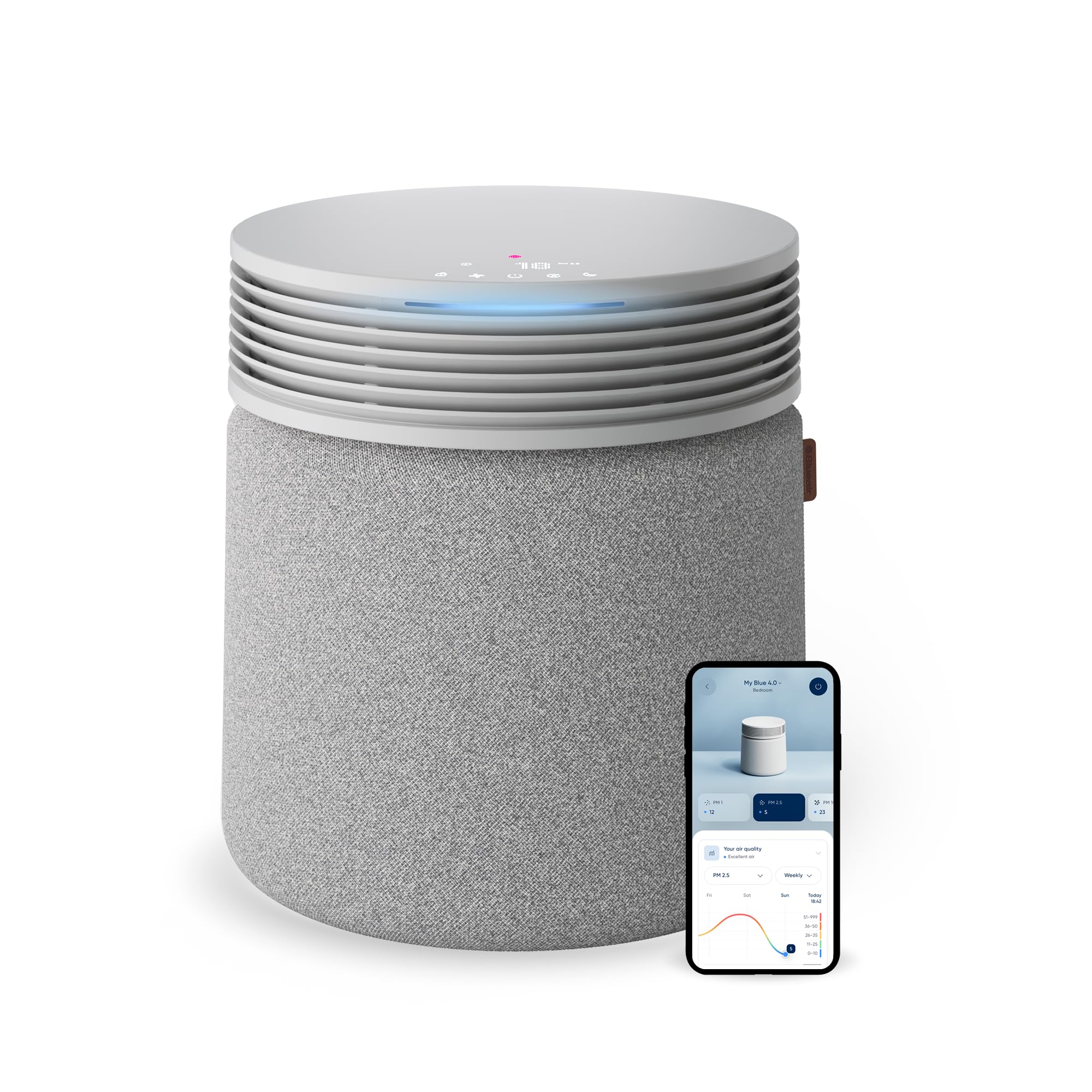
The Blueair Blue 3110 uses the brand’s proprietary HEPASilent technology, which combines electrostatic charging with mechanical fiber filtration to achieve high particle capture without the airflow resistance of standard HEPA. This allows the unit to move an extraordinary 3,385 square feet of air per hour on its highest setting while maintaining noise levels far below comparable CADR-rated machines. For large open-concept spaces where COVID aerosol dilution is the goal, the 3110’s air-moving capacity is unmatched in this lineup.
Smart sensors automatically detect particulate spikes from cooking, candles, or simply a room full of people exhaling — and the Auto Mode reacts by ramping up fan speed without manual intervention. The unit connects to the Blueair app for remote monitoring and scheduling, and its minimalist design doubles as a side table, which is a practical bonus for tight floor plans where every piece of furniture serves double duty.
The main trade-off is the cost of proprietary replacement filters, which need swapping roughly every six months depending on usage. Additionally, while HEPASilent is highly effective, the electret fibers can lose efficiency over time if not replaced on schedule. However, for sheer virus load reduction in a large shared space, no other model in this class moves more clean air per decibel.
Why it’s great
- Highest CADR-to-noise ratio in class
- Covers up to 3,385 sq ft in one hour
- Furniture-style design saves floor space
Good to know
- Proprietary filters are expensive
- App connectivity can be sluggish
- No washable pre-filter
2. AirDoctor AD2000
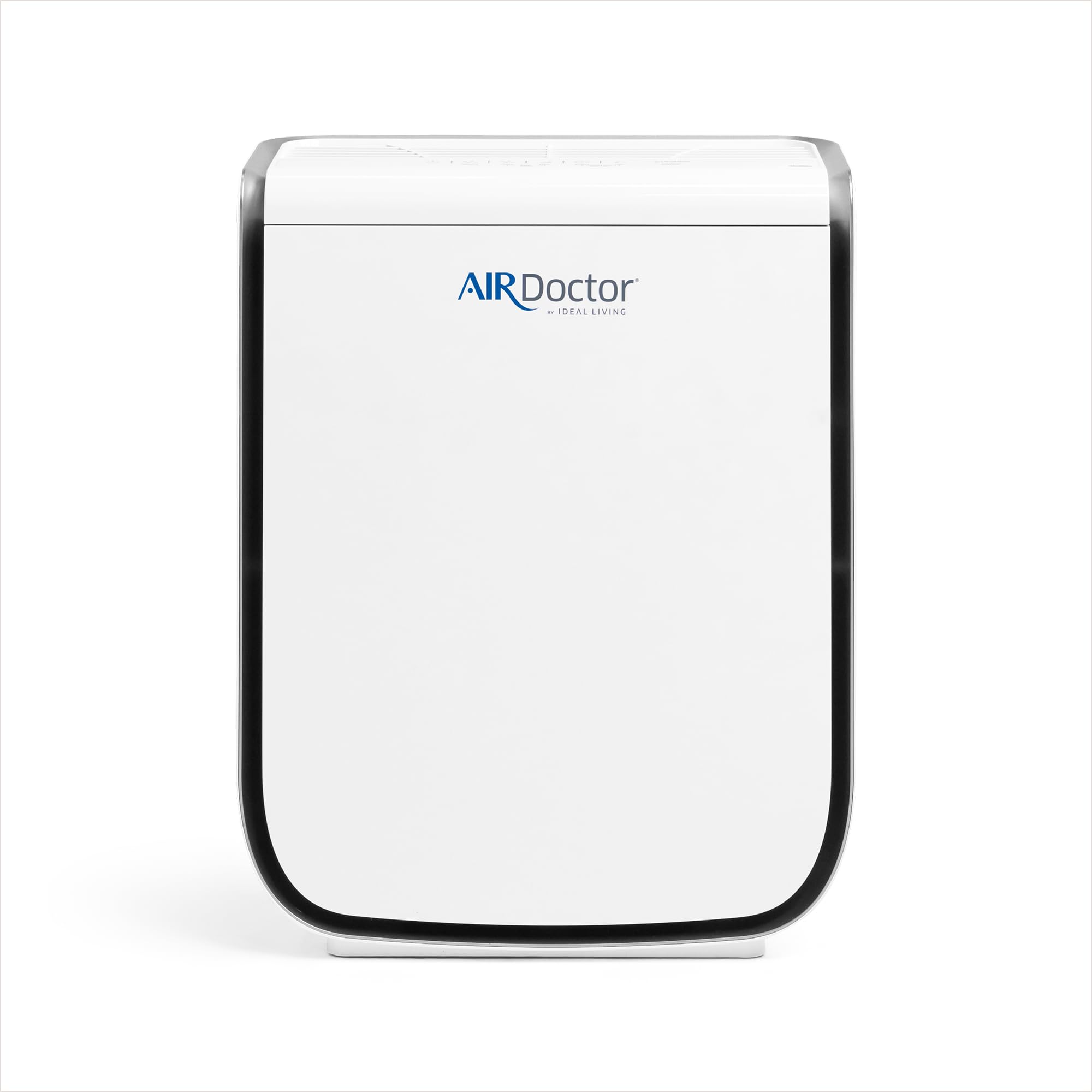
The AirDoctor AD2000 stands apart because of its UltraHEPA filter media, independently tested to capture 99.99% of airborne particles at 0.003 microns — two orders of magnitude beyond the HEPA standard. For COVID, this means the filter catches not only the larger respiratory droplets but also the fine aerosol nuclei that can remain suspended for hours. The unit’s three-stage system uses a pre-filter, a premium activated carbon layer loaded with potassium permanganate, and the UltraHEPA stage to address both particulate and gaseous challenges.
The Halo PM2.5 sensor continuously feeds real-time air quality readings to the unit’s display, and Auto Mode automatically shifts between four fan speeds to maintain clean air. Independent third-party testing backs every performance claim, and the unit is FSA and HSA eligible, making it an accessible option for those using pre-tax wellness funds. The 12.9-pound build feels substantial, and the front grille design allows for 360-degree intake.
Several users noted that the unit’s sensor can occasionally lag behind rapid particulate events, and the button-control interface feels dated compared to app-enabled competitors.
Why it’s great
- UltraHEPA captures particles 100x smaller than HEPA standard
- Heavy-duty carbon filter for VOCs and gases
- FSA/HSA eligible
Good to know
- Coverage limited to 1,220 sq ft
- Sensor response can be delayed
- No WiFi or app control
3. Coway Airmega 250

Coway’s Airmega 250 uses the HyperCaptive Filtration System, a three-stage process combining a washable pre-filter, an activated carbon filter, and a True HEPA filter. The washable pre-filter is a genuinely useful feature for sustained use — vacuuming or rinsing it monthly extends the life of the main HEPA element and reduces maintenance costs. The unit covers up to 1,860 square feet in one hour of continuous operation, making it suitable for combined living-dining-kitchen open layouts.
The built-in Air Quality Indicator uses a 24/7 particulate sensor that drives Smart Mode, automatically adjusting fan speed as conditions change. Rapid Mode engages maximum airflow when the sensor detects a sharp decline in air quality, such as after cooking or when a group of people enters the room. The unit’s design is understated and residential-friendly, and the 3-year warranty provides long-term assurance.
One notable limitation is the lack of WiFi connectivity — there is no app, no remote scheduling, and no way to monitor air quality from your phone. The sensor, while reliable, is also sensitive enough that cooking smoke in an adjacent room can trigger Rapid Mode, which some users found overly aggressive. Additionally, at 20.5 pounds, it is not a machine you will move between rooms daily.
Why it’s great
- Washable pre-filter reduces long-term costs
- Powerful 1,860 sq ft coverage
- Rapid Mode for quick event response
Good to know
- No WiFi or smart home integration
- Heavy at 20.5 pounds
- Sensor can trigger on distant cooking
4. Nuwave Forever

The Nuwave Forever is unique in this roundup because it eliminates the most expensive long-term ownership cost entirely: filter replacement. Its patented 7-stage system uses stainless-steel pre-filters, Bio-Guard electrostatic media, and an ozone removal filter — all of which are washable and reusable except the ozone filter, which lasts for the unit’s lifetime according to the manufacturer. The unit covers rooms up to 2,002 square feet, and its adjustable flow panel allows you to direct purified air at a 30°, 60°, or 90° angle.
Intertek Lab certification confirms that the system captures 100% of particles down to 0.1 microns, and the auto mode uses dual particulate and odor sensors to adjust airflow. WiFi connectivity via the Nuwave app gives you remote control over fan speed, timers, and real-time air quality monitoring. The Energy Star certification ensures that running it 24/7 will not spike your electric bill.
The main caveat is the washable filter care cycle — you must remove, wash with hot water and mild detergent, rinse thoroughly, and allow 24 hours of dry time. This is more labor-intensive than popping in a disposable filter, and if you forget to reinstall a dry filter, you risk mold growth inside the unit. Additionally, the electrostatic charging does produce trace amounts of ozone — though the included ozone removal filter is designed to capture that.
Why it’s great
- No recurring filter purchase cost
- Adjustable airflow direction
- Energy Star certified low consumption
Good to know
- Filter cleaning is time-intensive
- Electrostatic stage generates trace ozone
- Gets loud above fan speed 3
5. Trucozie T555
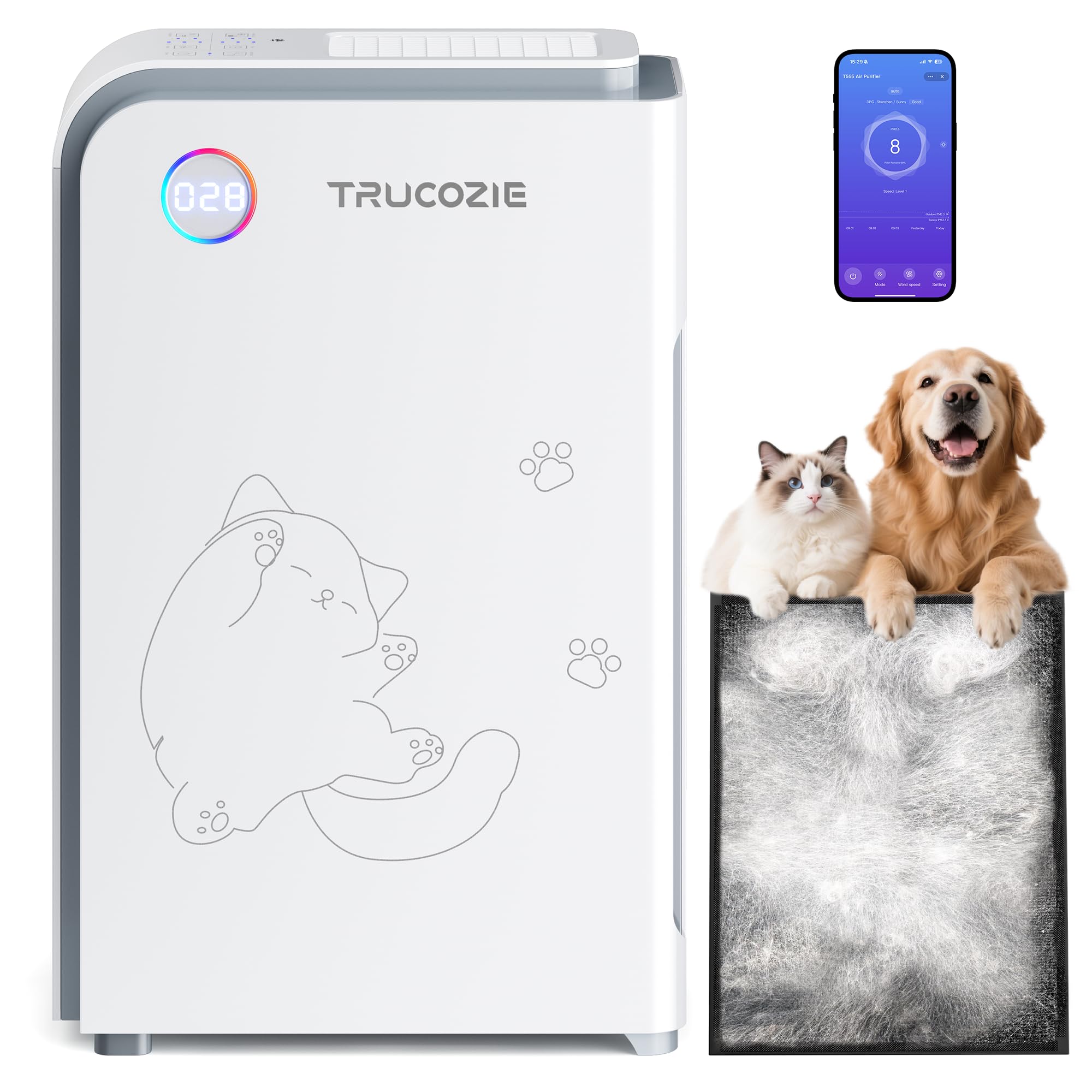
The Trucozie T555 is built with pet owners in mind, featuring a specialized pre-filter cotton designed to trap floating fur and dander before they reach the main H13 True HEPA filter. The CADR rating of 205 CFM places it in the upper tier of mid-range units, and the manufacturer rates it for spaces up to 3,000 square feet at one air change per hour. For smaller rooms, this translates to multiple air changes per hour, which is the target for effective viral aerosol reduction.
The unit uses the Tuya smart platform for WiFi control, allowing app-based scheduling, speed adjustment, and filter life monitoring. Sleep Mode drops noise to below 23 dB and kills all indicator lights, making it viable for bedroom use. The activated carbon layer is infused with bio-enzymes specifically formulated to break down pet, kitchen, and cigarette odors — not the primary concern for COVID, but a bonus for comprehensive indoor air quality.
Several users reported difficulty with the initial app setup, and the instruction manual provides minimal guidance for that process. The unit also lacks an auto-mode that responds to real-time PM2.5 fluctuations — you must manually switch between settings or rely on the scheduled program. At 20.3 pounds, it is one of the heavier units in the mid-range category.
Why it’s great
- Pet-specific pre-filter traps hair effectively
- High CADR of 205 CFM
- Sleep Mode under 23 dB
Good to know
- App setup requires multiple attempts
- No auto mode with real-time sensor
- Heavy and bulky for a mid-range unit
6. GermGuardian AC4825W

GermGuardian’s AC4825W tower has been a staple in the consumer air purifier market for years, and its staying power is a direct result of its reliable True HEPA filter. The three-layer system — pre-filter, charcoal filter, and True HEPA — captures 99.97% of particles at 0.3 microns, including virus-carrying aerosols. An optional UV-C light is included for germicidal activity, though as noted earlier, its impact on in-duct airborne viruses is marginal compared to mechanical filtration.
The 22-inch tall tower covers rooms up to 743 square feet, which makes it appropriate for medium to large bedrooms, living rooms, or small offices. The three-speed fan is controlled by a simple dial, and the UV-C light has its own dedicated button — no WiFi, no app, no complexity. This is a set-it-and-forget-it machine that works reliably out of the box.
The primary downside is that the UV-C bulb is an additional consumable that needs replacement roughly every 10-12 months, adding to the long-term cost. The unit is also noisier on its highest setting than many modern competitors — the fan is audible, and some users find it distracting during sleep. Additionally, the pre-filter is washable, but the main HEPA filter must be replaced every 6-8 months depending on usage.
Why it’s great
- Proven True HEPA performance
- Simple mechanical controls
- Washable pre-filter saves money
Good to know
- UV-C bulb is an additional consumable cost
- Loud on high speed
- No smart features or timer
7. Levoit Core 300-P

The Levoit Core 300-P is an AHAM Verifide unit with a CADR of 143 CFM for smoke, which means it can refresh a 222-square-foot room 4.8 times per hour — exceeding the 4 ACH target recommended for virus mitigation. The 56W high-torque motor is unusually powerful for a compact unit, and the 360-degree air intake ensures effective air mixing even when placed in a corner. The Sleep Mode drops noise to 24 dB, which is near-silent for most people.
One of the strongest features is filter flexibility: Levoit offers specialized replacement filters including a Toxin Absorber (for VOCs and smog), Smoke Remover (for wildfire smoke and particulates), and Pet Allergy filter. This allows you to tailor the unit’s filtration profile to your specific indoor air threats. The Core 300-P also has a built-in timer (2, 4, 6, or 8 hours) and a display-off button for pitch-dark operation.
The unit lacks WiFi connectivity, so it cannot be scheduled or monitored remotely. The filter change indicator is based on a timer rather than actual filter load, which can overestimate or underestimate remaining filter life depending on your air quality. Some users also noted that the proprietary filter shape means you cannot substitute cheaper universal filters.
Why it’s great
- High CADR for its size (143 CFM smoke)
- Multiple specialized filter options
- Near-silent 24 dB Sleep Mode
Good to know
- No WiFi or app control
- Filter change indicator is timer-based
- Proprietary filter shape limits alternatives
8. Levoit Core 200S-P

The Levoit Core 200S-P brings voice control and app connectivity to the compact purifier segment. It integrates with Amazon Alexa and Google Assistant, allowing you to adjust fan speed or turn the unit on and off hands-free — a useful feature when you want to boost filtration before entering the room. The 360° air intake and compact footprint (just 8 inches wide) make it an unobtrusive addition to a nightstand, desk, or nursery.
The unit is AHAM Verifide and uses a 3-in-1 filter system with a nylon pre-filter, high-efficiency activated carbon, and a main filter that captures 99.97% of particles down to 0.1 microns. It refreshes a 140-square-foot room 4.8 times per hour, which aligns with the recommended ACH for virus reduction in small spaces. The sleep mode operates at 27 dB — quiet enough not to disturb light sleepers.
Where the Core 200S-P falls short is its coverage area. At just 140 square feet, it is only appropriate for a small bedroom, dorm room, or home office. In any larger space, the single air change rate drops well below the effective threshold. Additionally, that 4.8 ACH figure is only achieved at the highest fan speed, which is noticeably louder than the low setting users report as barely audible.
Why it’s great
- Smart speaker integration
- Compact footprint fits small spaces
- AHAM Verifide performance
Good to know
- Coverage limited to small rooms
- 4.8 ACH only at max speed
- Proprietary replacement filters
9. DBFIT AP300
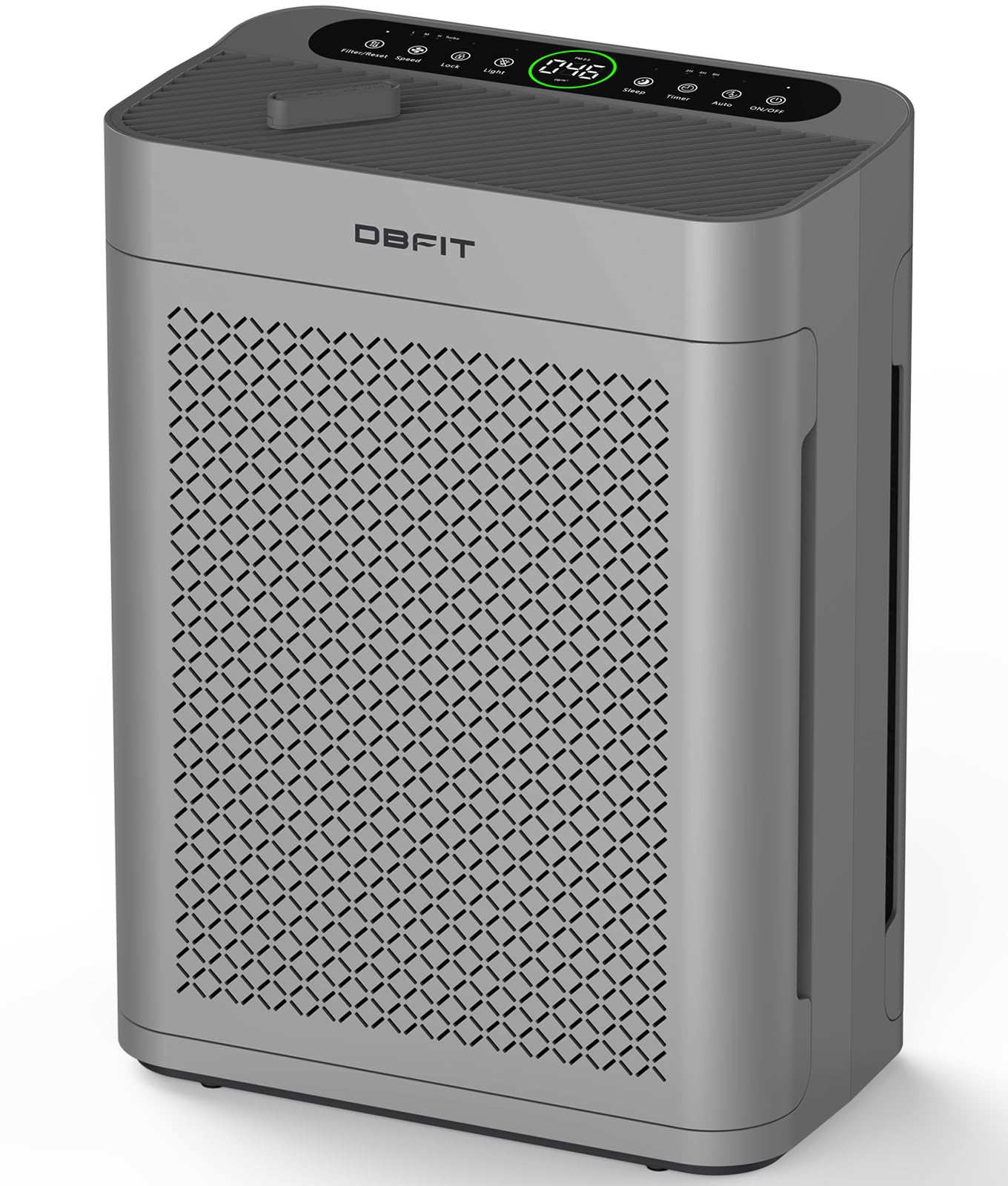
The DBFIT AP300 uses a dual-sided air intake design, pulling air from both sides simultaneously to effectively double the air volume processed compared to a single-intake unit of similar size. Two H13 HEPA filters handle the particle capture, while a dual-layer activated carbon filter (with 112.5% more carbon by weight than the previous generation) addresses odors and VOCs. The unit covers up to 3,000 square feet in total, and claims to refresh a 533-square-foot room in 10 minutes.
A built-in PM2.5 particle sensor feeds real-time air quality data to the front display, and Auto Mode uses this data to adjust fan speed across six settings — from Sleep (15 dB) up to Turbo. The washable pre-filter is a cost-saving feature: you can vacuum or rinse it to extend the main filter’s lifespan. An essential oil diffuser pad is included for optional aromatherapy, though this has no bearing on virus filtration.
The AP300’s main weakness is its relatively unknown brand and limited long-term track record compared to Levoit, Coway, or Blueair. Replacement filter availability on Amazon is also less certain, and the unit’s dual-filter design doubles your replacement cost when the filters eventually need swapping (every 3-6 months). Additionally, the 15 dB Sleep Mode specification appears to be measured in an anechoic chamber rather than a real room, so actual noise may be slightly higher.
Why it’s great
- Dual-intake design for faster air processing
- Real-time PM2.5 display
- Essential oil diffuser included
Good to know
- Unknown brand with limited long-term data
- Dual filters double replacement cost
- Sleep mode dB claim likely optimistic
FAQ
Can an air filter completely prevent me from catching COVID?
What CADR rating do I need for my bedroom to reduce COVID risk?
Does UV-C light kill the coronavirus inside an air purifier?
Should I run my air purifier 24 hours a day for COVID protection?
How often should I replace the HEPA filter when using it for virus protection?
Final Thoughts: The Verdict
For most users, the air filters for covid winner is the Blueair Blue 3110 because it combines the highest CADR-to-noise ratio in its price class with furniture-grade design and large-space coverage. If you want the very highest particle capture efficiency for the smallest particles, grab the AirDoctor AD2000. And for a medium-sized room at a mid-range budget, nothing beats the proven reliability of the Coway Airmega 250.