Every mile with flat feet can feel like your arches are collapsing inward, turning each stride into a battle against overpronation and shin splints. The right insole changes that — it locks your foot into a neutral alignment so you can run without that familiar ache radiating up through your knees and hips.
I’m Emma — the founder and writer behind Baby Bangs. I’ve spent years analyzing biomechanics research and sifting through thousands of user reports to find the insoles that actually stabilize flat feet during high-mileage running.
Below, I’ve reviewed the top models on the market. Whether you need rigid TPU support or plush cushioning for heel strike impact, this guide to the best insoles for running with flat feet breaks down exactly which insert works for your foot type and mileage demands.
How To Choose The Best Insoles For Running With Flat Feet
Flat feet lack the natural medial arch that absorbs shock and stabilizes your stride. When you run, the missing arch forces your ankle to roll inward — overpronation — which shifts impact stress up to your shins, knees, and lower back. The right insole fills that void and re-establishes a neutral foot position. Here’s what separates a good running insole from a dud for flat feet.
Arch Support Type: Rigid vs. Flexible
Flat feet need a semi-rigid or rigid arch support to resist collapse during the stance phase of your run. Flexible, soft foam insoles feel comfortable at first but will flatten under your weight within minutes — they provide no structural correction. Look for insoles with a TPU (thermoplastic polyurethane) or polypropylene shell embedded in the arch area. The material should have some give but not compress completely under your body weight. If you weigh over 200 lbs, prioritize heavy-duty models with a certified weight rating.
Heel Cup Depth and Alignment
A deep, sculpted heel cup cradles the calcaneus (heel bone) and prevents it from sliding laterally when your foot pronates. This stabilization is essential for runners because each heel strike generates two to three times your body weight in force. Shallow heel cups allow your foot to shift inside the shoe, which reduces the insole’s corrective effect and can create new friction points. Measure the depth by looking at the rear rim — anything less than a 5-6 mm rise offers minimal control.
Shock Absorption and Cushioning Density
Flat-footed runners often land heavier on the heel and forefoot due to the altered gait. You need a dual-layer foam system: a denser base layer for structural support and a softer top layer for initial impact absorption. Gel inserts in the heel and forefoot zones add targeted cushioning without adding excessive bulk. Avoid overly thick insoles that raise your foot too high inside the shoe — this can change the shoe’s heel-to-toe drop and introduce new instability.
Trim-to-Fit vs. True-to-Size
Most aftermarket insoles come in trim-to-fit sizes that let you cut the front to match your shoe’s length. This is fine for flat feet as long as the arch and heel cup remain untouched — trimming only the toe section. Some premium insoles (like PowerStep Pinnacle) are sized by shoe size and require no cutting, which eliminates the risk of accidentally cutting into the support structure. If you trim, use a shoe insole tracing and sharp scissors, and always size up if you’re between sizes.
Quick Comparison
On smaller screens, swipe sideways to see the full table.
| Model | Category | Best For | Key Spec | Amazon |
|---|---|---|---|---|
| PowerStep Pinnacle Maxx | Premium | Maximum stability & overpronation control | Firm flexible angled heel post | Amazon |
| Superfeet Run Cushion Low Arch | Premium | Low arch runners needing flexible support | Adaptive Comfort Technology foam | Amazon |
| PowerStep Pinnacle | Mid-Range | Podiatrist-recommended daily training | Dual-layer cushioning, no trimming | Amazon |
| Superfeet All-Purpose Support High Arch (Green) | Premium | High arch support for active lifestyle | Closed-cell foam, deep heel cup | Amazon |
| VALSOLE Heavy Duty Support | Mid-Range | Heavy runners (220+ lbs) needing firm support | Rigid TPU arch, deep heel cup | Amazon |
| CRUVHEAL Sport Shock Absorbing | Budget-Friendly | Basketball & high-impact training | Gel pads in heel and forefoot | Amazon |
| RooRuns Heavy Duty Arch Support | Budget-Friendly | Heavy-duty support & plantar fasciitis relief | Shock guard + extra strong TPU arch | Amazon |
In‑Depth Reviews
1. PowerStep Pinnacle Maxx Orthotic Insoles

The PowerStep Pinnacle Maxx is the gold standard for flat-footed runners who also overpronate. Its defining feature is the firm, flexible angled heel post that actively resists inward rolling during the gait cycle — something that soft insoles simply cannot do. Users with posterior tibial tendonitis and chronic arch collapse report near-immediate relief because the insole’s rigid polypropylene shell holds the foot in a neutral position through toe-off. Despite the stout construction, the top layer uses dual-density foam that feels comfortable underfoot after a brief break-in period of three to five runs.
This insole is noticeably thicker than the standard Pinnacle, which is deliberate — the added volume gives the heel post more leverage to control motion. The trade-off is that you may need to size up by half a shoe size or switch to wider models to maintain toe-room comfort. The anti-slip bottom keeps everything locked in place, even during aggressive speed work or hill repeats. For runners who have struggled with shin splints or IT band issues linked to overpronation, the Pinnacle Maxx provides the highest level of motion control available without stepping into custom orthotics.
The build quality is exceptional: the arch support does not collapse under heavy loads, and the antimicrobial top cover resists odor during sweaty summer miles. It is made in the USA and backed by a 30-day guarantee, which is rare for insoles in this category. If you are a moderate to heavy pronator logging 20+ miles per week and have not found relief with drugstore options, this is the insole that changes your run.
Why it’s great
- Angled heel post directly opposes overpronation
- Rigid shell provides uncompromising arch support that doesn’t collapse
- Made in USA with durable materials that outlast cheaper inserts
Good to know
- Requires extra shoe volume — may need half size up or wide width
- Firm feel demands a break-in period of several runs
- Heavier than average at around 4 oz per pair
2. Superfeet Run Cushion Low Arch Insoles

The Superfeet Run Cushion Low Arch is purpose-built for runners who need arch support but do not want a hard, plank-like feel underfoot. Its Adaptive Comfort Technology uses a proprietary foam that flexes with the foot during the gait cycle, providing efficient heel-to-toe turnover rather than rigidly blocking motion. This makes it an excellent match for flat-footed runners who still have some natural arch mobility and want an insole that supports without forcing a fully static foot position. The sculpted heel cup has a medium depth, which is less aggressive than the Pinnacle Maxx but sufficient for mild to moderate pronators.
Compared to the standard Superfeet All-Purpose Support (Green), the Run Cushion model uses a softer foam blend that feels more forgiving on long runs exceeding 10 miles. The moisture-wicking top cover manages sweat well, and the trim-to-fit design allows adjustment for different shoe brands. Reviewers consistently note that these insoles fit well in popular running shoes like ASICS, Adidas, and Nike without requiring a half-size up, which is a major plus for runners who have already dialed in their shoe sizing.
Some users report a slight sole burning sensation during the first few walks as the foot adapts to the new arch position, but this typically resolves within a week of gradual wear. The Run Cushion Low Arch is ideal for runners who found the PowerStep Pinnacle too firm or too bulky but still need reliable arch support to prevent hip and knee pain linked to pronation. For daily training at moderate intensity, this insole delivers an excellent balance of flexibility and support.
Why it’s great
- Adaptive foam flexes with the foot for natural motion
- Fits most running shoes without requiring a half-size up
- Excellent moisture management for long sweaty runs
Good to know
- Mild arch support may not stabilize severe overpronation
- Some users experience sole irritation during initial break-in
- Trim-to-fit process requires careful cutting
3. PowerStep Pinnacle Insoles

The PowerStep Pinnacle is the #1 podiatrist-recommended insole for plantar fasciitis and arch support, and for good reason. Its semi-rigid arch shape provides structural correction without the extreme firmness of the Maxx version, making it a better starting point for runners new to orthotics. The dual-layer cushioning — a firm base layer paired with a softer top layer — absorbs heel strike impact while maintaining the arch profile through your entire stride. Because the insoles are sold by shoe size and require no trimming, they eliminate the guesswork that often leads to poorly fitted inserts.
For flat-footed runners, the Pinnacle provides moderate pronation control. The arch support sits high enough to cradle the medial arch without jamming into the foot, and the deep heel cup keeps the calcaneus aligned. Users report significant reductions in plantar fasciitis heel pain within the first week, and many find they can tolerate 8,000 to 15,000 steps daily without discomfort. The insoles transfer easily between athletic shoes, casual sneakers, and even some work boots, which adds versatility for runners who also spend long hours on their feet.
The main limitation is that the standard Pinnacle is not designed for severe overpronators or very heavy runners (over 220 lbs). The foam, while durable, will eventually compress under extreme loads over time. For most recreational runners logging 10–15 miles per week with mild to moderate flat feet, this insole offers the most proven, low-risk option on the market. The 30-day guarantee provides further peace of mind if the fit or support level does not work for your foot.
Why it’s great
- Podiatrist-recommended with proven clinical results
- No trimming required — true-to-size fit out of the box
- Versatile enough for running shoes and daily wear
Good to know
- Support is insufficient for severe overpronation or heavy runners
- Dual-layer foam compresses faster than rigid TPU alternatives
- May feel too firm for runners accustomed to plush cushioning
4. Superfeet All-Purpose Support High Arch (Green)
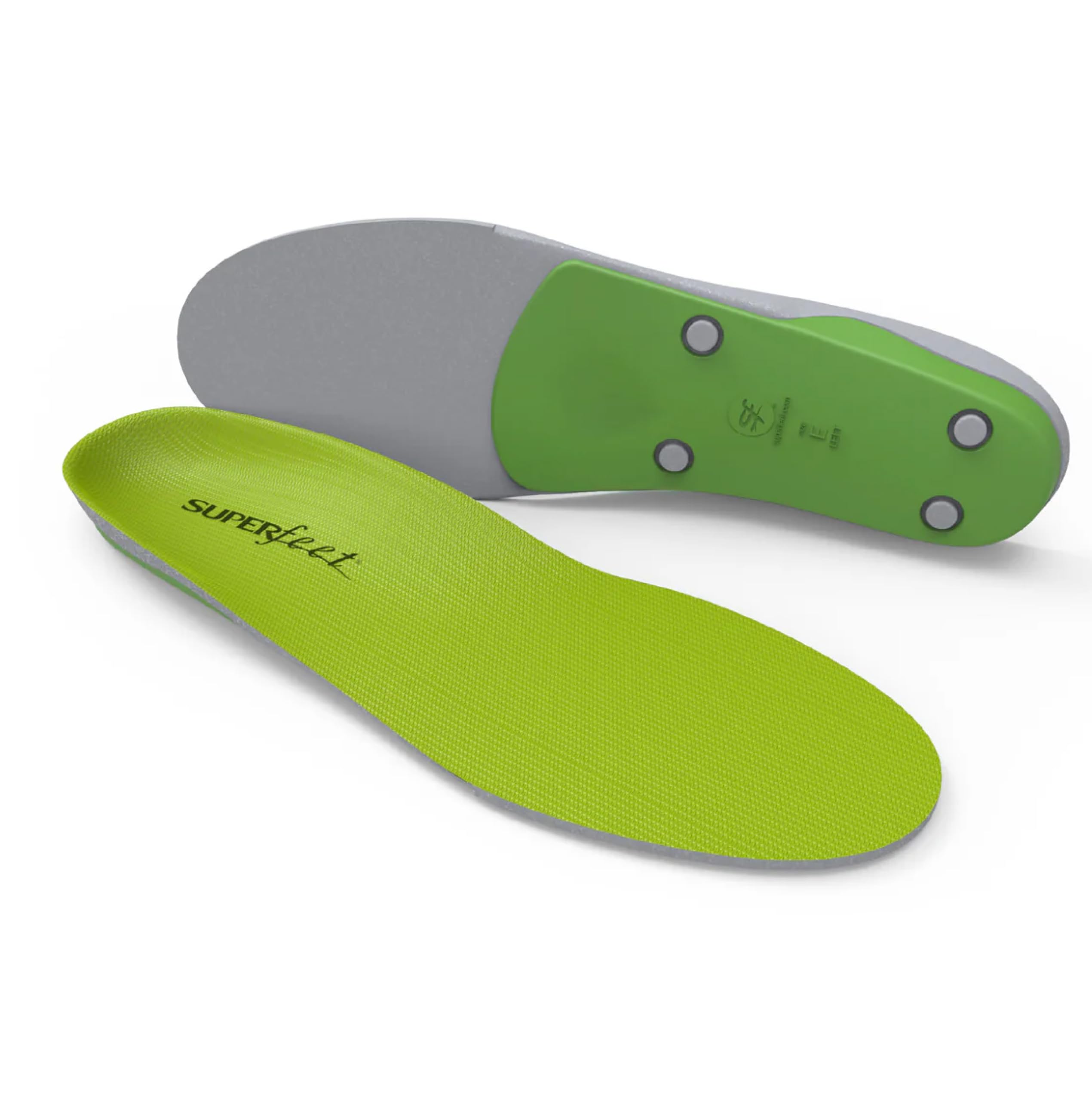
The Superfeet Green insole is a classic in the orthotic world, originally designed for high arches but often preferred by flat-footed users who need extremely rigid, uncompromising support. The high-density closed-cell foam is remarkably firm — it will not flatten, compress, or sag even after hundreds of miles. For runners whose flat feet are accompanied by heel spurs or chronic plantar fasciitis, this insole can provide instant relief because the arch fill materially changes the foot’s position inside the shoe. The deep sculpted heel cup measures over 7 mm in rise, which gives exceptional rearfoot control for overpronators.
This is not a plush insole. It is dense, heavy, and alters the feel of your shoe noticeably. Many users report that it dulls the springy sensation of high-performance running shoes, and it may require a half-size up to accommodate the extra volume. However, for runners who have tried every soft insole and continue to experience arch pain or post-shift foot fatigue, the Superfeet Green delivers a structural correction that softer options cannot match. The moisture-wicking top cover keeps feet dry, and the trim-to-fit sizing works well with most hiking boots, trail runners, and daily trainers.
It is worth noting that Superfeet now markets the Green insole under the name “All-Purpose Support High Arch,” but the construction is identical to the original product. The break-in period is real — expect the first week to feel stiff and unfamiliar. Once your foot adapts, the support becomes invisible; you stop noticing the insole and simply notice that your arch no longer aches after a run.
Why it’s great
- Extremely durable closed-cell foam that resists compression
- Deep heel cup provides maximum rearfoot stability for overpronators
- Proven long-term support for plantar fasciitis and heel spurs
Good to know
- Very firm feel requires a 5–7 day adaptation period
- Adds noticeable weight and volume to running shoes
- May dull the responsive feel of performance trainers
5. VALSOLE Heavy Duty Support Pain Relief Orthotics
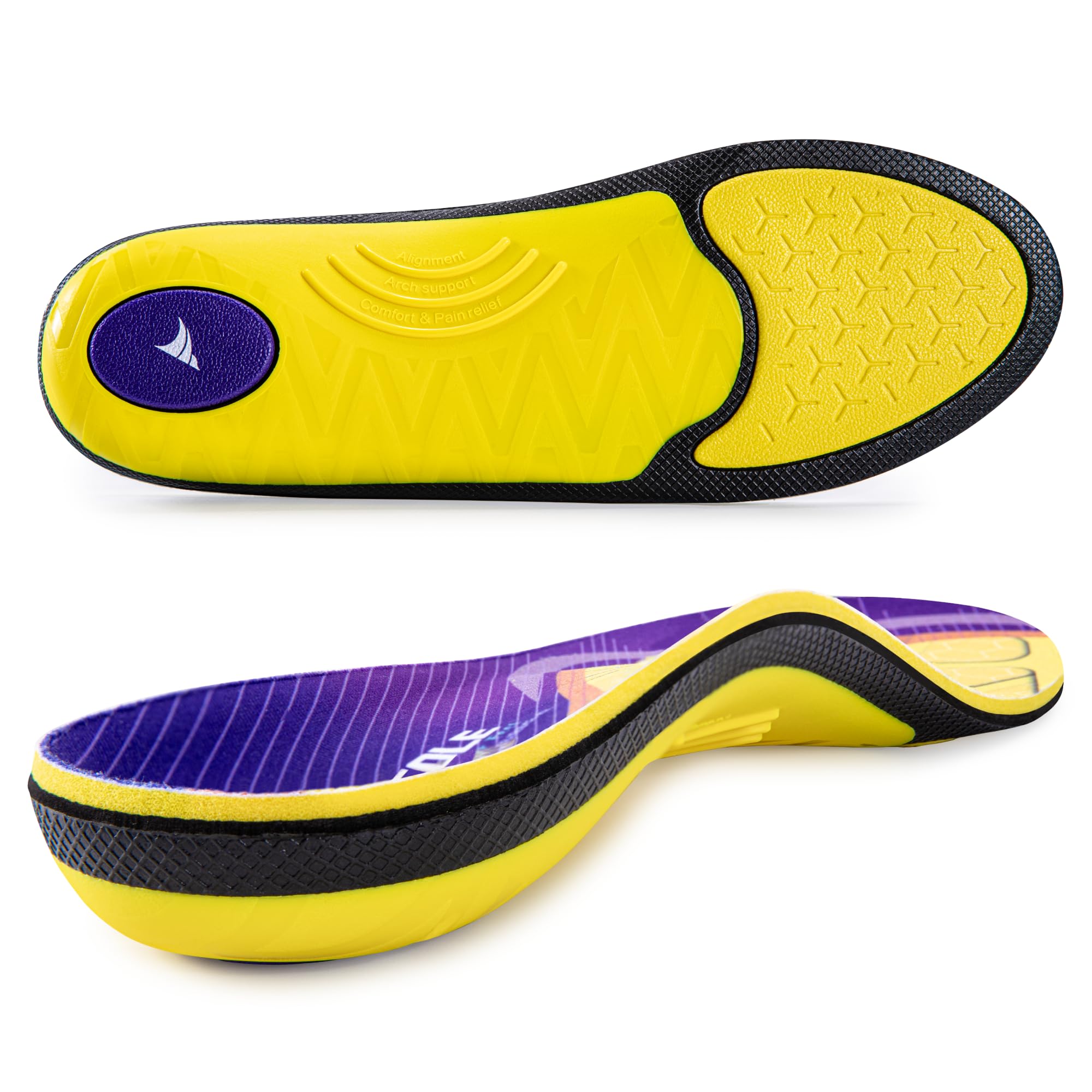
The VALSOLE Heavy Duty Support insole is engineered for one specific audience: runners and walkers over 220 pounds whose body weight crushes standard foam insoles within weeks. The key differentiator is the rigid TPU (thermoplastic polyurethane) arch insert that runs from midfoot to heel, providing a structural shelf that does not flex or collapse under heavy loads. Combined with a deep heel cup, this insole controls overpronation effectively even for heavier runners who typically experience rapid insole degradation.
The dual-layer foam base uses a combination of high-density PU and gel pads in the heel and forefoot, which absorbs shock without adding excessive thickness. Users who work 12–16 hour shifts on concrete floors report significant reductions in lower back and hip pain after switching to the VALSOLE. For running specifically, the insole provides a stable platform that prevents the medial arch from pancaking during the stance phase. The fit is true to size and requires minimal break-in — most users find them comfortable from the first wear.
One caution: the thickness of the VALSOLE may cause tightness in low-volume running shoes. Several reviewers noted that they had to loosen laces or switch to a wider shoe model to accommodate the volume. The insole also produces a slight noise from the TPU insert rubbing against the shoe’s sock liner during lateral movements, though this fades as the materials settle. For heavy flat-footed runners who need durable, load-bearing support, this is the most cost-effective option on the list.
Why it’s great
- Rated for users over 220 lbs with TPU arch that doesn’t collapse
- Gel heel pad provides targeted shock absorption for heavy runners
- Minimal break-in period compared to other rigid orthotics
Good to know
- Thick construction may not fit low-volume running shoes
- TPU insert can produce audible rubbing sounds initially
- Firm support may feel excessive for mild flat feet
6. CRUVHEAL Sport Shock Absorbing Insoles

The CRUVHEAL Sport Shock Absorbing insole is a strong entry-level option for flat-footed runners who participate in high-impact sports like basketball, tennis, or sprint training. The defining feature is the strategically placed gel pads in the heel and forefoot, which dissipate the high G-forces generated by jumping and hard cuts. The deep heel cup and non-slip gel heel pads keep the insole locked in place during lateral movements — a common failure point for cheaper inserts that shift inside the shoe.
For flat feet specifically, the arch support is moderate; it is not as aggressive as the PowerStep or Superfeet Green, but it provides enough lift to reduce overpronation for runners with mild flat arches. The foam has a springy, bouncy feel that many users describe as walking on clouds, which works well for runners who prioritize comfort over rigid correction. The insole is slightly heavier than average due to the gel inserts, but most users find the weight worth the impact protection.
Where the CRUVHEAL falls short for serious flat-footed runners is in its long-term structural support. The gel and foam construction will compress faster than TPU-reinforced alternatives, especially under heavier loads. Runners logging over 20 miles per week may find the support fading after two to three months of use. However, for recreational runners who want affordable shock absorption and decent arch comfort without a strict break-in period, this insole delivers strong value.
Why it’s great
- Gel pads in heel and forefoot excel at high-impact shock absorption
- Non-slip heel design keeps the insole stable during lateral cuts
- Comfortable out of the box with no break-in required
Good to know
- Arch support is too mild for moderate to severe overpronation
- Foam compresses faster than rigid TPU orthotics
- Heavier build adds noticeable weight to the shoe
7. RooRuns Heavy Duty Arch Support Plantar Fasciitis Insoles

The RooRuns Heavy Duty Support insole punches above its price tier by offering a TPU arch insert, dual-layer PU foam, and a gel heel pad at a budget-friendly price point. The “Shock Guard Technology” combines with an extra-strong TPU arch stabilizer to distribute weight across the foot, making this a viable option for runners who need heavy-duty correction but cannot justify spending on premium orthotics. The deep heel cup provides adequate rearfoot control for moderate pronators, and the soft velvety cover reduces heat and friction during long runs.
Users report positive results for a range of conditions — plantar fasciitis, heel spurs, shin splints, and general arch fatigue — with many noting improvement within the first week of use. The insoles fit a variety of shoe types, including running shoes, hiking boots, and casual sneakers, and the trim-to-fit design allows customization for different shoe lengths. The manufacturer explicitly rates these for users over 220 lbs, making them one of the few budget insoles that do not collapse under heavier loads.
The main trade-off comes in long-term durability. The PU foam, while comfortable initially, shows compression wear after several months of daily running. The “shock guard” technology is effective but not as refined as the gel systems found in premium options like PowerStep. Additionally, the recommended 3–7 day break-in period is real — the rigid TPU arch can feel aggressive at first, and wearing them gradually is non-negotiable to avoid discomfort. For budget-conscious flat-footed runners, this is the best value proposition on the market.
Why it’s great
- TPU arch stabilizer provides genuine structural support at a low price
- Rated for users over 220 lbs without collapsing
- Versatile trim-to-fit design works across multiple shoe types
Good to know
- PU foam compresses faster than more expensive closed-cell alternatives
- Break-in period required — can feel aggressive for the first week
- Shock guard tech is less refined than dedicated gel systems
FAQ
Can I use flat feet running insoles in any shoe?
Will these insoles make my running shoes tighter?
How often should I replace insoles for flat-footed running?
What is the difference between a running insole and a walking insole for flat feet?
Final Thoughts: The Verdict
For most users, the best insoles for running with flat feet winner is the PowerStep Pinnacle Maxx because its angled heel post provides the highest level of overpronation control available in a non-custom orthotic, backed by dual-layer cushioning that keeps long runs comfortable. If you want flexible support that adapts to your natural gait without a stiff feel, grab the Superfeet Run Cushion Low Arch. And for heavy runners over 220 lbs who need load-bearing structural support at a budget-friendly price, nothing beats the VALSOLE Heavy Duty Support.