That dull ache in your lower back that starts around noon. The sharp jab in your hip when you stand up from a chair. You’ve blamed your mattress, your posture, your chair — but the real culprit is often hiding inside your shoes. Standard insoles are thin pieces of fabric and foam designed for fit, not function. They do nothing to control the subtle collapse of your arch that sends misalignment up through your ankles, knees, hips, and into your spine.
I’m Emma — the founder and writer behind Baby Bangs. I’ve spent years analyzing the mechanical relationship between foot support and joint pain, and I’ve learned that the right orthotic can do more for back and hip pain than most people realize.
This guide breaks down the best options by structural need, not marketing fluff. Whether you stand on concrete all day or just want to walk your dog without wincing, these are the insoles for back and hip pain that actually deliver measurable relief.
How To Choose The Best Insoles For Back And Hip Pain
Picking the wrong insole is worse than picking none — it can shift your weight into new painful spots. The goal is not just cushioning your heel, but controlling how your foot strikes the ground and how your entire kinetic chain above it responds. Here are the three things that matter most.
Arch Support Type: Semi-Rigid vs. Soft
A soft, squishy insole feels great in the store but can actually destabilize your foot, causing your hip to rotate more to compensate. For back and hip pain, a semi-rigid shell (usually TPU or polypropylene) under the arch is what keeps your foot from collapsing inward — a motion called overpronation that torques the knee and hip. The insole should feel firm under the arch, not like a marshmallow. You want resistance that your arch pushes against.
Heel Cup Depth and Stability
A shallow heel cup lets your heel slide and wobble with every step, sending micro-instabilities straight up to your pelvis. Look for a deep, molded heel cup — at least 5-6 mm deep — that cradles the calcaneus bone. This creates a stable foundation for the entire leg. When the heel is locked in place, the hip doesn’t have to constantly micro-correct. That’s where fatigue and joint pain get reduced.
Rigidity Across the Midfoot
Insoles that flex in the middle — right under your arch — are useless for back and hip pain. The midfoot section should resist twisting when you try to wring it like a towel. This torsional stability prevents the foot from dumping inward during the mid-stance phase of walking. A rigid midfoot shell creates a lever that keeps the shin bone aligned, the knee tracking straight, and the hip joint stable. Without that, any cushioning in the heel is cosmetic.
Quick Comparison
On smaller screens, swipe sideways to see the full table.
| Model | Category | Best For | Key Spec | Amazon |
|---|---|---|---|---|
| PowerStep Pinnacle | Premium | Podiatrist-backed all-day relief | Semi-rigid Polypropylene Arch | Amazon |
| Move All Day Comfort | Premium | Shock absorption with stability plate | X-Frame Torsional Support | Amazon |
| Dr. Scholl’s Custom Fit | Premium | 5-in-1 lower body relief | 3/4 Length Custom Fit | Amazon |
| Superfeet Green | Premium | High arch, firm rigid support | Deep heel cup, dense foam | Amazon |
| Superfeet Work Cushion | Premium | Anti-fatigue for workers | All arch height support | Amazon |
| Welnove Heavy Duty | Mid-Range | Heavier users (over 220 lbs) | TPU arch shell | Amazon |
| EASYFEET Orthotic | Budget | Entry-level anti-fatigue | Shock-absorbing pads | Amazon |
In‑Depth Reviews
1. PowerStep Pinnacle Insoles

The PowerStep Pinnacle is the gold standard for a reason — it’s the #1 podiatrist-recommended orthotic, and the structure backs that up. The semi-rigid polypropylene shell runs the full length of the arch and resists twisting better than almost anything in this category. This torsional rigidity is exactly what stops overpronation, which is the mechanical root of most hip hiking and lower back torque during walking. The dual-layer EVA cushioning sits above the shell, so you get firm support without a concrete feel underfoot.
Users consistently report plantar fasciitis improvement within 10 days, but more importantly for this guide, several reviews explicitly note a reduction in lower back pain and hip discomfort after switching from softer insoles. The heel cup is deep and cradling without being restrictive, and because these are sold by shoe size with no trimming required, the fit is precise right out of the box. That precision matters — a wobbly fit at the heel undoes the support above it.
The one trade-off is that these feel stiff for the first few days. That’s normal for a semi-rigid orthotic, but if you’re used to plush foam, your arches may ache during the break-in window. Once your foot adapts, the hip and back relief becomes consistent across 12-hour shifts on concrete or long walking sessions. They fit athletic shoes and work boots best — formal dress shoes may not accommodate the volume.
Why it’s great
- Semi-rigid polypropylene shell stops overpronation at the source
- Podiatrist-recommended with clinically-backed results for back pain
- No trimming required — true size-specific fit reduces heel slip
Good to know
- Firm feel requires a 3-5 day break-in period
- Not suitable for shallow dress shoes or heels
2. Move All Day Comfort Insole
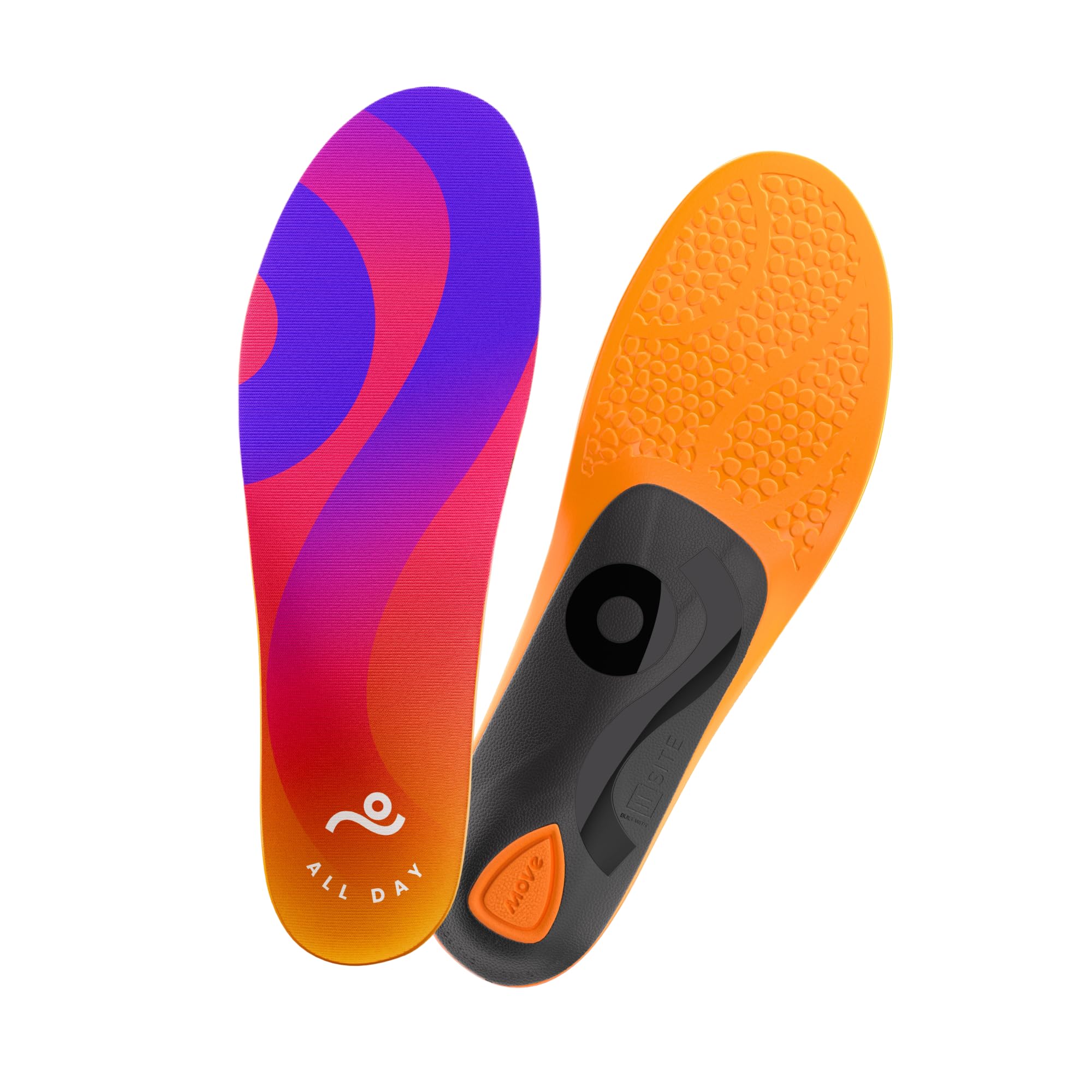
The Move All Day Comfort insole sits at the intersection of plush feel and structural control. Most insoles that feel this soft under the heel lack the rigidity to support the back, but Move solved that with an X-Frame Torsional Support system — a rigid plastic plate embedded in the midfoot that prevents the insole from collapsing. This is the critical spec: the midfoot section resists twisting, so your foot doesn’t dump inward during gait, which spares your hip from having to externally rotate to compensate.
The Active Heel Technology is the other standout feature. It uses a deeper, more contoured heel pocket that minimizes pressure on the sensitive fat pad while keeping the calcaneus locked in place. Users report that this reduces the sharp hip flexor pain that comes from standing still for long periods. The Recharge Foam layer provides a noticeable bounce-back that reduces the cumulative shock load traveling up to the lumbar spine — particularly useful for anyone walking on concrete or tile floors all day.
The thickness is the main caveat. At roughly 8-9 mm under the heel, these are not low-profile insoles. They fit perfectly in work boots, hiking shoes, and athletic sneakers, but they crowd the toe box in slim lifestyle shoes like Adidas Sambas or canvas low-tops. The price sits at a premium tier, but the combination of a rigid plate with soft foam is rare in this category — most insoles offer one or the other, not both.
Why it’s great
- X-Frame torsional plate provides rigid midfoot control
- Deep Active Heel pocket stabilizes the calcaneus
- Plush foam layer absorbs shock without sacrificing support
Good to know
- Too thick for slim profile or dress shoes
- Premium pricing places it at the top of the category
3. Dr. Scholl’s Custom Fit Orthotics 3/4 Length

Dr. Scholl’s Custom Fit is a different animal from most insoles — it’s a 3/4 length design that stops before the toes, leaving your toe box completely free. This is a major advantage for people with wide feet or bunions, and it also means the orthotic works in shoes where the factory insole cannot be removed. The custom fit process uses a heat-sensitive foam that molds to your specific arch shape, which is why you can get a unique contour rather than a generic dome.
The 5-in-1 clinically proven claim covers lower back, knee, heel, plantar fascia, and general foot fatigue. The triple-layer cushioning combines a soft top cloth, a shock-absorbing midlayer, and a 3D arch support base. Users in their 70s report walking all day on European cobblestone without back or knee pain. The key mechanism here is the customized arch contour — because it’s shaped to your foot, the pressure distribution is even, which prevents the hip from tilting to compensate for an uneven foot strike.
The durability has been a concern in recent batches. Some users report the top layer peeling after a few months of daily use, and the heel cushioning can develop a hole sooner than expected. If you’re hard on insoles (warehouse work, heavy hiking), the Dr. Scholl’s may wear out faster than a rigid-shell orthotic. But for moderate daily wear — walking, shopping, casual standing — the custom mold delivers a level of arch specificity that no generic foam insole can match.
Why it’s great
- Heat-molded custom arch contour for individual foot shape
- 3/4 length leaves toe box free for wide feet
- Clinically proven for lower back and knee pain relief
Good to know
- Durability is inconsistent — top layer can peel with heavy use
- Not as rigid as full-length shell orthotics for severe overpronation
4. Superfeet All-Purpose Support High Arch (Green)
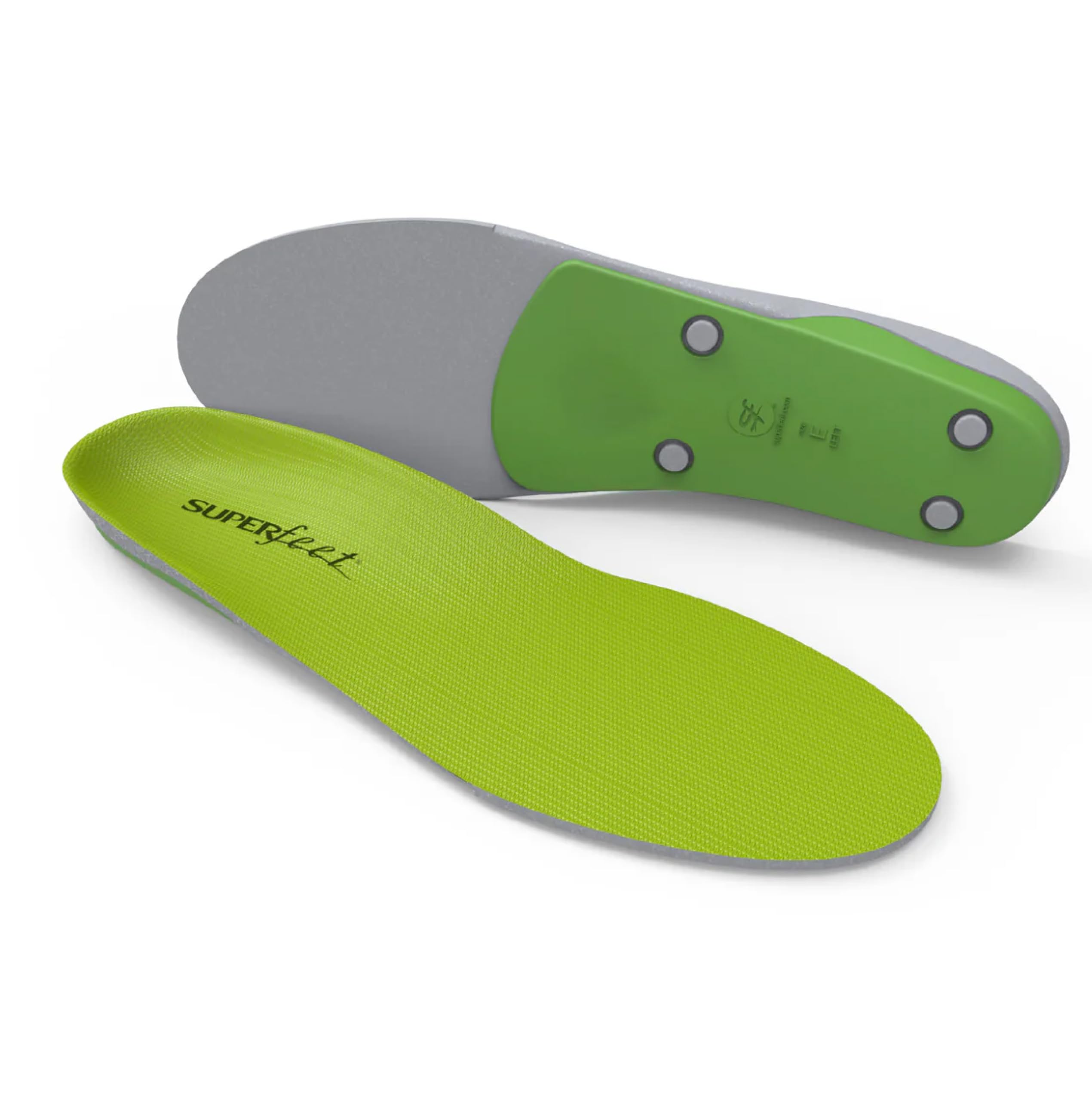
The Superfeet Green is legendary in the orthotic world for a simple reason: it uses a dense, closed-cell foam that does not compress under load. Most foam insoles squish down after a month, but the Superfeet Green retains its shape and support for up to 12 months. The sculpted heel cup is one of the deepest in this category — it wraps around the calcaneus and prevents the heel from shifting laterally, which stops the femur from rotating inward. That’s the direct link to hip pain relief.
The arch profile is surprisingly high. Even though it’s labeled for high arches, many users with flat feet and plantar fasciitis find it works because the rigid foam resists collapse better than any soft arch cookie. The heel is raised slightly higher than the forefoot, which changes your gait in a way that reduces tension on the sciatic nerve — a common source of referred hip and lower back pain. The moisture-wicking top cover is a bonus for all-day wear in warm environments.
The break-in period is real and uncomfortable for some. The foam is genuinely hard compared to gel or EVA options — you’re standing on a dense block, not a pillow. This pays off in longevity, but the first three days can cause arch soreness if you jump straight into a 10-hour shift. The other issue is fit: the deep heel cup and raised arch take up vertical space, so they won’t work in low-profile shoes like Vans or ballet flats. Stick to boots, trail runners, and roomy sneakers.
Why it’s great
- Closed-cell foam retains shape for up to 12 months
- Deep sculpted heel cup locks the calcaneus in place
- High arch profile reduces sciatic tension and hip rotation
Good to know
- Hard foam requires a break-in period of 3-5 days
- Too tall for low-profile or dress shoes
5. Superfeet Work Cushion Insoles
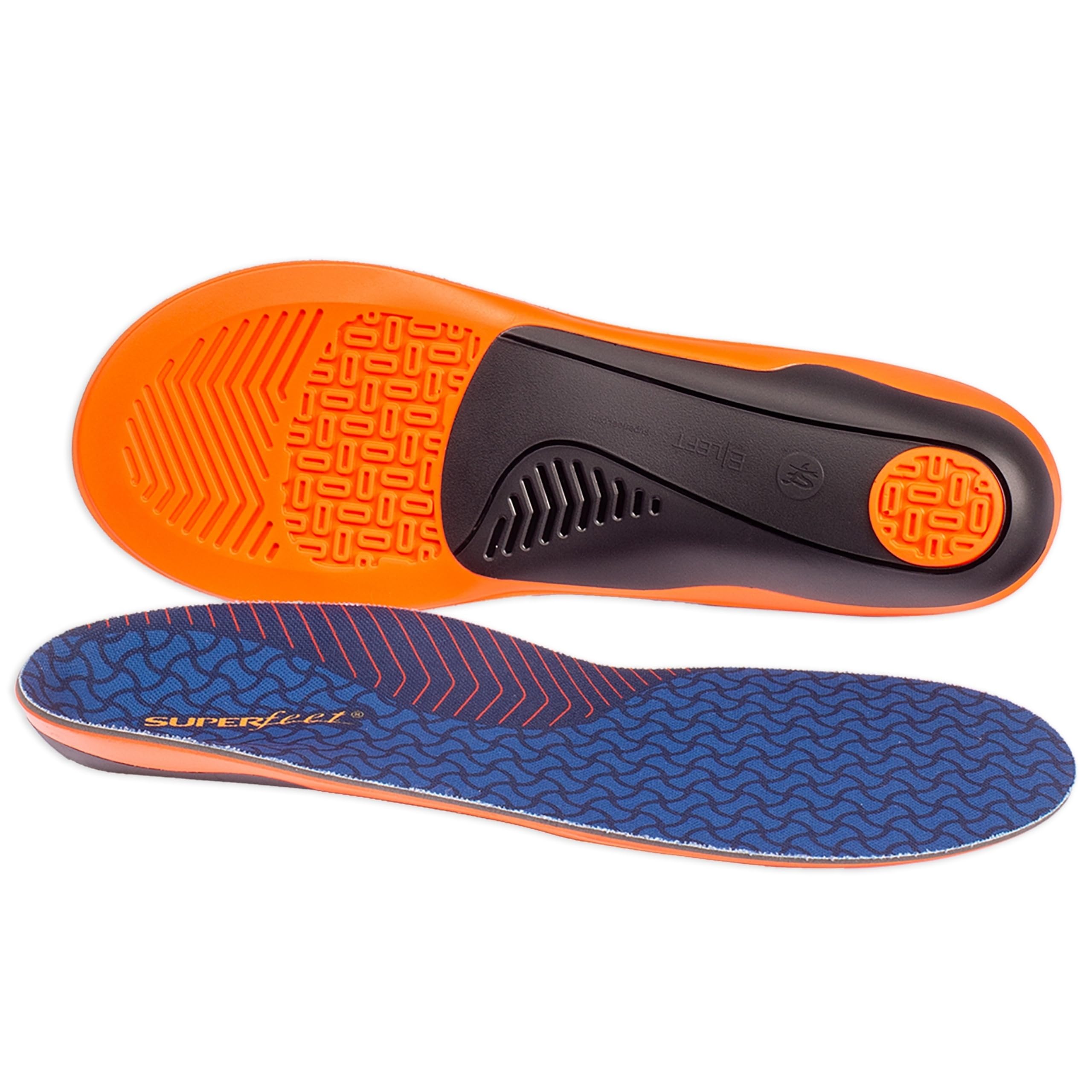
The Superfeet Work Cushion is designed specifically for people who stand on hard surfaces for hours — warehouse workers, nurses, restaurant staff — and it brings a softer feel than the classic Green while keeping the rigid arch shell. The anti-fatigue cushioning layer is thicker than any other Superfeet model, which means more shock absorption at heel strike. This is the spec that reduces the vibration that travels up the tibia into the knee and hip. Users report significant reduction in hip flexor pain and lower back fatigue after switching from standard boots.
The arch support is engineered to accommodate all arch heights, from flat to high. It achieves this through a medium-profile shell combined with a forgiving foam layer on top, so you get structure without aggressive pressure on the arch bone. The moisture-wicking top cover is practical for long shifts, and the trim-to-fit design allows you to cut down to size for work boots, hiking boots, and roomy athletic shoes. One reviewer noted it helped with hip instability in rubber boots used for fishing and outdoor work.
The trade-off is that the extra cushioning reduces the direct ground feel that some people want for stability. If you require a very firm, direct connection to the ground — for hiking or heavy lifting — the Work Cushion may feel a bit soft under the heel. It also runs slightly wider than other Superfeet models, so it fits well in Red Wing work boots and similar-duty footwear. The durability matches the Green: a year of support with minimal compression.
Why it’s great
- Thick anti-fatigue foam reduces shock transmission to hips and back
- Accommodates all arch heights without overcorrection
- Durable construction lasts up to 12 months of daily use
Good to know
- Extra cushioning reduces ground feel for some users
- Best suited for work boots, not casual or dress footwear
6. Welnove Heavy Duty High Arch Support Insoles
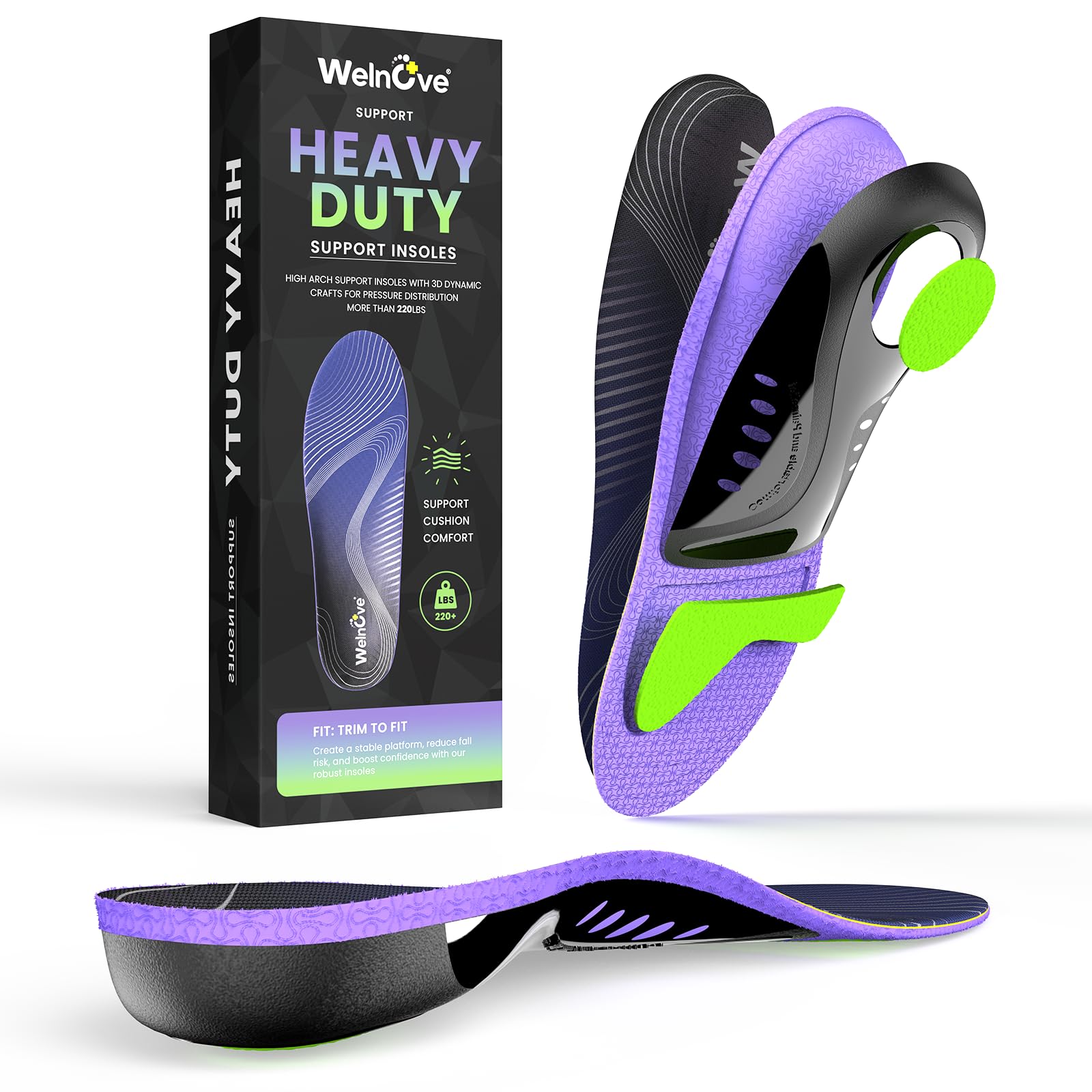
The Welnove Heavy Duty insoles target a specific demographic that most brands ignore: people over 220 pounds who need an arch shell that won’t collapse under higher ground reaction forces. The TPU (thermoplastic polyurethane) arch shell is stiffer than EVA alone and resists deformation better than budget foam options. For back and hip pain, this matters because a collapsing arch under heavier load multiplies the rotational torque on the knee and hip joint. The rigid shell prevents that collapse.
The EVA and Ortholite dual-layer cushioning provides adequate shock absorption for standing all day, and the forefoot and heel pads add extra impact damping. Users working 8-hour shifts on concrete at fulfillment centers report no foot pain at the end of their shift, and those with ankle instability note improved tracking. The deep heel cup is present but not as aggressive as the Superfeet Green — a good middle ground for people who need stability but find the Superfeet too intense.
The sizing is the weak link. The S size covers women’s 4-7 and men’s 5-8.5, which is a wide range for a single insole size, and the fit is not always consistent between shoe brands. Some users find the arch placement sits slightly off, causing discomfort after the second day. The brand offers a satisfaction guarantee and will accept returns even if trimmed, which is helpful, but it means you may need to try a different size. The arch is also high — double-check your natural arch height before committing.
Why it’s great
- TPU arch shell designed to support users over 220 lbs
- Dual EVA and Ortholite cushioning for all-day comfort
- Deep heel cup offers better stability than most budget insoles
Good to know
- Sizing can be inconsistent between shoe brands
- High arch may not suit flat-footed users
7. EASYFEET Orthotic Work Insoles

The EASYFEET Orthotic Work Insoles are the entry-level option in this guide, and they serve a specific purpose: if you’ve never worn a structured orthotic before, this is a low-risk way to feel what arch support does for your back and hips. The cushioning layer is enhanced with shock-absorbing pads at the heel and metatarsal, which dissipate some of the impact that would otherwise travel to your lumbar spine. Users standing 8+ hours with heavy equipment report elimination of foot pain and noticeable reduction in lower back pressure.
The thin design is a genuine advantage — these fit into a wider range of shoes, including some dress shoes and casual leather footwear, where thicker orthotics won’t fit. The breathable fabric top is comfortable against the skin, and the insoles can be trimmed for a more precise fit. The manufacturer offers a returns policy that accepts trimmed insoles, which removes the anxiety of cutting them wrong. For the price, the build quality is decent, with an expected lifespan of around 6-9 months for daily use.
The structural rigidity is the limitation. The EASYFEET lacks a rigid TPU or polypropylene shell, so it relies on foam contours to maintain arch shape. For moderate pronation or light daily walking, this is sufficient. For significant overpronation, heavy body weight, or severe hip and back pain, the foam will compress faster than a semi-rigid orthotic. The heel cup is present but shallow — it won’t lock the heel as securely as the PowerStep or Superfeet. Think of this as a solid upgrade from factory insoles, not a clinical orthotic replacement.
Why it’s great
- Thin profile fits more shoe types than most orthotics
- Shock-absorbing pads reduce impact on lumbar spine
- Low cost entry point with trim and return flexibility
Good to know
- No rigid shell — insufficient for severe overpronation
- Shallow heel cup provides less hip and back control
FAQ
Can insoles actually fix hip pain or just mask it?
How do I know if I need a high arch or low arch insole for back pain?
How often should I replace insoles for back and hip pain relief?
Do firm or soft insoles work better for lower back pain?
Final Thoughts: The Verdict
For most users, the insoles for back and hip pain winner is the PowerStep Pinnacle because its semi-rigid polypropylene shell provides the exact mechanical correction needed to stop overpronation while the dual-layer cushioning keeps you comfortable through long days. If you want a more plush feel with torsional midfoot control, grab the Move All Day Comfort Insole. And for heavy-duty work environments or heavier body weights, nothing beats the Welnove Heavy Duty Insoles for durability under load.