That first step out of bed in the morning — a sharp, stabbing pain in your heel that makes you wince before you can even stand straight. That’s the hallmark of a heel spur, and finding the right insole isn’t about general comfort; it’s about offloading the calcaneus and redistributing the strike impact away from that bony outgrowth. The specific engineering challenge here is building a cradle that supports the arch, cups the heel deeply, and uses a material matrix that absorbs shock without adding bulk.
I’m Emma — the founder and writer behind Baby Bangs. I’ve spent years analyzing the structural biomechanics of foot orthotics, cross-referencing material density, heel-cup depth, and arch-height ratios to separate the truly therapeutic designs from the foam pads that just feel soft for a week.
Whether you’re on concrete for ten-hour shifts or just trying to walk the dog without flinching, the right insert changes your gait pattern from the ground up. This guide breaks down the top-engineered insoles for heel spurs by measurable support and real-world construction, not marketing fluff.
How To Choose The Best Insoles For Heel Spurs
Heel spurs are calcium deposits on the underside of the heel bone that dig into the surrounding tissue. The wrong insole — one with soft, collapsing foam — allows the spur to press deeper into the fat pad. The right one suspends the arch and cups the heel so the spur never contacts the ground under full weight. Here’s what to check before you buy.
Heel Cup Depth and Stiffness
A shallow heel cup lets the fat pad splay sideways, defeating the purpose. Look for a deep U-shape that wraps the calcaneus tightly in rigid TPU or reinforced plastic. The sidewalls should be firm enough that you cannot collapse them with thumb pressure — this is what holds the spur away from the strike zone.
Arch Support Material
Soft gel arches feel nice in the store but do nothing to lift the medial longitudinal arch under load. You want a semi-rigid or rigid arch bridge — either molded TPU or a high-density polypropylene shell — that holds its shape through a full gait cycle. If you can bend the arch flat with one hand, it will flatten under your body weight within hours.
Shock Absorption at the Heel
Heel spurs hurt because each foot strike sends a shockwave through the calcaneus. Look for dual-layer systems: a firm base for stability plus a viscoelastic top layer (PORON, Ortholite, or gel pads) that dissipates shear. The heel pad should be at least 8-10 mm thick to provide meaningful deceleration before the force reaches the spur.
Length and Fit Profile
Full-length insoles add volume that can crowd the toe box and cause pressure points. 3/4-length designs sit behind the ball of the foot, targeting the arch and heel exclusively. This is often the better choice for heel spurs because it leaves room for the toes to splay naturally while delivering support exactly where the spur lives.
Quick Comparison
On smaller screens, swipe sideways to see the full table.
| Model | Category | Best For | Key Spec | Amazon |
|---|---|---|---|---|
| RooRuns Heavy Duty | Premium | Heavy users 220+ lbs | Rigid TPU + heel gel + E-TPU forefoot | Amazon |
| Cloudflo Plantar Fasciitis | Mid-Range | All-day standing on concrete | Ortholite cushion + rigid TPU shell | Amazon |
| Sof Sole Plantar Fascia | Premium | Podiatrist recommendation | Gel in heel + Plantar Relief Bridge | Amazon |
| Professional Heavy Duty | Mid-Range | High weight + long shifts | Dual PORON cushion + deep heel cup | Amazon |
| OUOKK 3/4 Arch Support | Budget-Friendly | Tight shoes / low-volume fit | 30 mm rigid TPU arch, 3/4 length | Amazon |
In‑Depth Reviews
1. RooRuns Heavy Duty Arch Support Plantar Fasciitis Insoles

The RooRuns earns the top spot because it combines three structural features that matter for heel spurs: a rigid TPU arch that doesn’t collapse under 220+ pounds, a deep heel cup that cradles the calcaneus, and dual-layer PU foam plus gel at the heel for actual shock deceleration. The E-TPU forefoot pad adds an extra layer of energy return, which reduces the compensatory gait patterns that develop when you’re trying to avoid heel pain.
Users report that it fits perfectly in running shoes, hiking boots, and work boots without requiring excessive trimming. The break-in period is real — the rigid arch can feel aggressive for the first two to three days, and the manufacturer explicitly warns about foot pressure during the first week. This is actually a good sign: it means the arch is doing its job of lifting the medial column away from the spur site.
The velvety breathable cover manages moisture well, and the heavy-duty construction shows no signs of delamination or flattening even after weeks of daily wear. For anyone over 200 pounds who needs all-day relief from heel spur pain, this is the most thoroughly engineered option on the list.
Why it’s great
- Rigid TPU arch holds shape under heavy loads — ideal for 220+ pound users
- Heel gel pad plus E-TPU forefoot provides two-stage shock absorption
- Deep heel cup offloads the spur effectively during gait
Good to know
- Requires a break-in period of 3–7 days due to rigid arch
- Not suitable for low-volume dress shoes; best in athletic or work footwear
2. Cloudflo Plantar Fasciitis Insoles
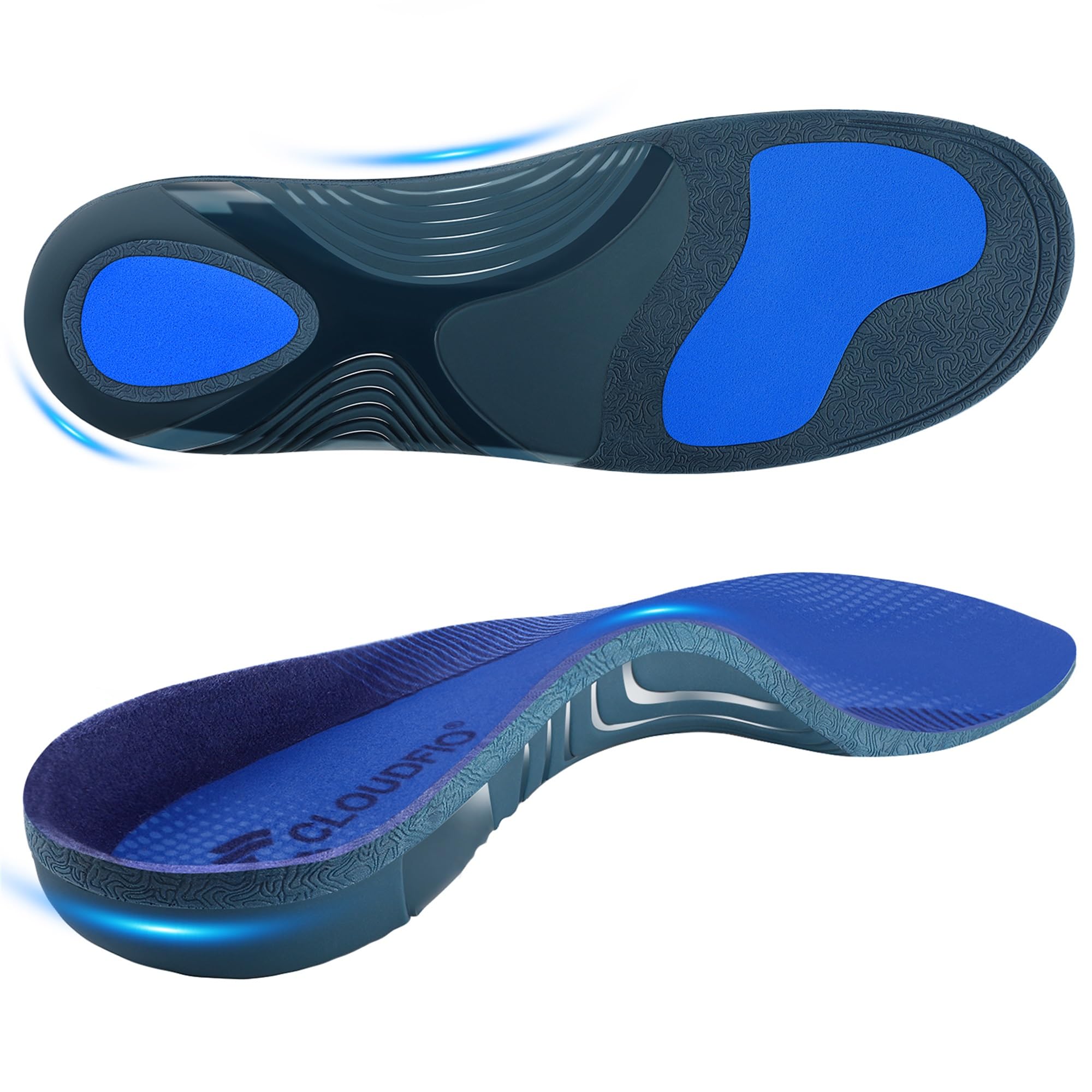
Cloudflo targets the specific pain of standing all day on concrete floors — the repeated micro-impacts that inflame a heel spur over ten hours. The construction uses a rigid TPU shell for arch stability paired with thick Ortholite cushioning in the forefoot and a PU pad in the heel. That combination gives you the structural lift you need while keeping the underfoot feel more forgiving than a purely hard orthotic.
Users consistently note that the heel and forefoot cushioning reduces the sharp pain that flares up after hours of standing. The sizing guide is clear, and most users report a perfect fit with minimal trimming required. It handles 220+ pound users without the arch collapsing, and the breathable velvet cover resists odor buildup even in work boots worn without socks.
The one trade-off is that the heel support is slightly softer than some pure orthotics — the PU pad absorbs shock well but doesn’t provide the same rigid offloading as a molded gel cup. For users whose heel spur pain is triggered more by prolonged standing than by explosive movements, this balance works in its favor.
Why it’s great
- Ortholite cushioning stays resilient over 10+ hour shifts on hard floors
- Rigid TPU shell prevents arch collapse while maintaining some flexibility
- Breathable velvet cover reduces moisture and odor in work boots
Good to know
- Heel cushion is softer than pure orthotics — may not suit severe spur cases
- Best in athletic shoes or work boots; too thick for low-profile casual footwear
3. Sof Sole Plantar Fascia Insoles (3/4 Length)

The Sof Sole is the rare product that podiatrists actually recommend by name — multiple user reviews confirm their doctor pointed them to this exact insole. The key feature is the Plantar Relief Bridge, a molded thermoplastic arch that provides firm structural lift, paired with a gel pocket in the heel that disperses the strike force away from the spur. The 3/4-length design leaves the toe box free, making it compatible with a wider range of footwear including casual sneakers and athletic shoes.
Long-term users report that a single pair lasts years before the gel begins to lose its elasticity. The truncated length means you generally don’t need to cut it, though you should remove the original insole to avoid stacking. The gel pad sits in a recessed pocket, so the heel height remains reasonable — you can slip these into most sneakers without the foot sitting too high in the heel counter.
The only durability caveat involves the rubber-like circle on the heel bottom, which can wear against the shoe lining over extended use. Users recommend checking the inside of the shoe periodically for abrasion. FSA and HSA eligibility is a practical bonus for those using pre-tax health spending accounts.
Why it’s great
- Podiatrist-recommended with a proven track record spanning years
- Gel heel pocket provides targeted shock dispersion for spur relief
- 3/4 length fits most athletic and casual shoes without trimming
Good to know
- Rubber heel pad may abrade the interior shoe lining over time
- Best suited for users with medium-to-normal arch height, not extreme high arches
4. Professional Heavy Duty Support Pain Relief Orthotics (Poron)

This insole uses double PORON cushioning — a urethane-based foam that outperforms standard EVA in both shock absorption and long-term compression resistance. The Golden Triangle design provides three-point support across the forefoot, arch, and heel, which helps distribute body weight evenly across the foot instead of concentrating it on the spur. The deep U-shaped heel cup is rigid enough to prevent supination and keep the heel aligned through the gait cycle.
Users under 230 pounds and those above it both report immediate improvement in heel pain after the first day, with particular praise from people working 9-10 hour shifts on hard flooring. The full-length design offers more coverage than 3/4 options, which helps if you also suffer from metatarsalgia or forefoot discomfort. The upper fabric is sweatproof and breathable, reducing the fungal growth risk that comes with all-day wear.
The trade-off is that the insole adds noticeable volume inside the shoe. Users with low-cut sneakers may find the heel sits too high, causing the foot to lift slightly out of the heel counter. It works best in high-top sneakers, work boots, or hiking boots where the ankle collar provides enough vertical room.
Why it’s great
- Dual-layer PORON foam retains over 95% of its thickness under repeated compression
- Golden Triangle design distributes weight away from the spur across three contact points
- Sweatproof fabric keeps feet dry during long shifts in boots
Good to know
- Full-length construction adds volume — may not fit low-cut or snug casual shoes
- Arch support is medium height; users with very high arches may need a taller profile
5. OUOKK 3/4 High Arch Support Inserts

The OUOKK is a 3/4-length orthotic that prioritizes arch height above all else — the rigid TPU arch rises to 30 mm, which is notably taller than most competitors. This makes it an excellent choice for users with naturally high arches whose heel spurs are exacerbated by a collapsed midfoot. The 3/4 design leaves the toe box empty, so it works well in dress shoes, loafers, and other footwear where a full-length insole would crowd the toes.
Users praise the immediate reduction in arch pressure and related knee and back pain, though multiple reviews note that the rigid arch feels very firm during the first several days. The manufacturer advises a gradual break-in of two to three hours per day, which is consistent with what we see from properly stiff orthotics. The thin edges save space inside the shoe, making this one of the few high-support insoles that can fit inside narrower footwear.
The lack of dedicated heel cushioning is the main limitation for pure spur relief — the rigid arch lifts the foot, but the heel area relies on the shoe’s own padding for shock absorption. For users whose spur pain is primarily arch-driven, this trade-off is acceptable. For those needing serious heel deceleration, the RooRuns or Sof Sole offer better heel-targeted engineering.
Why it’s great
- 30 mm rigid TPU arch is among the tallest available — ideal for high arches
- 3/4 length fits tight shoes and dress shoes where full insoles won’t work
- Thin edges minimize shoe volume displacement while maintaining support
Good to know
- No dedicated heel pad — shock absorption depends on the shoe’s own sole
- Rigid arch requires a multi-day break-in period for comfort
FAQ
Can insoles actually cure a heel spur or do they just mask the pain?
Why do some insoles recommend a break-in period of several days?
Should I choose a full-length insole or a 3/4-length insole for heel spur pain?
Final Thoughts: The Verdict
For most users, the insoles for heel spurs winner is the RooRuns Heavy Duty because it combines rigid TPU arch support with targeted heel gel and E-TPU forefoot cushioning — the full structural package for offloading a spur under any load. If you want a podiatrist-backed option with a proven gel heel pocket and a slim 3/4 profile, grab the Sof Sole Plantar Fascia. And for a budget-friendly entry point that fits tight shoes without sacrificing arch height, nothing beats the OUOKK 3/4 High Arch Support.