The grinding sensation in your knee during a morning walk or the deep ache in your hip after standing for an hour is a signal that your body’s natural suspension system is breaking down. For millions, the missing link isn’t a stronger joint — it’s a stable foundation under the foot that realigns the kinetic chain from the ground up.
I’m Emma — the founder and writer behind Baby Bangs. I’ve analyzed hundreds of gait studies, biomechanical reports, and insole material compositions to identify which designs actually unload the knee and hip joints versus those that only mask arch discomfort.
The most effective shoe inserts function as force-redirecting platforms that shift impact away from inflamed joints. This guide breaks down the top contenders so you can find the insoles for knee and hip pain that match your arch type, activity level, and body weight.
How To Choose The Best Insoles For Knee And Hip Pain
Knee and hip pain often stem from pronation issues — when your foot rolls inward or outward excessively, the tibia and femur rotate, misaligning the hip socket and kneecap. The right insole corrects this cascade. Prioritize products designed with a rigid or semi-rigid shell that controls motion rather than just soft foam that compresses flat within a month.
Match Arch Support To Your Foot Type
Low arches need aggressive medial posting to prevent overpronation, while high arches require deep heel cups that cradle the calcaneus and prevent lateral instability. A neutral arch can often get away with moderate support, but the key measurable spec is the height of the arch contour — typically between 18 mm and 28 mm for most structured insoles. Too little, and your knee will continue to collapse inward with every stride.
Prioritize Heel Cup Rigidity And Depth
The heel cup is your hip’s best friend. A deep, rigid cup (10-15 mm depth) locks the fat pad and limits excessive subtalar joint motion, which directly reduces rotational stress transmitted up to the knee and hip. Soft, shallow cups allow the heel to slide and wobble, amplifying joint torque. Look for cups made from polypropylene or a carbon-fiber blend — materials that provide motion control without adding bulky weight.
Consider Your Daily Impact Volume
A 30-minute daily walker has different needs than someone logging 20,000 steps on concrete. Higher impact volume demands insoles with a dual-density construction — a firm base layer for structural correction topped with a thin memory foam or gel layer for pressure distribution. Avoid single-density foam-only designs if you stand all day or run; they bottom out and transfer shock straight to the knees.
Quick Comparison
On smaller screens, swipe sideways to see the full table.
| Model | Category | Best For | Key Spec | Amazon |
|---|---|---|---|---|
| Superfeet Run Cushion Low Arch | Premium | Low arches & runners | Adaptive Comfort Technology heel cup | Amazon |
| PowerStep Bridge | Mid-Range | All-day wear & high arches | Memory foam + flexible frame | Amazon |
| Dr. Scholl’s Custom Fit 3/4 | Premium | Total lower body alignment | Triple-layer shock-absorbing system | Amazon |
| MOVE All Day Comfort | Premium | Extra plush daily cushioning | Rigid midfoot stability plate | Amazon |
| VALSOLE Heavy Duty | Mid-Range | Heavy users over 220 lbs | Firm high arch + shock absorption | Amazon |
| 10 Seconds Pressure Relief 3030 | Mid-Range | Metatarsal pad & medium arches | Plastazote memory foam topper | Amazon |
| Scholl In-Balance 3/4 | Budget | Everyday knee & heel relief | Deep heel cup in 3/4 length | Amazon |
In‑Depth Reviews
1. Superfeet Run Cushion Low Arch

Superfeet brings its decades of podiatric engineering into a runner-specific insole that prioritizes joint torque reduction over pure cushioning. The Adaptive Comfort Technology uses a shaped heel cup that locks the calcaneus, limiting subtalar joint pronation — the motion most responsible for rotating the tibia and stressing the knee and hip. Reviewers with fallen arches report that hip flexor pain and outer hip soreness disappeared within a week, which aligns with the biomechanical principle of controlling rotation at the source.
The trim-to-fit polyester top cover wicks moisture and resists odor, but the real performance comes from the semi-rigid polymer shell under the arch. It provides enough resistance to prevent arch collapse without feeling like a rigid board underfoot. The insole is specifically tuned for low arches (20 mm or less), so those with neutral or high arches should look elsewhere, as the medial posting will feel uncomfortable and may push the foot into supination.
Some runners noted a slight burning sensation on the sole after longer distances — likely due to the firm base transferring pressure to the plantar fascia before adaptation. This typically resolves after a break-in period of 15-20 miles. For anyone logging regular miles and experiencing knee or hip pain linked to overpronation, this is the most targeted fix available without a custom orthotic.
Why it’s great
- Adaptive heel cup controls pronation at the subtalar joint
- Rigid shell maintains arch height during mid-stance
- Low-profile design fits most running shoes without crowding the toe box
Good to know
- Specific to low arches; neutral or high arches will find it uncomfortable
- 1 pair per package — two pairs needed for multiple shoes
- May require a short break-in period for plantar fascia adaptation
2. PowerStep Bridge Flexible Arch Insole
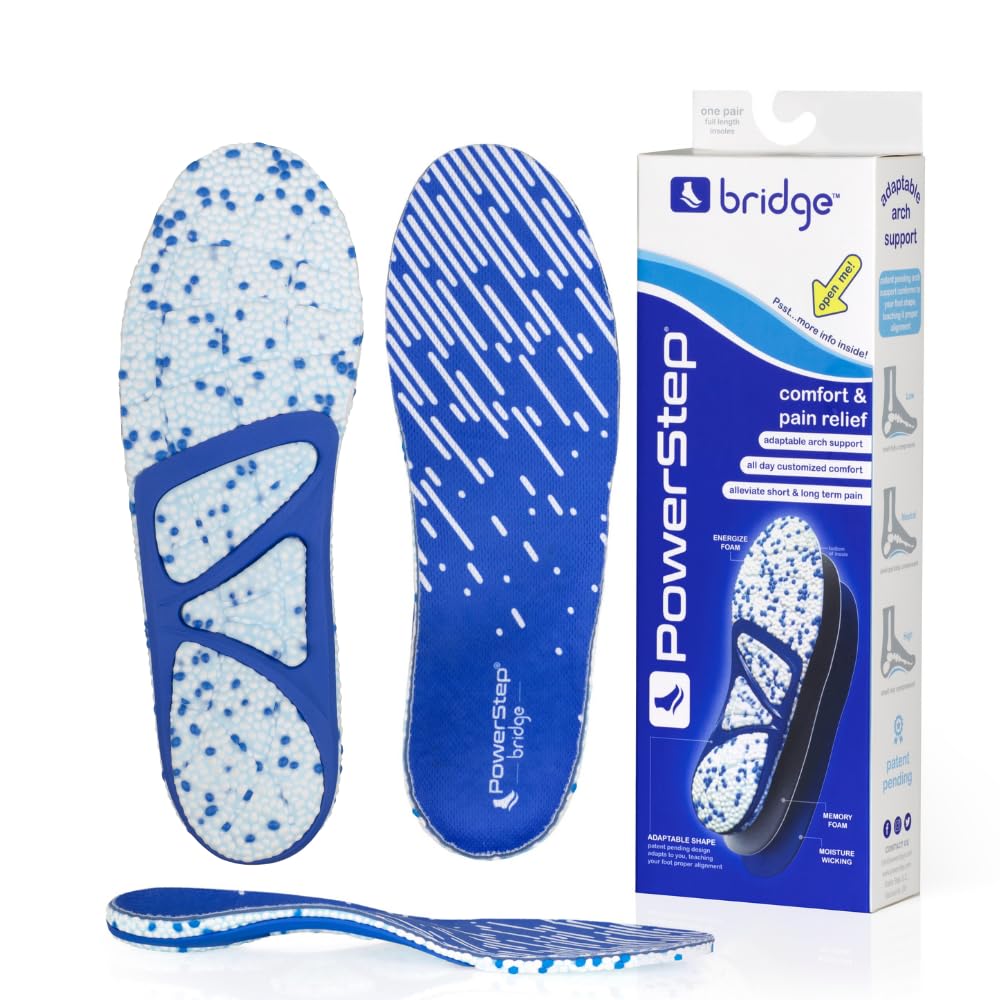
PowerStep’s Bridge insole occupies a rare middle ground — it delivers the structural support of a rigid orthotic with the forgiving ride of a memory foam insert. The key differentiator is the flexible frame: instead of a solid plastic shell that forces the foot into a fixed position, the Bridge design uses a semi-flexible polymer that adapts to the foot’s natural stride while still maintaining arch contour. This matters for knee and hip pain because excessive rigidity can cause the knee to lock during gait transition, shifting stress upward.
The dual-layer energizing memory foam provides immediate step-in comfort, but the real biomechanical work happens via special pressure-dissipating channels on the underside. These channels allow the foam to distribute weight evenly across the midfoot, reducing the peak pressure that typically radiates to the lateral knee and hip. Customer reports confirm that the insole improved shooting percentage and reduced leg pain in basketball players — a high-impact scenario where knee valgus collapse is common.
A small subset of heavy users reported the fabric top layer peeling at the heel after roughly one month of high-mileage wear (20,000-30,000 steps daily). This is a durability trade-off for the plush feel. For typical daily use of 5,000-10,000 steps, the lifespan extends to 4-6 months. You get excellent value, especially for high-arched individuals who need pronounced medial support without a stiff, unforgiving feel.
Why it’s great
- Flexible frame adapts to natural gait while maintaining arch support
- Dual-layer memory foam reduces peak midfoot pressure
- Works for high arches, flat feet, and neutral arches without fit issues
Good to know
- Fabric topper may peel at heel under extreme daily mileage
- Not ideal for shoes with very low volume or tight toe boxes
- Lacks the rigid heel cup of premium orthotic brands
3. Dr. Scholl’s Custom Fit 3/4 Orthotics

Dr. Scholl’s Custom Fit system is the most clinically validated option on this list for total lower body pain relief, with a triple-layer construction that targets foot, knee, hip, and lower back pain simultaneously. The 3/4 length design fits shoes where the original insole can’t be removed, and the adaptive 3D arch support is matched to your specific arch type, body weight, and shoe size via an online guide. The result is a semi-custom fit that costs a fraction of podiatrist-molded orthotics.
The three layers — shock-absorbing foam base, adaptive arch contour, and a pressure-reducing top cloth — work in concert to disperse impact forces across the entire plantar surface. This reduces the peak vertical ground reaction force that travels up the tibia and into the knee joint. Long-term users report sustained relief from chronic knee pain associated with high arches, and the wear life of 6-12 months per pair is strong for the price. The 3/4 length also means they fit easily into dress shoes, loafers, and casual sneakers where full-length insoles would bunch.
The main limitation is that the 3/4 length provides no toe cushion, which can be an issue for those with metatarsalgia or Morton’s neuroma. Additionally, because the arch support is fixed rather than trim-to-fit, individuals between arch types may find the support either too aggressive or insufficient. It’s best suited for those who can precisely determine their arch type using the Dr. Scholl’s foot arch test — a quick in-store or online process that returns a specific product number.
Why it’s great
- Triple-layer system clinically proven for lower body joint pain
- 3/4 length fits in shoes where full-length insoles won’t work
- Customized to arch type, weight, and shoe size for a near-custom fit
Good to know
- No toe cushion — not ideal for metatarsal or ball-of-foot pain
- Fixed arch support can’t be adjusted after purchase
- Requires precise arch type determination for optimal effectiveness
4. MOVE All Day Comfort Insole
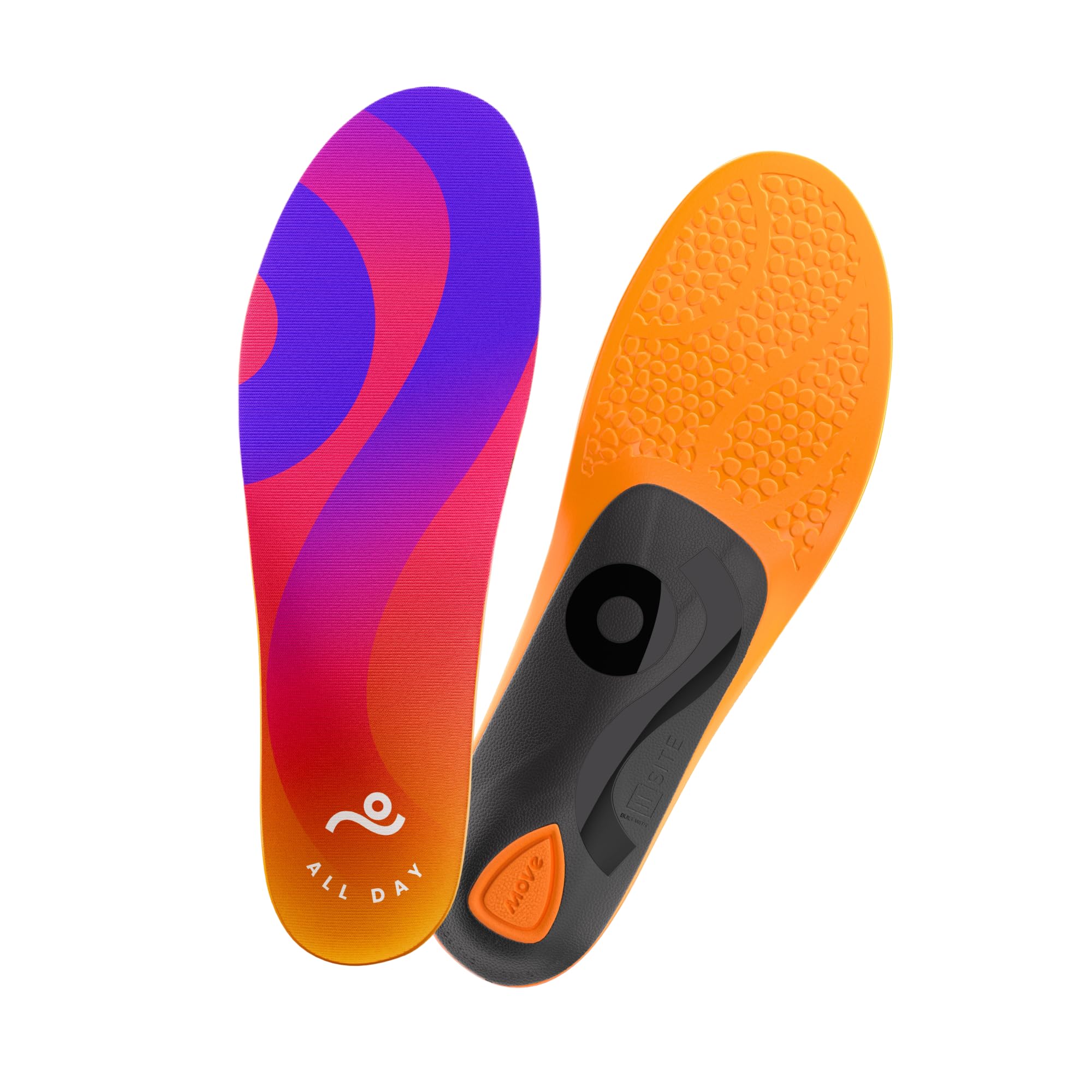
MOVE’s All Day Comfort insole is engineered for those who stand all day — nurses, retail workers, warehouse staff — where cumulative fatigue in the knees and hips leads to evening pain and stiffness. The defining component is the rigid midfoot stability plate embedded within the foam. Most cushioned insoles collapse under sustained body weight, but this plate maintains arch contour through a full 10-hour shift, preventing the foot from flattening out and rotating the femur inward.
The Move Recharge Foam is noticeably thicker than standard insoles, providing a plush, cloud-like step-in feel. However, this thickness means it may not fit low-profile footwear like Adidas Sambas or Gazelles without feeling crowded. Reviewers report a transformative improvement in comfort for hi-top sneakers (Jordan 1s, Dunks) and work boots, with the added heel cushion providing bounce that reduces impact shock at heel strike — the moment when knee and hip joint loading peaks.
The insole comes pre-trimmed to most common sizes but is easily cuttable for a custom fit. The primary trade-off is the premium investment — you are paying for the rigid stability plate and thick foam layer, which adds durability but also means replacement every 6-8 months under heavy use. If your daily routine involves hours on hard floors and you need joint impact reduction without swapping to clunky orthotics, this is your pick.
Why it’s great
- Rigid midfoot plate prevents arch collapse during long standing periods
- Thick heel cushion absorbs peak ground reaction force at strike
- Fits well in high-top sneakers, work boots, and casual shoes
Good to know
- Too thick for low-profile dress shoes or slim sneakers
- Premium investment compared to basic foam orthotics
- Limited odor control — moisture-wicking but not antimicrobial
5. VALSOLE Heavy Duty Support Orthotics

VALSOLE targets a specific demographic: individuals weighing over 220 pounds who need aggressive arch support to prevent the foot from collapsing under load. The insole features a firm, high-arch plastic shell reinforced by a deep heel cup that cradles the calcaneus and limits excessive motion. For users with flat feet or low arches who overpronate, this design is particularly effective at reducing internal tibial rotation — the mechanism that drives medial knee pain and hip stress.
Customer experiences consistently mention rapid relief from lower back, knee, and hip pain, with several users reporting complete elimination of pain after just one day of wear in work boots or athletic shoes. The firm yet spongy construction provides enough give to feel comfortable underfoot without compromising structural integrity. The high arch contour is pronounced — excellent for those with genuinely high arches, but likely uncomfortable for neutral or flat-footed individuals who don’t need that level of medial posting.
One notable limitation is that the stiffness requires loosening laces in many shoes to accommodate the extra height. Some users found they didn’t fit well in narrow modern athletic shoes like the Adidas Evo SL. The heavy-duty design also means a break-in period of 2-3 days is typical. For the price, VALSOLE delivers orthotic-grade motion control that competes with products costing twice as much, making it a strong pick for heavier individuals looking to unload their knees and hips.
Why it’s great
- Aggressive high arch support controls overpronation under heavy loads
- Deep heel cup locks the calcaneus for rotational stability
- Immediate pain relief reported for knee, hip, and lower back
Good to know
- May require loosening laces due to insole height
- Uncomfortable for flat-footed or neutral-arched users
- 2-3 day break-in period during adaptation
6. 10 Seconds Pressure Relief 3030 with Metatarsal Pad

The 10 Seconds 3030 insole is uniquely designed for individuals whose knee and hip pain is secondary to metatarsal head pressure — a common pattern where pain in the ball of the foot forces a limping gait that overloads the knee and hip. The integrated metatarsal pad sits directly behind the metatarsal heads, redistributing pressure off the second and third metatarsals and restoring a normal gait cycle. The Plastazote memory foam topper molds to the foot shape after a few wears, creating a custom-like contour.
Underneath the foam, Poron strike pads at the heel absorb shock at ground contact, reducing the impact wave that travels up the kinetic chain. For walkers and hikers, this translates to less joint ache after longer distances. Users who previously had to stop after 3 miles reported being able to push to 5 miles with manageable discomfort. The medium arch support is broad enough to accommodate most foot types without being overly corrective, meaning it won’t cause irritation for those who don’t need aggressive pronation control.
The main caveat is that the metatarsal pad is fixed in place — if your metatarsal heads sit slightly forward or backward relative to the pad position, the insole may not provide optimal relief. Additionally, after several weeks of heavy use, some users noted that the foam began to compress and the metatarsal pad became less effective. It’s best suited for those whose knee and hip pain correlates directly with forefoot discomfort, not for those with pure arch-driven overpronation.
Why it’s great
- Integrated metatarsal pad corrects gait distortion from forefoot pain
- Plastazote foam molds to foot for a customized contour
- Poron heel pads absorb impact at heel strike
Good to know
- Metatarsal pad position is fixed and may not fit all foot lengths
- Foam degrades faster than rigid orthotics under daily heavy use
- Medium arch — not for those needing high or low arch correction
7. Scholl In-Balance 3/4 Knee & Heel Pain Insoles

Scholl’s In-Balance insole is designed as a 3/4-length orthotic that targets knee and heel pain without taking up space in the toe box — making it an excellent option for dress shoes, loafers, or any footwear where full-length insoles cause crowding. The deep heel cup provides moderate motion control, stabilizing the calcaneus and reducing the rotational stress that travels up to the knee. The arch support is firm but not aggressive, leaning toward neutral-to-medium support rather than heavy correction.
European customers consistently note that the insoles significantly reduced knee pain during walking, with several reporting that daily joint discomfort disappeared after a few days of wear. The 3/4 length means they slip easily into shoes where the original insole cannot be removed, but the trade-off is that there is no cushioning or support under the toes — an issue if you suffer from forefoot pain or metatarsalgia. The build quality is solid, with the plastic arch shell maintaining its shape far longer than foam-only alternatives.
The sizing runs in a single range (4-6.5), which limits availability for larger foot sizes. Some users reported the arch height was slightly too low for high-arched individuals, and the absence of a top cover fabric means the plastic can feel slick against the foot in socks. It’s a competent, budget-friendly entry point for someone with moderate knee pain who wants a drop-in solution that doesn’t require removing the factory liner. For more severe pronation issues, a full-length, rigid orthotic will deliver stronger results.
Why it’s great
- 3/4 length fits shoes where full insoles don’t fit
- Deep heel cup provides calcaneus stability for knee relief
- Durable plastic arch support maintains shape over time
Good to know
- No toe cushioning — unsuitable for forefoot pain
- Arch support may be too low for high-arched individuals
- Plastic surface can feel slick against socks
FAQ
Can insoles fix knee and hip pain if I already have arthritis?
How long does it take for insoles to relieve hip pain?
Should I get full-length or 3/4-length insoles for hip pain?
How often should I replace insoles for knee and hip pain?
Can the wrong insole make my hip pain worse?
Final Thoughts: The Verdict
For most users, the insoles for knee and hip pain winner is the Superfeet Run Cushion Low Arch because it combines a research-backed heel cup design with adaptive arch technology that directly addresses the overpronation driving your joint pain. If you want plush cushioning with arch flexibility for all-day wear, grab the PowerStep Bridge. And for heavy users or those needing aggressive pronation control, nothing beats the VALSOLE Heavy Duty for its solid motion control at a fair investment.