Finding a phone that a loved one with dementia can actually use without frustration requires moving past standard senior phones. The core challenge isn’t volume or button size alone—it’s memory loss that makes recalling phone numbers or navigating a contact list nearly impossible. A landline designed for this specific condition uses visual and tactile cues to bypass that cognitive hurdle.
I’m Emma — the founder and writer behind Baby Bangs. I’ve spent hundreds of hours analyzing the hardware specifications and user feedback on phones tailored for memory support, focusing on photo-dialing systems, audio amplification, and simplified interfaces.
This guide compares the best models for safety and independence, giving you the clear details you need to choose the right landline phone for seniors with dementia that reduces confusion and keeps them connected.
How To Choose The Best Landline Phone For Seniors With Dementia
Not every big-button phone works for dementia care. The difference is in how the phone handles the memory and confusion that come with the condition. You want a device that reduces choices, relies on muscle memory, and provides clear audio without requiring the user to troubleshoot.
Photo Memory Buttons are Non-Negotiable
A phone that forces a user to scroll through a contact list or remember a speed-dial code is a phone that will sit unused. Look for models with dedicated photo slots where you can insert a small picture of the person being called. This turns dialing into a visual recognition task instead of a memory recall task. The best models offer between 3 and 4 of these slots.
Amplification and Ringer Volume
Hearing loss often coexists with dementia. An amplified handset with at least 40 dB of audio boost makes conversation possible without straining. The ringer should also be adjustable to extra-loud levels—90 dB or higher—so the user doesn’t miss calls. Check if the phone has an audio assist button that temporarily boosts the volume of an incoming call.
Corded Versus Cordless: Reliability Matters
A corded phone that draws power from the phone line itself remains operational during a power outage. This is critical for emergency use. Cordless models (DECT 6.0) offer portability but rely on base station power and backup batteries. For a user with dementia who may wander, a corded base unit with a cordless handset (or two) provides the best balance of stability and flexibility.
Visual and Audio Alerts
Many seniors with dementia turn down the ringer and forget to turn it back up. A phone with a bright visual ring indicator—often a flashing light on the base or handset—provides a secondary alert. Spoken Caller ID, which announces the caller’s name aloud, is also helpful because it removes the need to read a small screen or remember who is calling.
Quick Comparison
On smaller screens, swipe sideways to see the full table.
| Model | Category | Best For | Key Spec | Amazon |
|---|---|---|---|---|
| Swissvoice 3355 | Corded+Cordless Set | Photo dialing with secondary handset | 90 dB ringer / Photo buttons / SOS | Amazon |
| Serene Innovations | Corded Amplified | Maximum volume for hearing loss | 26 dB amplification / Photo buttons | Amazon |
| Gigaset E295A | Cordless | HD audio and large 2-inch display | HDSP audio / 100 contact phonebook | Amazon |
| AT&T CL2940 | Corded Basic | Reliable corded operation with tilt display | Audio Assist boost / Speakerphone | Amazon |
| VTech SN5307 | Accessory Handset | Adding photo dialing to an existing VTech system | 50 dB Audio Assist / 4 photo slots | Amazon |
| HePesTer HP-45 | Corded Basic | Budget-friendly 3 picture buttons | 40 dB+ volume / Memory protection | Amazon |
| Easyfone Prime-T6 | 4G Cell Phone | Cellular alternative with photo buttons | 4 picture buttons / SOS / Charging dock | Amazon |
In‑Depth Reviews
1. Swissvoice 3355
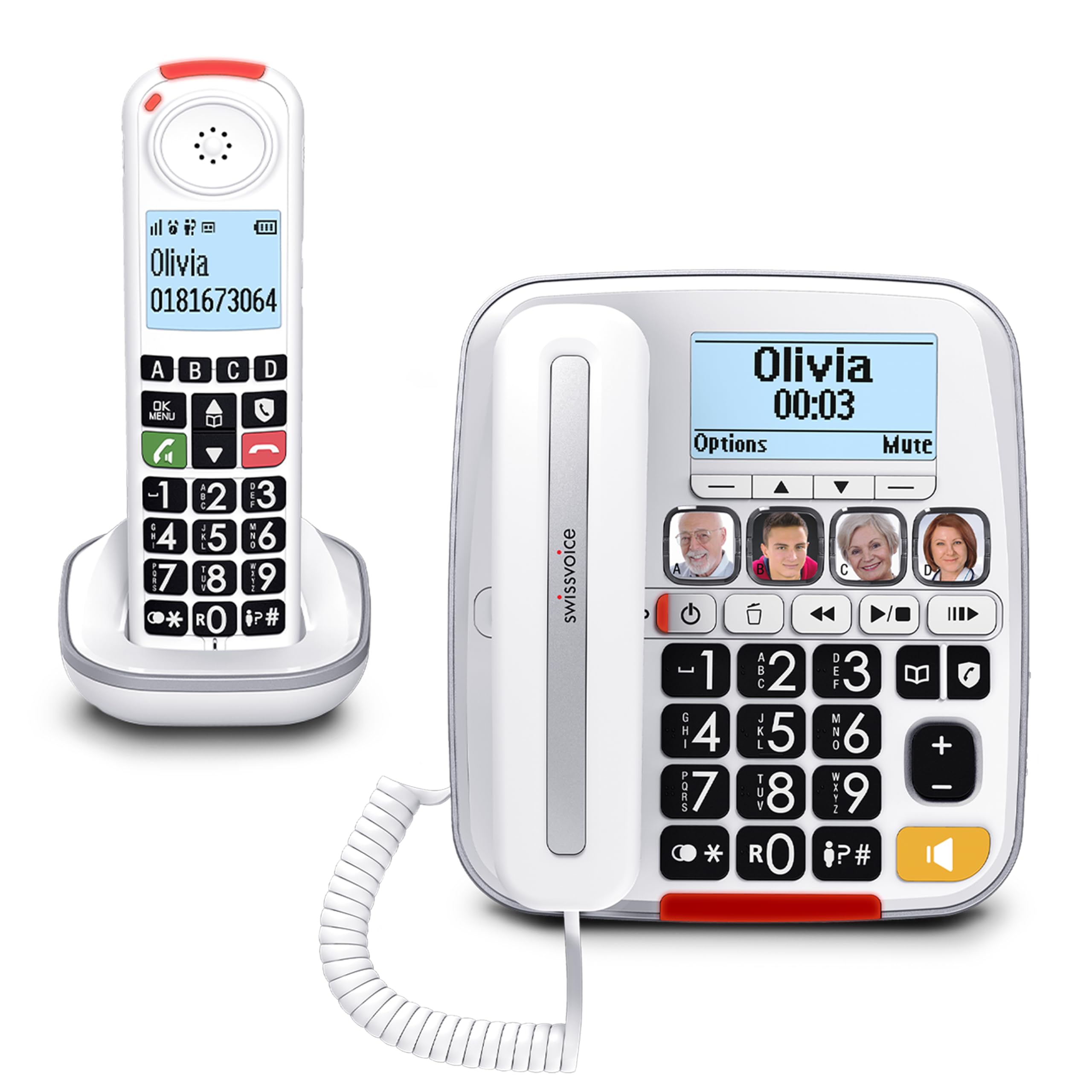
The Swissvoice 3355 is the strongest contender for dementia care because it combines a corded base unit with a separate cordless handset, giving you redundancy without complexity. The base unit contains four large photo memory buttons—including a dedicated SOS key—that let the user call family simply by pressing the picture of the person they want to reach. The ringer can be pushed up to 90 dB, which is loud enough for those with significant hearing loss to hear from another room.
The corded handset stays powered during outages, while the cordless handset can be placed in a commonly used area like the kitchen table or nightstand. The phone supports three-way calling and has a built-in call block feature for telemarketers. Swissvoice targets the hard-of-hearing and memory-impaired market specifically, and the 3355 shows that focus in every design choice: the photo buttons are recessed to prevent accidental presses, and the display remains high-contrast.
Hearing aid compatibility is built in, so users don’t need to remove their devices to hear clearly. The inclusion of both handsets in the box means you don’t have to buy accessories separately. For a mid-premium package, this delivers the most dementia-relevant features out of the gate.
Why it’s great
- Four photo memory buttons with SOS are ready out of the box
- 90 dB adjustable ringer and hearing aid compatible
- Corded base works during power outages
Good to know
- Higher upfront cost than basic corded models
- The cordless handset requires base station power
2. Serene Innovations Amplified Big Button Phone

The Serene Innovations corded phone is built around one principle: making voices loud and clear. With 26 dB of handset amplification, it is designed for seniors who have both memory issues and moderate to severe hearing loss. The phone includes photo memory buttons that can be programmed with pictures of family members, so the user doesn’t need to remember or dial numbers.
The corded connection means no batteries to replace and no loss of service when the power goes out—a critical safety feature. The buttons are extra-large and backlit, and the display shows caller ID information in a high-contrast, easy-to-read font. The unit’s ringer is also amplified and adjustable, so incoming calls are less likely to be missed.
One standout detail is the tone control adjustment, which allows caregivers to fine-tune the frequency response to match the user’s specific hearing loss profile. This goes beyond simple volume boosting. The phone is wall-mountable and has a visual ring indicator that flashes when calls come in.
Why it’s great
- 26 dB amplification with tone control for hearing loss
- Corded operation works during power outages
- Photo memory buttons for one-touch calling
Good to know
- Only one handset included in the box
- Design is functional but basic
3. Gigaset E295A

The Gigaset E295A is a cordless DECT phone (Made in Germany) that stakes its reputation on audio clarity and display readability. The handset features a 2-inch black-and-white display with high contrast and large font sizes, making it easier for someone with low vision to read caller ID or the on-screen menu. The keys are extra-large and ergonomically spaced, reducing misdials.
HDSP (High Definition Sound Performance) technology delivers significantly clearer audio than standard cordless phones. This reduces the cognitive load on the user—less strain to hear means less confusion during a call. The phonebook holds up to 100 contacts, though for dementia users, the four speed-dial buttons on the base are more relevant than scrolling through a list.
The base station supports up to three additional handsets, making home-wide coverage possible. It lacks dedicated photo slots, so it works best for users in earlier stages of dementia who can still recognize a name on a button. The ECO DECT mode reduces radiation and power consumption, which is a nice bonus for around-the-clock operation.
Why it’s great
- HD audio quality reduces listening strain
- Large, high-contrast 2-inch display
- Expandable to multiple handsets
Good to know
- No direct photo memory buttons on the handset
- Cordless design requires power and batteries
4. AT&T CL2940

The AT&T CL2940 is a no-frills corded phone that prioritizes reliability and ease of use. Extra-large buttons and a tiltable display make it accessible for users with vision problems or unsteady hands. The Audio Assist feature provides a temporary volume boost during calls, helping when the person on the other end speaks softly.
Because it is fully corded, dial tone and basic call functions work even without AC power—only Caller ID and display functions require four AA batteries. This makes it a solid emergency phone. The ringer is adjustable to extra-loud levels, and the speakerphone function allows hands-free conversation, which can be less intimidating for some users.
This model does not have photo memory buttons, so it is better suited to a senior who can still manage a small speed-dial list or who primarily answers incoming calls. AT&T’s build quality is consistent and well-documented, and the setup takes under five minutes.
Why it’s great
- Corded operation ensures calls during power outages
- Tiltable display with extra-large buttons
- Audio Assist provides on-demand volume boost
Good to know
- No photo memory buttons for dementia support
- Caller ID requires separate AA batteries
5. VTech SN5307 (Accessory Handset)

The VTech SN5307 is not a standalone phone—it is an accessory handset for the VTech CareLine SN5127 or SN5147 base systems. If you already own one of those bases, this handset adds four photo speed-dial slots that are perfect for a dementia user. Each slot accepts a printed photo, turning the handset into a visual calling tool.
The 50 dB Audio Assist amplification is among the highest in this category, giving caregivers confidence that the user will hear clearly. The handset also has a large backlit display and extra-large buttons. A visual ring indicator flashes on top of the handset, alerting the user to incoming calls without relying on the ringer alone.
Spoken Caller ID announces names aloud, which helps if the user struggles to read the small screen. The handset is lightweight and can be placed anywhere within the DECT 6.0 range of the base. For someone who is already using a VTech care system, this is the most cost-effective way to add dementia-friendly features.
Why it’s great
- Four photo slots for visual one-touch dialing
- 50 dB Audio Assist boost for hearing support
- Spoken Caller ID reduces confusion
Good to know
- Requires a compatible VTech CareLine base to function
- Only works as part of a multi-handset system
6. HePesTer Big Button Phone

The HePesTer HP-45 is a straightforward corded phone with three replaceable picture buttons. This is an entry-level approach to photo dialing: you slide a small photo into each button, and pressing it dials the pre-programmed number. The phone is wall-mountable and comes with nonskid pads to keep it from sliding on a table.
Volume amplification reaches up to 40 dB+, which covers mild to moderate hearing loss. The phone does not have Caller ID, which is actually a benefit in some dementia scenarios—there is no screen to misinterpret. The ringer volume is adjustable but not exceptionally loud compared to premium models.
A notable feature is memory protection: stored phone numbers are retained even when the phone line is unplugged. This prevents a caregiver from needing to reprogram the photo buttons after moving the phone or during a service outage. It is a budget-conscious option that delivers the core photo-dialing feature without extra frills.
Why it’s great
- Three photo buttons make dialing simple
- Memory protection retains numbers without line power
- Wall-mountable and affordable
Good to know
- No Caller ID or visual ring indicator
- Build quality feels less robust than premium models
7. Easyfone Prime-T6
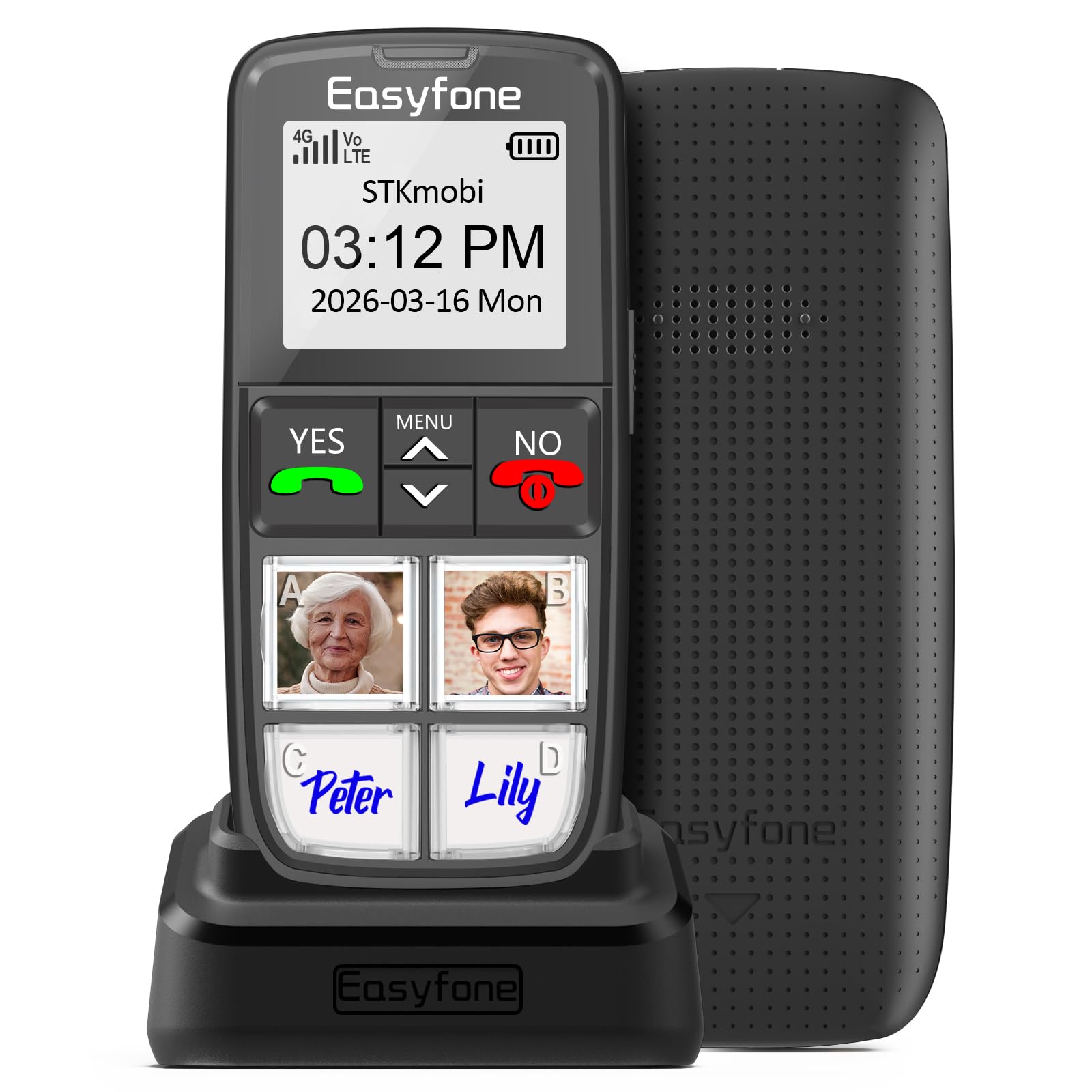
The Easyfone Prime-T6 is a 4G cellular phone masquerading as a simplified landline experience. It features four large picture memory buttons on the front face, each programmed to call a specific contact. The operating system is stripped down to the absolute minimum—no apps, no browser, just calling. This makes it a viable alternative for homes where a landline jack is not available or reliable.
The phone includes an SOS button that, when held, calls a pre-set emergency number. It comes with an easy charging dock, so the user simply places the phone on the cradle to charge—no fumbling with cables. The 1050 mAh battery provides solid standby time. Audio is clear, and the phone is hearing aid compatible (HAC rated).
The biggest catch is carrier compatibility. It works with T-Mobile and its MVNOs (like Tello and SpeedTalk), and a SIM card is included for the SpeedTalk network. Users outside T-Mobile’s coverage area will not get service. It is not a traditional landline, but for the right use case, it functions identically—with photo dialing and no confusing menus.
Why it’s great
- Four picture buttons make dialing visual and simple
- Dedicated SOS button for emergencies
- Charging dock eliminates cable fuss
Good to know
- Limited to T-Mobile network and its MVNOs
- Requires charging, not a true landline
FAQ
How many photo memory buttons do I need for a dementia phone?
Will a cordless phone work if the power goes out?
What audio amplification level is best for someone with hearing loss and dementia?
Why is spoken Caller ID helpful for dementia patients?
Can I use a cell phone instead of a landline for dementia care?
Final Thoughts: The Verdict
For most users, the landline phone for seniors with dementia winner is the Swissvoice 3355 because it combines photo memory buttons, a corded base for outage safety, a secondary cordless handset, and 90 dB amplification in one complete package. If you need maximum hearing amplification with photo dialing, grab the Serene Innovations. And for a budget-conscious photo-dialing option without extra features, nothing beats the simplicity of the HePesTer HP-45.