Watching a loved one struggle for breath or managing your own chronic respiratory condition puts accuracy front and center. A pulse oximeter that gives false highs or delays in reading can erode the confidence you need to make informed decisions at home. The difference between a toy and a trustworthy tool comes down to certification, sensor quality, and how the device handles low perfusion.
I’m Emma — the founder and writer behind Baby Bangs. I’ve spent years analyzing medical device specs, decoding FDA registration databases, and cross-referencing clinical validation studies to separate genuine clinical-grade hardware from recreational gadgets.
This guide cuts through the confusion to reveal the only five devices that earn the label best medical grade pulse oximeter through verified accuracy, durable construction, and meaningful features for home monitoring.
How To Choose The Best Medical Grade Pulse Oximeter
Not every fingertip device that reads SpO2 counts as medical grade. The label gets thrown around loosely. You need to know exactly what to verify before you trust a number with your health decisions.
FDA Registration vs. FDA Clearance
Many sellers register with the FDA as a device manufacturer but never submit clinical data for 510(k) clearance. Clearance means the device has been tested against an existing legally marketed predicate and found substantially equivalent. Always search the FDA Establishment Registration & Device Listing database using the manufacturer name and model number. A cleared device lists a 510(k) number; a mere registration number does not prove clinical validation.
Low Perfusion Performance
When your fingers are cold, your circulation is poor, or you are recovering from surgery, blood flow to the fingertip drops. A non-medical oximeter will flash errors or give erratic readings under low perfusion. Medical-grade units use advanced LED and sensor arrays that lock onto the pulse signal even when the plethysmograph waveform is weak. Look for devices that explicitly advertise low-perfusion measurement capability.
Plethysmograph and Perfusion Index
A plethysmograph waveform displays the volume change in your capillary bed with each heartbeat. It visually confirms that the sensor is tracking a real pulse, not motion artifact. Perfusion Index (PI) quantifies pulse strength on a scale — a PI above 0.5% generally indicates a stable reading. Devices that show both waveform and PI let you assess reading quality in real time rather than blindly trusting a number.
Quick Comparison
On smaller screens, swipe sideways to see the full table.
| Model | Category | Best For | Key Spec | Amazon |
|---|---|---|---|---|
| Innovo iP900AP | Premium | Clinical accuracy at home | ±2% SpO2 accuracy, 30-hour battery | Amazon |
| Zacurate 500C Elite | Mid-Range | Caregiver ease of use | 6-direction OLED, silicon cover | Amazon |
| AccuMed CMS-50D1 | Budget | Basic spot checks during exercise | 32-hour battery, auto-rotation LED | Amazon |
| iHealth PO3 | Mid-Range | Trend tracking via app | Bluetooth sync, rechargeable battery | Amazon |
| Innovo iP900BP-B | Premium | Data logging with Bluetooth | Respiratory rate, PI display, app | Amazon |
In‑Depth Reviews
1. Innovo Deluxe iP900AP Fingertip Pulse Oximeter
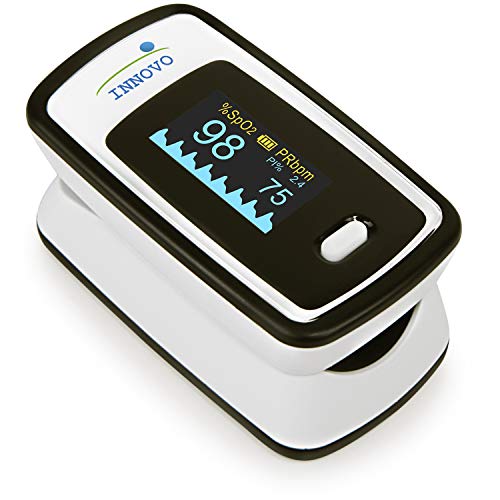
The Innovo iP900AP sits at the top because it combines clinical-grade accuracy with features that actually matter for home monitoring. Its improved LED and sensor array maintain reliable SpO2 and pulse rate readings even at low blood perfusion — a common failure point for cheaper units. The plethysmograph waveform and perfusion index display let you visually confirm that the signal is stable before you log a number.
Auditory alarms for high and low thresholds make this device particularly useful for caregivers tracking elderly parents overnight. The adjustable display brightness and 30-hour battery life mean you are not hunting for a charger at 2 a.m. Users consistently report consistent readings that match hospital equipment, which is the ultimate validation for a medical-grade claim.
The iP900AP lacks Bluetooth connectivity, so you cannot automatically log trends to a phone. If you need digital record-keeping, consider the Bluetooth-enabled version. But for pure spot-check accuracy with zero app fuss, this is the most trustworthy device on the list.
Why it’s great
- Excellent low-perfusion performance maintains accuracy with cold hands or poor circulation
- Full plethysmograph waveform and perfusion index give you real-time reading confidence
- Auditory alarm system warns immediately when SpO2 or pulse rate falls outside safe limits
Good to know
- No Bluetooth or app connectivity for automatic trend logging
- Auditory beep volume is not adjustable, which some users find intrusive overnight
2. Zacurate 500C Elite Fingertip Pulse Oximeter

The Zacurate 500C Elite earns its place with a patented 6-direction OLED display that makes reading results effortless from any angle. For caregivers who need to glance at a sleeping patient without repositioning the device, this feature reduces disturbance and speeds up response time. The built-in plethysmograph waveform provides the same signal-quality confirmation found in premium monitors.
Customizable auditory alarms trigger when SpO2 or pulse rate deviates from set thresholds, giving caregivers instant notification of critical changes. The included silicon cover adds shock and dirt resistance — a practical touch for devices that get dropped or carried daily. The unit ships with a lanyard and batteries, ready for immediate use.
The 500C Elite does not include perfusion index on the main display, so you lose some granularity compared to the Innovo iP900AP. Battery life is rated similarly to competitors but actual runtime depends heavily on how often the OLED brightness is set to high. For caregiver scenarios where quick readability matters more than deep data, this is an excellent tool.
Why it’s great
- Six display orientations make readings visible from any angle without moving the patient
- Included silicon cover protects against drops and dust in daily caregiver use
- Auditory alarm gives immediate warning when readings fall outside safe parameters
Good to know
- No perfusion index number on the main screen for detailed signal strength assessment
- OLED brightness at high settings reduces total battery runtime between changes
3. iHealth Rechargeable Fingertip Pulse Oximeter PO3
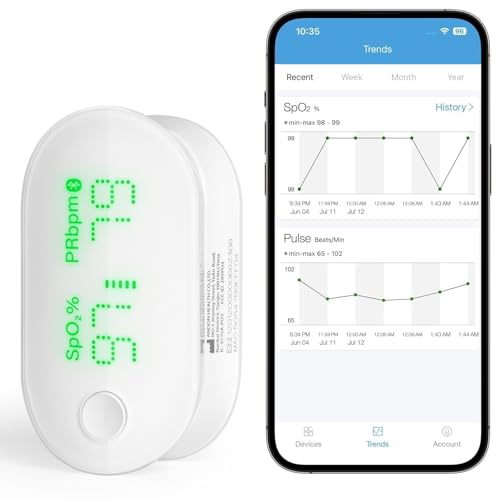
The iHealth PO3 stands out by throwing out disposable batteries entirely. A built-in rechargeable lithium polymer battery delivers roughly 300 readings per charge, and the Micro-USB cable makes topping up simple. The real differentiator is the Bluetooth pairing with the free iHealth MyVitals App, which tracks SpO2 and pulse rate trends by hour, day, week, and year across multiple user profiles.
The app displays a real-time plethysmograph waveform and perfusion index, giving you the same signal-quality tools found on clinical monitors. Multiple telemedicine programs trust this device for remote patient monitoring, which suggests the sensor accuracy meets professional standards. The large LED screen shows results clearly even in dim light without the complexity of multi-direction OLED adjustments.
iHealth explicitly states the PO3 is for sports and recreational use only, not for medical purposes, despite its telemedicine adoption. This creates a confusing positioning — the hardware is capable, but the marketing disclaimer means you should verify its performance matches your specific needs. The 3-hour charge time and limited total capacity are worth noting if you need continuous overnight monitoring.
Why it’s great
- Rechargeable battery eliminates ongoing cost and waste of disposable AAA cells
- Bluetooth app provides detailed trend tracking across multiple user profiles
- Real-time plethysmograph and perfusion index in-app for reading validation
Good to know
- Officially labeled for sports/recreational use, not cleared as a medical device
- Rechargeable battery lasts only about 3 hours per full charge when used continuously
4. Innovo iP900BP-B Fingertip Pulse Oximeter with Bluetooth

The Innovo iP900BP-B takes the core accuracy of the iP900AP and adds Bluetooth wireless syncing plus respiratory rate measurement — a vital sign that most fingertip oximeters skip. Respiratory rate is derived from the plethysmograph waveform, and while not as precise as capnography, it provides a useful trend for monitoring breathing changes at home. The ‘Beyond Oximeter’ App stores readings with waveform visualization and perfusion index.
The patented 6-direction display mirrors the Zacurate Elite flexibility, so you can orient the screen without moving the device. Low-perfusion performance matches the non-Bluetooth Innovo sibling, meaning cold or poorly perfused fingers still produce stable readings. The 30-hour battery life on two AAA batteries remains impressive even with Bluetooth active during syncing sessions.
Innovo explicitly states this model is not designed for continuous overnight monitoring or recording, so do not expect it to function as a sleep study tool. The app interface is functional but lacks the polished user experience of the iHealth MyVitals platform. For users who need SpO2, pulse rate, and respiratory rate in a single portable device with data export capability, this is the strongest contender.
Why it’s great
- Measures respiratory rate in addition to SpO2 and pulse rate for broader trend insight
- Bluetooth syncing with app stores waveform, PI, and historical data for review
- 6-direction display and 30-hour battery make daily use convenient
Good to know
- Not intended for continuous overnight monitoring despite Bluetooth data logging
- App interface is less polished than dedicated health platforms like iHealth MyVitals
5. AccuMed CMS-50D1 Fingertip Pulse Oximeter

The AccuMed CMS-50D1 serves as an entry-level option for users who want a basic spot-check device without spending on premium features. It delivers SpO2 and pulse rate readings in roughly 8 to 10 seconds on a rotating LED display that automatically switches between portrait and landscape orientations. The included travel case and lanyard make it easy to toss into a gym bag or carry-on for travel use.
Battery life stretches up to 32 continuous hours on two AAA cells, and the auto-shutoff preserves power when you forget to turn it off. The device is lightweight at under 2 ounces, which reduces finger fatigue during repeated checks. Users report reliable readings for pre- and post-exercise monitoring and high-altitude tracking.
AccuMed explicitly markets this unit as not intended for medical use, and it lacks the low-perfusion optimization found on clinical-grade devices. The display does not include a plethysmograph waveform or perfusion index, so you have no way to confirm signal quality before trusting the number. If you need absolute accuracy for health management, the extra investment in a higher-tier device is justified.
Why it’s great
- Exceptional 32-hour battery life from two standard AAA batteries
- Compact and lightweight with included travel case for portability
- Auto-rotating LED display adapts to reading orientation automatically
Good to know
- No plethysmograph waveform or perfusion index to verify reading reliability
- Marketed for sports/recreational use, not cleared as a medical device
FAQ
What specifically makes a pulse oximeter medical grade versus consumer grade?
Can I trust a pulse oximeter that does not display a plethysmograph waveform?
How does low perfusion affect pulse oximeter readings and which devices handle it best?
Final Thoughts: The Verdict
For most users, the best medical grade pulse oximeter winner is the Innovo iP900AP because it delivers clinical-grade accuracy, low-perfusion reliability, and caregiver-friendly alarms without requiring a smartphone or app subscription. If you want to track long-term trends with Bluetooth data logging and respiratory rate, grab the Innovo iP900BP-B. And for a rechargeable device with polished app integration but a recreational-use disclaimer, the iHealth PO3 works well for general wellness monitoring.