Caring for a loved one confined to a hospital bed at home brings unique challenges, and few are as persistent as the risk of pressure ulcers. The wrong surface can turn a simple night’s rest into a source of pain, interrupted sleep, and worsening skin breakdown. A purpose-built mattress topper is no longer a luxury—it is a medical necessity that directly impacts recovery, comfort, and quality of life.
I’m Emma — the founder and writer behind Baby Bangs. I spend my time dissecting the specific physical specs, material science, and real-world clinical applications that separate a genuine therapeutic tool from an expensive mistake in the home-care mattress topper space.
Whether you are equipping a home hospice room or supporting a post-surgery recovery, finding the best mattress topper for hospital bed requires knowing exactly which technologies prevent tissue damage and which ones just feel soft.
How To Choose The Best Mattress Topper For Hospital Bed
Selecting the right topper for a hospital bed is fundamentally different from buying a plush memory-foam overlay for a standard bed. The stakes involve tissue viability, prolonged immobility, and hygiene management. Focus on these three critical factors to make a safe, effective choice.
Alternating Pressure vs. Static Support
For patients who cannot reposition themselves independently, an alternating pressure system is the gold standard. These toppers use an electric pump to inflate and deflate air cells in timed cycles (typically every 10-12 minutes), constantly shifting the points of contact to prevent capillary closure and tissue ischemia. Static foam toppers, including gel overlays, provide pressure redistribution but do not actively remove pressure. Choose alternating air for moderate-to-high risk of bedsores; choose a high-quality foam or gel system for lower-risk patients who can turn themselves.
Pump Noise and Cycle Adjustability
An air pump running all night in a bedroom is a potential source of sleep disruption for both patient and caregiver. Look for pumps rated at or below 28 dBA—about the sound level of a quiet library. The ability to switch between alternating and static modes gives you flexibility: active pressure relief during the day and a stable surface for uninterrupted rest at night. Pressure adjustability (soft-to-firm dials) allows custom tuning based on the patient’s weight and sensitivity.
Material Hygiene and Fluid Resistance
Incontinence, wound drainage, and spills are realities of home hospital care. The topper’s cover must be waterproof from top to bottom, not just splash-resistant. Medical-grade vinyl or polyurethane with sealed seams prevents fluids from soaking into the core, which causes odor and bacterial growth. Removable, machine-washable covers simplify daily care. Also verify that the topper is latex-free to avoid allergic reactions in sensitive patients.
Quick Comparison
On smaller screens, swipe sideways to see the full table.
| Model | Category | Best For | Key Spec | Amazon |
|---|---|---|---|---|
| Drive Medical Gel Overlay | Static Gel | Low-to-moderate risk pressure relief | 15 sealed gel bladders at 3.5″ thick | Amazon |
| Invacare Foam Mattress | Medical Foam | Full mattress replacement, long-term care | 1.8 density foam, 5 Fortress Cells | Amazon |
| ProHeal Multi-Tier Foam | Die-Cut Foam | Moderate-to-high risk, sloped heel | 6″ multi-tier die-cut + memory foam | Amazon |
| Kekoy Air Pad (Blue) | Alternating Air | Active pressure relief, micro-air vents | 5 pressure modes, 28 dBA pump | Amazon |
| Kekoy Air Pad (Beige) | Alternating Air | High cell count, 130 air cells | 130 sealed PVC cells, 28 dBA pump | Amazon |
| Lunderg Air Pad | Alternating Air | Doctor-recommended, static mode option | 23 dBA pump, static mode switch | Amazon |
| Glory Medical MT-02 | Alternating Air | Entry-level alternating pressure system | 22 air chambers, 12-minute cycle | Amazon |
In‑Depth Reviews
1. Drive Medical 14893 Premium Guard Gel Mattress Overlay
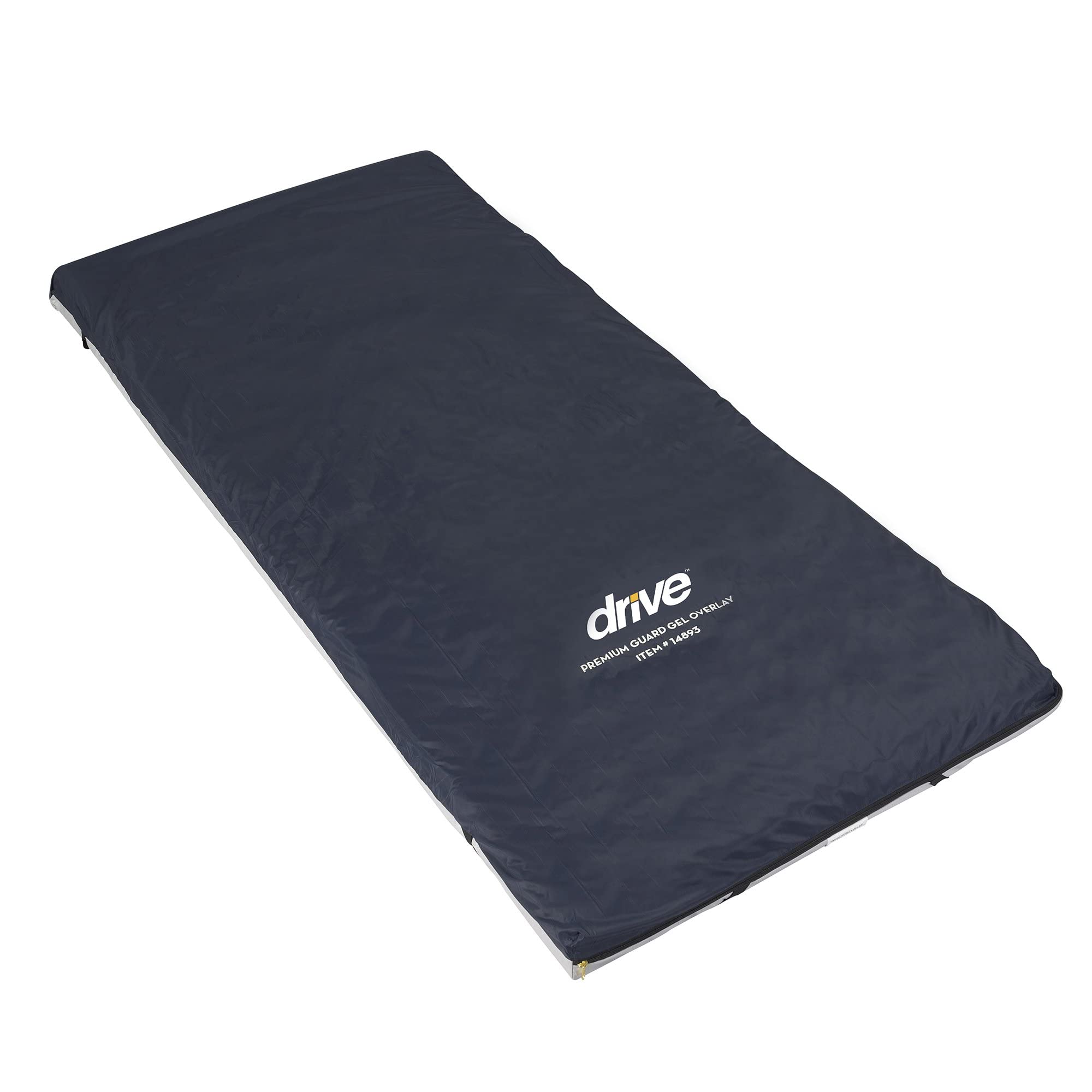
This overlay from Drive Medical is a heavyweight performer in the static pressure redistribution category. Its 15 individual gel bladders run the full length of the 76″ x 34″ surface, providing a consistent, non-electric approach to pressure relief that eliminates the noise, pump maintenance, and power dependency of alternating air systems. Each gel cell conforms independently to the patient’s contours, reducing peak pressure over bony prominences like the sacrum and heels.
The cover construction pairs a fluid-resistant nylon top with a waterproof vinyl bottom, a smart combination that blocks moisture migration while reducing friction shear against the patient’s skin. At 3.5 inches thick, this overlay raises the overall sleeping height modestly, and its 300-500 pound weight capacity makes it suitable for bariatric patients. The trade-off is weight: the unit is nearly 48 pounds, making repositioning for cleaning a two-person task.
Where this overlay truly excels is in long-term stability. Without moving parts or compressors, there is nothing to fail, no cycles to calibrate, and no hum to mask. For a patient who can shift position independently or with minimal assistance, the gel technology delivers predictable, quiet, and effective pressure redistribution without the clinical feel of an air mattress.
Why it’s great
- Zero moving parts eliminates pump noise and mechanical failure risk.
- 15 independent gel bladders conform precisely to individual body contours.
- Fluid-resistant nylon top reduces shear and friction against the skin.
Good to know
- Very heavy at nearly 48 pounds, difficult to rotate for cleaning.
- No active pressure cycle — not ideal for fully immobile patients.
- Static gel surface may feel warm for patients prone to overheating.
2. Invacare Hospital Bed Mattress (36x80x6 Inches)

This is not a topper in the traditional overlay sense—this is a full medical-grade replacement mattress designed to fit standard 36×80-inch hospital bed frames. Invacare builds this unit around five uniquely shaped “Fortress” foam cells that target pressure redistribution across the torso, hips, and heels. The 1.8 density foam with a 34 IFD firmness rating strikes a deliberate balance: supportive enough to prevent hammocking, yet forgiving enough to reduce interface pressure.
The cover is a highlight. It uses a tough-coated polyurethane material that is fluid-resistant, washable, and completely latex-free. A full anti-slip bottom surface runs the entire underside of the mattress, unlike competitors that only place gripper strips at the corners. This design prevents migration when the bed head is elevated, a common problem with lighter toppers that bunch toward the foot of the frame during articulation.
At 6 inches thick, this mattress adds substantial depth compared to typical 3-4 inch overlays. The trade-off is that it must replace the existing hospital bed mattress entirely, making it a larger upfront investment. Users consistently report that this foam formulation does not develop body impressions after months of use, and the flat concealed zipper on the cover prevents moisture ingress at a weak seam point.
Why it’s great
- Full anti-slip bottom keeps the mattress anchored during bed articulation.
- 1.8 density foam with 34 IFD resists permanent body impressions.
- Fluid-resistant, washable, latex-free cover with sealed seams.
Good to know
- Must be used as a full mattress replacement, not a topper overlay.
- Some reports indicate it measures slightly thinner than 6 inches after expansion.
- Firm feel may be too rigid for lightweight or bony patients.
3. ProHeal Multi-Tiered Die-Cut and Memory Foam Mattress (36″ x 80″ x 6″)

The ProHeal mattress targets one of the most challenging pressure ulcer zones—the heel—with an intentionally sloped section that shifts the load from the calcaneus to the lower leg. This geometric design detail is rare in the home-care market and directly addresses a common failure point where standard flat toppers allow the heel to bear disproportionate pressure against the bed surface.
Its multi-tiered foam construction uses high-density die-cut foam in the torso and head sections for firm, ventilated support, while the heel section switches to open-cell memory foam that cradles the foot without occluding circulation. The 28 ILD rating across the main body keeps the surface firm enough to prevent bottoming out but pliable enough to distribute load across a broader contact area. A 360-degree zipper with a protective flap prevents fluid ingress through the zipper track itself, a weak point that cheaper covers expose to contamination.
The removable nylon cover is vapor-permeable to dissipate heat and moisture, and the triple-laminate vinyl bottom adds both fluid resistance and fire-retardant properties. This is not a topper for low-risk scenarios—it is explicitly designed for moderate-to-high risk patients where comprehensive pressure redistribution and easy decontamination are non-negotiable.
Why it’s great
- Sloped heel section offloads pressure from the calcaneus to the lower leg.
- 360-degree zipper with protective flap prevents fluid damage at the seam.
- Vapor-permeable cover reduces perspiration and heat buildup.
Good to know
- Some users report early depressions forming in the memory foam section.
- Firm overall feel may not suit patients accustomed to plush surfaces.
- Full mattress replacement required—cannot be used as an overlay.
4. Kekoy Alternating Air Pressure Mattress Pad (75″ x 36″ Blue)
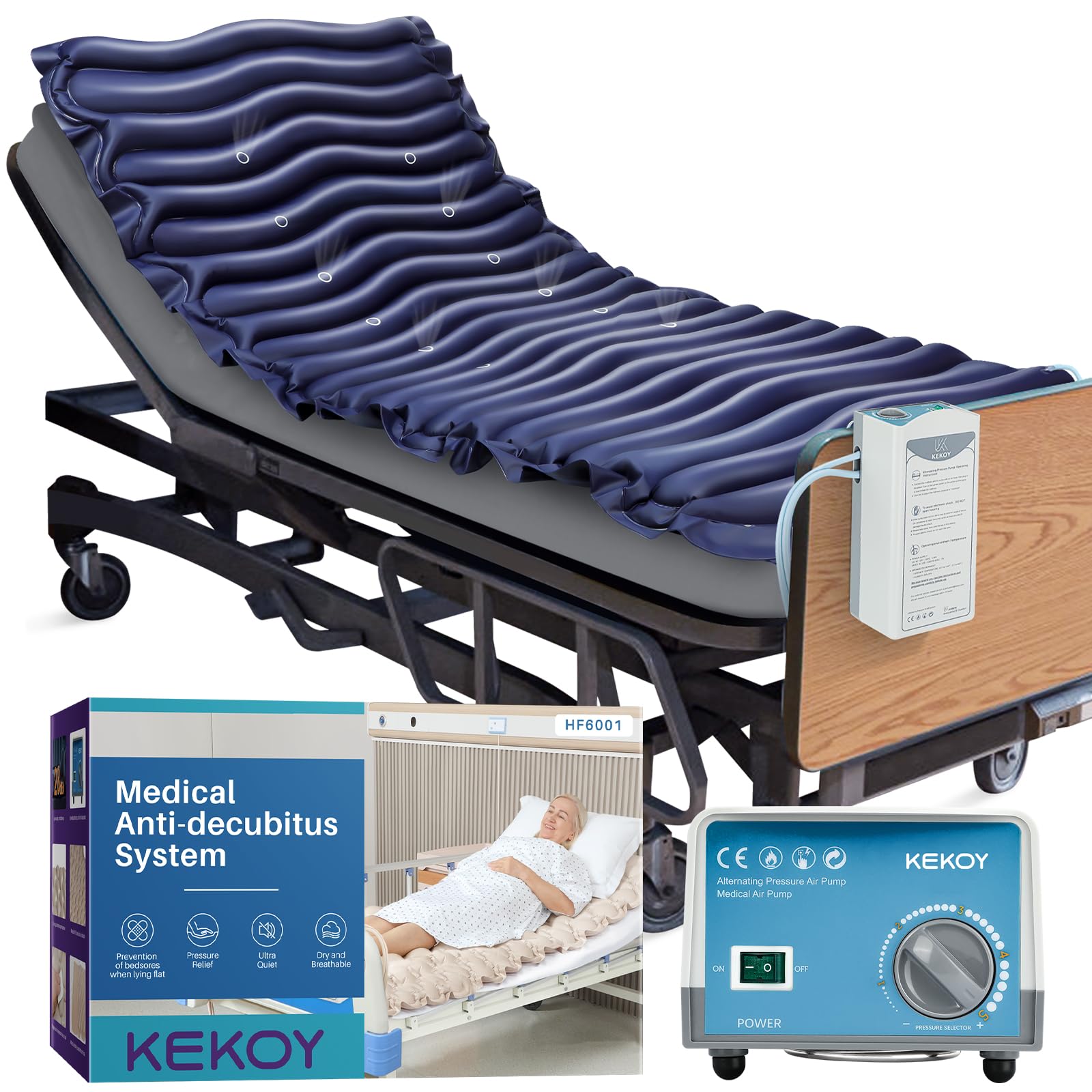
Kekoy’s blue alternating air pad brings a refined pump experience to the home care setting. The aluminum pump operates at under 28 dBA—roughly the noise floor of a quiet residential bedroom—and offers five distinct pressure levels from softest (1) to firmest (5). The alternating cycle runs every 10-12 minutes in a wave-like motion that shifts pressure points from the heels upward, mimicking the natural repositioning a caregiver would provide every hour.
The distinguishing feature here is the micro-air vent system. Tiny perforations across the 75″ x 36″ surface create a passive airflow that wicks moisture and heat away from the patient’s skin, addressing the common complaint of sweating on vinyl air mattresses. The cover uses medical-grade PVC that is both waterproof and heat-resistant, and the zippered closure simplifies removal for spot cleaning. At 6.9 pounds for the full system, this pad is light enough for a single caregiver to reposition during linen changes.
Setup mirrors other alternating pads in this class: unroll, connect the quick-connector hoses, plug in, and allow 20 minutes for full inflation. The pump includes both static and alternating modes, giving the user the option to lock all cells at a consistent firmness when the patient needs a stable surface for sleep or repositioning. The 300-pound weight capacity covers the majority of adult patients.
Why it’s great
- Micro-air vents actively circulate air to reduce moisture and heat buildup.
- Five adjustable pressure modes allow fine-tuning for patient weight and sensitivity.
- Lightweight system at under 7 pounds for easy handling by one caregiver.
Good to know
- Requires constant power—deflates completely when unplugged.
- Not suitable for use in nursing homes or assisted living facilities per policy.
- PVC material may produce off-gassing odor initially after unpacking.
5. Kekoy Alternating Air Pressure Mattress Pad (75″ x 35″ Beige)

This beige variant from Kekoy differentiates itself with an impressive 130 independently sealed air cells across a 75″ x 35″ inflated footprint. More cells means smaller individual chambers, which translates to a finer resolution of pressure redistribution. Instead of large balloon-like compartments that create a pronounced ridge pattern, the 130-cell design produces a gentler, more continuous support surface that reduces the “bumpy” sensation some patients find uncomfortable on lower-cell-count alternators.
The pump matches the blue variant’s 28 dBA noise level and 5-mode pressure adjustability, and it includes a static mode for when the patient wants a break from the alternating cycle. Kekoy also includes a patch kit in the box—a practical addition given that PVC air cells can develop pinhole leaks over extended use, especially when the topper is regularly wrung during cleaning or repositioning.
The 10-12 minute alternating cycle remains consistent with clinical recommendations for capillary pressure relief. The waterproof PVC cover handles incontinence and spills effectively, though it lacks the dedicated micro-air vents of the blue model. In practice, caregivers report that mattress pad heaters or low-moisture barrier sheets help mitigate heat retention on this denser cell configuration.
Why it’s great
- 130 smaller air cells provide finer pressure redistribution without large ridges.
- Includes a practical patch kit for long-term maintenance of PVC cells.
- FSA and HSA eligible for eligible healthcare accounts.
Good to know
- No dedicated micro-air vents—heat and moisture retention may be higher.
- Must remain plugged in at all times; deflates when unplugged.
- PVC material may feel warm or sticky in hot climates without a mattress pad.
6. Lunderg Alternating Air Pressure Mattress Pad with Static Mode
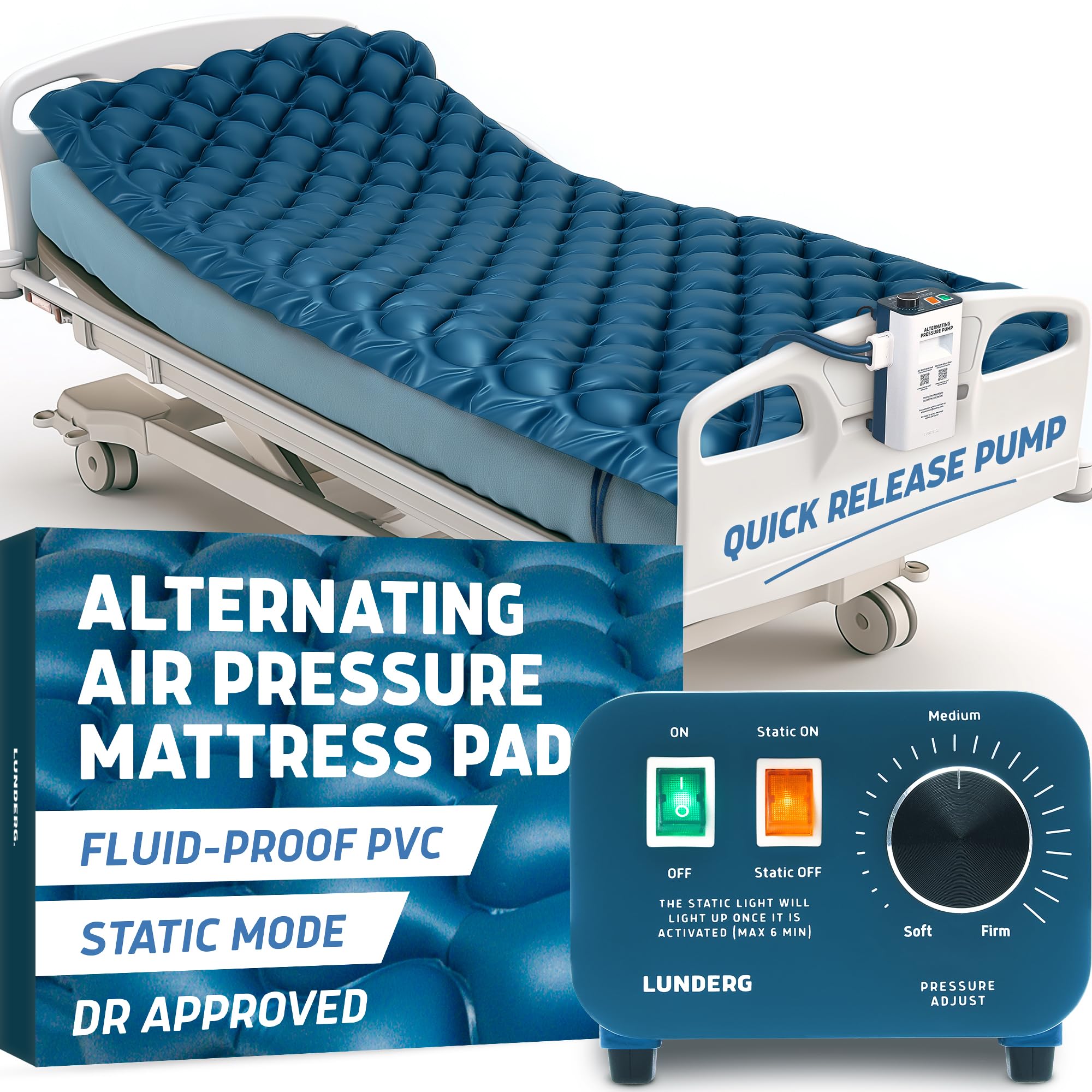
Lunderg’s alternating pad is the quietest pump option on this list at just 23 dBA—a level most people would struggle to hear over the hum of a ceiling fan or a HVAC system. This makes it a strong candidate for bedrooms where pump noise is a primary concern, especially for light-sleeping patients or caregivers who share the room. The soft-to-firm pressure dial gives granular control over inflation firmness, and the static mode switch lets the user lock all cells at full inflation for a stable, non-alternating surface when needed.
The system supports up to 300 pounds and fits standard twin-size hospital bed frames at 35″ x 75″. Lunderg markets this as doctor- and therapist-approved, and the clinical language around bed sore prevention and circulation support is matched by the build quality: a 1-inch PVC pad with reinforced seams and a quick-connector hose system that simplifies setup. The waterproof surface cleans easily with mild detergent and water.
One operational nuance: full inflation takes approximately 20 minutes (about three full cycles), and the pump should be set to “Firm” initially, then dialed back to the patient’s comfort level. The hose length is adequate for standard hospital bed headboard placement, and the pump’s compact footprint (smaller than a shoebox) tucks neatly onto a bedside table or hooks onto the bed frame.
Why it’s great
- Quietest pump in this lineup at 23 dBA for minimal sleep disruption.
- Static mode provides a stable, non-alternating surface for resting periods.
- Quick-connector hoses simplify setup and pump replacement if needed.
Good to know
- Requires 20 minutes for full inflation before patient use.
- PVC material may feel less breathable than multi-layer foam alternatives.
- Limited to twin size—does not accommodate extra-wide hospital bed frames.
7. Glory Medical MT-02 Alternating Pressure Mattress Topper (78″ x 32″)
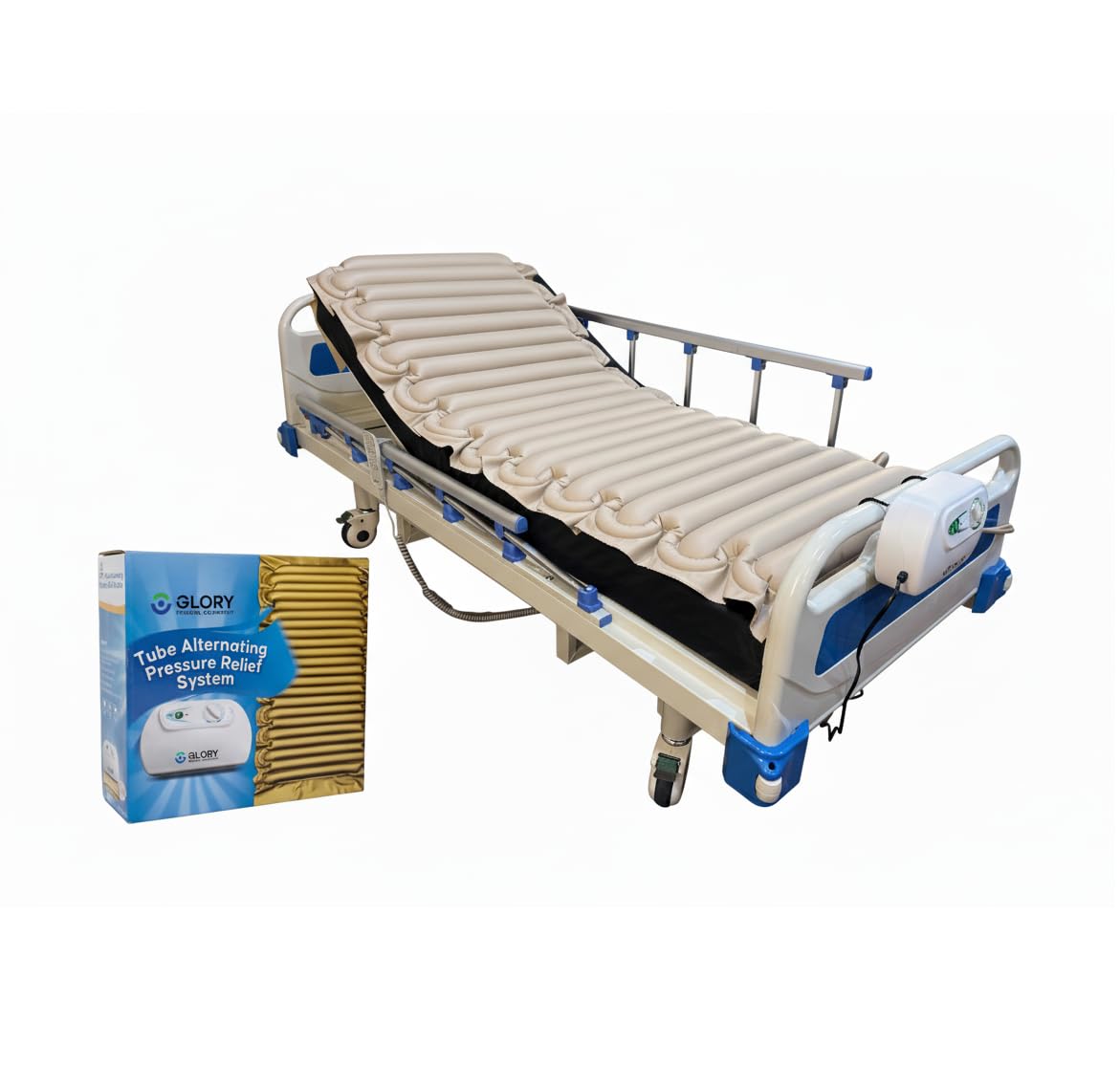
The Glory Medical MT-02 is the value entry point into alternating pressure therapy. It packs 22 air chambers with a 12-minute alternating cycle into a 78″ x 32″ footprint, making it slightly narrower than standard twin hospital bed overlays. This narrower width may leave gaps at the edges of a 36-inch-wide frame, but it ensures a snug fit on narrower home-care beds or bariatric frames with less lateral space.
The pump is a compact 9″ x 6″ x 3″ unit with a 5-foot hose and a straightforward firmness knob. It lacks the multi-mode adjustability of the Kekoy and Lunderg pumps—no static mode, no graduated pressure levels—but for patients who need simple, reliable cyclic pressure relief without confusing controls, this simplicity is a feature, not a limitation. The medical-grade vinyl construction is fully waterproof and supports up to 300 pounds.
User reports consistently highlight ease of assembly and immediate comfort improvement for patients transitioning from a standard hospital mattress. One caregiver noted that the topper “allowed for constant pressure relief, comfort and rest” for a hospice patient. The primary drawback is the lack of a static mode: the pump cycles continuously, which can be disruptive if the patient wants a stable surface for eating or conversation.
Why it’s great
- Budget-friendly introduction to alternating pressure therapy.
- Simple single-knob controls—no confusing modes or settings.
- Waterproof medical-grade vinyl cleans easily with mild soap.
Good to know
- No static mode—pump cycles continuously with no break option.
- Narrower 32-inch width may leave gaps on standard 36-inch frames.
- Some units have reported inconsistent cell inflation out of the box.
FAQ
Can I use an alternating pressure pad on a bed that already has a mattress topper?
How often should I replace a hospital bed mattress topper?
Final Thoughts: The Verdict
For most users, the best mattress topper for hospital bed winner is the Kekoy Alternating Air Pad (Blue) because it combines a whisper-quiet 28 dBA pump, five adjustable pressure modes, and micro-air vents that actively reduce moisture buildup—critical for preventing skin maceration. If you want non-electric, zero-maintenance pressure redistribution, grab the Drive Medical Gel Overlay. And for a full medical-grade replacement mattress that eliminates the need for a topper entirely, nothing beats the ProHeal Multi-Tier Foam Mattress and its dedicated sloped heel design.