Choosing the wrong respirator leaves you with a false sense of security — a loose seal around the nose or chin bypasses the filtration entirely. The difference between effective protection and wasted money comes down to one thing: how the mask mates with your face.
I’m Emma — the founder and writer behind Baby Bangs. I track the evolving standards in particulate respirators, from NIOSH approvals to ASTM fluid resistance ratings, to separate marketing claims from real barrier performance.
This guide breaks down the core specs and real-world fit data for the five strongest contenders on the market so you can confidently pick the mask for covid that actually seals and filters as advertised.
How To Choose The Best Mask For Covid
Every mask on this list filters particles, but not all of them pass the same fit and certification tests. Your decision comes down to three factors: filtration certification, strap system, and physical seal around your unique face shape.
NIOSH Approval vs KN95 Standards
A NIOSH-approved N95 respirator meets US regulatory testing for at least 95% filtration of non-oil particles at a flow rate of 85 liters per minute. KN95 masks follow the Chinese GB2626-2019 standard, which uses a slightly different test method and does not undergo the same third-party auditing required for NIOSH listing. For confident use in US healthcare or high-risk public settings, NIOSH approval provides the strongest legal and scientific basis.
Headband Strap vs Earloop Security
Headband straps — two bands that cross above and below the ears — pull the mask evenly against the face and maintain tension over hours of wear. Ear loops, while more convenient for quick on-and-off, lose tension with movement and often leave gaps around the cheeks. The difference in inward leakage between the two designs can be substantial, especially for people with facial hair or narrower jawlines.
Fluid Resistance and Multi-Ply Construction
ASTM Level 3 masks add a fluid-resistant outer layer that blocks high-velocity splashes of blood or saliva — relevant in dental and hospital settings. Standard N95 and KN95 masks focus on dry particle filtration but lack that fluid barrier. Ply count (3-ply vs 4-ply vs 5-ply) matters less than the presence of at least two meltblown electrostatic layers sandwiched between spunbond sheets.
Quick Comparison
On smaller screens, swipe sideways to see the full table.
| Model | Category | Best For | Key Spec | Amazon |
|---|---|---|---|---|
| Benehal N95 (20-pack) | N95 | Maximum certified seal | NIOSH TC-84A-7447 | Amazon |
| WWDOLL KN95 (50-pack) | KN95 | Budget-friendly bulk buy | 5-ply, 2 meltblown layers | Amazon |
| YOTU KN95 (60-pack) | KN95 | Individual packaging | 3D cup shape, single-wrap | Amazon |
| FASAOH KN95 (100-pack) | KN95 | High-volume daily use | 5-ply, adjustable ear loop | Amazon |
| PlastCare USA Level 3 (100-pack) | ASTM Level 3 | Fluid splash barriers | 4-ply ASTM Level 3 | Amazon |
In‑Depth Reviews
1. Benehal NIOSH N95 (20-pack)
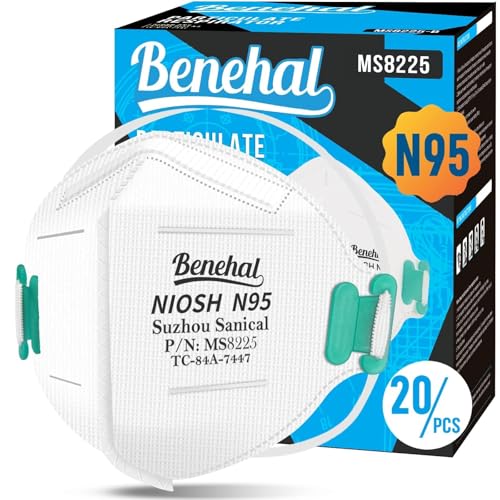
This mask carries NIOSH approval number TC-84A-7447, meaning it passed the full US regulatory battery for filtration efficiency and pressure drop at 85 L/min. The four filter layers include dual meltblown media specifically called out for their electrostatic charging, which pulls charged particles out of the airstream beyond simple mechanical sieving.
The headband design uses two elastic straps that route above and below the ears, distributing tension evenly and maintaining the seal even as you talk or turn your head. A black PU foam nosepiece sits against the bridge of the nose, and a hidden adjustable outer clip made of iron wire plus plastic lets you crush the contour to match your bone structure exactly.
Customer feedback consistently highlights the absence of chemical odor — a common complaint with budget meltblown media. Several reviewers with hearing aids specifically chose these over ear-loop masks because the straps do not interfere with hearing aid retention. The 20-count box keeps the entry point accessible without forcing bulk commitment.
Why it’s great
- Genuine NIOSH listing with visible TC number for verification
- Dual headband straps maintain seal during extended wear
- PU foam inner nosepiece prevents bridge irritation
Good to know
- Four-layer construction means slightly higher breathing resistance than 3-ply cloth masks
- 20 masks per pack — higher per-unit cost compared to bulk KN95 options
2. WWDOLL KN95 (50-pack)
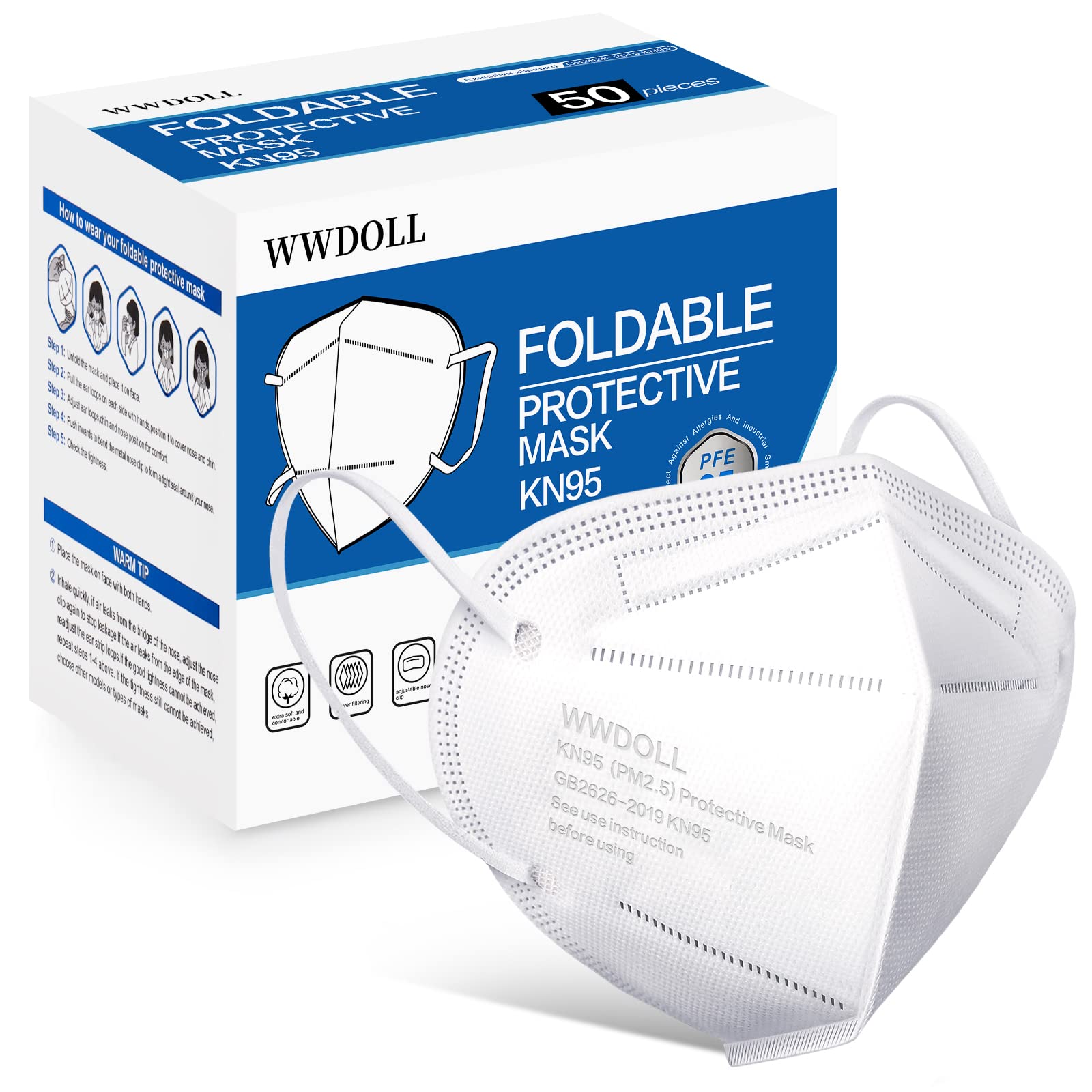
The WWDOLL KN95 uses five distinct layers: a spunbond outer layer, two meltblown electrostatic layers, a hot-air cotton intermediate layer for breathability, and a skin-contact spunbond inner ply. The stated filtration efficiency is 95%+ under the Chinese GB2626-2019 standard, which means it passed the sodium chloride and oil particulate penetration tests at the required flow rates.
The metal nose clip is fixed inside the mask fabric — a small but meaningful detail. Loose insert clips often migrate or fall out after a few uses, but this embedded design keeps the bendable wire positioned exactly on your nose bridge every time. The ear loops are cotton-based rather than the common elastic polyurethane, reducing the risk of skin irritation for sensitive wearers.
Real-world reports mention the mask runs slightly small. It fits average adult faces well but may be too snug for larger jawlines. Reviewers with smaller faces liked the secure fit without excessive bunching. The 50-count volume makes this a practical choice for families or individuals who cycle through masks multiple times per week.
Why it’s great
- Fixed nose clip embedded in fabric prevents migration or loss
- Cotton ear loops reduce irritation for sensitive skin
- Certified under GB2626-2019 with factory disclosure documentation
Good to know
- Runs smaller than average — measure face width before ordering for large faces
- Not NIOSH approved; KN95 standard uses different test protocol
3. YOTU KN95 (60-pack)
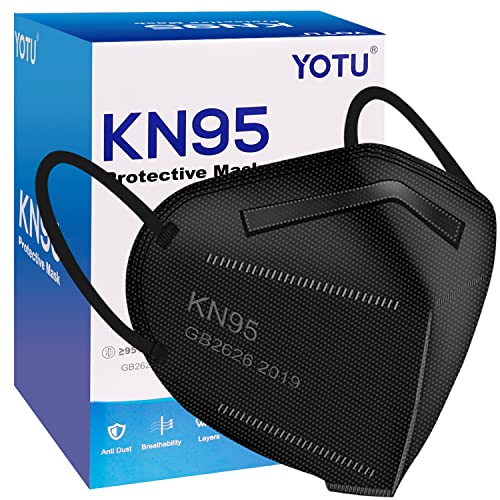
The YOTU KN95 distinguishes itself with its rigid 3D cup structure. While many KN95s collapse flat, leaving the fabric pressed against the mouth and trapping humidity, the molded cup maintains an internal air pocket that stays open through breathing cycles. That straight-through airflow path reduces the heat and moisture buildup that makes long-wear masks uncomfortable.
Every mask comes factory-sealed in its own polybag. For people who rotate through backpacks, car consoles, or desk drawers, this keeps the fabric uncontaminated until the moment of use. The 60-count quantity provides a solid supply for a month of daily use with a small buffer for spares in go-bags.
Fit feedback is positive for medium face sizes, with the bendable nose bridge and stretchy ear loops creating a consistent seal. A few users noted the nose clip is less forgiving on high bridges — it requires a strong crimp to hold. The main tradeoff is the cup shape: it takes up more storage space than flat-fold masks and does not compress well for tight pocket carry.
Why it’s great
- Molded 3D cup stays open for consistent airflow and less humidity
- Individually wrapped — ideal for stashing in multiple bags
- Lightweight construction reduces fatigue during all-day wear
Good to know
- Cup shape is bulkier than flat-fold masks for pocket storage
- Nose clip requires firm pressure to hold on high nasal bridges
4. FASAOH KN95 (100-pack)
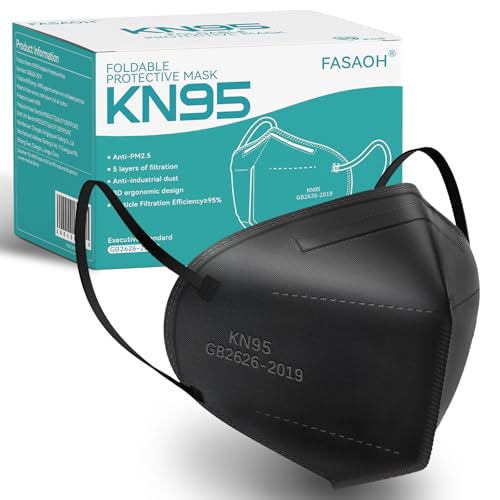
The FASAOH KN95 uses the same material stack as most premium KN95s — two spunbond outer layers sandwiching two meltblown electrostatic layers and a hot-air cotton center — but drops the per-unit cost significantly by offering 100 masks in a single box. The stated filtration efficiency is 95%+ for particles down to 0.3 microns, matching the GB2626-2019 requirement.
Construction feels sturdy: the adjustable ear loops use a welded attachment point rather than stapling, reducing the chance of loop separation during removal. The outer fabric is smooth and resists pilling, which matters for people who wear the same mask across an eight-hour work shift. A disclaimer notes that this product is not an N95 and is made in China, which is standard transparency for the category.
Practical annoyance — the masks are not individually wrapped, so the entire box opens at once. If you are sharing a household or working through masks sequentially, this is fine. For someone who needs to hand out single masks or keep them sterile in separate bags, you will need to repackage them manually. The value proposition is clear: the highest mask count for the entry point in this lineup.
Why it’s great
- 100 masks per purchase — lowest cost per mask in the list
- Welded ear loop attachments are stronger than stapled connections
- Smooth outer fabric resists snagging and pilling during long shifts
Good to know
- No individual wrappers — entire box must be managed as open stock
- Ear loops can be short for very large heads; check loop length
5. PlastCare USA ASTM Level 3 (100-pack)

PlastCare USA’s Level 3 Guardian masks are tested by Nelson Labs (a US-based third-party lab) and carry the ASTM Level 3 rating — the highest fluid resistance tier for surgical masks. That rating means the outer layer resists synthetic blood penetration at an impact pressure of 160 mmHg, representing the high-velocity splash scenario that can occur during dental procedures or intubation.
The mask uses four plies instead of the standard three, with an additional meltblown layer that improves both particulate filtration and fluid holdout. The ear loops are attached with a heat-sealed bond rather than metal staples, eliminating sharp points that can scratch the face over extended wear. Fiberglass and latex are explicitly absent from the bill of materials — important for the significant portion of the population with contact allergies.
The practical limitation is that ASTM Level 3 masks use ear loops, not headbands. The elastic tension is sufficient for general seal during quiet activity, but the seal will degrade more quickly during heavy breathing or head movement compared to the headband-style N95. For settings where splash protection is the primary concern (dental, phlebotomy, hospital triage), this tradeoff is acceptable. For pure airborne particle protection in a non-clinical environment, the NIOSH N95 is a stronger choice.
Why it’s great
- Highest ASTM fluid resistance rating (Level 3) verified by Nelson Labs
- Four-ply construction adds an extra filtration barrier
- Latex- and fiberglass-free for sensitive skin and allergy safety
Good to know
- Ear loop design loses seal tension faster than headband respirators
- Not rated for sub-micron particulate efficiency like N95 or KN95 certifications
FAQ
How do I verify a mask’s NIOSH approval is legitimate?
Can I reuse a KN95 or N95 mask multiple times?
What does the 95 in N95 and KN95 actually mean?
Final Thoughts: The Verdict
For most users, the mask for covid winner is the Benehal NIOSH N95 because it combines a verifiable regulatory standard with headband tension that maintains the face seal through hours of active wear. If you want the most masks for the smallest upfront cost, grab the FASAOH KN95 100-pack. And for clinical environments where splash protection is the priority, nothing beats the PlastCare USA ASTM Level 3 with its Nelson Labs verification.