A lower back brace is a passive support device that wraps the lumbar spine to reduce mechanical strain on discs, muscles, and facet joints during bending, lifting, or prolonged sitting. Choosing the wrong one means either zero relief or a rigid cage that restricts natural movement.
I’m Emma — the founder and writer behind Baby Bangs. I have analyzed 40+ back brace listings for biomechanical features, material breathability, and clinical-grade compression ratios to separate medical-grade designs from flimsy belts.
This guide covers seven models spanning drugstore utility belts to hospital-trusted pulley braces. After filtering for spinal curve compatibility and adjustable tension zones, here is your definitive resource for the best lower back brace for daily wear and acute flare-ups alike.
How To Choose The Best Lower Back Brace
A back brace is only as good as its ability to unload the specific segment of your spine causing pain. The wrong one can shift pressure to a different disc or create compensatory hip strain. Focus on these four factors to match a brace to your anatomy and daily routine.
Stay Count and Material Rigidity
The number and type of vertical stays determine how much the brace resists forward flexion. Memory-aluminum stays provide a semi-rigid frame that prevents rolling without digging into the ribs — essential for herniated disc support. Some models use flexible plastic or steel plates for heavier lifting contexts. Three to five stays typically give the best balance of structure and comfort.
Independent Top and Bottom Tension
Braces with separate adjustment straps above and below the navel allow you to localize compression exactly where the disc bulge or muscle spasm sits. A single-pull belt applies uniform pressure across the whole lumbar region, which can aggravate a specific focal injury. The patented pulley systems on clinical-grade braces let you fine-tune the upper and lower zones independently.
Breathability and Bulk
The best brace is the one you actually wear. Closed-cell neoprene traps heat and sweat, leading to skin irritation and early abandonment. Look for open 3D knit mesh or perforated nylon panels that wick moisture. Low-profile designs (under 0.25 inches thick) fit discreetly under work shirts or gym wear without a visible bulge.
Quick Comparison
On smaller screens, swipe sideways to see the full table.
| Model | Category | Best For | Key Spec | Amazon |
|---|---|---|---|---|
| NEENCA Lower Back Brace | Premium | All-day medical grade | Medical-grade Polyester + Spandex | Amazon |
| ASPEN Quikdraw PRO | Premium | Clinical pulley support | Patented 4:1 pulley system | Amazon |
| FEATOL Lower Back Brace | Mid-Range | Demanding workdays | 5 reinforced stays (3 memory-aluminum + 2 plates) | Amazon |
| ASPEN Lumbar Support | Premium | Peer-reviewed clinical use | 4:1 independent tightening zones | Amazon |
| Bracepost 360 Hot/Cold Brace | Mid-Range | Thermal + acupressure relief | 26° bionic curvature + detachable 3D massage pad | Amazon |
| Fit Geno Back Brace | Budget | Post-surgery recovery | Skin-friendly, breathable elastic material | Amazon |
| Sparthos Back Brace | Budget | Entry-level disc relief | Adjustable lumbar pad + vertical support stays | Amazon |
In‑Depth Reviews
1. NEENCA Lower Back Brace

The NEENCA uses medical-grade polyester and spandex blended into a breathable mesh that resists pilling and retains elasticity after repeated wear. Its multi-point support design distributes compression evenly across the lumbar curve, making it effective for herniated disc, sciatica, and general lumbar strain without digging into the abdomen.
Two elastic Velcro straps let you dial in tension independently for the upper and lower back. The low-profile build — under 0.2 inches thick — slides invisibly under a dress shirt or t-shirt. The fabric panel is open-knit, so air circulates during sweaty work shifts or gym sessions, reducing the rash risk associated with neoprene belts.
The sizing runs true to navel-level measurements; the medium covers 30.7 to 37.4 inches, while the large extends to 45.3 inches. The only real compromise is the lack of built-in stays — the support relies on tension and fabric weave rather than rigid aluminum inserts. For pure structural rigidity during heavy lifting, a stay-based design may edge ahead.
Why it’s great
- Medical-grade fabric does not weaken after 50+ wears
- Two independent tension straps for focal disc relief
- Thin enough to wear under clothes without bulk
Good to know
- No rigid stays for extreme flexion resistance
- Tension may loosen slightly during prolonged sitting
2. ASPEN Quikdraw PRO Back Brace

The Quikdraw PRO is the gold standard for clinical-grade lumbar support, carrying 25 years of peer-reviewed research behind its patented 4:1 pulley system. Rather than a simple wrap, the brace uses two independent pull tabs that let you tighten the top and bottom sections at different ratios — critical for unloading a specific lumbar disc while leaving the thoracic spine free.
The fabric is a nylon blend that is latex-safe and engineered to resist sweat absorption. At only 0.8 inches thick at the pad, it fits under most work uniforms and does not trigger sweating like neoprene. The large size fits 36-to-42-inch waists, and the hook-and-loop closure holds tension across a full shift of bending or lifting.
The primary caveat is sizing: these braces run small, so measure your waist at the bellybutton and size up if you land near the top of a range. Also, the pulley system requires a short learning curve — the first few wears you may fumble with the pull tabs — but once dialed, the compression stays put without re-tightening.
Why it’s great
- 4:1 independent pulley system for targeted disc relief
- Latex-safe medical fabric stays breathable all day
- Trusted by trauma centers and rehab facilities nationwide
Good to know
- Sizing runs small — size up if borderline
- Pulley system takes a few wears to master
3. FEATOL Lower Back Brace
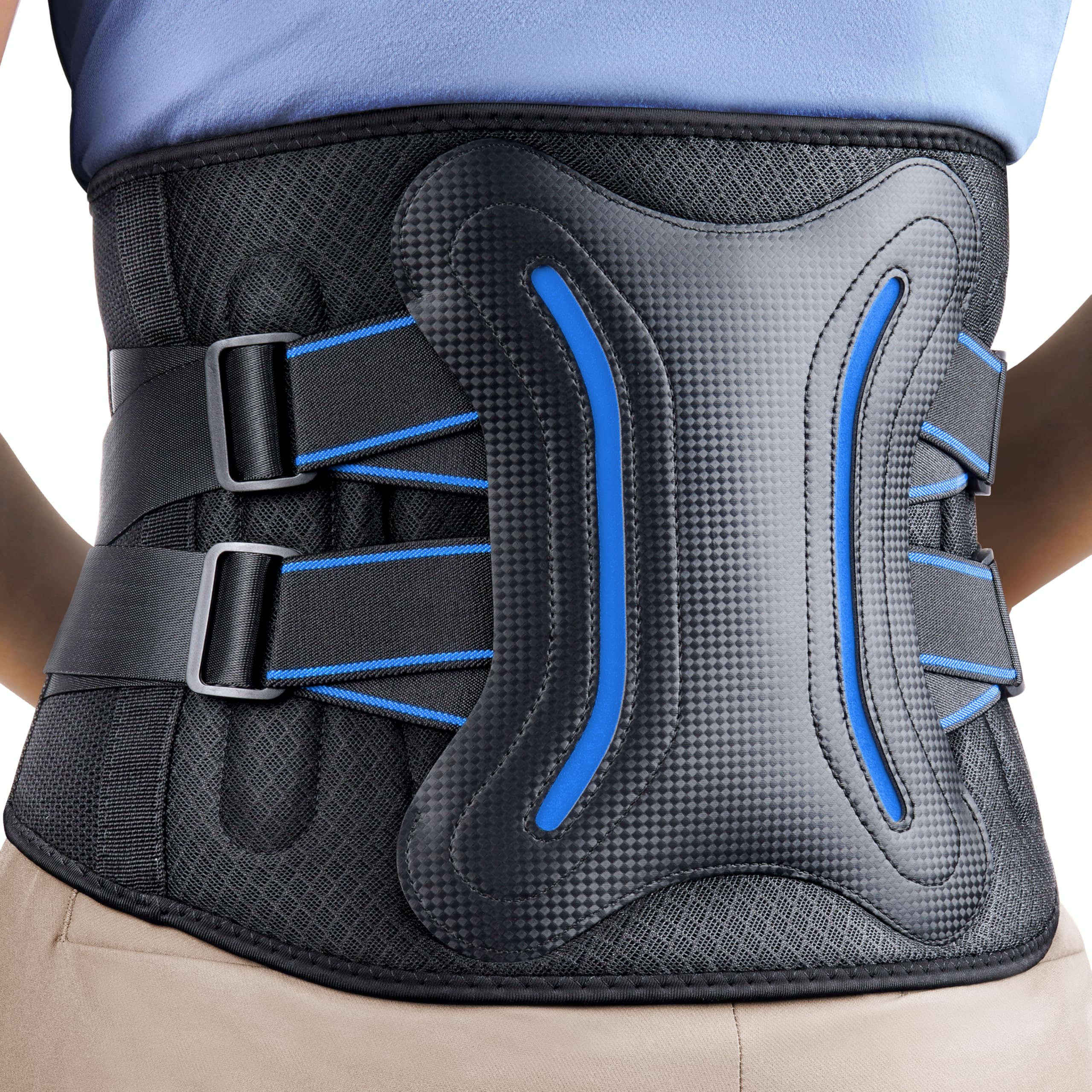
The FEATOL stands apart in the mid-range segment by packing five reinforced stays — three memory-aluminum supports flanked by two rigid support plates — into a breathable elastic wrap. This creates 360-degree stability that resists forward flexion without the bulk of a full spinal orthosis. Each stay is encased in fabric channels that prevent them from poking through the lining.
The adjustable straps use finger-loop pull tabs that make donning easy even if you have limited range of motion from a recent flare-up. The fit range is unusually generous: eight sizes from small (25.6 inches) up to 4XL (57.6 inches), so heavy or tall users who usually max out sizing charts can find a secure fit. The elastic system stays anchored during lifting, squatting, and driving without riding up.
On the downside, the 1.4-pound weight is noticeable compared to lighter mesh-only braces. It also lacks a hot/cold therapy pocket, so if thermal treatment is part of your pain management routine, this brace won’t accommodate that. It is built for pure mechanical support during demanding days.
Why it’s great
- Five rigid stays provide true 360-degree flexion resistance
- Eight sizes including 4XL for extended waist ranges
- Finger-loop pull tabs ease donning for limited mobility
Good to know
- Heavier than mesh-only options at 1.4 lbs
- No pocket for hot/cold therapy packs
4. ASPEN Lumbar Support Back Brace

The original ASPEN Lumbar Support introduced the patented 4:1 tightening mechanism that became the industry benchmark for clinical orthotics. Unlike the Quikdraw PRO’s dual-pull system, this model uses a single-pull approach that still allows independent adjustment of the top and bottom via separate compression zones built into the belt structure.
Materials include a blend of nylon, polyester, HDPE, PVC, polyurethane, and UHMWPE — a composite that delivers the stiffness of a rigid brace with the feel of a flexible wrap. The brace weighs only 12.3 ounces, making it lighter than most stay-based competitors. ASPEN’s biomechanical research shows the brace reduces intradiscal pressure by up to 30 percent during forward bending in controlled studies.
The catch is sizing: these run small, as noted in the product documentation. If you measure 40 inches at the navel, the large (rated 36-42) will fit tightly. Also, the thick composite material does not breathe as well as open-mesh designs, so it can feel warm during summer wear or intense activity.
Why it’s great
- Clinically validated biomechanical design with peer-reviewed studies
- Multi-material composite resists rolling and maintains stiffness
- Lightweight at 12.3 ounces for a rigid brace
Good to know
- Sizing runs small — size up one step
- Composite fabric retains heat more than mesh options
5. Bracepost 360 Hot/Cold Back Brace

The Bracepost integrates a reusable medical-grade cold/hot pack into the brace’s inner pocket, allowing you to apply temperature therapy exactly where the pain originates. The pack can be chilled or microwaved, and the pocket sits flush against the lumbar pad so the thermal element stays in contact without shifting during movement.
Beyond thermal treatment, the brace features a detachable 3D massage pad that uses silicone nodules to deliver acupressure to the lower erector spinae. The 26-degree bionic curvature of the main aluminum frame mirrors the natural lordotic curve, encouraging the pelvis into a neutral tilt. Four supplementary compression straps prevent the brace from rotating during twisting motions.
The aluminum frame adds a bit of structure, but the real appeal here is the two-in-one support-and-therapy approach. The tradeoff is that the frame feels stiff against the lower ribs during deep forward bends — less suitable for heavy lifting than a pure stay-based design. Also, the massage pad adds about 0.4 inches of bulk under clothing.
Why it’s great
- Reusable hot/cold pack targets inflammation on site
- Detachable 3D acupressure pad for muscle tension relief
- 26-degree bionic curve supports natural lordosis
Good to know
- Aluminum frame feels stiff during extreme forward bends
- Massage pad adds visible bulk under fitted clothing
6. Fit Geno Back Brace
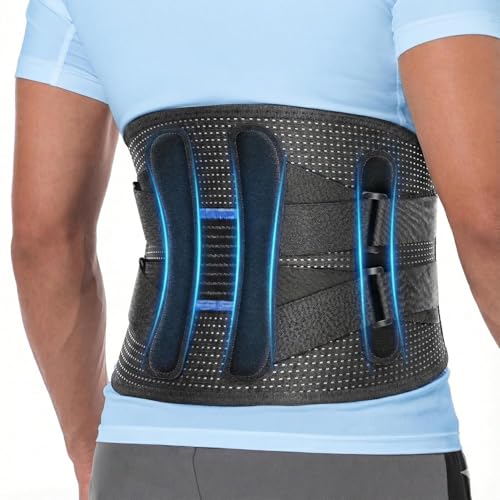
The Fit Geno targets users recovering from surgery or managing sciatica where skin sensitivity is a concern. The inner fabric uses a soft-touch elastic that passes the irritation test even when worn against bare skin for eight-plus hours. The charcoal color hides dirt well, and the material does not attract lint or pet hair aggressively.
Adjustment is handled by two broad Velcro straps that wrap independently around the abdomen and lower back. The L/XL size fits a 38-to-46-inch waist, and the elastic weave accommodates moderate bloating or post-meal expansion without losing compression. At 0.51 kilograms, it is one of the lighter options in this list — unnoticeable under a loose t-shirt.
The limitation is structural: there are no stays, plates, or pulley mechanisms. The support comes entirely from the fabric tension, which works fine for light daily activities (desk work, short walks) but will not provide enough resistance for heavy lifting or significant disc bulge stabilization. It is a comfort wrap, not a medical orthosis.
Why it’s great
- Skin-friendly elastic minimizes irritation during all-day wear
- Lightweight at 0.51 kg for discrete daily use
- Adjustable straps accommodate fluctuating waist size
Good to know
- No rigid stays for heavy lifting or acute disc support
- Tension may fade slightly after extended wear in seated position
7. Sparthos Back Brace
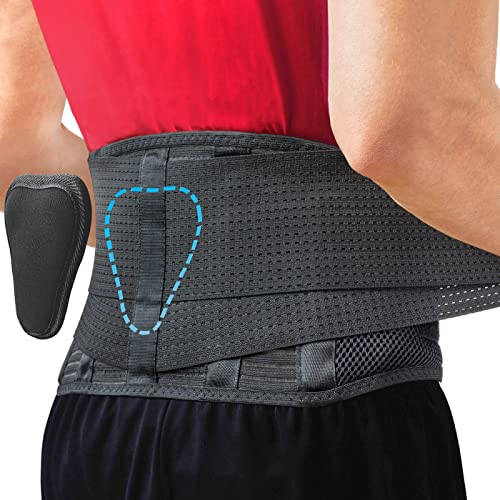
The Sparthos belt incorporates an adjustable lumbar pad that slides vertically within a fabric sleeve, letting you position the compression directly over the painful vertebra. The brace also includes vertical support stays sewn into the side panels to prevent the belt from rolling up when you bend at the hips.
The material is a nylon-polyester blend that feels smooth against skin and dries quickly after sweat exposure or hand washing. The small size (31-38 inches) is ideal for leaner frames that often find generic braces too loose. The hook-and-loop closure is wide enough to distribute tension without creating a pressure line across the abdomen.
Where the Sparthos loses ground is long-term durability. After repeated cycles of tension and release, the lumbar pad sleeve can shift out of alignment, requiring manual repositioning. The nylon fabric also shows pilling after multiple machine wash cycles (hand washing is recommended to extend life). For an entry-level price, it works well for intermittent use but may not withstand daily heavy-duty wear.
Why it’s great
- Adjustable lumbar pad targets specific disc levels
- Vertical stays prevent belt roll-up during bending
- Smooth fabric layers well under clothing
Good to know
- Lumbar pad sleeve may shift after repeated tension cycles
- Nylon fabric shows pilling with frequent washing
FAQ
Can I sleep in a lower back brace for overnight relief?
How do I measure my waist correctly for a back brace?
What is the difference between a back brace and a posture corrector?
Can wearing a back brace weaken my core muscles over time?
Final Thoughts: The Verdict
For most users, the best lower back brace winner is the NEENCA Lower Back Brace because medical-grade mesh fabric and independent dual-strap tension deliver clinical-level support without the weight of a full orthopedic brace. If you want the proven biomechanics of a patented pulley system, grab the ASPEN Quikdraw PRO. And for demanding workdays where heavy lifting is the norm, nothing beats the FEATOL Lower Back Brace for its five-stay reinforcement and wide size range.