Choosing the wrong workout gear when your knees, hips, or lower back demand forgiveness can waste months in recovery and stall progress. The machines that promise joint relief often deliver clunky motion, noisy operation, or flimsy frames that wobble under real effort. The market is flooded with options that look similar on paper but differ drastically in how they transfer force through your skeleton.
I’m Emma — the founder and writer behind Baby Bangs. I’ve spent thousands of hours reverse-engineering manufacturer specs, analyzing drivetrain materials, and comparing stride kinematics across the major home fitness brands to separate genuine joint-saving engineering from marketing noise.
Whether you’re rehabbing an injury or building a sustainable long-term routine, finding the best low-impact exercise equipment means understanding how frame geometry, resistance type, and stride path actually interact with your body’s natural movement.
How To Choose The Best Low-Impact Exercise Equipment
Low-impact equipment must absorb your body weight or support your range of motion without transferring shock through cartilage. The three variables that determine success are resistance type, frame geometry, and user adjustability range. Ignoring any one of these leads to discomfort or early equipment failure.
Resistance Type and Drivetrain Quality
Magnetic resistance dominates this category for good reason. It creates drag via magnets that never physically contact the flywheel, which means zero friction wear and near-silent operation — essential for home environments and joint-sensitive users who need smooth initiation at every resistance level. Felt pad or strap systems degrade over months, requiring replacement and producing jerky motion. Look for perimeter-weighted flywheels over central hub designs; they store more rotational inertia and deliver smoother start-stop motion at low cadence, which is critical during rehab and long-duration steady-state cardio.
Stride Path and Joint Alignment
Elliptical stride length directly dictates how your hips and knees track. A stride that is too short for your leg forces a choppy motion that loads the patellar tendon. A stride that is too long overextends the hip flexors. Recumbent bikes demand attention to the seat-to-pedal arc — an infinite slider seat system lets you dial in the exact millimeter, avoiding the fixed-hole positions that leave most users either too stretched or too cramped. Rowers require rail length and ergonomic seat height; a seat that sits too low forces a posterior pelvic tilt, compressing the lumbar discs stroke after stroke.
Frame Material and Weight Capacity Margin
Alloy steel frames are the standard for durability, but not all steel is equal. Look for thickened carbon steel main beams and dual-triangle support structures that prevent lateral wobble during full-power strides. The manufacturer’s weight capacity should be treated as the absolute limit, not the recommended operating zone. For consistent stability, choose equipment rated at least 30 lb above your current body weight. This margin preserves bearing alignment and prevents the metal fatigue that creates creaking and play after a year of daily use.
Quick Comparison
On smaller screens, swipe sideways to see the full table.
| Model | Category | Best For | Key Spec | Amazon |
|---|---|---|---|---|
| Concept2 RowErg | Air Rower | Full-body data-driven training | PM5 monitor, 500 lb capacity | Amazon |
| Teeter Power10 Rower | Magnetic Rower | Bi-directional push/pull rowing | 2-way magnetic, elliptical path | Amazon |
| Teeter FreeStep LT7 | Recumbent Stepper | Therapy-grade zero-impact stepping | PT-licensed stride, 350 lb cap | Amazon |
| Niceday Elliptical CT11-19 | Elliptical Trainer | Tall users needing long stride | 19 in stride, 400 lb capacity | Amazon |
| Sunny 360 Rower SF-RW522067 | Magnetic Rower | Full-motion handlebar engagement | 51.3 in rail, 330 lb capacity | Amazon |
| VANSWE RB405 Recumbent Bike | Recumbent Bike | Heavy-duty comfort and rehab | Infinite slider seat, 400 lb cap | Amazon |
| MERACH S19 Recumbent Bike | Recumbent Bike | Compact magnetic recumbent cycling | 6.6 lb flywheel, 330 lb capacity | Amazon |
| Sunny Row-N-Ride P2100SMART | Multi-Purpose Squat/Row | Space-saving full-body strength | 3 squat depths, 330 lb capacity | Amazon |
| MERACH MR-E32 Under Desk Elliptical | Seated Pedal Exerciser | Office or senior leg movement | 12 speeds, 250 lb capacity | Amazon |
In‑Depth Reviews
1. Concept2 RowErg

The Concept2 RowErg sets the benchmark for low-impact full-body conditioning because its air resistance self-adjusts with your effort — harder pulls create more drag, softer strokes stay gentle. The PM5 monitor transmits via Bluetooth and ANT+ to over 40 fitness apps, giving you comparable data that no other rower at this level matches. The aluminum front legs and steel rear legs create a 96-inch footprint that separates into two pieces for storage, and the 14-inch seat height fits nearly every user without forcing lumbar compression.
Rated for up to 500 lb, the RowErg’s flywheel design produces a smooth, familiar rowing sensation that gyms have trusted for decades. The device holder integrates cleanly into the monitor arm, keeping your phone or tablet secure during interval work. The adjustable footrests and ergonomic handle accommodate different body mechanics, and the caster wheels let you roll the separated halves into a closet without lifting.
Real owners consistently report that assembly takes under 30 minutes and the machine remains whisper-quiet even during sprint intervals. The only trade-off is the length — you need about 9 feet of clear floor space for the full stroke, but the easy storage halves that footprint when not in use.
Why it’s great
- Industry-standard PM5 delivers race-grade data with Bluetooth and ANT+.
- 500 lb weight capacity with no wobble during high-power strokes.
- Separates into two pieces for storage with built-in transport wheels.
Good to know
- Requires 9 feet of floor length for full stroke extension.
- Takes two D cell batteries; monitor draws power from flywheel during use.
2. Teeter Power10 Rower

The Teeter Power10 reimagines rowing by adding resistance on both the pull and the push — you engage your chest, triceps, and anterior core during the forward phase, not just your back and biceps on the return. The patented elliptical path replaces the traditional linear slide rail with a compact wheel-and-fork system that measures only 38 inches deep, a fraction of the floor space conventional rowers demand. The 7-level magnetic resistance stays friction-free and whisper-quiet, so early morning sessions won’t disturb anyone in adjacent rooms.
Multi-grip handles let you switch between wide, neutral, and close grips mid-session, targeting different upper-body muscle groups without stopping. The adjustable layback angle modifies how much core engagement each stroke requires, making it adaptable for users recovering from abdominal surgery or managing diastasis recti. The monitor tracks time, calories, distance, and pace, and the Bluetooth HRM compatibility integrates with the free Teeter Move app for structured coaching.
Owners highlight the bi-directional resistance as a game-changer for building balanced upper-body strength while keeping the lower body engaged. The trade-off is that the magnetic resistance tops out at 7 levels, which may feel light for experienced rowers seeking maximum drag. The 300 lb weight capacity and 106 lb unit weight require two people for initial setup.
Why it’s great
- Bi-directional magnetic resistance works both pulling and pushing motions for balanced muscle engagement.
- Compact 38-inch footprint eliminates the need for a long slide rail.
- Multi-grip handles allow instant upper-body targeting without stopping.
Good to know
- Only 7 resistance levels; advanced users may max out quickly.
- 106 lb unit weight requires two people for initial assembly and positioning.
3. Teeter FreeStep LT7 Recumbent Cross Trainer

The Teeter FreeStep uses a physical-therapy-licensed natural stride that aligns your hips, knees, and ankles in a stepping arc rather than a cycling motion. This means zero joint compression even at full resistance — the patented mechanism maintains constant foot contact with the pedals, eliminating the impact point that occurs when your foot leaves the pedal on standard elliptical trainers. The 20-level magnetic resistance ranges from 0 to 105 lb, controlled via console quick-keys for instant intensity changes.
The ComfortMax seat is extra-large with more positioning options than typical recumbent trainers, and the SureGrip handles use a high-grade polyurethane coating that resists wear and sweat degradation. The 9-inch color LCD screen displays 7 tracking metrics and includes 21 pre-programmed goal-based workouts. The media rack has a USB charging port and adjustable height, so you can follow classes on the free Teeter Move app while monitoring real-time data from the console.
Users recovering from arthritis, Parkinson’s, or MS report that the FreeStep permits consistent exercise when traditional bikes or ellipticals cause flare-ups. The 350 lb capacity and 150 lb unit weight provide a rock-solid feel at any resistance. The primary consideration is the 59-inch depth — it’s not a space-saver, but the Electronic Step Lock makes entry and exit genuinely safe for users with limited mobility.
Why it’s great
- PT-licensed stride eliminates joint compression by maintaining continuous foot contact.
- 20-level magnetic resistance with console quick-keys for instant adjustment.
- Extra-large ComfortMax seat and Electronic Step Lock for safe entry/exit.
Good to know
- 59-inch depth requires dedicated floor space.
- 150 lb unit weight demands planning for room placement.
4. Niceday Elliptical CT11-19
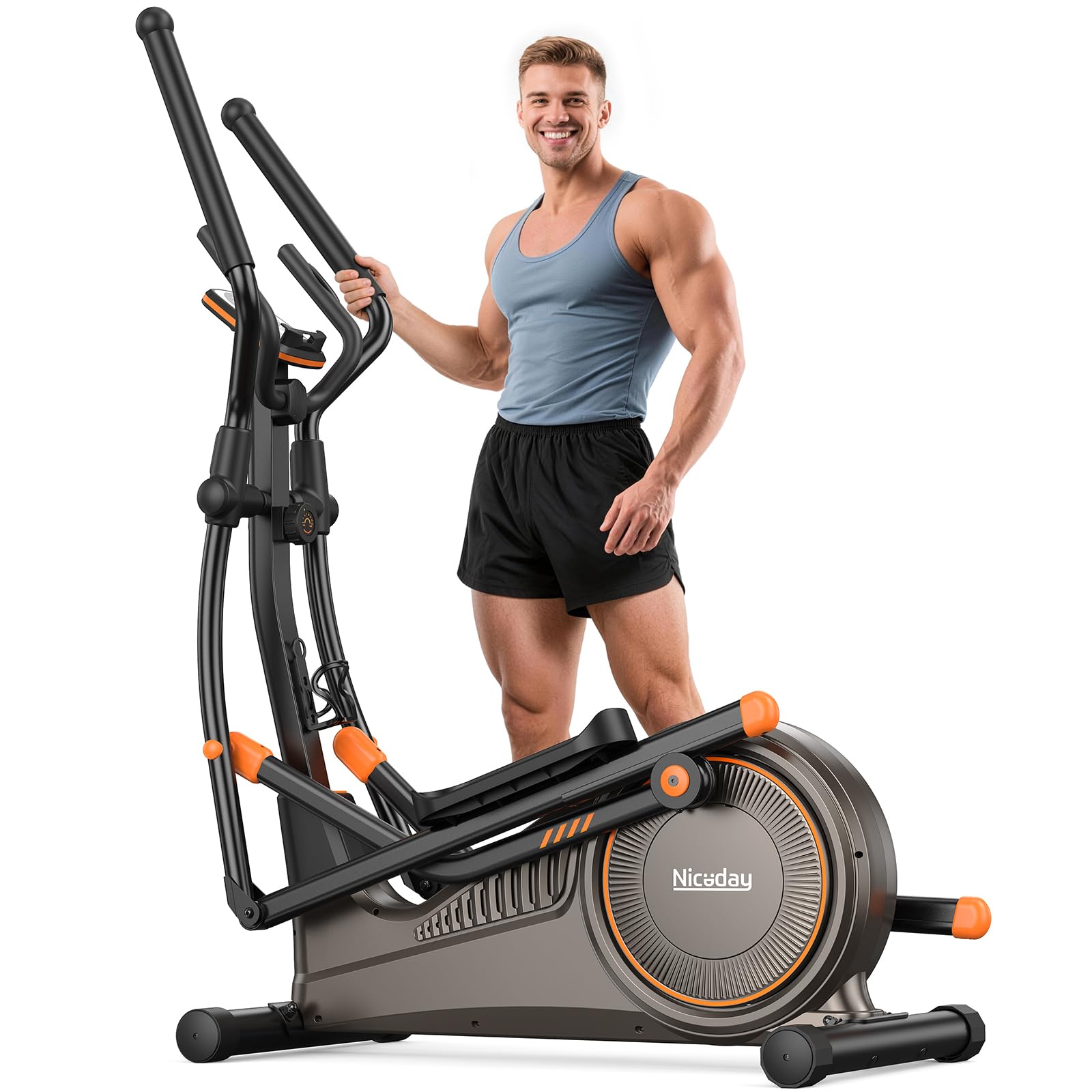
The Niceday CT11-19 delivers a 19-inch gym-grade stride that accommodates users up to 6 feet 5 inches, solving the cramped stride problem that plagues compact ellipticals. The dual-triangle frame structure paired with a dual-axis linkage drastically reduces bearing wear while maintaining lateral stability at high cadence. The 18 lb perimeter-weighted flywheel provides strong inertia for smooth start-up and continuous motion, and the 16-level magnetic drive system lets you dial resistance directly through muscle force against the magnets.
The thickened carbon steel main beam creates a rock-solid foundation rated for 400 lb, engineered to resist the metal fatigue that creates wobble over years of use. The digital monitor tracks six metrics including heart rate via contact sensors, and the Kinomap partnership turns your routine into interactive virtual cycling. Assembly takes roughly 30 minutes with included tools and video guide, and the front transport wheels make relocation simple by lifting the rear.
Owners consistently note that the 19-inch stride eliminates the “choppy” feeling typical of sub-18-inch home ellipticals. The unit runs below 15 dB even at maximum resistance — silent enough for apartment living. The 48-inch depth is compact for an elliptical with this stride length, though the 62-inch height requires a ceiling clearance check before purchase.
Why it’s great
- 19-inch stride fits users up to 6’5” with natural gait motion.
- 400 lb capacity with thickened carbon steel frame and dual-triangle structure.
- 18 lb perimeter-weighted flywheel for ultra-smooth low-cadence operation.
Good to know
- 62-inch height requires ceiling clearance check before use.
- Contact heart rate sensors are less accurate than chest-strap Bluetooth options.
5. Sunny Health & Fitness 360 Rower SF-RW522067
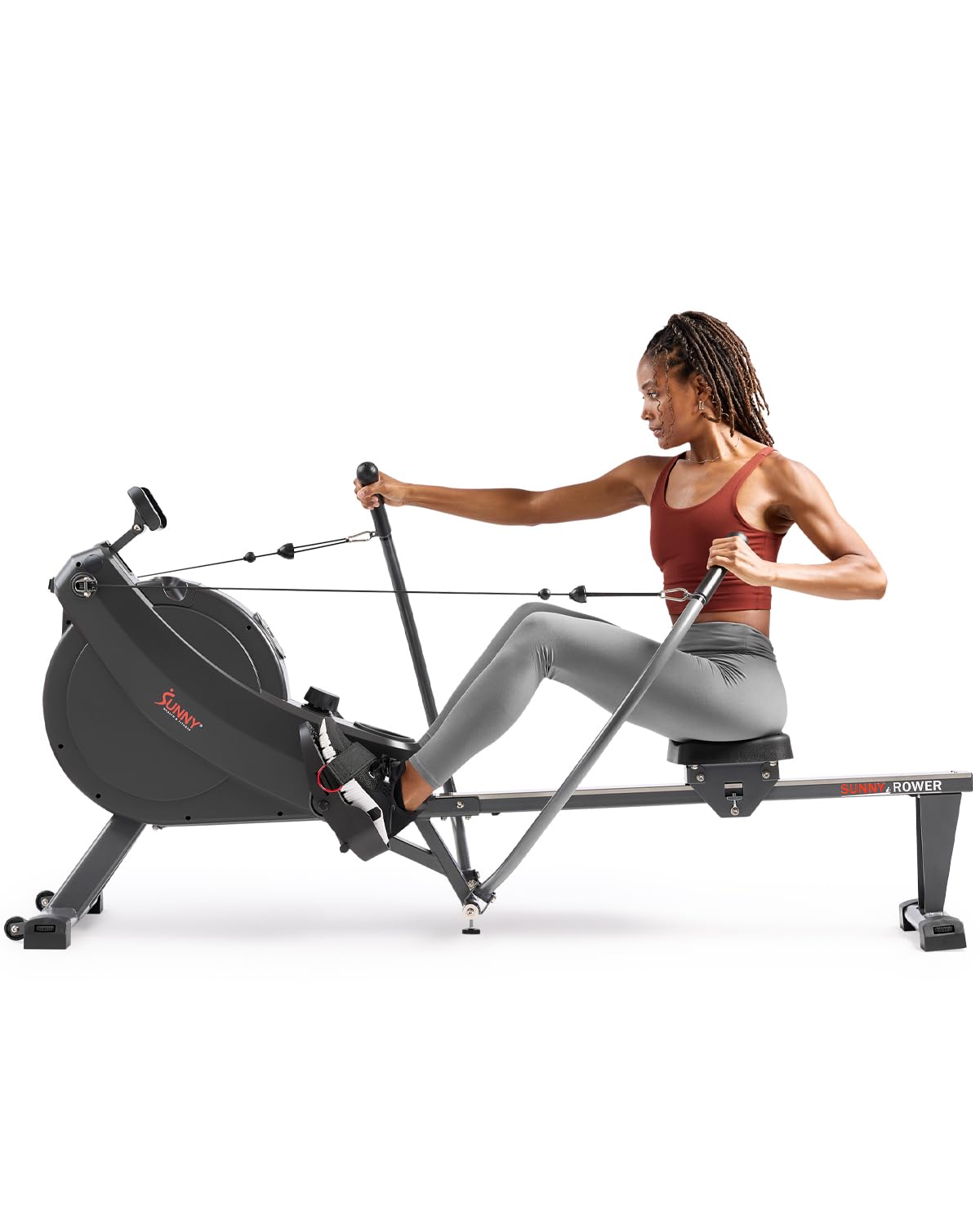
The Sunny 360 Rower uses a 360-degree full-motion handlebar design that mimics natural rowing form more closely than fixed-axis rowers, activating your legs, back, core, and arms through a full range of circular movement. The double cord handlebar adds realism to each stroke while improving shoulder mobility. The 51.3-inch rail with a stainless steel cover delivers smoother, quieter gliding compared to standard painted rails, and the metal frame construction supports a 330 lb user capacity.
The ergonomic padded seat sits at a 17.6-inch height, reducing the strain on your lower back when transitioning on and off the rower. The advanced LCD monitor tracks distance, time, stroke count, strokes per minute, calories, and total count. A heart rate monitor is available as a separate add-on for those who want live pulse data. The unit folds up for vertical storage, though you’ll want to measure your ceiling height before leaning it against a wall.
Customer reviews frequently praise the quiet magnetic operation and the natural feel of the 360-degree handles. A few users note that the maximum resistance could be higher for advanced athletes, but for steady-state zone 2 cardio and beginner-to-intermediate training, the tension range is well-suited. The 91.8 lb unit weight keeps it planted during aggressive rowing.
Why it’s great
- 360-degree full-motion handles mimic natural rowing arm path for better shoulder engagement.
- 51.3-inch stainless steel rail for smooth, quiet gliding.
- 17.6-inch seat height reduces lumbar strain during entry and exit.
Good to know
- Maximum resistance may feel light for experienced strength athletes.
- Heart rate monitor is sold separately and not included.
6. VANSWE RB405 Recumbent Bike
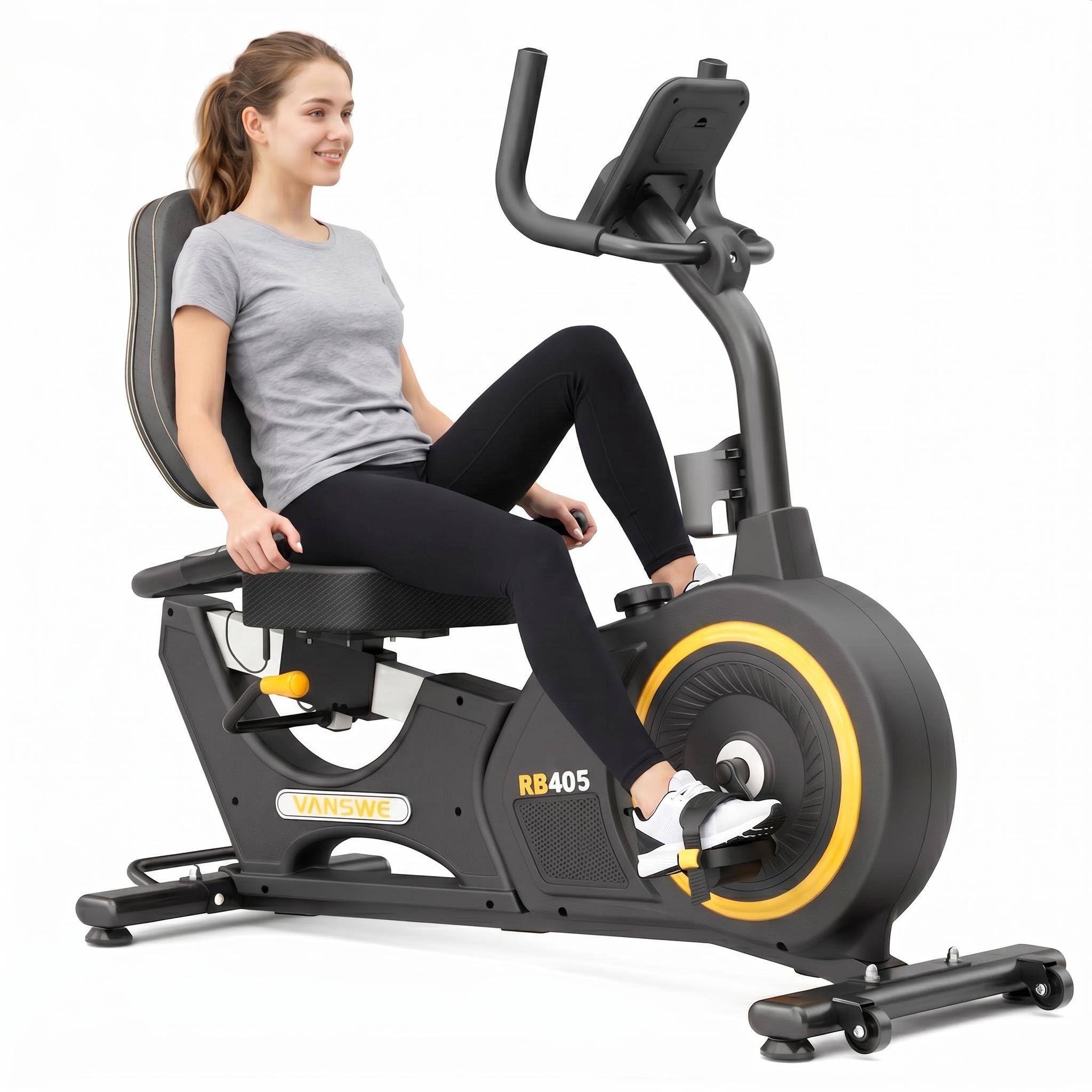
The VANSWE RB405 solves one of the most persistent recumbent bike complaints — fixed seat positions that never feel quite right — with an Infinite Slider Seat System that adjusts down to the exact millimeter, accommodating leg lengths from 29 to 40 inches (roughly 5’1” to 6’4”). The 3.4-inch extra-thick padded cushion and contoured backrest provide superior spinal support, making this a strong candidate for users managing chronic lower back pain or recovering from hip and knee injuries.
The frame is commercial-grade alloy steel rated for 400 lb, and the 11 lb precision flywheel paired with 8-level magnetic resistance delivers near-silent operation. The backlit LED monitor shows key metrics, and Bluetooth connectivity works with Kinomap and Zwift for virtual training. The unit arrives 90 percent pre-assembled — you attach the seat, pedals, and handlebars — and built-in transport wheels simplify room-to-room movement.
Real-world feedback emphasizes the stability: the 73 lb base weight and wide 20-inch stance eliminate wobble even during high-cadence intervals. The tablet holder keeps entertainment at eye level, which encourages longer sessions. The seat slider mechanism uses a heavy-duty track rather than spring-loaded pins, so it stays locked under aggressive pedaling without slipping.
Why it’s great
- Infinite Slider Seat adjusts millimeter-by-millimeter for exact leg length fit.
- 400 lb capacity with commercial-grade steel frame and 73 lb unit weight.
- 90 percent pre-assembled for fast setup with transport wheels.
Good to know
- Only 8 magnetic resistance levels; advanced cyclists may want more granularity.
- Bluetooth app connectivity is limited to Kinomap and Zwift — no proprietary training ecosystem.
7. MERACH S19 Recumbent Bike
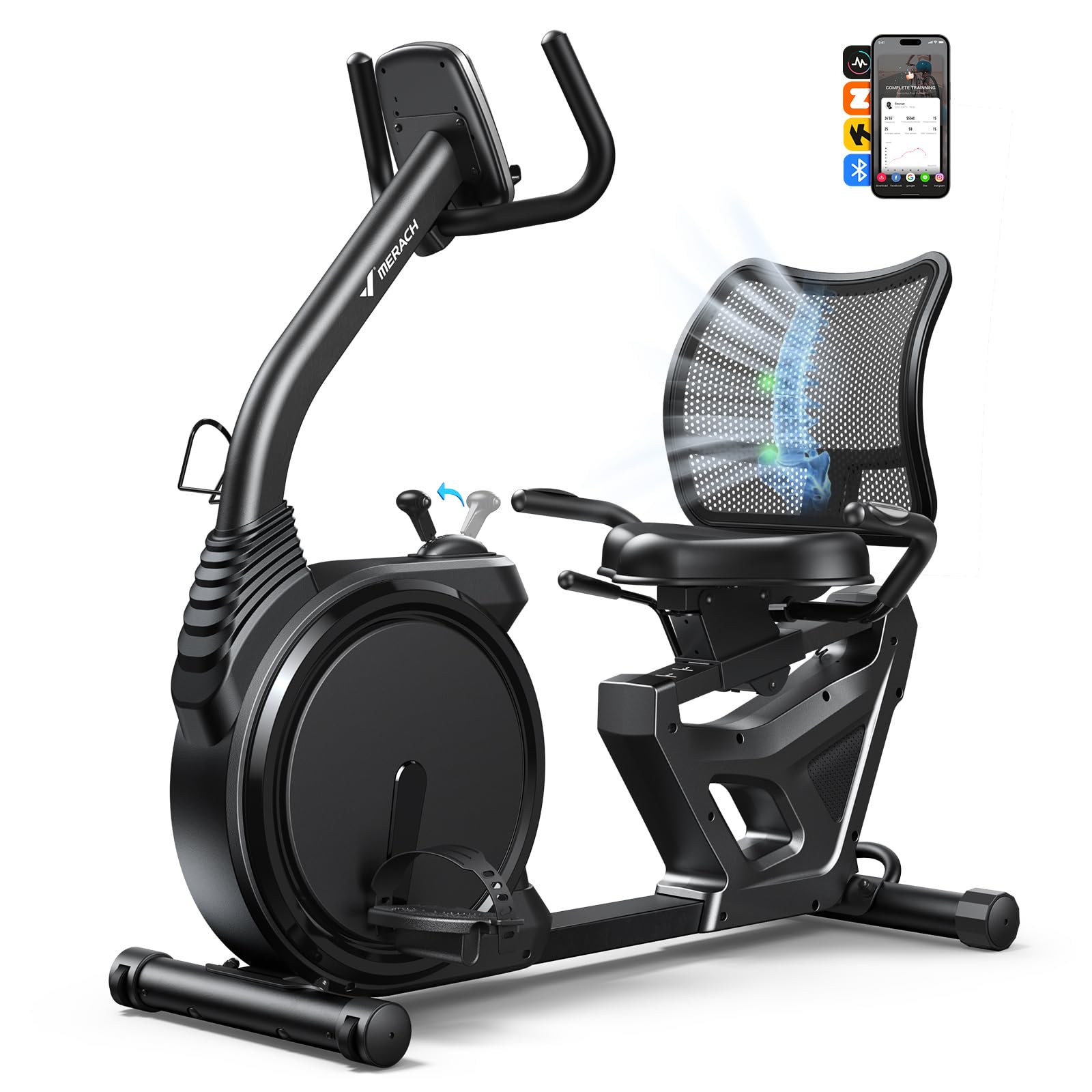
The MERACH S19 uses an 8-level car-style shift lever for resistance adjustment — a single pull changes the magnetic drag without fumbling with twist knobs or digital down buttons. The 6.6 lb perimeter-weighted flywheel and dual-belt drive system keep operation virtually silent, and the 84.9 lb frame ensures the bike stays planted during aggressive cadence changes. The recumbent design positions your hips behind the pedals, reducing lower back strain compared to upright stationary bikes.
The ergonomic seat features a breathable mesh backrest and adjusts across 8 positions for inseam accommodation. The frosted handlebars resist sweat accumulation while providing a non-slip grip — a detail often overlooked in budget recumbent bikes that use smooth plastic handles. The LCD display tracks time, distance, speed, calories, and heart rate via pulse sensors, and Bluetooth syncs with the MERACH app for gamified rides through the FantomFite platform.
Customer reviews highlight the smooth, near-silent pedaling and the ease of the lever-based resistance change. Several users specifically mention successful post-knee-surgery rehabilitation, noting the bike allowed controlled range-of-motion without painful joint loading. The recommended height range (5’2” to 5’10”) means taller users should verify fit before purchase, as the extended seat leg length maxes out at 35.43 inches.
Why it’s great
- Car-style shift lever provides instant, tactile resistance changes without digital menus.
- Frosted non-slip handlebars resist sweat degradation better than standard plastic.
- Dual-belt drive with 6.6 lb flywheel delivers near-silent magnetic operation.
Good to know
- Maximum recommended height is 5’10”; taller users may feel cramped.
- LCD screen is battery-operated not plug-in — batteries require occasional replacement.
8. Sunny Row-N-Ride P2100SMART
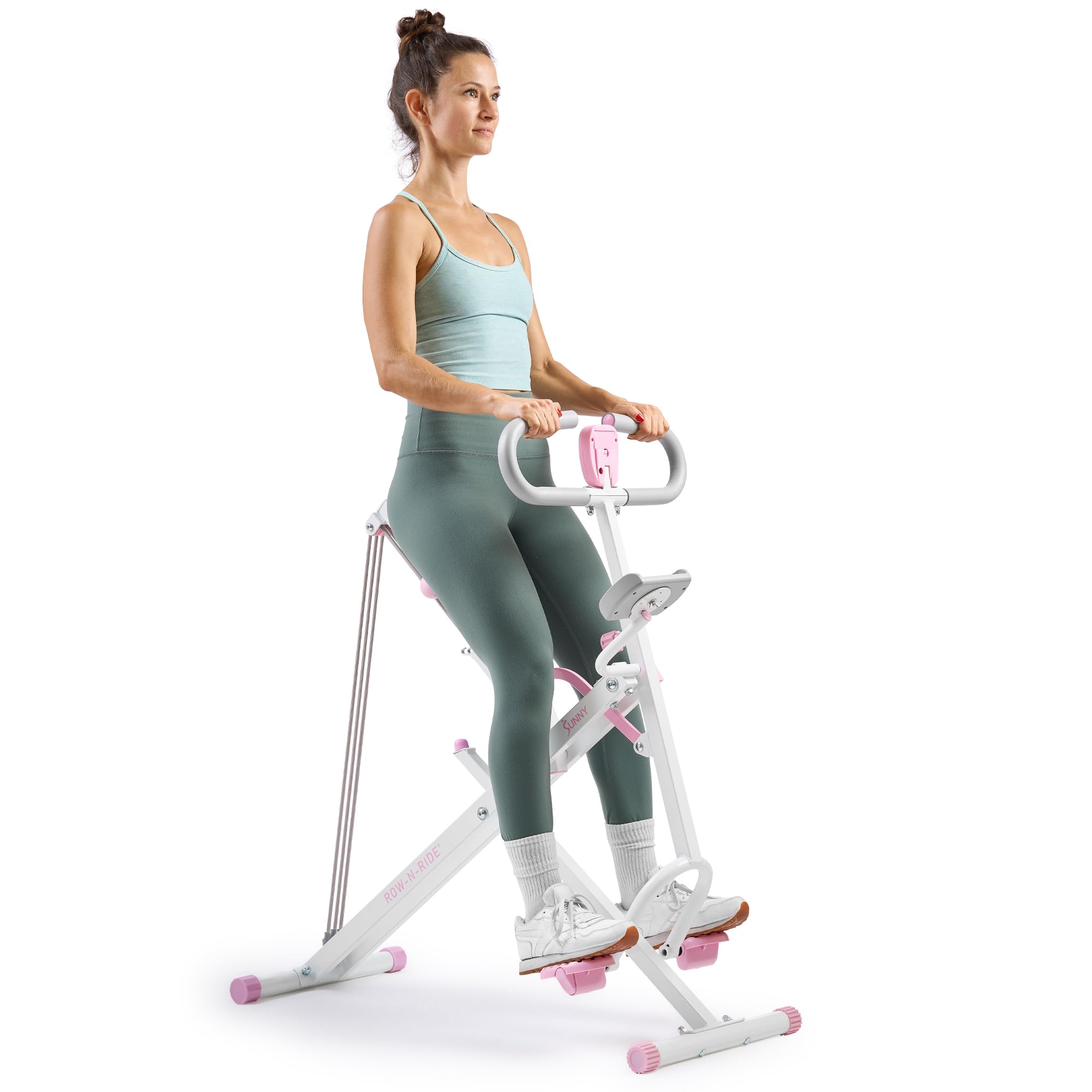
The Sunny Row-N-Ride combines squats, incline chest presses, and bent-over rows into a single compact unit, making it one of the most space-efficient full-body strength trainers that still keeps impact near zero. The machine offers 3 adjustable squat depths — shallow, parallel, and deep — controlled by changing the machine angle from 30 to 90 degrees. This allows you to progressively load the glutes and quads without the spinal compression of barbell back squats.
The padded seat and 4 adjustable handlebar length settings accommodate different torso and arm lengths, and the digital monitor tracks calories, duration, and rep count. The SunnyFit app gives free access to over 1,000 trainer-led workouts and 10,000 scenic tours with no membership fee, which adds programming structure for users who don’t want to design their own routines. The 4 resistance levels use a cord-based system that is quieter than traditional cable machines but offers less granular progression than magnetic systems.
Owners appreciate the small footprint — roughly 49 inches deep by 19 inches wide — and the 28.7 lb weight makes it easy to move between rooms. The 330 lb capacity is solid for a multi-function unit in this price range. Users note that the resistance levels feel like a progression from light to moderate, not heavy, so it works best for toning, endurance, and rehab rather than maximal strength building.
Why it’s great
- Combines squat, chest press, and row in one compact footprint under 50 inches deep.
- 3 adjustable squat depths allow progressive glute and quad loading without spinal compression.
- Free SunnyFit app with 1,000+ workouts eliminates programming guesswork.
Good to know
- Only 4 resistance levels; not sufficient for heavy strength progression.
- Cord-based resistance is quieter than cables but less smooth than magnetic systems.
9. MERACH MR-E32 Under Desk Elliptical

The MERACH MR-E32 is a powered seated pedal exerciser driven by a 60W motor, offering 12 manual speed levels and 12 preset auto modes (P1–P12) that vary resistance automatically to simulate interval training. This is the only motorized option in the lineup — the motor drives the pedals forward or reverse, so users with limited leg strength can still achieve active range of motion without relying solely on their own power. The noise level stays below 15 dB, making it suitable for open-plan offices or shared living spaces.
The LED touch screen and included remote control let you adjust speed and direction without bending over, and the real-time display shows time, distance, speed, stroke count, and calories burned. The compact dimensions — 15.6 by 14.9 by 7.4 inches — slide under standard 30-inch desks with clearance to spare. The alloy steel frame supports up to 250 lb, and the 11.1 lb weight makes it genuinely portable between rooms or to the office.
User feedback emphasizes the therapeutic value for maintaining leg muscle activation during sedentary workdays and post-surgery recovery. The motor assist is the key differentiator — purely manual under-desk ellipticals require constant self-propulsion, which can fatigue recovering muscles quickly. The reverse pedal function targets different muscle groups (hamstrings and glutes vs. quads) and adds variety. The pedal stride length is limited to 15 inches, so taller users should verify comfortable leg extension before purchase.
Why it’s great
- 60W motor drives pedals so users with weak legs still get active range of motion.
- 12 auto modes provide intervals without manual adjustment during use.
- Ultra-compact 15.6-inch depth slides under standard desks with remote control.
Good to know
- Maximum stride of 15 inches may feel short for users over 5’10”.
- Motor requires power outlet — not purely passive or battery-operated.
FAQ
Is a recumbent bike better for lower back pain than an elliptical?
How much magnetic resistance do I need for effective cardio?
Can motorized under-desk ellipticals replace full-sized equipment for rehab?
Final Thoughts: The Verdict
For most users, the best low-impact exercise equipment winner is the Concept2 RowErg because its air resistance adapts naturally to every fitness level and its PM5 monitor gives you professional-grade data for tracking progress over years. If you want bi-directional push-pull resistance that builds balanced upper-body strength while sparing the lower back, grab the Teeter Power10 Rower. And for zero-impact stepping that mimics physical therapy equipment and supports users up to 350 lb, nothing beats the Teeter FreeStep LT7.