Your baby’s red, rough patches aren’t just dry — they’re a cry for a skin barrier that can’t yet defend itself. Infant eczema demands a moisturizer engineered to lock in hydration without stinging or greasing up onesies.
I’m Emma — the founder and writer behind Baby Bangs. I’ve spent months cross-referencing dermatologist guidelines with the actual ingredient decks on Amazon to isolate which lotions truly calm reactive infant skin.
After comparing occlusion power, pH balance, and National Eczema Association acceptance across a tight field, I found the five formulas that belong in your rotation. This guide cuts through the marketing noise to deliver a clear, evidence-backed lotion for infant eczema.
How To Choose The Best Lotion For Infant Eczema
Infant skin is roughly 30% thinner than adult skin, meaning it loses moisture faster and absorbs irritants more readily. The right eczema lotion compensates for this structural disadvantage by sealing in water while sending lipids and soothing agents into the upper layers. Start with the ingredients that repair, not just coat.
Barrier-Replicating Technology vs. Simple Occlusion
Petrolatum-based ointments (like Aquaphor) work by forming a physical seal over the skin. They are excellent at preventing water loss but contribute no restorative lipids. For daily management, look for formulas that use MLE (Multi-Lamellar Emulsion) technology or ceramides — these actually mirror the lipid matrix of healthy skin, allowing deeper penetration and longer-lasting improvement.
Colloidal Oatmeal and the 24-Hour Itch Timer
Colloidal oatmeal (finely ground Avena sativa) forms a protective film that holds moisture against the skin while its avenanthramides reduce inflammation and itching. Studies show significant itch reduction within 24 hours of application. If your infant scratches through the night, a lotion with labeled colloidal oatmeal content — typically found in mid-range to premium creams — delivers measurable relief.
pH and Preservative Profiles
Healthy infant skin sits at a pH around 5.5. Eczema-prone skin trends alkaline, accelerating water loss and bacterial overgrowth. A mildly acidic eczema cream (pH 5.0–6.0) helps rebalance the surface. Equally important: confirm the lotion is free from alcohol, parabens, phthalates, and synthetic fragrances — these destabilize the microbiome and can trigger immediate stinging on raw patches.
Quick Comparison
On smaller screens, swipe sideways to see the full table.
| Model | Category | Best For | Key Spec | Amazon |
|---|---|---|---|---|
| Mustela Stelatopia+ | Premium | Daily barrier repair | 99% natural, EWG Verified | Amazon |
| ATOPALM MLE Cream | Mid-Range | Deep lipid replacement | MLE technology, pH 5.5 | Amazon |
| La Roche-Posay Lipikar AP+MAX | Mid-Range | 72-hour dry skin relief | Niacinamide & ceramides | Amazon |
| Mustela Stelatopia Intense | Premium | Flare-up soother | Colloidal Oatmeal 1% | Amazon |
| Aquaphor Baby Healing Ointment | Budget | Protective barrier seal | 41% petrolatum, fragrance-free | Amazon |
In‑Depth Reviews
1. Mustela Stelatopia+ Lipid-Replenishing Cream
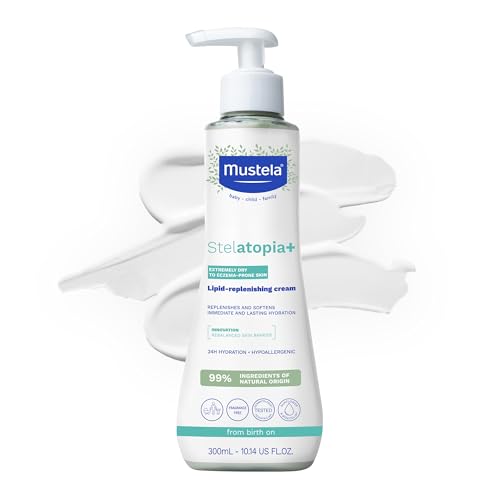
Mustela’s Stelatopia+ line was reformulated to deliver 24-hour moisture replenishment for eczema-prone skin using a prebiotic complex and natural sunflower oil. The texture is a rich cream that absorbs within about 90 seconds — no greasy residue lingering on a baby’s neck folds or behind the knees.
The EWG Verified badge here matters: it means the formula was checked for transparency and ingredient hazard scores, a meaningful signal for parents worried about undisclosed preservatives. The pump dispenser also keeps contamination risk low when you’re applying one-handed while holding a squirming infant.
Clinically tested for newborns, the cream relies on patented Avocado Perseose for barrier strengthening. It performs best as a twice-daily maintenance lotion rather than an acute flare-up rescue. For deep sleepers, the 24-hour hydration claim holds in low-humidity nursery conditions.
Why it’s great
- Pump bottle keeps the cream clean between uses
- Absorbs fast and leaves zero sticky feel on clothes
- EWG verification gives third-party ingredient confidence
Good to know
- Premium tier pricing for a relatively small tube volume
- Not ideal as a heavy overnight occlusive on raw patches
2. ATOPALM MLE Eczema Cream
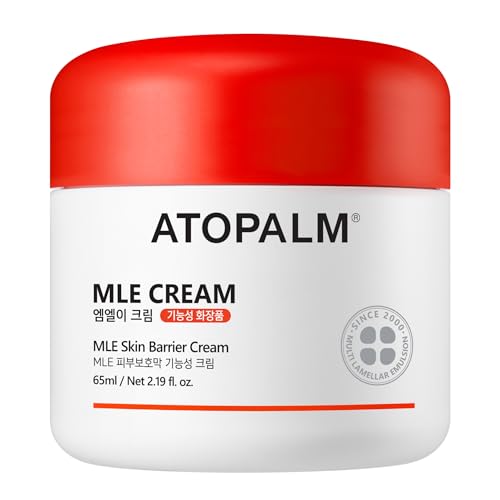
ATOPALM takes a different, more structural approach: its MLE (Multi-Lamellar Emulsion) technology rebuilds the outer lipid layer by arranging ceramides, cholesterol, and fatty acids in the same order they appear in healthy skin. The 2.2-ounce tube packs serious science into a small footprint.
Korean skincare expertise shines through in the texture — it’s a lightweight cream that sinks in almost immediately, making it a strong candidate for daytime use under clothing. The mildly acidic pH (5.5) helps restore the skin’s acid mantle, which tends to drift alkaline in eczema flares.
Free from 10 common irritants including parabens, artificial fragrances, and essential oils, this cream covers the whole face and body. The trade-off: the package is noticeably smaller than competing options, so parents managing widespread eczema may reorder frequently.
Why it’s great
- MLE technology mimics real skin structure for deeper repair
- Fast-absorbing formula leaves toys and onesies grease-free
- pH-balanced formula soothes without stinging
Good to know
- Small tube won’t last long with twice-daily full-body use
- Higher price per ounce than petrolatum-based alternatives
3. La Roche-Posay Lipikar AP+MAX Triple Repair Body Cream
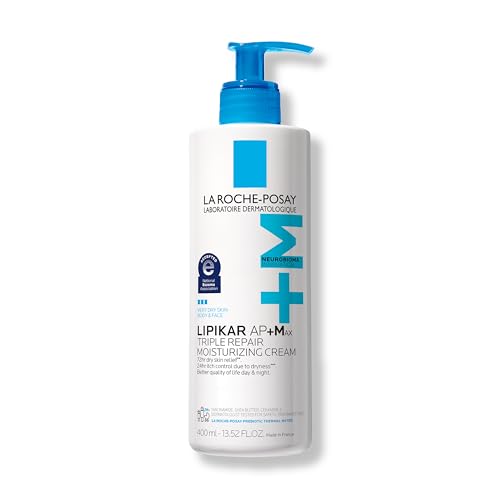
La Roche-Posay’s Lipikar AP+MAX hits a rare balance: it carries the National Eczema Association’s acceptance seal, is safe for infants as young as two weeks, and comes in a generous 15.87-ounce pump bottle that cuts the hassle of daily reapplications. The formula combines shea butter, glycerin, niacinamide, and ceramides for a multi-layered approach to dryness.
The Neurobioma technology here targets the skin’s microbiome and nervous system simultaneously, which translates to tangible itch reduction — clinical data shows 24-hour itch control from dryness after consistent use. The cream itself is thick but rubs down to a velvety finish that doesn’t stain crib sheets.
Dermatologist- and pediatrician-tested with no added fragrance, this is one of the few options that works well as both a daily moisturizer and a post-bath sealant. The only caution is for extremely raw skin: the rich texture can feel heavy on badly broken patches, so start with a thinner layer and build up.
Why it’s great
- Large pump bottle minimizes waste and mess
- Accepted by the National Eczema Association
- 24-hour itch control backed by clinical data
Good to know
- Rich texture may feel greasy on highly sensitive, broken skin
- Not targeted specifically at acute flare-ups like ointments
4. Mustela Stelatopia Intense Eczema Relief Cream
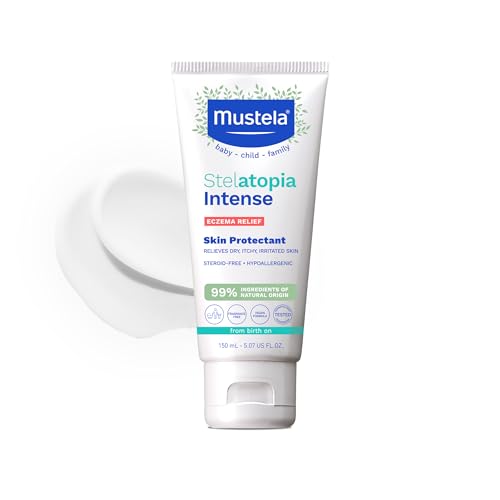
Mustela’s Stelatopia Intense is a colloidal oatmeal cream formulated explicitly for mild to moderate eczema flares. The 5.07-ounce tube is positioned as an on-demand reliever: a thicker, more targeted emollient than the Stelatopia+ daily cream, ideal for spot-treating the elbows, wrist creases, and cheeks that flare reddest.
Colloidal oatmeal at 1% concentration provides avenanthramides, which reduce histamine release and calm the skin’s urge to itch. The rest of the formula — 99% natural ingredients — includes sunflower oil distillate, a lipid source that reinforces the moisture barrier without clogging pores. Parents report visible redness reduction within two applications.
The texture is richer than a standard lotion but still spreadable for quick application during a diaper change. It lacks the EWG verification of the Stelatopia+ line, though Mustela maintains its own strict traceability standards. Use this fast when you see a patch turning angry — it’s not meant for everyday all-over slathering.
Why it’s great
- Colloidal oatmeal delivers measurable itch relief within hours
- High natural-origin percentage appeals to clean-label parents
- Redness visibly fades after two applications
Good to know
- Not EWG Verified like the brand’s own Stelatopia+ line
- Smaller tube size relative to daily-use alternatives
5. Aquaphor Baby Healing Ointment
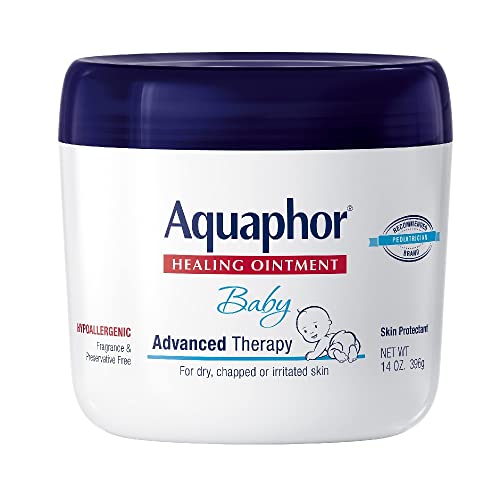
Aquaphor Baby Healing Ointment is the reliable entry-level workhorse — a 14-ounce tub of 41% petrolatum that creates an impenetrable moisture seal. Unlike heavy creams, it contains no water, so it never dilutes when layered over a water-based lotion. It’s the go-to for overnight occlusion or as a diaper-rash barrier when baby is in a full flair.
Parents trust it because its ingredient list is short: petrolatum, mineral oil, ceresin, lanolin alcohol, panthenol, glycerin, and bisabolol. No preservatives, no fragrances, no parabens. It holds up to drool rash around the chin and chapped cheeks from winter wind with zero sting upon application.
The catch: petrolatum is purely occlusive and contributes no restorative lipids. It will not strengthen the skin barrier over the long term the way ceramide or MLE formulas do. Use it as a protective topcoat over a therapeutic cream, not as a standalone eczema treatment.
Why it’s great
- Extremely affordable per ounce for full-body coverage
- Zero irritants plus bisabolol for calming inflammation
- Versatile for drool rash, diaper area, and winter windburn
Good to know
- Greasy feel transfers to onesies and bedding
- No barrier-repair ingredients — just occlusion
FAQ
Can I use an adult eczema cream on my infant?
How often should I apply lotion for infant eczema?
Do I need a prescription lotion or can OTC creams work?
Final Thoughts: The Verdict
For most users, the lotion for infant eczema winner is the Mustela Stelatopia+ Lipid-Replenishing Cream because it blends EWG-verified safety, 24-hour hydration, and prebiotic barrier support in a format that’s easy to apply daily. If you want deep lipid-layer repair without the heavy feel, grab the ATOPALM MLE Eczema Cream. And for an affordable protective seal that stops moisture loss during the night, nothing beats the Aquaphor Baby Healing Ointment.