A fully stocked pantry is a luxury, but a long-term food storage system is a lifeline. The disconnect between buying a bag of rice and building a supply that can genuinely weather a multi-year disruption is massive — and getting it wrong means wasting money on meals that degrade, spoil, or simply don’t deliver the calories your family needs.
I’m Emma — the founder and writer behind Baby Bangs. I’ve spent countless hours cross-referencing shelf-life data, caloric densities, packaging integrity specs, and real-world serving sizes to separate marketing claims from actual survival value.
After comparing seven of the most serious contenders in the category, this guide breaks down exactly what separates a smart investment from a shelf turd. You’ll get the full picture on finding the right long term food storage for your situation without the hype.
How To Choose The Best Long Term Food Storage
Selecting a solid emergency food supply comes down to three main pillars: the actual shelf life of the food, the caloric value per serving, and the quality of the ingredients. Don’t get seduced by a low price tag that hides a bucket full of sugary drinks and cheap rice fillers.
Decoding the Shelf Life Claim
A “25-year shelf life” is only valid if the food is stored properly in a cool, dry environment and the packaging remains airtight. Look for Mylar pouches with oxygen absorbers and nitrogen flushing — these are non-negotiable for long-term preservation. Buckets alone are not enough unless the food inside is individually sealed.
Real Calories vs. Filler Calories
Many budget-friendly kits bulk up their serving counts by including items like white rice, pasta, and sugary drink mixes. These provide quick energy but lack the protein, fiber, and fat needed for sustained energy during a crisis. Prioritize kits that list caloric density per pouch and show a balance of macronutrients from real ingredients like beans, meat, and whole grains.
Packaging and Portability
Consider how the food is packed. Individual #10 cans or mylar pouches inside a bucket offer the best protection against moisture, pests, and oxygen. Stackable buckets are a bonus for tight storage spaces, but the primary concern is the integrity of the pouch inside. A puncture on a single pouch can ruin an entire bucket of food if the pouches aren’t individually sealed.
Quick Comparison
On smaller screens, swipe sideways to see the full table.
| Model | Category | Best For | Key Spec | Amazon |
|---|---|---|---|---|
| Mountain House 14-Day Kit | Freeze-Dried | Premium, 30-Year Taste Guarantee | 84 servings, 30-year shelf life | Amazon |
| Legacy Food Storage 120 Serving | Freeze-Dried | Highest calorie density per serving | 45,720 total calories, 25-year shelf life | Amazon |
| ReadyHour Breakfast Bucket | Dehydrated | Morning meals, 2,000+ cal/day | 128 servings, 25-year shelf life | Amazon |
| Ready Hour Beans Trio & Rice | Staples | Core staple base, versatile meals | 100 servings, 30-year shelf life | Amazon |
| The Survival Tabs 60-Day Kit | Compressed | Ultra-compact, lightweight quick fuel | 720 tabs, 25-year shelf life | Amazon |
| ReadyWise 360 Serving Kit | Mix | Large family bulk supply | 360 servings, 25-year shelf life | Amazon |
| ePackageSupply 5-Gallon Buckets | Container | DIY bulk storage of staples | 90 mil HDPE, BPA-free, Gamma Seal | Amazon |
In‑Depth Reviews
1. Mountain House 14-Day Emergency Food Supply

Mountain House sets the gold standard with its 30-Year Taste Guarantee, a claim backed by decades of proven storage performance. This 14-Day kit delivers 84 servings of freeze-dried meals like lasagna, pasta alfredo, and scrambled eggs — comfort food that actually tastes good after years in the pantry. Every pouch is sealed using a nitrogen-flush process that removes oxygen, which is the primary cause of flavor degradation and spoilage over time.
Each serving typically comes in at around 200–300 calories, but the key here is ingredient quality: no artificial flavors or colors, and the texture rehydrates better than most competitors. The packaging is designed for responsible disposal through TerraCycle, a nice touch for the eco-conscious prepper. At 15.5 pounds total, this kit is manageable for a two-person household looking for a serious, ready-to-go solution.
The biggest drawback is the price point, which puts it firmly in the premium tier. It also lacks the massive calorie density of some bulk competitors — you might need to supplement with additional calorie sources for extended active use. For sheer quality and long-term reliability, however, this is the most trusted name in the game.
Why it’s great
- Industry-leading 30-Year Taste Guarantee
- No artificial flavors or colors in any meal
- Nitrogen-flushed Mylar pouches for max preservation
Good to know
- Premium price, high upfront investment
- Moderate calorie density per serving
- Heavier per calorie than some other kits
2. Legacy Food Storage 120 Serving Emergency Food Supply
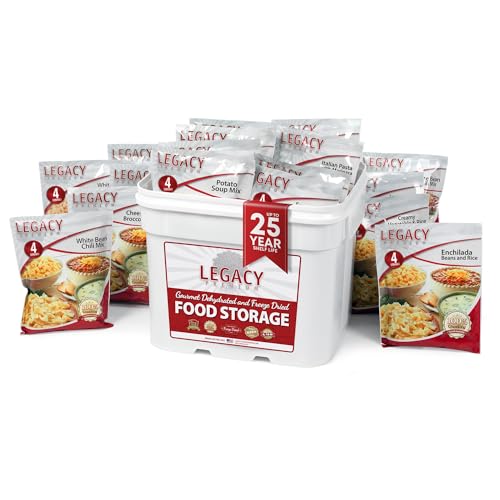
Legacy focuses on what matters most — actual caloric density per serving. With 45,720 total calories packed into just 120 servings, this bucket delivers roughly 381 calories per serving, which is significantly higher than many competitors that rely on filler items like rice or sugary drinks to inflate serving counts. The 12 entrees are made with premium, non-GMO ingredients and contain no added MSG, high-fructose corn syrup, or trans fats.
Preparation is as simple as adding boiling water directly to the Mylar pouch, and the meal is ready in minutes. The four-serving pouches are nitrogen-flushed with oxygen absorbers for a certified shelf life of up to 25 years. Legacy’s no-filler philosophy means you get real protein and fiber from beans, meats, and whole grains rather than cheap starch fillers that spike blood sugar and provide little long-term energy.
The trade-off is that the bucket is quite large and heavy at 29 pounds, and the variety of meals is limited to 12 options. If you prioritize raw nutritional firepower over menu diversity, this is your pick.
Why it’s great
- Highest calorie density per serving in this review
- No filler ingredients, real meat and grains
- 25-year shelf life with nitrogen-flushed pouches
Good to know
- Limited menu rotation (12 entree options)
- Heavy bucket (29 pounds) not ideal for grab-and-go
- Premium pricing per bucket
3. ReadyWise 360 Serving Emergency Food Supply

The ReadyWise 360-serving kit is a bulk-density solution that aims to feed a family for months. It comes as three separate buckets, each packed with a mix of freeze-dried and dehydrated entrées and breakfast meals. The split-lid design is a genuine convenience hack — you can access pouches without dumping out the entire bucket, and the lid flips over to double as a serving tray or food holder.
Each pouch is designed for simple preparation: add hot water, wait a few minutes, and eat. The variety includes comfort classics like Cheesy Macaroni, Lasagna, and Pasta Alfredo, plus some breakfast options. The shelf life is rated at 25 years, and the food is sealed in mylar pouches with oxygen absorbers. At 62 pounds total for the three buckets, it’s a heavy setup but one that provides tremendous value in terms of cost per serving compared to premium single-bucket kits.
On the downside, some pouches are heavier on carbohydrates and rely more on dehydrated vegetables rather than freeze-dried meats. The caloric density per serving can be lower than premium options, so you may need to eat larger portions to hit your daily energy requirements during an active emergency.
Why it’s great
- Excellent cost per serving for bulk quantity
- Split-lid design with integrated serving tray
- 25-year shelf life in sealed mylar pouches
Good to know
- Heavier on carbs, less protein per serving
- Some pouches use dehydrated ingredients
- Very heavy total weight (62 lbs)
4. Ready Hour Breakfast Bucket (128 Servings)
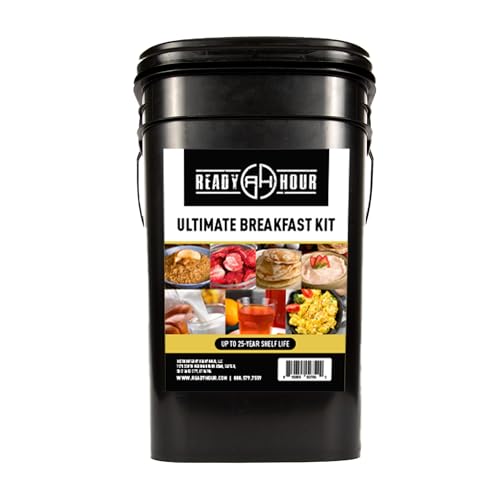
Breakfast is often the most overlooked meal in emergency food kits, and Ready Hour fills that gap nicely with a dedicated bucket. This 128-serving kit delivers over 2,000 calories per day, built around seven different breakfast varieties including Maple Grove Oatmeal, Buttermilk Pancakes, and Scrambled Eggs. Most items require only hot water and a short wait, with some pouches needing no preparation at all.
The food is sealed in quadruple-wrapped, resealable pouches with double-sized oxygen absorbers — a serious level of protection that supports the 25-year shelf life claim. The industrial-strength bucket itself is flood-safe and stackable, making it easy to integrate into an existing pantry rotation. For families with kids, having a familiar breakfast option can be a huge psychological boost during a stressful event.
The main limitation is that this is purely a breakfast solution — you will still need a separate lunch/dinner kit or a staples supply to cover full-day nutrition. Additionally, many of the items are primarily carbohydrate-based, so you’ll want to pair this with protein-rich meals from another source to maintain energy balance over time.
Why it’s great
- Dedicated breakfast variety with 7 options
- Quadruple-wrapped pouches with large oxygen absorbers
- Flood-safe, stackable bucket design
Good to know
- Breakfast only — requires separate meal kit
- Heavy on carbohydrates
- Calorie density varies between pouches
5. Ready Hour Beans Trio with Rice Kit Bucket (100 Servings)

This kit strips away the fluff and focuses on the most critical survival staples: beans and rice. With 100 servings of Long Grain White Rice, Southwest Rice, Black Beans, Red Beans, and Pinto Beans, you get a complete protein source when eaten together. The 30-year shelf life is one of the longest in the industry, and the quadruple-wrapped resealable pouches inside a rugged water-resistant bucket offer serious long-term protection.
Prep is straightforward — boil water, add pouch contents, cook for under 30 minutes, and eat. The beauty of beans and rice is their versatility: you can combine them with virtually any other ingredient to create a balanced meal. This makes them an ideal foundation supply that you can build upon with freeze-dried meats, vegetables, or sauces from other kits. The bucket weighs 13 pounds, making it easy to store and transport compared to heavier mixed-meal buckets.
The downside is that these are simple staples, not complete meals. You will need to supplement with fats, spices, and vegetables to make the diet palatable over long periods. Also, the white rice variety is less nutritionally dense than brown rice or quinoa, though it stores much longer.
Why it’s great
- 30-year shelf life, longest in this review
- Complete protein when beans and rice are combined
- Lightweight and easy to store at 13 lbs
Good to know
- Requires supplemental ingredients for balanced meals
- White rice is less nutrient-dense than alternatives
- Not a standalone “meal in a pouch” solution
6. The Survival Tabs 60-Day Kit (720 Tabs)
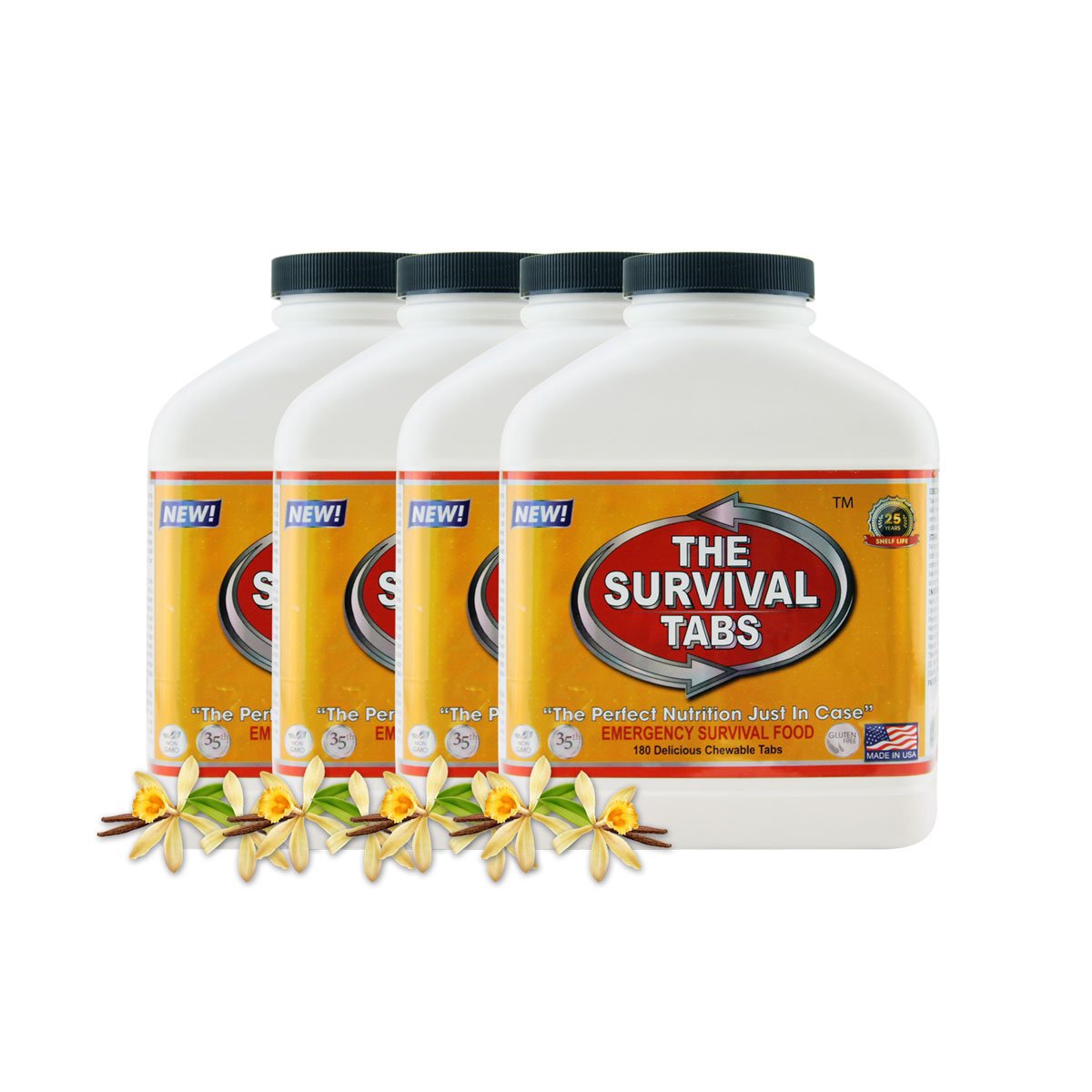
The Survival Tabs take a radically different approach to long-term storage: compressed nutrition in tablet form. Each bottle contains 180 chewable vanilla-flavored tablets, with four bottles providing a claimed 60-day supply for one person at a rate of 12 tablets per serving. At 20 calories per tab, a full serving delivers 240 calories, which is minimal — you would need to eat significantly more to sustain an active lifestyle.
What makes these tabs unique is the 100% of 15 essential vitamins and minerals per serving, along with a gluten-free and non-GMO formula. The compact dimensions (7.5 x 5 x 2.75 inches per bottle) make this the ultimate solution for a bug-out bag, vehicle kit, or any space-constrained scenario. The 25-year shelf life is verified by the packaging, and the tabs require no water, preparation, or cooking to consume.
The harsh reality is that 240 calories per serving is not enough for sustained physical activity. This is a “survival” product meaning you will not starve, but you will lose weight. The vanilla flavor, while palatable, becomes monotonous very quickly. Think of these as an insurance policy for extreme mobility scenarios, not a primary food source for home-based, long-term storage.
Why it’s great
- Ultra-compact and lightweight for bug-out bags
- 100% of essential vitamins and minerals per serving
- Gluten-free and non-GMO with 25-year shelf life
Good to know
- Low calorie density (240 cal per serving)
- Requires significant quantity for active living
- Flavor monotony over extended use
7. ePackageSupply 5-Gallon Food Grade Buckets (6 Pack)

If you prefer to build your own storage system from scratch, these ePackageSupply buckets are the foundation. Each bucket is made from 90 mil HDPE plastic, which is exceptionally durable and BPA-free, with an FDA-compliant rating for direct food contact. The gamma seal screw-on lid provides an airtight seal that is far superior to a standard snap-on lid, and the reinforced stacking ring makes vertical storage stable and efficient.
Each bucket holds 5 gallons (640 oz) of dry goods, meaning you can fill these with rice, beans, oats, pasta, or any other bulk staple you buy in large quantities. The metal handle with a plastic grip makes carrying a full bucket manageable even when fully loaded. Dimensions of 11.9 x 14.56 inches mean they fit neatly on standard shelving units. The buckets are also freezer-safe down to -5°F, extending your storage options for long-term frozen items.
The obvious caveat is that these are empty containers — you need to source, package, and seal your own food inside them. To achieve a true 25-30 year shelf life, you must use oxygen absorbers and mylar bags inside the buckets. They are also heavy (2 pounds empty) before you add any food. This is the right choice for experienced preppers who want control over their inventory but not for someone looking for a ready-to-eat solution.
Why it’s great
- Heavy-duty 90 mil HDPE, BPA-free and FDA compliant
- Gamma seal lids provide superior airtight seal
- Reinforced stacking ring for stable vertical storage
Good to know
- Empty containers — requires DIY food packaging
- Additional mylar bags and O2 absorbers needed for long-term
- Heavier than standard buckets when full
FAQ
How much long term food storage do I need for a family of four for one year?
What is the difference between freeze-dried and dehydrated food for long term storage?
Can I store regular grocery store food for long term storage?
How do I rotate my long term food storage to avoid waste?
Final Thoughts: The Verdict
For most users, the long term food storage winner is the Mountain House 14-Day Emergency Kit because it delivers the longest proven shelf life, the most trusted brand in the industry, and genuinely good-tasting meals that your family will want to eat. If you want maximum caloric density for your dollar, grab the Legacy Food Storage 120 Serving Bucket. And for a budget-conscious bulk supply that covers a large family, nothing beats the ReadyWise 360 Serving Kit — just be prepared to supplement with protein-rich staples to balance the carb-heavy profile.