A baby’s brain forms over 1 million neural connections each second in the first year, and the toys they grip, bat, and mouth directly shape that wiring. The right playthings do more than occupy tiny hands — they build the architecture for language, motor control, and cause-effect reasoning before a child speaks their first word.
I’m Emma — the founder and writer behind Baby Bangs. I’ve spent years analyzing how material safety, textile density, and age-specific mechanics affect infant development outcomes from the nursery floor up.
Every toy on this list passed a rigorous screen for non-toxic construction and developmental alignment, making this guide the only resource you need to find the best learning toys for babies that actually support growth without hidden hazards.
How To Choose The Best Learning Toys For Babies
Not every colorful box on the shelf earns a spot in a developing infant’s hands. The difference between a toy that teaches and one that just distracts comes down to three factors: material safety, the type of sensory feedback, and whether the activity encourages the baby to initiate action rather than passively observe. Below are the specific criteria that separate developmental winners from floor clutter.
Material Safety Above All
Babies explore every toy with their mouths first — that is not a behavior you can train away. Any toy for a child under 18 months must be constructed from food-grade silicone, BPA-free ABS plastic, or certified organic fabric. Check for third-party lab certification to ASTM F963 and CPSIA standards. Wood is excellent if it is finished with water-based, non-toxic lacquer. Avoid anything with small parts that fit through a choke tube (1.25 inches in diameter) and skip any painted surface that flakes under a thumbnail scratch test.
Cause-Effect Mechanics Over Passive Screens
An electronic book that plays a word when a baby presses a button is teaching cause and effect — that is good. A video that plays automatically without any baby-initiated action teaches nothing except passive viewing. Prioritize toys that require a physical action: pushing a lever, spinning a drum, pulling a string, or kicking a pad. These movements build the neural loop between intention and outcome, which is the foundation of problem-solving.
Age-Window Alignment
0-6 months: high-contrast black-and-white patterns, unbreakable mirrors, soft rattles that reward grasping. 6-12 months: spinning drums, stacking rings, shape sorters with large pieces, pull strings for pincer grasp development. 12-18 months: word books with touch-activated audio, simple puzzles, push-pull walkers. Buying a toy for a milestone the baby has not reached yet leads to frustration; buying one for a milestone already passed leads to boredom. Match the toy to the month, not the label.
Quick Comparison
On smaller screens, swipe sideways to see the full table.
| Model | Category | Best For | Key Spec | Amazon |
|---|---|---|---|---|
| Plunack 6-in-1 Set | Premium All-in-One | Full milestone coverage 6-12 months | 27 pieces, food-grade silicone & BPA-free ABS | Amazon |
| Baby Einstein Kick Pad | Premium Musical Mat | Tummy time & crib cause-effect play | 5 kick buttons, 3 languages, 3 modes | Amazon |
| LeapFrog 100 Words Book | Mid-Range Audio Book | Bilingual vocabulary building 18+ months | 100 words in English & Spanish, sound effects | Amazon |
| Infantino Busy Board Boat | Mid-Range Activity Board | Newborn to 36 months sensory play | Double-sided, folds flat, carry handle | Amazon |
| Adena Montessori Kit | Budget Montessori Set | 6-12 month fine motor & tummy time | Spinning drum, mirror puzzle, fabric ball | Amazon |
In‑Depth Reviews
1. Plunack 6 in 1 Montessori Baby Toys
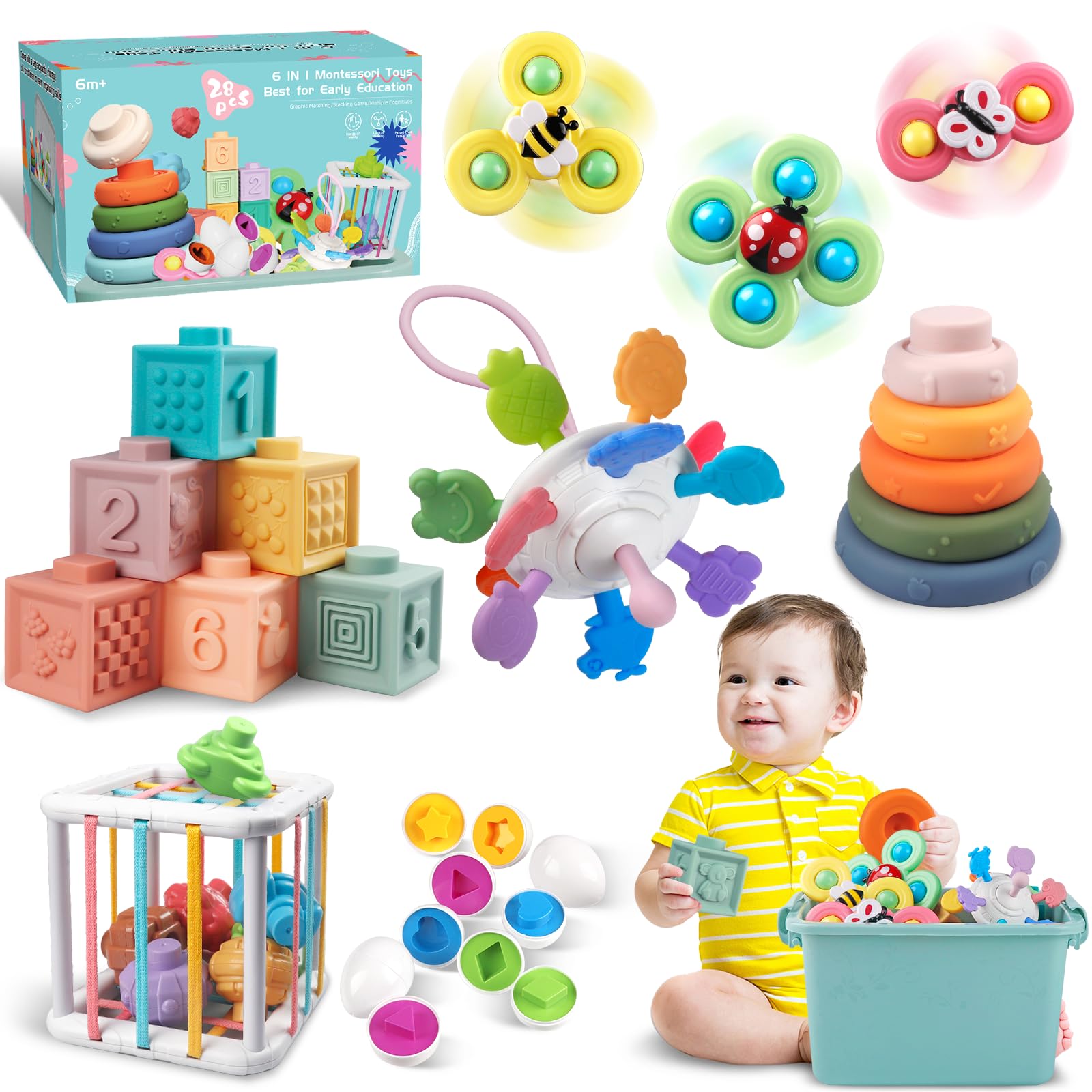
The Plunack set collapses what would be six separate toy purchases into one organized bin containing 27 individual pieces — stacking rings, shape-sorter eggs, soft building blocks, suction-cup spinners, a pull-string toy, and a sensory exploration bin. Every component is molded from food-grade silicone or BPA-free ABS plastic, both certified to ASTM F963 and CPSIA standards, meaning you can hand these to a teething 6-month-old without worrying about chemical leaching. The shape-sorter eggs alone teach 12 colors and 6 geometric forms, while the textured pull strings are specifically designed to strengthen the pincer grasp that pediatric occupational therapists target starting at month six.
What separates this set from cheaper alternatives is the material consistency: the silicone blocks withstand 200°C heat and are dishwasher-safe, so sterilization between play sessions is effortless. The suction-cup spinners stick firmly to highchair trays and bathtub walls, keeping a baby engaged during meals and baths without sliding off. Each toy targets a discrete developmental milestone rather than offering random sensory noise, which is the hallmark of thoughtful Montessori-inspired design.
The included storage bin doubles as a sensory play container and keeps all 27 pieces organized for travel to daycare or grandparents’ homes. For parents who want one comprehensive kit that covers fine motor skills, spatial reasoning, color recognition, and cause-effect learning from 6 to 18 months, this is the most efficient purchase you can make.
Why it’s great
- 27 pieces cover 6 distinct skill categories in one box — no need to buy separate toys for each milestone
- Food-grade silicone withstands 200°C and is dishwasher-safe for easy daily sterilization
- Suction spinners attach to highchair trays, car windows, and bathtub walls without falling
Good to know
- Some babies may lose interest in the shape-sorter eggs before mastering all 12 colors and 6 shapes
- Storage bin is functional but not as visually appealing as dedicated toy chests
2. Baby Einstein Ocean Explorers Kick Pad

The Neptune Kick Pad reimagines the traditional crib mobile as an interactive cause-effect learning station. Five oversized kick buttons, each color-coded and shaped differently, trigger lights, music, and spoken words across three distinct play modes: Melody Mode for musical exposure, Piano Mode where babies create original marimba-based melodies, and Discovery Mode that teaches colors, numbers, and shapes in English, Spanish, and French. The soft fabric mat is machine-washable and attaches to crib rails for reclined play or detaches completely for tummy time and seated floor exploration.
The standout engineering detail here is the sensitivity calibration of the kick sensors — they require a deliberate leg movement but not so much force that a newborn cannot trigger them. This makes the pad appropriate from birth through 36 months, adapting as the baby transitions from lying on their back to sitting upright and tapping the buttons with their hands. The three-language exposure is a genuine differentiator; most competing musical mats offer only English, while the Einstein pad builds early phonetic recognition in multiple languages through repeated passive exposure.
The pad requires 3 AA batteries and includes a 1-year manufacturer warranty, which is rare in this price tier. For parents who want a stationary crib activity that builds leg strength and auditory discrimination simultaneously, this is the most sophisticated option available for the 0-12 month window.
Why it’s great
- Tri-lingual Discovery Mode teaches colors, numbers, and shapes in English, Spanish, and French
- Kick sensors are calibrated for newborns — deliberate leg movement triggers sounds without excessive force
- Mat detaches from crib for tummy time and seated floor play, extending useful life to 36 months
Good to know
- Requires 3 AA batteries; demo batteries are included but weak and should be replaced immediately
- Music modes can become repetitive for adults during extended play sessions
3. LeapFrog Learning Friends 100 Words Book

The LeapFrog 100 Words Book replaces the passive board book with an interactive electronic page-turner that rewards each tap with the spoken word, a matching sound effect, and a fun fact about the object. The vocabulary is organized into nine categories — pets, animals, food, mealtime, colors, activities, opposites, outside, and transportation — each curated by early-learning specialists to match the recognition patterns of toddlers 18 months and older. The light-up star button plays the Learning Friends theme song and allows the child to select their favorite word, which the book remembers and repeats on subsequent plays.
The full bilingual capability is the strongest argument for this book over cheaper sound-button alternatives. Every word, song, and instruction can be toggled between English and Spanish with a single sliding switch, so a child hears the same vocabulary in both languages with consistent native pronunciation. This is not a translation feature bolted on as an afterthought — the Spanish audio tracks use proper inflection and pacing, which matters for language acquisition in bilingual households.
The book runs on 2 AA batteries and is sized at 9.4 inches wide by 9.2 inches tall — large enough for a toddler to manipulate independently but not so heavy that it tips over on a lap. For parents focused on vocabulary expansion and early reading readiness in a bilingual context, this remains the gold standard for electronic learning books in the 18-24 month range.
Why it’s great
- Full bilingual playback with native pronunciation in both English and Spanish — not a gimmick overlay
- 100 age-appropriate words curated by learning experts across 9 distinct categories
- Light-up star button lets child save a favorite word, building early personalization and recall
Good to know
- Official age recommendation is 18+ months; younger babies may try to mouth the book rather than tap pages
- Sound effects can be loud at default volume; no low-volume setting is available
4. Infantino Busy Board Mirror & Sensory Discovery Boat

The Infantino Busy Board Boat packs a surprising amount of sensory variety into a collapsible fabric structure that weighs under a pound. One side features a super-selfie mirror surrounded by high-contrast black-and-white prints aimed at newborns developing visual tracking, while the opposite side contains spinning gears, bead runs, crinkle flaps with animal illustrations, and number graphics. The entire board folds in half with a carry handle, making it one of the few developmental toys that fits easily into a diaper bag or stroller storage pocket.
The double-sided design is the practical differentiator here. Babies under 6 months benefit most from the mirror and high-contrast side during tummy time, while older infants from 6 to 36 months explore the gear-spinning and bead-manipulation side that builds fine motor dexterity. The crinkle flaps are made from tear-resistant fabric and pass the choke-tube test, so you do not have to supervise every second of play. The board lays flat on the floor for tummy time, folds into a triangle for seated play, or hangs over the edge of a playpen thanks to the integrated strap.
For parents who travel frequently or need a portable sensory solution that works from birth through toddlerhood, this board eliminates the need to pack separate toys for each age stage. The low weight and collapsible design mean it takes up less space than a onesie in a diaper bag.
Why it’s great
- Double-sided design serves newborns (mirror, high-contrast) and older infants (gears, beads) with one product
- Folds flat with carry handle; weighs under a pound for easy diaper bag storage
- Crinkle flaps are tear-resistant and pass choke-tube safety standards
Good to know
- Gears spin freely but offer no resistance, so the cause-effect feedback is purely visual
- Fabric exterior can show stains quickly; requires spot cleaning rather than machine washing
5. Adena Montessori Baby Toys Play Kit

The Adena Montessori Play Kit strips away all excess packaging and delivers three core Montessori materials — a spinning rainbow drum, a knobbed mirror puzzle, and a fabric rainbow ball — that each isolate a single developmental skill. The spinning drum is the star of the set: a wooden cylinder wrapped in alternating colored segments that rotates on a low-friction axle. A baby lying on their tummy can bat the drum with their palm, watching the colors blur into a pattern while the drum produces a gentle rattling sound from internal bearings. The rolling movement builds arm and wrist muscles while the visual pattern reinforces color tracking and peripheral awareness.
The knobbed mirror puzzle introduces a very early form of problem-solving: a baby must grasp the chunky wooden knob and lift the mirror piece out of its shallow recess. This is the same fine motor challenge found in expensive Montessori subscription boxes, but executed here with simpler materials at a lower investment. The fabric ball is lightweight enough for a 6-month-old to grasp with two hands and transfer between palms, developing bilateral coordination. All materials are manual — no batteries, no lights — which aligns with the Montessori principle that the child must initiate movement to learn.
For parents who want to test Montessori methodology without committing to a full-priced subscription kit, this three-piece set provides the core sensory and motor experiences that define the approach. The spinning drum alone often becomes a baby’s favorite tummy-time companion, encouraging extended floor time that strengthens neck and core muscles.
Why it’s great
- Spinning drum rewards batting with visual color blur and gentle rattle — pure cause-effect mechanics without batteries
- Knobbed mirror puzzle introduces early problem-solving through grasp-and-lift manipulation
- All three toys are manual and silent, respecting the Montessori principle of child-initiated play
Good to know
- Three toys only — ideal for focused play but limited variety compared to all-in-one sets
- Fabric ball is lightweight and may roll away from babies who cannot yet crawl effectively
FAQ
At what age should I introduce a spinning drum to my baby?
Do electronic learning books delay language development?
What makes a busy board better than individual sensory toys?
How do I clean silicone baby toys safely?
When should I rotate my baby’s toys for maximum learning benefit?
Final Thoughts: The Verdict
For most users, the best learning toys for babies winner is the Plunack 6-in-1 Set because it packs 27 pieces across six skill categories into one organized bin, saving money and floor space while covering the critical 6-18 month window with food-grade safety materials. If you want a stationary crib activity that builds leg strength and trilingual auditory skills, grab the Baby Einstein Kick Pad. And for portable sensory variety from birth through toddlerhood, nothing beats the Infantino Busy Board Boat.