Between eight and twelve months, your baby transforms from a passive observer into an active explorer. Everything goes into the mouth, every surface gets tapped, and every object gets shaken to see what noise it makes. The right toys during this stage don’t just entertain — they wire the brain for cause-and-effect reasoning, fine motor control, and sensory integration.
I’m Emma — the founder and writer behind Baby Bangs. I’ve spent countless hours analyzing developmental toy categories, weighing the safety certifications, material grades, and age-appropriate design choices that separate engaging learning tools from frustrating clutter.
After sorting through what actually works during these critical months, I’ve narrowed down the top contenders for the best learning toys for 8-12 months that genuinely support your baby’s rapidly developing skills.
How To Choose The Best Learning Toys For 8-12 Months
The 8-12 month milestone is a sensory and motor explosion. Your baby is likely sitting independently, starting to crawl or cruise, and using both hands to transfer objects. Choosing toys that match these specific emerging skills — rather than ones meant for older toddlers — makes the difference between engaged learning and frustrated tossing.
Material Safety and Teething Readiness
At this age, the mouth is a primary exploration tool. Every toy should be made from BPA-free, phthalate-free, and lead-free materials. Food-grade silicone is the gold standard because it’s soft enough to soothe sore gums yet durable enough to withstand repeated chewing. Avoid hard plastics with sharp edges or small parts that could become choking hazards.
Cause and Effect Mechanics
Babies around 8-12 months are just beginning to understand that their actions produce reactions. Toys with levers, buttons, switches, and pull strings teach this core cognitive principle. The best options offer clear, immediate feedback — a pop-up animal, a spinning spinner, or a musical sound — that helps your baby connect the action with the outcome.
Fine Motor Skill Development
Look for toys that require grasping, pinching, twisting, and stacking. These movements build the small hand muscles needed later for writing and self-feeding. Stacking rings, shape sorters, and pull-string toys are classics for a reason — they directly target pincer grasp development and hand-eye coordination during this narrow window.
Quick Comparison
On smaller screens, swipe sideways to see the full table.
| Model | Category | Best For | Key Spec | Amazon |
|---|---|---|---|---|
| Plunack 6-in-1 Montessori Set | Premium Multi-Play | Complete developmental coverage | 27 pieces, food-grade silicone & ABS | Amazon |
| Duchong Pop Up Toy | Mid-Range Interactive | Cause-and-effect learning | 3 modes: animal sounds, game, quiet | Amazon |
| Qirptey Montessori Shape Sorter | Mid-Range All-in-One | Sorting, stacking, and teething | 4-in-1: blocks, cups, sorter, teether | Amazon |
| Jumble Jangle Suction Teether | Budget Sensory | High-chair entertainment and teething | BPA-free, strong suction base | Amazon |
| LeapFrog 100 Words Book | Budget Vocabulary | Early language exposure | 100+ words, English & Spanish modes | Amazon |
In‑Depth Reviews
1. Plunack 6-in-1 Montessori Baby Toys Set
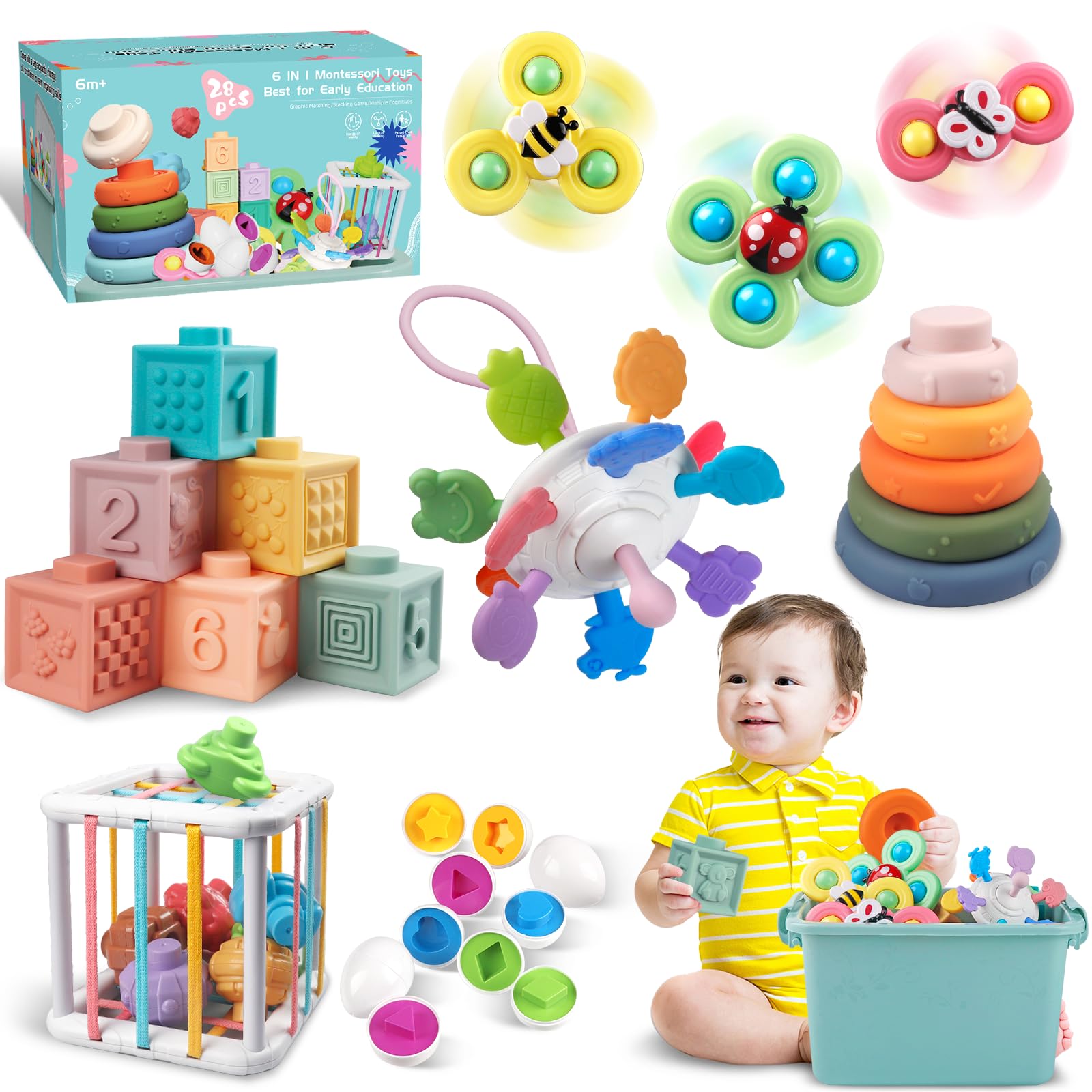
This kit is the most thoughtfully assembled developmental bundle I’ve found for this age range. Instead of buying six separate toys that may or may not engage your baby, Plunack packs 27 individual pieces — matching eggs, soft stacking blocks, stacking rings, suction cup spinners, a pull-string sensory toy, and an exploration bin — into one gift-ready set. Every component is crafted from either food-grade silicone or BPA-free ABS plastic, and each piece passes the choke tube test, meaning nothing is small enough to pose a risk but soft enough to offer teething relief.
Pediatric OTs specifically recommend the pull-string activity for developing the pincer grasp starting at six months, and the suction cup spinners stick firmly to high-chair trays, bathtub walls, and car windows, which makes this set genuinely versatile beyond the nursery. The stacking rings teach size sequencing, the shape sorter eggs build spatial reasoning across twelve colors and six shapes, and the sensory bin doubles as storage — a practical touch that keeps the 27 pieces from scattering across your living room floor.
For the price, you’re getting a complete Montessori-inspired curriculum for the 6-12 month stage rather than a single-function toy. The only catch is that the sheer number of pieces means you’ll want to supervise play sessions or rotate items to keep your baby from becoming overwhelmed. But for parents who want one comprehensive set that grows with their child through multiple milestones, this is the clear winner.
Why it’s great
- 27 pieces cover stacking, sorting, pulling, spinning, and teething in one box
- Food-grade silicone handles 200°C heat and is dishwasher-safe for easy sterilizing
- Suction spinners stick to high-chair trays and bathtubs for mess-free play anywhere
Good to know
- Large set requires adult supervision to keep pieces organized
- Age rating starts at 18 months, but individual components are safe for 6+ months with supervision
2. Duchong Pop Up Toy

This pop-up toy nails one of the most important developmental concepts for 8-12 month olds: cause and effect. Your baby activates a lever, switch, dial, or button, and an animal pops up with a corresponding sound or name. The tactile feedback is immediate and satisfying — exactly what a curious brain at this age craves. The toy offers three distinct modes: an animal sound mode that pairs each pop-up with the correct animal name and noise, a follow-the-light game mode that challenges your baby to find hidden animals, and a quiet mode that works without batteries for when you need a break from the music.
The construction uses top-grade ABS plastic that’s polished smooth and burr-free, so there are no sharp edges or rough spots. It’s also BPA-free, which matters because your baby will inevitably try to mouth the levers and buttons. The multiple activation mechanisms — pushing, sliding, turning, and pressing — give your baby a range of fine motor challenges rather than just one repetitive motion. Each action requires a slightly different grip, which helps build dexterity across the whole hand.
The only drawback is that batteries aren’t included, and the toy does rely on them for the two sound-active modes. Without batteries, you’re limited to the quiet mode, which is still fun but loses the audio feedback that makes the cause-and-effect learning so powerful. For parents who prioritize a screen-free way to teach logical connections, this is a strong contender.
Why it’s great
- Three distinct play modes keep the toy engaging as your baby develops new skills
- Multiple activation types (lever, switch, dial, button) target different fine motor grips
- Quiet mode works without batteries for low-stimulation play sessions
Good to know
- Batteries are not included and are required for sound modes
- Age rating recommends 12+ months, but the quiet mode works well for slightly younger babies
3. Qirptey Montessori Shape Sorter Bin
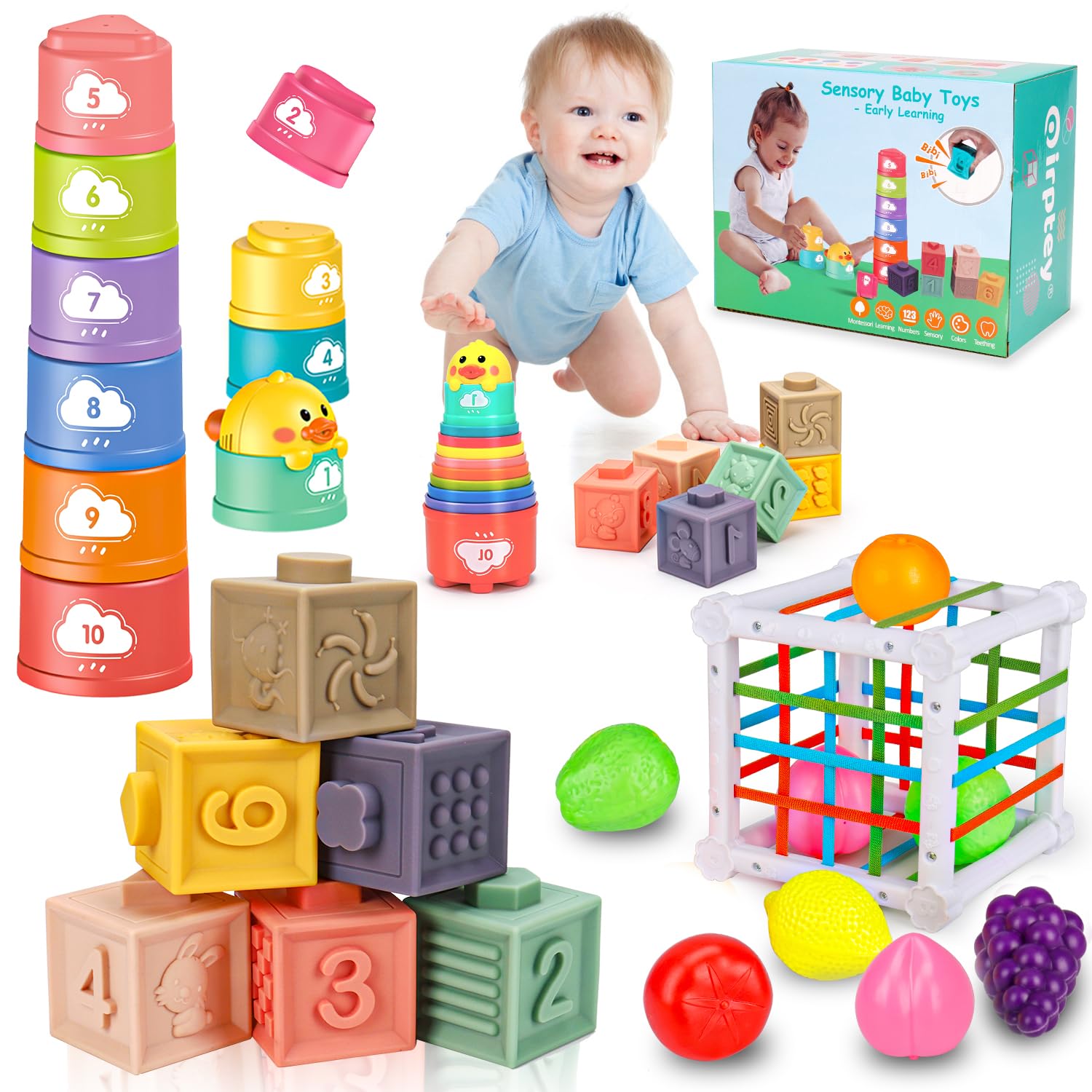
This set combines four classic developmental activities — stacking blocks, stacking cups, a shape sorter, and teething toys — into one cohesive kit. The shape sorter features fruit-themed slots (guava, orange, peach, tomato, lemon, grape), which adds a layer of visual recognition that goes beyond basic circles and squares. The stacking cups have embossed animals and numbers on the bottom, turning bath time into a matching game when you’re ready to transition the play to the tub.
The material choice here is what sets it apart from cheaper alternatives. The blocks and teethers are made from food-grade silicone that’s soft enough for sore gums, while the shape sorter bin and stacking cups use high-quality ABS. This dual-material approach means the teething components are gentle and flexible, but the structural pieces are sturdy enough to withstand being thrown or dropped repeatedly. The colors are bright and distinct, which supports early color recognition without being garish or overstimulating.
The main limitation is that the set isn’t as expansive as the Plunack bundle — you’re getting fewer pieces and fewer activity types. The shape sorter is also relatively simple, with only six shapes, so your baby may master it quickly. However, for parents who want a focused set that hits the core stacking, sorting, and teething needs without the clutter of 27 pieces, this is a tidy and effective option.
Why it’s great
- Food-grade silicone blocks double as teething toys for sore gums
- Stacking cups with embossed animals work as bath toys and matching games
- Fruit-shaped sorter slots add visual interest beyond basic geometric shapes
Good to know
- Only six shape sorter pieces — may not challenge your baby for long
- Fewer total pieces than other all-in-one sets on this list
4. Jumble Jangle Suction Teething Toy
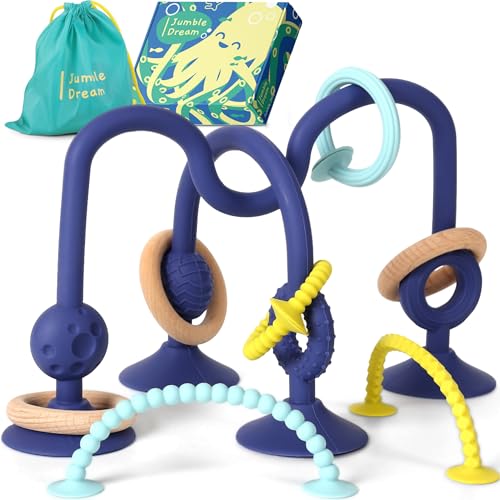
If mealtimes have become a game of “how fast can the baby throw this on the floor,” this suction toy is your solution. The Jumble Jangle features a strong suction base that anchors firmly to high-chair trays, smooth car seats, and bathtub walls, ending the constant retrieval cycle. The textured surfaces provide sensory stimulation while also soothing teething gums, and the BPA-free plastic construction meets all ASTM safety requirements, so you don’t have to worry about what’s going into your baby’s mouth.
What makes this particularly effective for the 8-12 month stage is the combination of suction and texture. Your baby can pull, twist, and mouth the toy without it sliding away, which builds hand strength and coordination. The toy is also dishwasher-friendly, which is a practical necessity for anything that spends time on a high-chair tray. The dark blue color hides food stains better than lighter options, another small but appreciated design consideration.
The obvious trade-off is that this is a single-function toy. It doesn’t teach cause and effect, stacking, sorting, or vocabulary — it’s purely a sensory teether with a clever suction base. It’s a fantastic complementary piece to a more comprehensive set, but it shouldn’t be your only learning toy. For parents specifically battling the high-chair drop game, however, it’s a targeted solution that works.
Why it’s great
- Strong suction base keeps the toy attached to high-chair trays, stopping the drop-and-retrieve cycle
- Dishwasher-safe and BPA-free for easy, safe cleaning after every meal
- Textured surfaces provide both sensory exploration and teething relief
Good to know
- Single-function toy does not teach cause-and-effect or stacking skills
- Best used as a supplementary tool alongside a more comprehensive developmental set
5. LeapFrog Learning Friends 100 Words Book

This interactive book introduces your baby to vocabulary through touch-sensitive pages featuring Turtle, Tiger, and Monkey. Each page covers a category like pets, animals, food, mealtime, colors, activities, opposites, and outside — over 100 age-appropriate words in total. When your baby presses a word, the book says the word aloud, plays a corresponding sound effect, or shares a fun fact. The light-up star button plays two theme songs, adding a musical element that captures attention during story time.
The bilingual functionality is a standout feature for families who want early language exposure in both English and Spanish. The book delivers words, songs, and instructions in both languages, which supports cognitive flexibility and language acquisition during the sensitive period for sound discrimination. The pages are thick and easy for small hands to turn, though the book is electronic, so it needs two AA batteries for operation.
The primary limitation for the 8-12 month age range is that LeapFrog recommends this toy for 18 months and up. The vocabulary and page-turning mechanics are better suited for toddlers who can sit still for longer periods. For an 8-month-old who wants to chew the corner and bat at the pages, this is more of a supervised group activity than a solo exploration toy. It’s a solid investment for the near future, but it won’t hit its stride until your baby is closer to 18 months.
Why it’s great
- Bilingual English and Spanish modes support early dual-language exposure
- 100+ words with sound effects keep babies engaged during supervised play
- Thick, durable pages withstand rough handling better than paper books
Good to know
- Recommended for 18+ months — younger babies may need more supervision to use it
- Requires 2 AA batteries that are included only for demo purposes
FAQ
What kind of learning toys work best for an 8-month-old who is crawling?
Are Montessori toys really better for this age than electronic toys?
How many pieces should a toy set have for a 10-month-old?
Can a teething toy also be a learning toy?
Final Thoughts: The Verdict
For most users, the best learning toys for 8-12 months winner is the Plunack 6-in-1 Montessori Set because it delivers 27 pieces across six activity types in one organized bundle, using food-grade silicone and BPA-free ABS that’s safe for both teething and structured play. If you want a dedicated cause-and-effect experience, grab the Duchong Pop Up Toy with its three distinct play modes. And for a high-chair teething solution that stops the drop game, nothing beats the Jumble Jangle Suction Toy.