Between 6 and 12 months, your baby’s brain is building the neural pathways that literally wire their hands to their eyes. The right toy at this stage doesn’t just distract — it teaches cause-and-effect, refines the pincer grip, and strengthens the tiny muscles that will later hold a crayon or spoon. But with shelves packed with flashing plastic, separating real developmental tools from noisy gimmicks is where most parents get tripped up.
I’m Emma — the founder and writer behind Baby Bangs. I’ve spent months analyzing the tactile feedback, material safety, and age-stage engineering behind dozens of infant toys to find the ones that actually earn their place in a baby’s hands.
Whether you’re looking for the first purposeful object for tummy time or a travel-friendly kit that keeps curious fingers busy on a plane, this guide breaks down the five best learning toys for 6-12 month olds.
How To Choose The Best Learning Toys For 6-12 Month Olds
Between half-birthday and first birthday, your baby moves from reflexive grabbing to intentional manipulation. The toys that support this shift share three non-negotiable traits: they reward a simple action with a clear response, they’re safe to chew, and they offer multiple ways to play as the baby’s skill set grows. Here’s what to look for when shopping this category.
Prioritize Open-Ended Play Over Prescribed Outcomes
A toy that can be stacked, knocked down, chewed, and stacked again teaches more than a button that always plays the same song. Stacking cups, soft blocks, and spinning drums let the baby experiment with gravity, weight, and spatial relationships rather than passively receiving a programmed response. Look for sets with at least three independent pieces that can be combined in different orders.
Check for Dual-Stage Design That Spans the Whole Window
A 6-month-old explores primarily with their mouth and whole-hand palmar grasp. A 10-month-old uses the index finger to poke and the thumb-and-forefinger pincer to pick up small shapes. The best toys in this category accommodate both stages: chunky pieces for early batting and grasping, plus smaller (but still safe) components for later sorting and fitting. Avoid toys that are too simple for the older end or too complex for the younger end.
Demand Real Material Transparency
Every toy in this age group will end up in a mouth. Non-toxic, BPA-free, and food-grade certifications are the baseline, not a bonus. For teething-specific pieces, food-grade silicone is softer on gums and easier to sanitize than hard plastic. For fabric elements, machine-washable construction prevents bacteria buildup. Avoid toys with loose glitter, small magnets, or any part that fits entirely inside a toilet paper tube — those are choking hazards for this age.
Quick Comparison
On smaller screens, swipe sideways to see the full table.
| Model | Category | Best For | Key Spec | Amazon |
|---|---|---|---|---|
| Jyusmile 5 in 1 Montessori Set | Multi-Piece Kit | Full sensory variety in one box | 6 pieces in 5 toy types | Amazon |
| Duchong Pop Up Animals | Cause-and-Effect | Introducing switches and levers | 3 play modes + quiet mode | Amazon |
| Qirptey Shape Sorter Bin | Sorting & Stacking | Shape recognition and pincer grip | 4-in-1 with food-grade silicone | Amazon |
| Adena Montessori Play Kit | Tummy Time Set | Early batting and visual tracking | Classic spinning drum + mirror | Amazon |
| LeapFrog 100 Words Book | Audio-Visual | Bilingual vocabulary building | 100+ words in English/Spanish | Amazon |
In‑Depth Reviews
1. Jyusmile 5 in 1 Montessori Toy Set
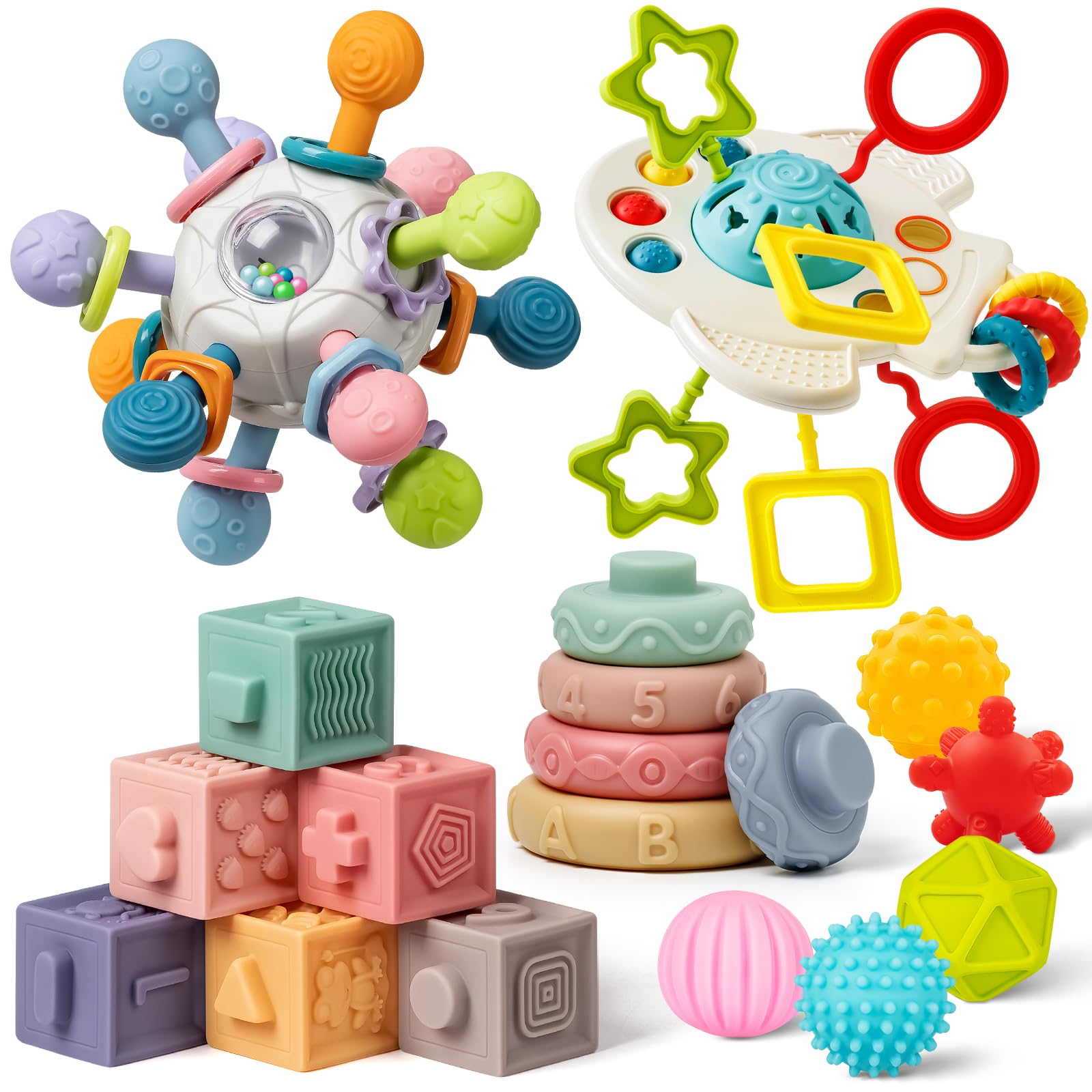
This kit bundles a pull-string airplane toy, a rattle teether, six soft stacking blocks, five stacking rings, and five textured sensory balls — all in one box. For a parent who wants to cover multiple developmental categories without buying five separate products, this is the most efficient starting point. The pull-string toy alone offers four different fine-motor actions: tugging, sliding, pushing, and pressing, each producing a different sound or movement.
The stacking blocks and rings serve the older end of the age range well. The blocks have embossed numbers and animals on each face, turning a stacking tower into a first counting lesson. The rings vary in diameter and color, requiring the baby to order them by size — a spatial-sequencing task that engages problem-solving, not just random piling. All pieces are made from BPA-free, non-toxic materials appropriate for mouthing.
The sensory balls are the least essential component here; they’re basic, but they do add texture variety. The rattle teether includes twelve soft rubber tips that double as gum relief for teething babies around 7-9 months. The only real trade-off is the sheer number of small pieces — you’ll want a dedicated bin to avoid losing items under the couch.
Why it’s great
- Covers stacking, sorting, pulling, and teething in one purchase
- Pull-string airplane develops hand-eye coordination through four different actions
- Blocks double as counting and animal-recognition tools
Good to know
- Many loose pieces require organized storage
- Sensory balls are less engaging than the other components
2. Duchong Pop Up Animals Toy

Pop-up toys are a classic cause-and-effect tool for a reason: the hidden animal that springs up when the baby flips a switch or pushes a button directly rewards the motor action with a surprise. The Duchong version refines that formula with three distinct modes. In animal-sound mode, each pop-up triggers the correct animal name and its real sound — a subtle vocabulary lesson. In game mode, a light guides the baby to the correct lever, adding a visual tracking challenge. Quiet mode keeps the fun battery-free for travel or low-stimulation play.
The physical controls themselves are thoughtfully differentiated for a developing hand. One is a sliding switch, one is a press-button, one is a dial, and one is a lever. Each requires a slightly different finger or wrist movement, so the baby learns that different actions produce different outcomes. Perfect for the 8-12 month range when babies become obsessed with operating things independently.
The ABS plastic body is polished smooth and BPA-free. The unit is compact (roughly 8 inches wide) and runs on batteries not included. Some parents note that the game mode light can be overly stimulating for very young babies — the quiet mode is a smarter starting point for 6-month-olds, graduating to the sound modes around 9 months.
Why it’s great
- Three play modes grow with the baby from 6 to 12 months
- Four different switch types (lever, dial, button, slider) build varied fine-motor skills
- Animal names and sounds add early vocabulary exposure
Good to know
- Requires 3 AA batteries not included in the box
- Game-mode lights may be distracting for the youngest babies
3. Qirptey Shape Sorter Bin and Stacking Set
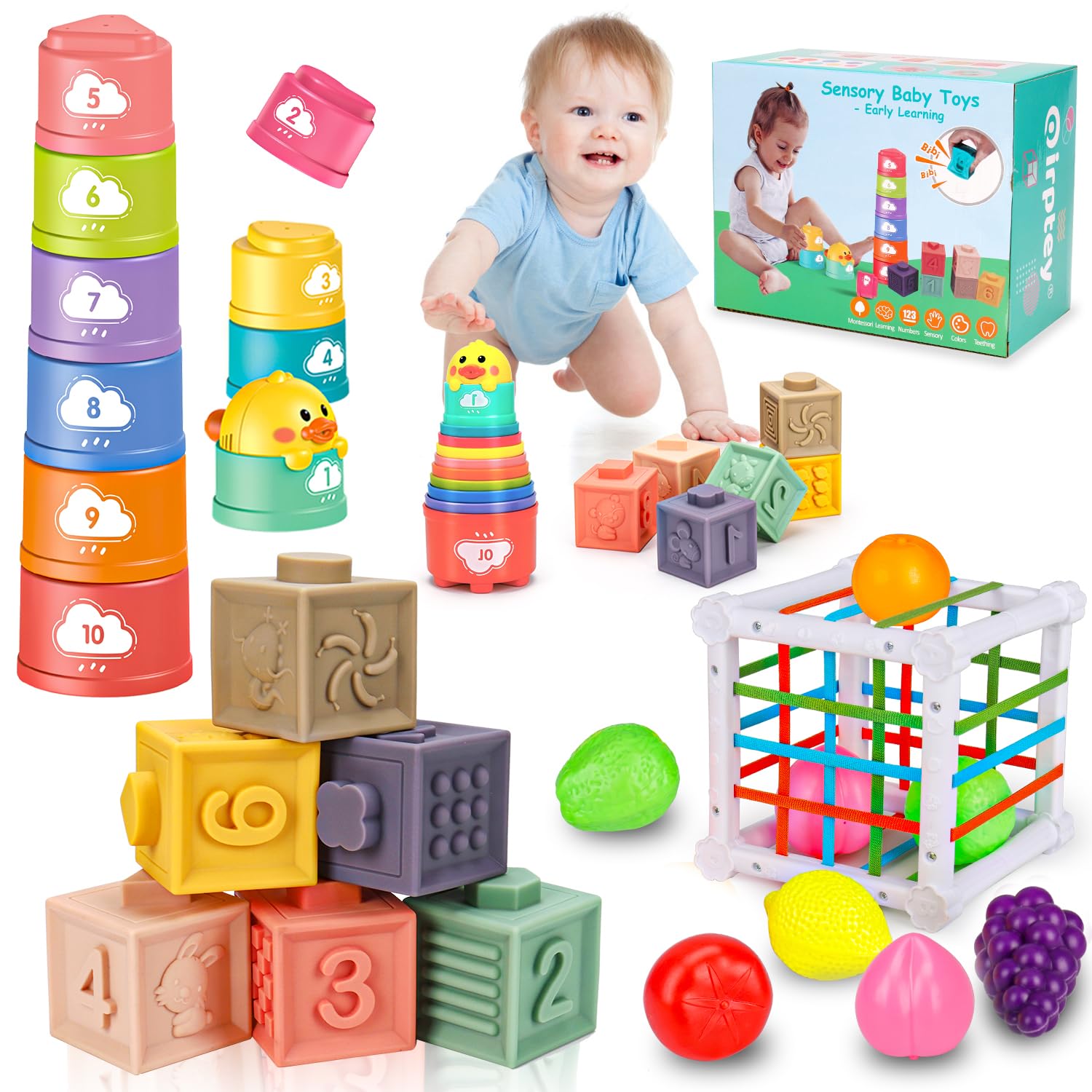
This set combines stackable cups, stacking blocks, a shape-sorter bin, and teething toys into a single system. The shape sorter uses fruit-shaped pieces — guava, orange, peach, tomato, lemon, grape — which is a clever twist that makes color and shape recognition more concrete for a baby. Each fruit piece is made from food-grade silicone, meaning it’s safe to chew and easy to wash. For a teething baby around 7-10 months, these soft shapes double as gum massagers.
The stacking cups are embossed with numbers and textures on the bottom, so the baby gets tactile variety while learning size ordering. The cups can also be used as bath toys — they float and pour water, extending the play value beyond dry floor time. The stacking blocks are lightweight ABS with rounded edges, designed to topple easily without hurting if the baby knocks them over on themselves.
The material split works well: silicone for the teething/wet play pieces and ABS for the structural blocks. The one inch cubed dimensions listed in the specs are misleading — the blocks are actually about 2 inches each, making them safe for the 6-month pincer grasp but too large to be a choking hazard. The set is best suited for 8-12 months when babies begin intentionally fitting shapes into holes.
Why it’s great
- Food-grade silicone pieces double as teething relief and shape sorters
- Cups work in the bathtub for water-based sensory play
- Fruit-shaped sorter makes abstract shape concepts concrete
Good to know
- Shape-sorter bin is not suitable for independent play until 8+ months
- Silicone pieces attract lint and dust if left out
4. Adena Montessori Play Kit (Mirror, Drum, Ball)

This is the most pared-back option in the list — and that’s precisely why it works for the younger end of the age range. The kit includes a wooden-framed mirror for self-discovery, a rainbow spinning drum, and a fabric ball. No batteries, no buttons, no lights. The spinning drum is the star: when the baby bats it during tummy time, the colors rotate in a hypnotic pattern and the drum produces a soft, soothing rolling sound. The action is immediately visible and rewarding.
The mirror helps the baby begin the slow process of self-recognition, which typically emerges between 9 and 12 months. The fabric ball is lightly textured and easy to grasp with the whole hand — perfect for the palmar grasp that dominates at 6 months. Everything is manual and demands the baby’s own physical effort to produce an outcome. For parents who want a quiet, low-stimulation alternative to lights-and-music toys, this kit is the answer.
The drum base is wood and the surface is fabric, so it’s lightweight enough for a baby to tip over but sturdy enough to withstand repeated batting. The mirror frame is wood with rounded edges. The fabric ball is machine-washable on a gentle cycle. Be aware that the drum does not spin freely on carpet — it works best on a smooth wood or tile floor during tummy time.
Why it’s great
- Three-piece set designed specifically for 6-12 month developmental stages
- Spinning drum teaches cause-and-effect without batteries or noise
- Wooden mirror encourages early self-recognition
Good to know
- Drum does not spin well on thick carpet
- Fewer pieces than the multi-kit options — better as a supplement than a main set
5. LeapFrog Learning Friends 100 Words Book

While most toys in this category focus on physical manipulation, the 100 Words Book targets auditory learning and vocabulary acquisition — a different but equally important developmental track. Turtle, Tiger, and Monkey guide the baby through 100 age-relevant words organized into categories like pets, animals, food, colors, opposites, and outdoor objects. Touching a word triggers its pronunciation plus a related sound effect or fun fact. The light-up star button plays two theme songs.
The bilingual capability is the standout feature here. Every word, song, and instruction is available in both English and Spanish, making this an accessible tool for bilingual households or parents who want early second-language exposure. The categories are well-chosen: opposites like “big” and “little” help build abstract concepts that complement the concrete stacking and sorting play going on with physical toys.
Two important caveats for this age range. First, LeapFrog lists the minimum age as 18 months, which is based on their own cautious recommendation. Many 9-12 month olds can handle the page-turning and button-pressing with supervision — just be aware that a 6-month-old will mostly chew the corner. Second, the 100-word vocabulary overlaps heavily with the first words you’ll be teaching anyway, so consider this a reinforcement tool rather than a primary learning source for the youngest babies.
Why it’s great
- Bilingual English/Spanish output supports early dual-language exposure
- 100 words organized into 12 intuitive categories
- Sound effects and fun facts add engagement beyond simple pronunciation
Good to know
- Officially recommended for 18+ months — best used with supervision at 9-12 months
- Requires 2 AA batteries (included for demo only)
FAQ
Can a 6-month-old actually learn from a shape sorter?
Is an electronic book better than a cardboard book for this age?
How many toys does a 9-month-old actually need at once?
Final Thoughts: The Verdict
For most users, the learning toys for 6-12 month olds winner is the Jyusmile 5 in 1 Montessori Set because it covers stacking, sorting, pulling, and teething in a single purchase at a mid-range price point. If you want a dedicated cause-and-effect tool that teaches switch operation and animal sounds, grab the Duchong Pop Up Animals Toy. And for quiet, battery-free play that emphasizes muscle development over audio stimulation, nothing beats the Adena Montessori Play Kit.