The first birthday marks a cognitive explosion. Your one-year-old is no longer a passive observer — they are a tiny scientist, testing cause and effect, grip strength, and spatial relationships with every object within reach. The right toy at this stage isn’t just entertainment; it is the raw material for building neural pathways.
I’m Emma — the founder and writer behind Baby Bangs. I’ve spent years analyzing the developmental science and market data behind infant and toddler toys, separating the genuinely educational from the overpriced noise.
This guide breaks down the five best-rated options and explains what makes a toy truly effective at this age. My goal is to help you confidently choose the best learning toys for 1 year old children that deliver real developmental value without breaking your budget.
How To Choose The Best Learning Toys For 1 Year Old
A one-year-old is in a specific developmental window: they are mastering the pincer grasp, starting to understand object permanence, and beginning to mimic real-world actions. The best toys for this stage target these exact skills. Here is what to prioritize.
Prioritize Open-Ended Play
A toy that can be used in multiple ways — stacking, sorting, pounding, or pushing — grows with the child. A single-purpose electronic toy often gets ignored after one or two uses. Wooden blocks, shape sorters, and bead mazes offer hundreds of unique play combinations.
Demand Multi-Sensory Input
At twelve months, the brain is building connections between what the eyes see, the hands feel, and the ears hear. A good learning toy engages at least two of these senses simultaneously. A xylophone that lights up when struck combines audio feedback with visual reward and tactile action.
Verify Safety and Durability
This age group puts everything in their mouths. Avoid small parts that can become choking hazards. Look for non-toxic, water-based paints on wood and BPA-free ABS plastics. Edges should be smoothly sanded or rounded. A toy that can survive a drop from a high chair is also a practical necessity.
Quick Comparison
On smaller screens, swipe sideways to see the full table.
| Model | Category | Best For | Key Spec | Amazon |
|---|---|---|---|---|
| WOODMAM 7-in-1 Cube | Wooden Activity Cube | Multi-skill development | 2.89 lbs, 7 activities | Amazon |
| Joyreal Hammering Toy | Wooden 3-in-1 Set | Gross & fine motor skills | Includes xylophone & fishing | Amazon |
| LeapFrog 100 Words Book | Electronic Book | Vocabulary & bilingual learning | 100+ words, English/Spanish | Amazon |
| VTech Busy Learners Cube | Electronic Activity Cube | Early cause & effect | 5 sides, 25 songs, motion sensor | Amazon |
| SYAOMUNLY Workbench | Tool Set / Workbench | Role-play & problem-solving | 8 accessories, LED lights & songs | Amazon |
In‑Depth Reviews
1. WOODMAM Wooden 7-in-1 Activity Cube

This is the most complete wooden activity set you can buy for this age without stepping into premium boutique territory. The 7-in-1 design packs a bead maze, xylophone, shape sorter, spinning gears, animal sliding game, learning clock, and a separate sorting and stacking board into one compact cube. Each activity targets a different developmental domain — fine motor precision from the bead maze, auditory processing from the xylophone, and logic from the shape sorter.
Safety is clearly the engineering priority here. The shape blocks are larger than average, reducing choking risk, and the entire cube is made from natural wood with water-based, odorless paint. The edges are polished smooth across multiple passes. At nearly three pounds, it has a satisfying heft that stays put during play, and the top bead maze detaches so you can use it as a table-top toy or take it in the car.
The packaging is gift-ready, saving you the cost of wrapping. This is the ideal pick for a first birthday present that parents will appreciate as much as the toddler. The only real catch is that the xylophone notes are more about rhythm than perfect pitch, which is perfectly fine for this age group.
Why it’s great
- Seven diverse activities in one compact footprint — excellent value per play mode.
- Large, smooth wooden blocks eliminate choking hazard worries.
- Detachable top bead maze turns it into a portable travel toy.
Good to know
- Xylophone is more for sensory exploration than musical accuracy.
- Requires floor or table space for the full cube setup.
2. Joyreal Wooden Montessori Toys — Hammering, Xylophone & Fishing
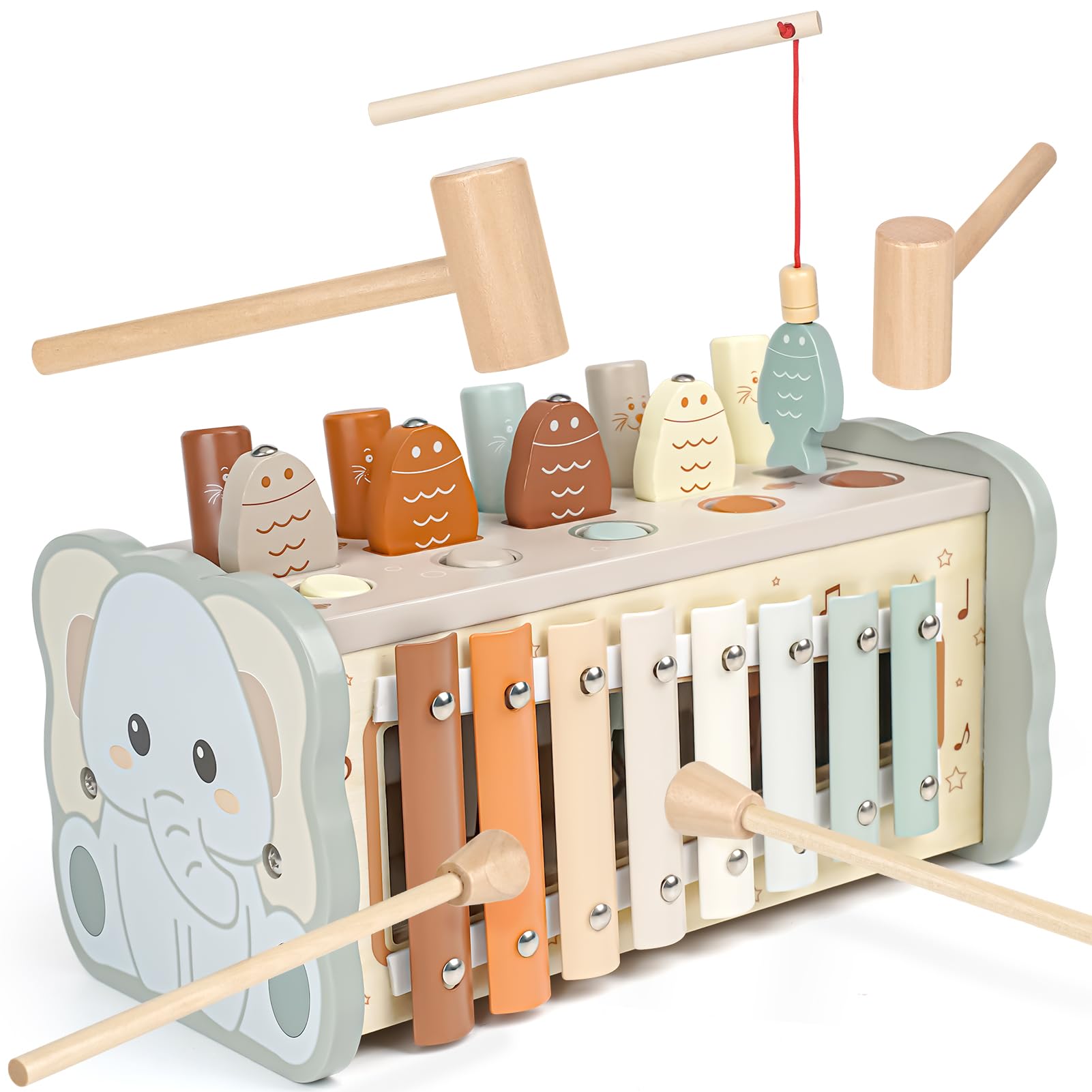
What sets the Joyreal set apart is its deliberate design philosophy. Rather than bright, overstimulating primary colors, this toy uses a neutral color palette that is noticeably calmer for a developing nervous system. The set combines a classic pounding bench with a musical xylophone and a magnetic fishing game — three distinct play styles that develop different muscle groups and cognitive skills.
The pounding bench works the gross motor muscles of the arm and shoulder, the xylophone refines wrist action and introduces auditory patterns, and the magnetic fishing game demands fine pincer control and hand-eye coordination. The kit includes two hammers and two mallets, making it suitable for a playdate or parent-child interaction. The wood is premium with non-toxic paint, and all edges are smoothly polished.
This is a strong alternative to the WOODMAM cube if you prefer a more focused, activity-specific toy that encourages active hitting and catching rather than turning and sliding. The only real limitation is that the fishing game components are small and should be put away after play to prevent loss or mouthing.
Why it’s great
- Neutral color scheme is easier on the eyes for focused, imaginative play.
- Three distinct play modes cover gross motor, fine motor, and auditory skills.
- Two hammers and mallets encourage cooperative or parent-child play.
Good to know
- Magnetic fishing pieces are small and require adult supervision.
- Does not offer as many simultaneous activities as an activity cube.
3. LeapFrog Scout and Violet 100 Words Book

While the previous two picks focus on physical manipulation, the LeapFrog 100 Words Book targets a completely different developmental axis: language acquisition. Designed for children 18 months and older (though many 1-year-olds are ready earlier), this sturdy electronic book introduces over 100 age-appropriate words organized into categories like pets, food, colors, opposites, and outside.
The key feature here is the bilingual capability. Touching a word plays it in both English and Spanish, complete with sound effects and simple fun facts. The light-up star button plays the Learning Friends theme song and a “My Favorite Word” track. The pages are thick and durable enough to survive enthusiastic turning, and the volume control is a parent-friendly touch.
This is not a substitute for active gross motor play, but it is an excellent supplement for car rides, quiet time, or days when the weather keeps you indoors. The word choice is genuinely curated by learning experts, which separates it from cheaper knockoffs that just repeat random nouns. The only downside for a strict 12-month-old is that the recommended age starts at 18 months, but many babies with advanced language interest will engage sooner.
Why it’s great
- Full bilingual English/Spanish mode builds early vocabulary naturally.
- Thick, durable pages designed to withstand toddler handling.
- Sound effects and fun facts keep engagement high beyond simple word repetition.
Good to know
- Officially recommended for 18+ months; some 12-month-olds may not stay engaged.
- Requires 2 AA batteries and does not promote physical movement.
4. VTech Busy Learners Activity Cube, Purple

If you want electronic engagement without a screen, the VTech Busy Learners Cube is the gold standard in this category. Its five sides include four light-up buttons that introduce animal names, animal sounds, and shapes. The real differentiator is the motion sensor — when the cube is pushed or moved, it triggers fun sounds that encourage the baby to crawl after it, turning passive play into an active motor exercise.
The cube packs 25 playful songs and melodies, so it will not become repetitive quickly. Volume control and an auto shut-off feature are included, which are non-negotiable for parental sanity. The design also assists with sitting up to play, making it useful for younger 6-month-olds as well. The age range of 6 months to 3 years means this toy has a longer usable life than many others.
The trade-off is obvious: this is an electronic toy with plastic construction, not a wooden Montessori item. It relies on battery power and programmed responses rather than open-ended creativity. For parents wanting to limit screen-adjacent electronic stimuli, the wooden options are a better fit. But for babies who are motivated by sound and light, the motion sensor feature is genuinely clever and motor-skill-positive.
Why it’s great
- Motion sensor encourages crawling and gross motor movement.
- Five sides with 25 songs offer solid variety and long engagement.
- Includes volume control and auto shut-off for parent convenience.
Good to know
- Plastic build and electronic sounds may not appeal to Montessori-leaning families.
- Demo batteries are included but need immediate replacement for regular use.
5. SYAOMUNLY Musical Learning Workbench
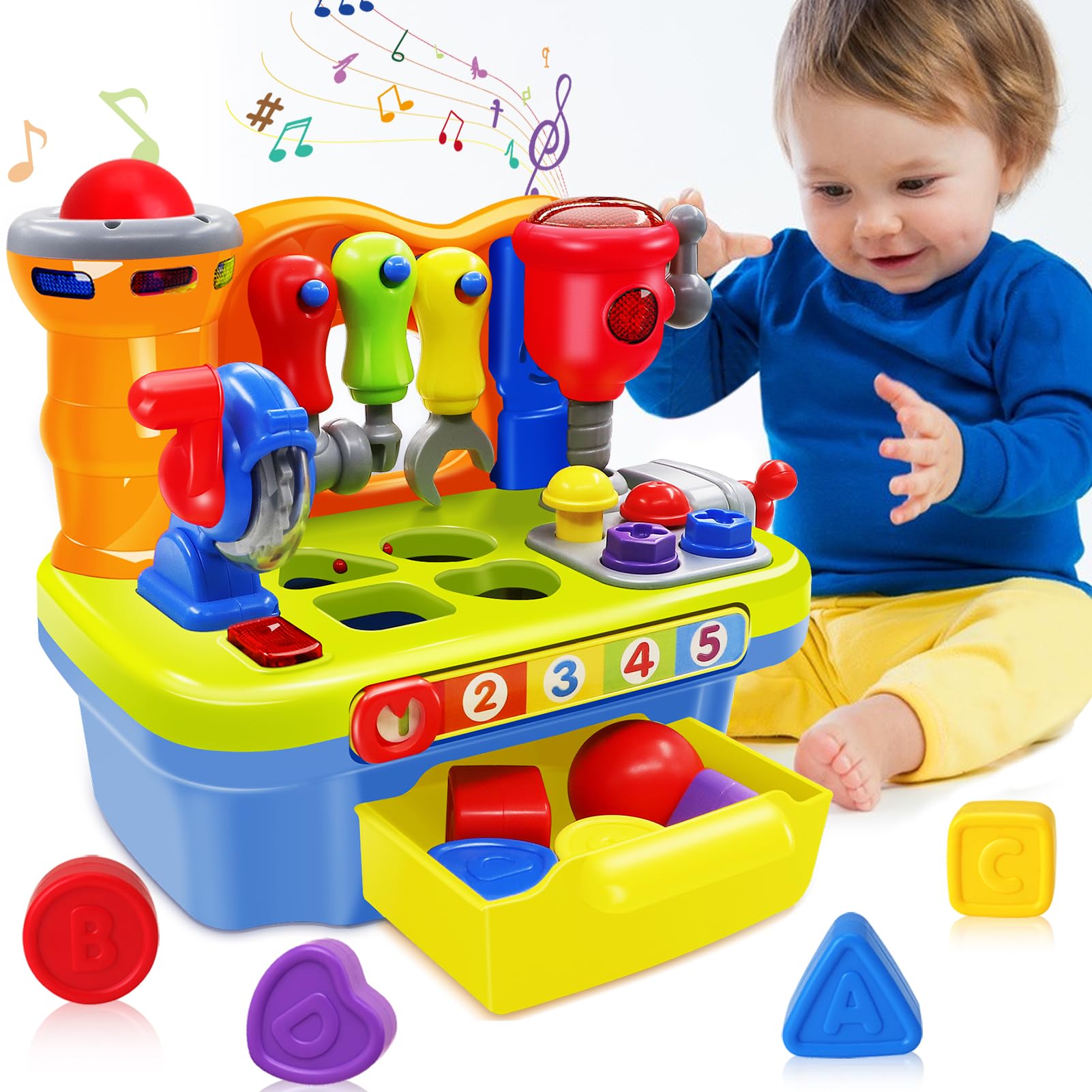
The SYAOMUNLY Workbench introduces a powerful new concept for a one-year-old: role-playing. The set includes a workshop table plus eight accessories — blocks with different shapes, a ball, a chainsaw, a drill, a bench clamp, nails, screw caps, and building tools. This taps into the toddler’s natural desire to imitate mom and dad, making it a standout pick for social and emotional development.
Educationally, it covers color recognition, shape matching, fine motor skills (inserting shapes into the drawer), and problem-solving. The LED lights and sound effects add the exciting feedback that one-year-olds crave. The seven included songs and phonics elements reinforce the names of shapes and tools. The included storage box keeps everything contained, which parents will appreciate.
The main consideration is that this is made from ABS plastic rather than wood. The ABS is BPA-free and durable, but it does not have the natural feel of the wooden toys. Also, the sound and light features are engaging but can be overstimulating for some children. For a child who loves cause-and-effect and enjoys mimicking grown-up activities, this is a highly effective learning tool.
Why it’s great
- Role-play element encourages social imitation and imaginative play.
- Eight accessories provide varied fine motor and problem-solving activities.
- LED feedback and songs reward each action, reinforcing cause-and-effect learning.
Good to know
- ABS plastic construction lacks the tactile warmth of wood.
- Sound and lights may be overwhelming for some babies.
FAQ
Should I buy electronic toys or wooden Montessori toys for a 1 year old?
How many toys does a 1 year old actually need at one time?
What is the most important skill a learning toy should develop at 12 months?
Final Thoughts: The Verdict
For most users, the best learning toys for 1 year old winner is the WOODMAM Wooden 7-in-1 Activity Cube because it packs the most developmental variety into a single, safe, and durable wooden package. If you want a toy that specifically targets gross motor coordination and active play, grab the Joyreal Hammering Toy. And for bilingual language development during quiet time, nothing beats the LeapFrog 100 Words Book.