Choosing a probiotic that features Lactobacillus casei specifically means targeting a hardy, lactic-acid-producing strain shown to survive the digestive tract and adhere to intestinal walls. Not all probiotics make it past stomach acid, and strain specificity — not just CFU count — determines whether the bacteria actually colonize. This guide focuses on five formulations that actually list L. casei (or its subspecies) on the label, because the strain name is what matters for digestive and immune support.
I’m Emma — the founder and writer behind Baby Bangs. I spend my days cross-referencing supplement labels against published clinical data, focusing on third-party testing, CFU viability, and delivery technology that determines if the bacteria survive the gut.
Below I break down the potency, prebiotic pairings, and capsule protection of five options to help you find the right lactobacillus casei probiotic for your wellness routine without falling for marketing gimmicks.
How To Choose The Best Lactobacillus Casei Probiotic
When you are searching for a probiotic centered on Lactobacillus casei, you are likely targeting digestive regularity and immune function. However, the market is flooded with multi-strain blends that may contain only trace amounts of this specific strain. The three factors below will help you narrow the field to formulas that actually deliver L. casei at a meaningful dose.
Verify the specific strain name on the label
Generic “Lactobacillus casei” on the front of a bottle is not enough — look for the subspecies or strain designation like L. casei KE-99 or L. casei DN-114 001. The strain code determines what clinical research supports its benefits. Without a specific strain name, you have no way to know if the bacteria in the capsule has ever been studied for gut adhesion or immune modulation.
Prioritize delivery technology over raw CFU
A capsule that lists 50 billion CFU is useless if the bacteria die in stomach acid. For L. casei — which is moderately acid-resistant but still vulnerable — look for enteric-coated or delayed-release capsules. Shelf-stable bottles also indicate the manufacturer has taken steps to protect viability through temperature fluctuations during shipping and storage.
Check for complementary prebiotic fibers
Lactobacillus casei thrives when it has a food source upon reaching the colon. Prebiotic fibers like fructooligosaccharides (FOS), inulin, or trehalose help the newly arrived bacteria colonize and outcompete less desirable microbes. A formula that pairs L. casei with a prebiotic is a sign of a well-designed supplement rather than a bare-minimum capsule.
Quick Comparison
On smaller screens, swipe sideways to see the full table.
| Model | Category | Best For | Key Spec | Amazon |
|---|---|---|---|---|
| Probiohealth | Single-Strain | Targeted L. casei support | 6 Billion CFU, L. casei KE-99 | Amazon |
| Physician’s CHOICE 60B | Multi-Strain | Full-spectrum gut & immune | 60B CFU, 10 strains + prebiotics | Amazon |
| Nutricost Probiotic Complex | Multi-Strain | High CFU at value price | 50B CFU, vegetarian capsules | Amazon |
| Toniiq L. Gasseri | Single-Strain | High-potency L. gasseri focus | 50B CFU, delayed-release | Amazon |
| Swanson L. Rhamnosus with FOS | Single-Strain | Budget-friendly digestive aid | 5B CFU, vegan + FOS prebiotic | Amazon |
In‑Depth Reviews
1. Probiohealth

Probiohealth is the most straightforward option on this list because it names a specific Lactobacillus casei subspecies — KE-99 — directly on the bottle. This strain has been researched for its ability to survive gastric transit, and the 6 billion CFU dose is a realistic, targeted amount rather than an inflated number. The formula includes FOS and trehalose as prebiotic fibers that feed L. casei after it reaches the colon, a pairing that increases the likelihood of colonization.
The capsules are vegetarian and shelf-stable, which matters if you travel or do not refrigerate your supplements. Because this is a single-strain product, you are getting a pure dose of L. casei without competing strains diluting the effect. For someone specifically looking for Lactobacillus casei — not a broad multi-strain blend — this is the most direct route.
The 60-count bottle provides a two-month supply at the recommended dose, making the cost per serving reasonable for a targeted probiotic. The absence of unnecessary fillers or proprietary blends is a clear signal that the manufacturer prioritized strain integrity over marketing flair.
Why it’s great
- Named strain L. casei KE-99 with clinical relevance
- Includes FOS and trehalose prebiotic fibers
- Vegetarian, shelf-stable capsules
Good to know
- Lower CFU compared to multi-strain blends
- Not suitable for those wanting a high-dose multi-strain
2. Physician’s CHOICE Probiotics 60 Billion CFU

Physician’s CHOICE delivers 60 billion CFU across 10 strains, including Lactobacillus casei along with acidophilus, rhamnosus, and other well-studied species. The multi-strain approach targets a broader range of digestive issues — occasional constipation, diarrhea, gas, and bloating — which makes it a better fit if your gut issues are not isolated to one symptom. The bottle is shelf-stable, and the capsules are acid-resistant to improve survival past the stomach.
Organic prebiotics are added directly into the capsule, so you do not need to source a separate fiber supplement to feed the bacteria. The 30-count size provides a one-month supply at the high CFU dose, and the third-party testing for purity and potency adds a layer of trust that is essential in the supplement category. The strain diversity means L. casei is present but not dominant, which is fine if you want comprehensive coverage.
This is the product to pick if you want a doctor-informed formula that covers both L. casei benefits and broader microbiome support. The ten-strain blend means you are getting more bacterial species, but the cost per serving is higher than single-strain alternatives.
Why it’s great
- 60B CFU with acid-resistant capsules for survival
- Includes organic prebiotics for colonization support
- Third-party tested for purity and potency
Good to know
- Only 30 capsules per bottle (one-month supply)
- L. casei is one of ten strains, not the focus
3. Nutricost Probiotic Complex
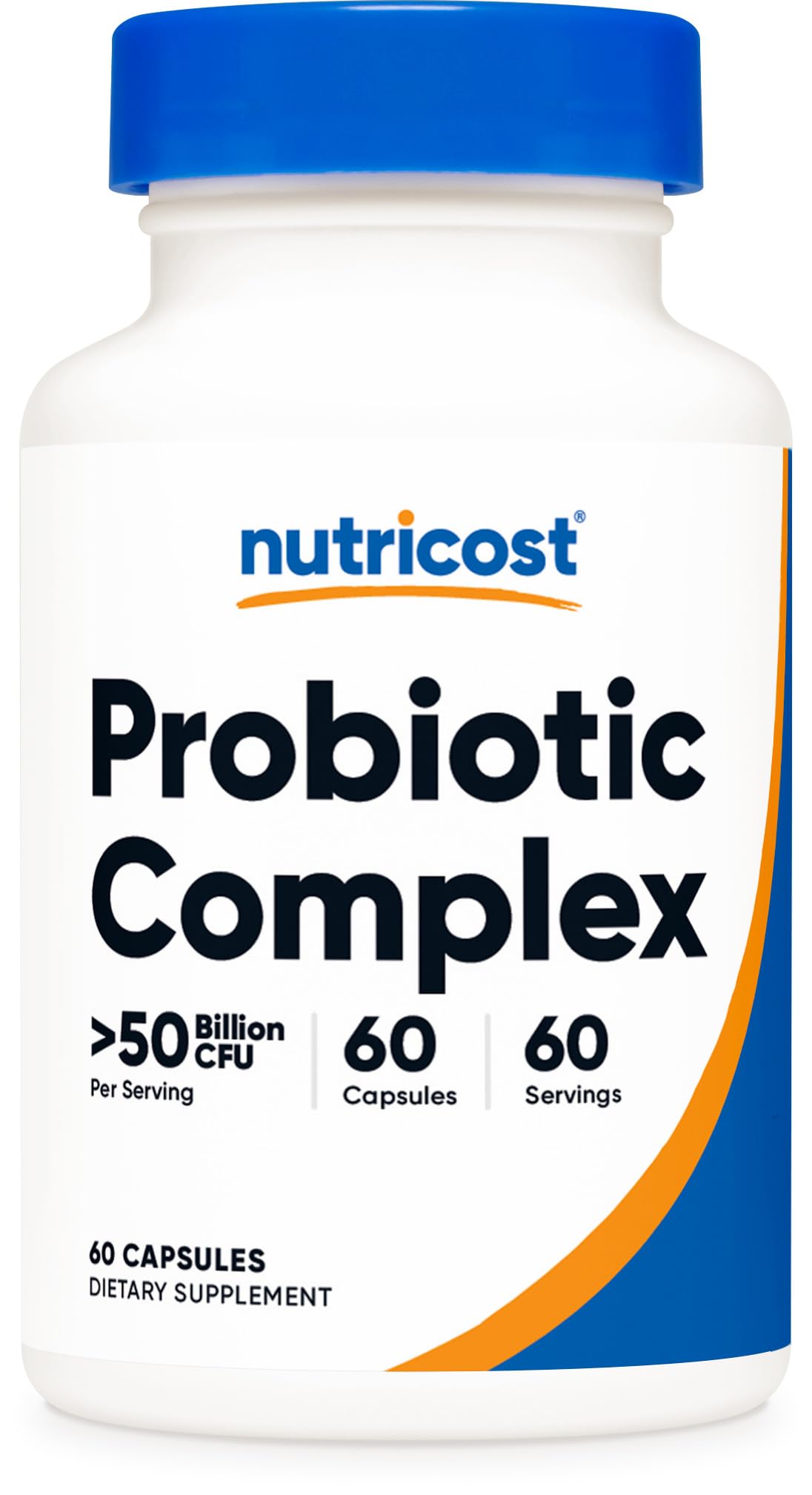
Nutricost Probiotic Complex provides 50 billion CFU per serving in a multi-strain capsule, making it one of the higher-potency options in the mid-range tier. The formula includes Lactobacillus casei as part of a broader blend, and the capsules are vegetarian and free from gluten and GMOs. For buyers who want a strong CFU number without paying a premium, this is the most direct match.
The 60-capsule count gives a full two-month supply, and the bottle is shelf-stable so no refrigeration is required. Because the label does not specify a particular L. casei subspecies or a guaranteed survival technology, you are relying on the default CFU count to deliver results. Nutricost is a reputable budget-friendly brand, but the lack of delayed-release or acid-resistant coating means some bacteria may be lost to stomach acid.
This is a solid entry point for someone new to probiotics who wants a high CFU number at a low cost. If targeted L. casei colonization is your priority, you may want a single-strain product with a named subspecies, but as a general digestive aid, this performs well for the price.
Why it’s great
- 50B CFU at a very competitive price point
- Vegetarian capsules, non-GMO, gluten-free
- 60 capsules for a two-month supply
Good to know
- No named L. casei subspecies on label
- No acid-resistant or delayed-release technology listed
4. Toniiq Lactobacillus Gasseri

Toniiq’s Lactobacillus Gasseri supplement stands out because of its advanced delayed-release capsule technology, designed to protect the bacteria from stomach acid and deliver them intact to the intestines. While this is a single-strain product focused on L. gasseri rather than L. casei, the delivery mechanism and third-party testing approach are worth noting for anyone comparing probiotic quality. The 50 billion CFU per serving is ultra-high for a single strain, and the addition of inulin as a prebiotic fiber supports colonization.
Toniiq products undergo both in-house and independent third-party lab testing to verify CFU count and purity, which is a higher standard than many budget brands. The bottle is shelf-stable, and the capsules are small and easy to swallow. If you are specifically after Lactobacillus casei, this is not the direct match — but if you are open to L. gasseri for weight management or gut health, the quality here is significant.
The 60-capsule count at this CFU level provides a two-month supply. The delayed-release technology alone makes this a better value than many probiotics with the same CFU number that use standard capsules.
Why it’s great
- Delayed-release capsules protect bacteria from stomach acid
- Third-party tested for purity and CFU accuracy
- Includes inulin prebiotic for colonization
Good to know
- Uses L. gasseri, not L. casei — different strain
- Higher cost per serving than entry-level options
5. Swanson Lactobacillus Rhamnosus with FOS

Swanson’s Lactobacillus Rhamnosus with FOS is a budget-friendly single-strain probiotic that includes a prebiotic fiber source to support bacterial growth. The 5 billion CFU dose is modest, but for maintenance digestive health rather than acute symptom relief, this is a sufficient amount. Swanson is a well-established supplement manufacturer with a reputation for reliable quality at low prices, and the vegan capsule formulation makes it accessible to plant-based users.
The inclusion of FOS (fructooligosaccharides) as a prebiotic is a smart addition that helps the L. rhamnosus — a close relative of L. casei — establish itself in the gut. The 60-capsule bottle provides a two-month supply at a very low cost per serving. However, the 5 billion CFU is on the low end, and there is no acid-resistant or delayed-release capsule technology, so survival through the stomach is not guaranteed.
This product is a solid choice for someone on a tight budget who wants a clean, single-strain probiotic with a prebiotic boost. If you need a higher CFU dose or targeted L. casei support, the Probiohealth option would be a better fit for just a few dollars more.
Why it’s great
- Very low cost per capsule for a two-month supply
- Includes FOS prebiotic to support colonization
- Vegan, clean ingredient profile
Good to know
- Only 5B CFU — lower than most modern probiotics
- No delayed-release or acid-resistant capsule protection
FAQ
What makes Lactobacillus casei different from other probiotic strains?
Do I need a high CFU count for L. casei to be effective?
Can L. casei help with occasional constipation or diarrhea?
Final Thoughts: The Verdict
For most users, the lactobacillus casei probiotic winner is the Probiohealth because it names a specific L. casei subspecies (KE-99), includes matching prebiotic fibers, and offers a clean single-strain formula at a reasonable cost. If you want full-spectrum digestive and immune support with a high CFU count, grab the Physician’s CHOICE 60B. And for a budget-friendly entry point with a prebiotic boost, nothing beats the Swanson L. Rhamnosus with FOS.