Labor pain simulators use electrical muscle stimulation (TENS technology) to replicate the intensity and rhythm of real contractions, giving expecting partners, birth coaches, and family members a visceral lesson in what labor actually demands. These devices clamp onto abdominal muscles and ramp up through adjustable levels, creating a controlled but deeply uncomfortable physical experience that empathy alone cannot teach.
I’m Emma — the founder and writer behind Baby Bangs. I’ve spent years analyzing the hardware behind birth preparation tools, from TENS unit mode architectures to electrode pad adhesion reliability on different skin types.
Whether you are a midwife, a birthing class instructor, or a partner who believes in showing up prepared, understanding the differences between these simulators helps you pick the most effective training device. This guide provides the clearest evaluation of the best labor pain simulators to support real birth prep work.
How To Choose The Best Labor Pain Simulators
A labor pain simulator is essentially a specialized TENS unit with enough mode variety and intensity granularity to mimic the building wave of a contraction. The wrong device feels like a flat buzz instead of a rising pressure, which defeats the entire purpose of the exercise.
Mode Count and Contour Realism
Simulators with fewer than 10 modes tend to produce repetitive pulse patterns that do not replicate the slow ramp-up and plateau of a real contraction. Look for at least 20 modes — the extra patterns allow you to cycle through different wave shapes, from sharp spikes to deep, slow-building cramps. Devices with independent channel control let you adjust intensity separately for different muscle groups, which is critical when the person being simulated has a larger or more sensitive abdomen.
Electrode Pad Coverage and Adhesion
The number and size of electrode pads determines how much surface area of the abdomen or back gets stimulated. Four pads are the minimum for a basic abdominal simulation, but eight pads or more allow you to wrap the sensation around the lower back — a key source of real back labor. Low-impedance gel pads with a 45-use lifespan reduce the frustration of pads peeling off midway through a demo, especially if the session runs over 20 minutes.
Battery Endurance and Charge Method
Birth classes and partner practice sessions can run 30 to 60 minutes per participant. A device that dies after 4 hours of cumulative use will strand you mid-class. Rechargeable units with a 30-hour or 60-hour battery life are the practical choice for educators who run multiple sessions per week. USB-C charging is preferred over proprietary cables because a power bank or laptop can recharge the unit between demos.
Quick Comparison
On smaller screens, swipe sideways to see the full table.
| Model | Category | Best For | Key Spec | Amazon |
|---|---|---|---|---|
| AVCOO 3-in-1 TENS | Premium | Maximum contraction pattern variety | 24 modes, 40 intensity levels | Amazon |
| AUVON PT1+Pro | Premium | Extended 60-hour runtime for classes | 60-hour rechargeable battery | Amazon |
| TEC.BEAN 24-Mode | Mid-Range | Budget-friendly mode variety | 24 modes, 20 intensity levels | Amazon |
| AUVON Dual Channel | Mid-Range | Separate channel control for back labor | 20 modes, independent A/B channels | Amazon |
| TENS 7000 | Classic | Clinical trust and durability | Medical-grade, 9V battery | Amazon |
In‑Depth Reviews
1. AVCOO 3-in-1 TENS Unit Muscle Stimulator
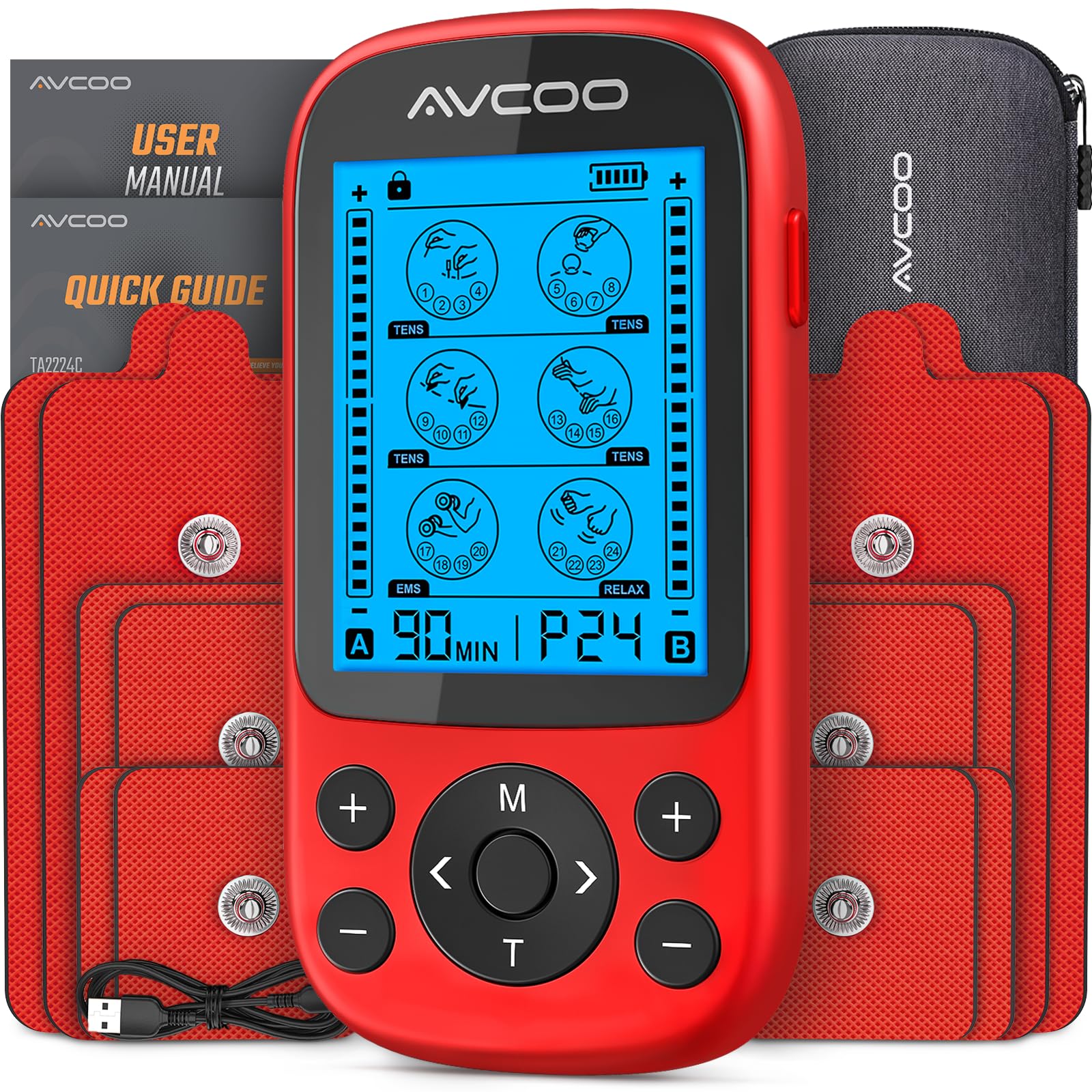
The AVCOO offers the widest mode library — 24 patterns paired with 40 intensity levels per channel — giving instructors the most control over how a contraction feels. You can start with a slow tapping pattern at level 5 and gradually shift to a deep pulsing wave at level 25, which closely mimics the escalating pressure of active labor. The 12 included pads let you cover the full abdomen and lower back simultaneously, a setup most simulators require an extra purchase to achieve.
The 3-in-1 label means it combines TENS, EMS, and massage functions, but for labor simulation you will primarily use the TENS modes. The portable size fits into a small EVA case that can be tossed into a birth-class bag without adding bulk. The USB rechargeable battery supports multiple demo sessions before needing a charge, so you do not have to hunt for a 9V replacement mid-class.
One limitation is the lack of independent channel controls — both channels run the same mode, only the intensity can be set separately. For a partner simulation that targets distinct muscle groups (upper abdomen versus low back) this could matter, though most users find the 40-level granularity compensates well.
Why it’s great
- 24 modes provide the most realistic contraction wave variety
- 12 electrode pads cover abdomen and lower back in one setup
- 40 intensity levels allow fine-grained pain ramp-up
Good to know
- Channels share the same mode; cannot run different patterns on A and B
- No physical therapists usage data included for pregnancy-specific scenarios
2. AUVON Rechargeable TENS Unit PT1+Pro

The PT1+Pro distinguishes itself through battery endurance — a 600 mAh rechargeable cell delivering up to 60 hours of continuous use. For a childbirth educator running back-to-back weekend classes, this means charging once a month rather than every other day.
This unit comes with 12 premium electrode pads made from low-impedance solid gel. The adhesion holds through a 20-minute simulation even when the participant sweats from the discomfort. The Type-C charging port means you can top it off between classes using a standard laptop cable. The flip cover over the control panel prevents accidental mode changes when the device is inside a bag or being handled during an intense demo.
The main trade-off is that 8 modes are less flexible than the 24-mode units when you want to rapidly switch through wildly different pulse shapes. You also cannot run two different modes simultaneously across the A and B channels — both channels mirror the selected mode.
Why it’s great
- 60-hour battery life eliminates mid-class dead device scenarios
- Low-impedance gel pads stay adhered during sweaty sims
- Customizable pulse width and frequency for tailored contraction feel
Good to know
- Only 8 pre-set modes compared to 24-mode competitors
- Both channels share the same mode selection
3. TEC.BEAN 24 Mode TENS Unit Muscle Stimulator

The TEC.BEAN delivers 24 modes and 20 intensity levels at a price point that makes it accessible for individual partners who want to practice at home before a birth class. The unit comes with 8 pads — 4 palm-sized electrodes, 2 large rectangles, and 2 small pads — which gives you enough layout variety to target the lower back and abdomen. A 30-hour rechargeable battery means casual users only charge it every few weeks.
The adjustable timer is useful for structured simulation sessions. You can set it to 20 minutes (the default), which matches the typical length of a focused contraction drill. The timer indicator light keeps you aware of remaining time without needing to glance at a phone. The whole device is compact enough to slide into a back pocket, so it does not add noticeable weight to a birth-preparation bag.
The 20 intensity levels are adequate for most participants, but experienced instructors may find the step between levels 10 and 11 too abrupt for a smooth climb simulation. The pad holder included in the box is a simple plastic sheet — not as protective as the EVA or hard cases found on pricier units.
Why it’s great
- 24 modes offer strong contraction pattern variety
- 8 pads allow combined abdomen and lumbar setup
- Up to 30 hours of use per charge
Good to know
- 20 intensity levels may feel less granular during escalation
- Included pad holder is basic plastic, not a travel case
4. AUVON Dual Channel TENS Unit Muscle Stimulator

The standout feature of this AUVON model is the fully independent channel control — you can set mode and intensity separately for channel A and channel B. In a labor simulation context, this lets you run a sharp contracting pattern on the abdomen while a slower pulsing pattern simulates back labor on the lower lumbar region. That kind of dual-pattern realism is rare in this category and makes the device especially valuable for doulas who want to demonstrate the difference between front labor and back labor.
The unit includes 8 pads — four 2-inch squares and four 2×4-inch rectangles — shipped in sealed foil packs that preserve gel freshness. The 2×4 pads are better suited for the large muscle groups of the back, while the smaller squares handle the abdomen. The device runs on a rechargeable lithium ion battery, and the slim profile (just 0.43 inches thick) makes it the most pocketable option here.
One drawback is the 20-minute auto-off timer, which resets after that period even if you are mid-simulation. During a long class demo you will need to restart the device manually. The lead wires are standard 2mm connectors, so replacement pads are easy to find, but the included pads start losing grip after the 45th use, requiring periodic re-orders.
Why it’s great
- Independent mode selection per channel allows distinct abdomen vs. back simulations
- Ultra-slim 0.43-inch design for easy pocket storage
- 8 pads with two sizes for targeted muscle coverage
Good to know
- 20-minute auto-off requires restart during longer demos
- Pads degrade after repeated use and need periodic replacement
5. TENS 7000 Digital TENS Unit

The TENS 7000 is the most clinically established device on this list — over 3 million units sold since 2008 and a long-time standard in physical therapy settings. For a birth educator or midwife who values proven reliability over flashy features, this unit delivers consistent pulse patterns that have been used in pain management research for years. The hard carrying case keeps the device and accessories organized, which is helpful when traveling between birth prep sessions.
The unit runs on a single 9V battery rather than a rechargeable cell. This is a mixed advantage: you never have to worry about a degraded rechargeable battery holding less charge over time, but you do need to keep spare 9V batteries on hand. The 9V battery bay adds some thickness to the device relative to the slim AUVON units. The 2 lead wires and 4 pads are sufficient for basic abdominal simulation, but you will need to buy additional pads if you want to cover the back simultaneously.
It lacks the mode count of the newer competitors — offering fewer pre-set options — and does not have independent channel control. The TENS 7000 is best suited for educators who want a bulletproof backup unit or who prefer to run simpler, repeatable contraction patterns rather than multi-layered simulations. The included 9V battery works immediately out of the box, removing the step of charging before a first use.
Why it’s great
- Clinically trusted with over 15 years of medical professional use
- Hard carrying case protects device during travel
- 9V battery removes need for charging between classes
Good to know
- Fewer pre-set modes than modern 24-mode simulators
- Only 4 pads included; back coverage requires extra purchase
- No independent channel control for dual-pattern simulations
FAQ
Can a labor pain simulator be used on someone who is currently pregnant?
How many electrode pads do I need for a realistic back labor simulation?
What does the intensity level number actually mean during a simulation?
Final Thoughts: The Verdict
For most users, the best labor pain simulators winner is the AVCOO 3-in-1 TENS Unit because its 24 modes and 40 intensity levels produce the most realistic contraction feel without requiring a second device. If you want the longest battery life for running multiple class demos, grab the AUVON PT1+Pro. And for independent channel control that lets you simulate front and back labor simultaneously, nothing beats the AUVON Dual Channel.