The difference between finishing a black diamond run with confidence and spending the season on the bench often comes down to what is holding your knee together at the moment of a hard carve. A knee brace for skiing is not just about post-injury recovery; it is the mechanical insurance your joint needs against the rotational forces and lateral blows that define the sport.
I’m Emma — the founder and writer behind Baby Bangs. I have spent the last two years dissecting orthopedic bracing designs, analyzing material stack-ups from neoprene blends to aluminum hinge frames, and mapping each brace’s tensile support profile to the specific demands of alpine skiing.
Whether you are rebuilding strength after an ACL reconstruction or trying to prevent a first tear, this guide breaks down the seven most reliable knee braces for skiing, ranked by structural integrity, hinge accuracy, and real-world sweat durability.
How To Choose The Best Knee Braces For Skiing
Skiing places unique stress on the knee: aggressive forward lean, sudden rotational torque when an edge catches, and the blunt impact of a hard fall on snow. A brace designed for running or weightlifting will not cut it. You need a brace that addresses three specific ski-specific failure points: hyperextension, lateral (valgus) collapse, and rotational instability.
Hinge Architecture & ROM Control
The hinge is the brace’s engine. For skiing, look for triaxial or polycentric hinges that track the knee’s natural rolling motion rather than forcing a simple pin-joint path. An adjustable range-of-motion (ROM) lock is critical — you should be able to set extension stops at 10°, 20°, or 30° to prevent full hyperextension during a fall. Without ROM stops, a hard twisting fall can still blow out a reconstructed ACL even while wearing a brace.
Frame Material & Weight Profile
Aluminum or stainless steel frames (like those on the Komzer or Breg T Scope) provide rigid lateral support for post-surgical knees, but they add bulk. For recreational skiing, a heavy-duty neoprene brace with bilateral metal hinges often provides enough protection without turning your ski pants into a wrestling match. The weight penalty matters — a 1.1 kg brace on a lightweight skier can fatigue the quadriceps earlier.
Moisture Management & Boot Integration
Ski boots already compress the calf and shin. A knee brace that adds more bulk above the boot top can cause pressure points and circulation issues. Look for open-patella designs that avoid rubbing against the top of the boot cuff. Lycra or HydraCinn fabric wicks sweat and resists the cold — neoprene without a moisture layer becomes heavy and slippery when damp, leading to brace migration mid-run.
Quick Comparison
On smaller screens, swipe sideways to see the full table.
| Model | Category | Best For | Key Spec | Amazon |
|---|---|---|---|---|
| DonJoy BIONIC FULLSTOP | Premium | Post-surgical ACL prevention | FullStop hyperextension control | Amazon |
| DonJoy Drytex Sport | Mid-Range | Breathable everyday skiing | Drytex moisture-wicking fabric | Amazon |
| Komzer Professional ACL | Premium | Heavy ligament instability | Stainless steel polycentric gears | Amazon |
| Brace Direct Breg T Scope | Premium | Post-OP ROM rehab | Telescoping frame 17″–27″ | Amazon |
| Shock Doctor 875 | Mid-Range | All-mountain active skiers | Bilateral dual hinges | Amazon |
| Mueller Hg80 5401 | Mid-Range | Light medial-lateral support | Triaxial tracking hinges | Amazon |
| GHORTHOUD Hinged ROM | Budget | Entry-level protection | 0°–120° ROM locking dial | Amazon |
In‑Depth Reviews
1. DonJoy Performance BIONIC FULLSTOP Knee Brace

The DonJoy BIONIC FULLSTOP is the reference standard for aggressive skiers who need definitive hyperextension protection. Its patented FullStop technology locks extension at a pre-set angle, preventing the knee from snapping backward when a ski tip catches a slick mogul. The brace uses a four-point leverage system that distributes rotational load away from the ACL and PCL, making it the most mechanically robust option for anyone returning to high-speed carving after a ligament injury.
The frame is built from a rigid polymer blend with bilateral polycentric hinges that conform closely to the leg’s anatomy. Unlike larger post-op frames, the BIONIC FULLSTOP wraps tight enough to fit under mid-weight ski pants without creating a visible bulge at the knee. The open-patella design keeps pressure off the kneecap during deep flexion — critical for the tuck position. The compression sleeve uses a moisture-wicking fabric that stays dry through four hours of aggressive skiing.
This brace is heavy, weighing around 1.3 pounds, but the trade-off is unmatched lateral stiffness. It is not meant for casual wear — it is a performance tool for skiers with diagnosed ACL or MCL instability who still want to ski double-black terrain. The closure straps use a ratchet system that stays locked even when wet, a feature that most velcro-only braces lack during afternoon snow.
Why it’s great
- FullStop hyperextension lock is unique to this brace — no other model offers this precision
- Four-point leverage system distributes torque away from ACL/PCL
- Moisture-wicking fabric stays dry under ski pants
Good to know
- Heavier than mid-range braces — noticeable after four hours of skiing
- Premium price tier — serious investment for serious skiers
- Not ideal for mild injuries; overkill for preventative use
2. DonJoy Drytex Sport Hinged Knee Brace
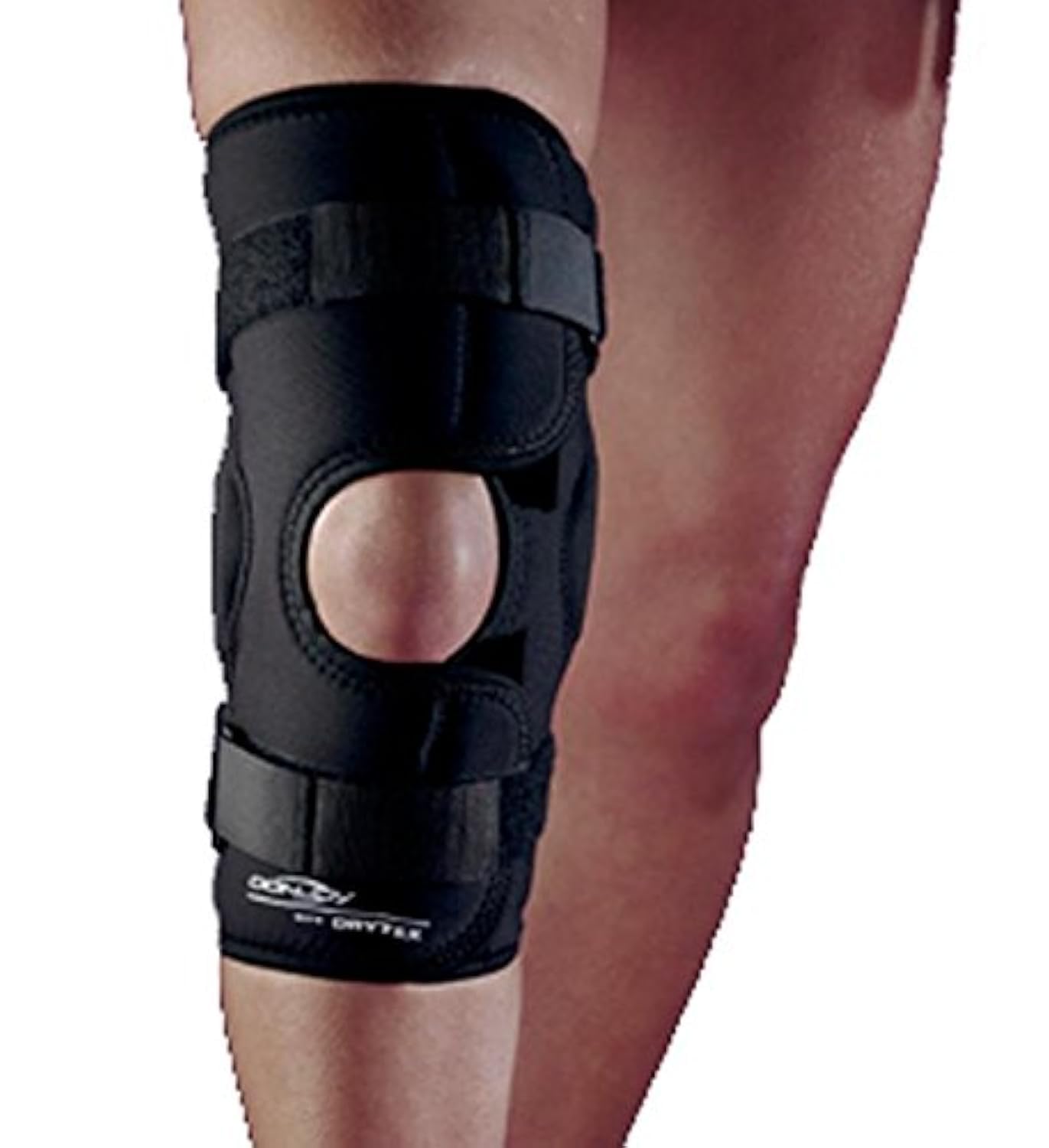
The DonJoy Drytex Sport solves one of the most annoying problems for skiers: a sweaty, slipping brace. Its Drytex fabric is a moisture-wicking weave that pulls sweat away from the skin and dries quickly between runs, so the brace stays put instead of sliding down the calf. The brace features bilateral polycentric hinges that provide moderate medial-lateral stability — not as rigid as the BIONIC, but enough for skiers with minor meniscus or MCL sprains.
The fit relies on a compressive sleeve design with a front closure strap, making it easier to layer under ski pants compared to wrapped braces with multiple straps. The open-patella cutout reduces pressure during deep knee bends in the backseat position. The Drytex Sport is specifically recommended for bone and joint health recovery, and it works well for skiers who are at least six months post-injury and want a brace that reminds them not to over-rotate rather than one that mechanically blocks motion.
One limitation: the hinges are not adjustable for ROM, so you cannot lock the brace to prevent full extension. For skiers who need hyperextension protection, this is a deal-breaker. But for recreational skiers who want breathability and moderate support, it is a comfortable mid-range choice that fits inside most ski boots without causing pressure points on the shin.
Why it’s great
- Drytex fabric dries fast and resists slippage inside ski pants
- Open-patella design prevents kneecap pressure during deep flexion
- Low profile fits under ski boots without shin compression
Good to know
- Hinges are non-adjustable — no ROM extension stops
- Not stiff enough for ACL-deficient knees or post-surgical rehab
- One-size packaging can be misleading; measure thigh and calf carefully
3. Komzer Professional ACL Knee Brace

The Komzer Professional ACL brace brings industrial-grade materials to the ski slope. Its frame combines an aluminum chassis with stainless steel polycentric gear hinges — the same hinge type used in high-end post-op braces. The gears mesh precisely during movement, providing a smooth rolling action that does not bind at the shin or thigh when you stack into a hardshell boot. The brace also includes adjustable ROM stops via a tool kit, letting you set extension limits from 0° to 90° to match your surgeon’s protocol.
The silicon-coated neoprene frame liners on the top and bottom cuffs grip the leg aggressively — this brace does not slide, even when the neoprene gets damp from sweat. The strap system uses numbered hook-and-loop closures with foam cushions, so you can replicate the same tightness every time you put it on. For skiers with a history of ACL, PCL, or meniscus tears, this brace provides the most mechanical protection below the threshold.
The weight is a trade-off: at nearly 2.5 pounds, it is one of the heaviest braces on this list. That mass can fatigue the leg during a full day of skiing, especially on moguls. The frame also adds noticeable bulk to the knee area, requiring baggy ski pants or gator-style snow pants. It is a braces you feel — but for that feeling, you get near-surgical lateral stiffness that few mid-range braces can match.
Why it’s great
- Stainless steel polycentric gear hinges for smooth, accurate tracking
- Adjustable ROM stops with included tool kit for precise extension limits
- Silicon-coated liners prevent slippage even in wet conditions
Good to know
- Heavy frame — nearly 2.5 pounds — fatigues the quad over a full day
- Bulky profile requires roomy ski pants to fit
- Neoprene liner can retain heat during warm spring skiing
4. Brace Direct Breg T Scope Premier Post Op Knee Brace
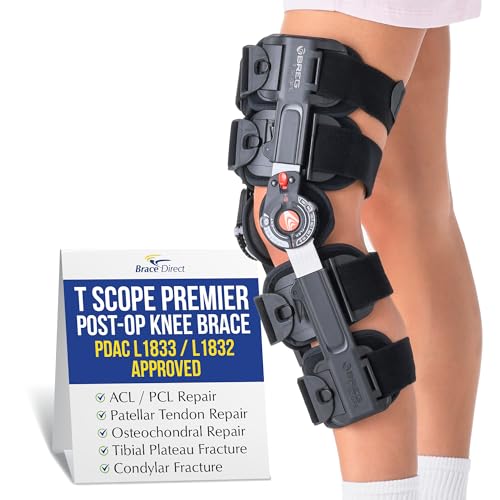
The Breg T Scope Premier is the brace you want if you are still in the early weeks of post-surgical rehab but need to get back on snow gently. Its key feature is the telescoping frame that extends from 17 inches to 27 inches, allowing the brace to accommodate swelling changes and multiple leg lengths without requiring a refitting. The bilateral hinges lock at specific ROM angles — 0°, 30°, 60°, or 90° — controlled via an external dial, so you can gradually increase flexion as the ligament heals.
The open-frame design is exceptionally lightweight for a post-op brace — around 1.5 pounds — which reduces fatigue when wearing it for eight hours a day. The quick-clip buckles make donning and doffing easy, even when the knee is tender. Brace Direct also offers a free video fitting session, which is particularly valuable for skiers who are not sure how to align the hinge axis with their femoral condyle.
This brace is not designed for aggressive skiing or high-impact falls. The frame provides excellent immobilization for walking and light carving, but it lacks the lateral stiffness needed to prevent a valgus collapse during a high-speed fall. Think of it as a rehab-to-snow transition brace, not a permanent ski brace. It fits best with thigh circumferences up to 30.5 inches and requires a calf-to-thigh measurement for accurate sizing.
Why it’s great
- Telescoping frame adjusts to leg length and swelling changes
- Quick-clip buckles allow fast application on tender knees
- Lightweight for a post-op brace at 1.5 pounds
Good to know
- Not designed for high-speed skiing or heavy lateral loads
- Limited to post-op immobilization and light activity
- Best for skiers with thighs up to 30.5 inches in circumference
5. Shock Doctor Knee Brace 875

The Shock Doctor 875 hits the sweet spot for recreational skiers who need reliable support without the bulk of a full aluminum frame. It uses heavy-duty bilateral dual hinges that provide enough lateral stiffness to protect against MCL sprains, while the four-way stretch Lycra mesh allows full knee flexion for dynamic skiing. The pre-curved anatomical design matches the natural bend of the leg when strapped into a ski boot, reducing the pinching sensation that flat braces create at the back of the knee.
The compression sleeve promotes therapeutic heat, which aids blood flow to the tendons and muscles during cold-weather skiing. The airflow vented tech reduces odor and moisture, so the brace stays fresh even after consecutive days on the slopes. The easy-grip tabs on the closure straps let you adjust tension without removing gloves — a small detail that matters when you are adjusting in a lift line.
One downside: the hinges are not ROM-adjustable, so you cannot set specific extension stops. For skiers with healed injuries who just want to prevent re-injury, this is fine. But if you need precise hyperextension control, you will need to step up to the DonJoy BIONIC. The Shock Doctor 875 is also on the heavier side for a mid-range brace at 16 ounces, but the trade-off is noticeable stability during aggressive carving.
Why it’s great
- Bilateral dual hinges provide good lateral stability without aluminum bulk
- 4-way stretch Lycra mesh allows full flexion for dynamic skiing
- Grip tabs are easy to adjust with winter gloves on
Good to know
- Hinges lack adjustable ROM stops for hyperextension control
- Heavier than other mid-range options at 16 ounces
- Can feel warm during spring skiing despite airflow vents
6. Mueller Hg80 Hinged Knee Brace 5401
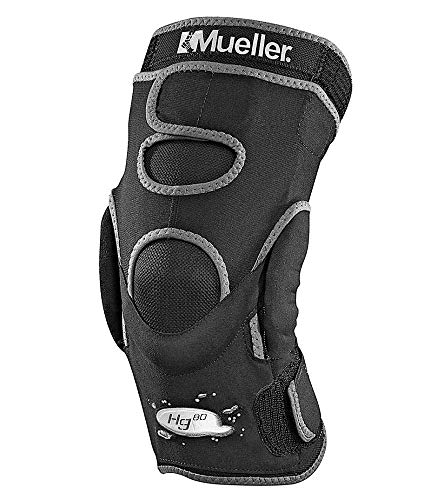
The Mueller Hg80 is the comfort king of this list. Its HydraCinn fabric is a proprietary moisture-wicking material that feels soft against the skin and stays dry longer than standard neoprene — a real advantage when you are spending hours in a ski lodge with the brace on. The triaxial hinges are the standout feature: they track the knee’s natural rolling motion more accurately than simple pin hinges, reducing the chance of the brace binding during a hard turn.
The brace is designed to prevent medio-lateral (side-to-side) movement and hyperextension, making it suitable for skiers recovering from mild MCL sprains or general knee arthritis. The adjustable design slips onto the leg easily and tightens with a hook-and-loop closure; the fit stays secure even when you are hiking uphill in the sidecountry. At 8.8 ounces, it is the lightest hinged brace here, which means you will forget you are wearing it after the first few runs.
The catch: the brace provides only moderate lateral stiffness. For skiers with a completely torn ACL or advanced instability, the Mueller Hg80 will not provide enough resistance to prevent a catastrophic valgus collapse. It is best used as a preventative brace for skiers with healthy ligaments who want to reduce the risk of a first injury, or for those who are 12+ months post-surgery and need a lightweight reminder brace.
Why it’s great
- Triaxial hinges track natural knee motion without binding
- HydraCinn fabric is the most comfortable neoprene alternative available
- Very lightweight at 8.8 ounces — ideal for long ski days
Good to know
- Insufficient lateral stiffness for unstable ACL/PCL knees
- Best suited for prevention or late-stage recovery
- Hook-and-loop closure can lose grip when wet with snowmelt
7. GHORTHOUD Hinged ROM Knee Brace

The GHORTHOUD is the budget-friendly entry point for skiers who need basic mechanical support without a large investment. The brace features bilateral hinges with a locking ROM dial that lets you set extension stops from 0° to 120°, which is rare at this price point. The open-patella design reduces pressure on the kneecap during flexion, and the 360-degree Lycra compression sleeve fits snugly whether you have thick or thin calves.
The brace is versatile — the hinges and locking dials are removable, so you can convert it into a simple compression sleeve for daily activities or for the off-season. This modularity makes it a good first brace for recreational skiers who are not sure how much support they need. The Lycra fabric provides even compression that can improve blood flow and reduce swelling during a long day on the slopes.
The trade-offs are real: the hinges are not as durable as the stainless steel gears on the Komzer or the triaxial hinges on the Mueller. Over a full season of skiing, the ROM dial may loosen. The fabric also lacks the moisture-wicking properties of more expensive braces, so it can become damp and heavy during warm days. For occasional skiers or those with mild instability, however, it is a solid value that delivers functional protection.
Why it’s great
- ROM locking dial adjustable from 0° to 120° at a budget price
- Removable hinges allow conversion to a compression sleeve
- 360-degree Lycra fit prevents gaps around the calf and thigh
Good to know
- Hinges are less durable than premium options — may loosen over a season
- Lycra fabric lacks moisture-wicking properties
- Best suited for occasional skiing or mild instability
FAQ
Can I wear a knee brace inside a ski boot?
What is the difference between a hinged and unhinged knee brace for skiing?
How do I measure my thigh and calf for a knee brace?
Will a knee brace prevent an ACL tear while skiing?
Final Thoughts: The Verdict
For most users, the knee braces for skiing winner is the DonJoy Performance BIONIC FULLSTOP because its FullStop hyperextension control offers the most targeted protection for the specific rotational and backward forces that ski turns create. If you want a breathable mid-range option that fits easily under ski pants, grab the DonJoy Drytex Sport. And for a heavy-duty brace with surgical-grade materials that works well for post-op ACL rehab, nothing beats the Komzer Professional ACL.