That sharp pinch under your kneecap at mile three isn’t just a nuisance — it’s the signal that your joint needs intelligent support, not just a wrap. A specialized runner’s brace must balance enough structure to limit medial-lateral wobble with the flexibility to not restrict your natural stride cadence.
I’m Emma — the founder and writer behind Baby Bangs. I’ve spent years analyzing the biomechanics of running gear, from foam densities in shoes to the compression gradients in joint supports.
This guide breaks down the engineered differences between side-stabilized braces, compression-only sleeves, and carbon-infused recovery tools so you can find the right knee brace for running that matches your specific pain point, activity level, and anatomy.
How To Choose The Best Knee Brace For Running
Running places repetitive impact through your knee at roughly 2-3 times your body weight per stride. The wrong brace will either migrate down your calf by mile two or restrict your hamstring swing so much that your gait compensates, creating hip or ankle pain down the line. You need to match the brace’s mechanical features to your specific knee pathology.
Identify Your Need: Stability vs. Compression
If you have a history of ACL sprains, meniscus tears, or patellar tracking issues, you need a brace with rigid side stabilizers and a patella gel pad to physically guide the kneecap and limit lateral shift. If you are dealing with general runner’s knee (patellofemoral pain syndrome) without instability, a high-quality compression sleeve that improves proprioception and blood flow is often more comfortable and less bulky for long miles.
Material Breathability & Moisture Management
Neoprene blends offer excellent elastic compression and warmth, which can soothe stiff joints, but they trap heat. If you run in warm climates or sweat heavily, look for carbon-fiber or open-weave nylon-spandex blends that wick moisture and resist odor. A brace that soaks through becomes a chafing hazard by the end of a 10K.
Fit Precision: The Thigh Circumference Rule
Unlike sleeves that measure at the knee center, stabilizer braces require measurement of your thigh circumference exactly 4 inches above the kneecap. A brace that is too loose will not hold the side stabilizers in place; one that is too tight will cut off popliteal circulation behind the knee. Always check the manufacturer’s sizing chart against your personal thigh measurement.
Quick Comparison
On smaller screens, swipe sideways to see the full table.
| Model | Category | Best For | Key Spec | Amazon |
|---|---|---|---|---|
| NEENCA Professional (B07R62C645) | Stabilizer | ACL / Meniscus recovery | Dual spring stabilizers + gel pad | Amazon |
| Modvel 2-Pack | Compression Sleeve | General ache & swelling | Nylon-latex blend, 6 sizes | Amazon |
| Galvaran (B0F7LCHKGX) | Stabilizer | Patellar instability after sprain | 4 memory stabilizers + V-band | Amazon |
| adidas Climacool (B073H8NK43) | Performance Sleeve | High-sweat, high-speed runs | Aeroready moisture-wicking | Amazon |
| NEENCA Carbon Sleeve (B0BXSTKJBT) | Recovery Sleeve | Post-run inflammation control | Carbon fiber + bioelectric ions | Amazon |
In‑Depth Reviews
1. NEENCA Professional Knee Brace (B07R62C645)

The NEENCA Professional is a Class 2 medical device that brings real mechanical stability to a runner’s knee. Its dual spring stabilizers run along both sides of the joint to resist varus and valgus forces — the sideways collapse that often triggers pain in runners with ACL or meniscus history. The anatomically contoured patella gel pad wraps around the kneecap to centralize tracking during the gait cycle, which directly addresses the patellofemoral grinding so common on downhills.
The 64% nylon and spandex blend provides graduated compression that avoids the tourniquet effect behind the knee, and the anti-slip gel strips keep the brace from migrating during high-cadence intervals. The air-knit fabric absorbs and evaporates moisture quickly, making it suitable for long sessions even in moderate humidity. It is also FSA/HSA eligible, which is a practical bonus for runners managing chronic conditions.
This is not a lightweight sleeve for casual joggers — the built-in stabilizers and gel pad add bulk that some runners may notice under compression tights. However, for anyone who needs genuine structural reinforcement during a run, the trade-off in mass is worth the joint confidence it delivers. It fits either leg and comes in multiple sizes based on thigh circumference.
Why it’s great
- Dual metal side stabilizers limit medial-lateral wobble effectively
- Patella gel pad improves tracking and disperses pressure
- Breathable fabric reduces sweat buildup on long runs
Good to know
- Bulker than a compression-only sleeve; may not fit under tight running pants
- Latex content means those with latex allergies should check the blend
2. Modvel Compression Knee Brace 2-Pack (B08JGP1WYM)

The Modvel 2-Pack is a pure compression sleeve with no rigid stabilizers — its job is to boost blood flow, reduce soft-tissue swelling, and improve proprioceptive awareness of the knee joint during a run. The nylon and latex blend applies even circumferential pressure without digging into the popliteal space, and the moisture-wicking construction prevents the clammy feeling that ruins a long run in warm weather.
With sizes from XS to 3XL, this kit accommodates a broad range of body types, and having two sleeves means you can rotate them between wash cycles or brace both knees after a hard trail session. The sleeve stays in place due to the elastic compression gradient rather than silicone strips, which some runners with sensitive skin prefer. It washes well without losing its shape or compression force over repeated cycles.
The limitation is clear: a compression sleeve does not control lateral instability. If you have a torn meniscus or Grade II MCL sprain, this will not provide the structural stop you need. It is best suited for runners with general patellofemoral ache, mild arthritis, or post-workout swelling who want a low-profile, comfortable sleeve they can set and forget.
Why it’s great
- Two sleeves for the price of one — great for rotation or bilateral support
- Very wide size range from XS to 3XL
- Breathable, moisture-wicking fabric stays comfortable on long runs
Good to know
- No side stabilizers or patella pad — pure compression only
- Latex content may be problematic for those with allergies
3. Galvaran Knee Brace (B0F7LCHKGX)
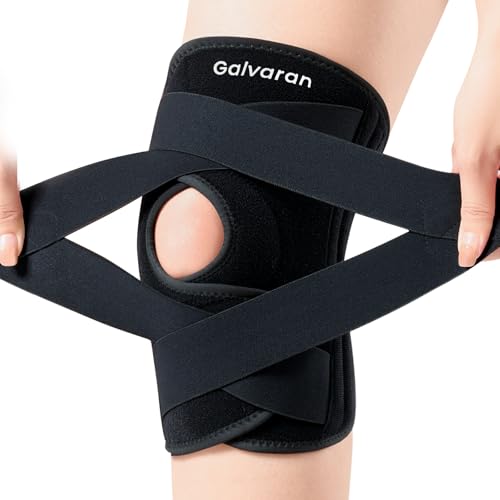
The Galvaran brace takes stabilization a step further with four memory side stabilizers — two per side — and a unique V-shaped band that wraps 360 degrees around the patella. This design is engineered to prevent the kneecap from drifting laterally during the stance phase of a run, which is the exact failure mode for runners with patellar instability after a sprain or dislocation. The hook-and-loop closure system allows you to dial the compression in real time mid-run.
Its material composition is a dense neoprene blend (60% neoprene) bonded with a strong fiber composite substrate for impact resistance. This gives it a substantial feel that provides genuine load-sharing for ligaments and tendons, but the trade-off is reduced breathability compared to open-knit sleeves. Runners who sweat heavily will need to hand-wash it after each use to prevent odor buildup in the neoprene core.
Sizing is based on a thigh measurement taken 4 inches above the kneecap center, which is a more reliable anchor point than knee circumference for a brace with rigid stabilizers. The brace fits either left or right leg, and the V-band design is particularly effective for runners who feel their kneecap grinding or clicking on the descent portion of a run.
Why it’s great
- Four memory stabilizers and a V-band create the most robust lateral control in this list
- Adjustable hook-and-loop closure for custom compression mid-run
- Thigh-based sizing ensures stabilizers stay anchored
Good to know
- Neoprene build is less breathable; may feel warm in hot weather
- Hand wash only to preserve the fiber composite structure
4. adidas Performance Climacool (B073H8NK43)

The adidas Climacool is a performance-oriented compression sleeve built for runners who prioritize thermoregulation and unrestricted movement over mechanical stability. Its Aeroready moisture-wicking fabric pulls sweat away from the skin and dries rapidly, and the seamless construction eliminates chafe points — a critical factor for marathon-distance training. The dual-compression kinesiology band applies targeted support around the patellar tendon without a rigid hinge.
This sleeve is exceptionally lightweight at only 0.03 kg, and the silicone grip at the top edge prevents it from sliding down during high-cadence repetitions. It is designed to be worn alone or under shorts with minimal bulk, making it the best option here for speed workouts and racing where every ounce and every degree of freedom matters. The polyester blend stretches without losing its compressive memory over time.
What it does not offer is any mechanical block against lateral or rotational forces. If you have a history of knee dislocation or ACL reconstruction, this sleeve will not protect you during a sudden pivot or uneven terrain. It is ideal for the runner whose primary issue is mild ache, swelling, or a desire for proprioceptive feedback — not structural instability.
Why it’s great
- Aeroready fabric is the most breathable and quickest-drying in this group
- Seamless construction eliminates chafing on long runs
- Ultra-lightweight with silicone grip for stay-put wear
Good to know
- No stabilizers or hinge — pure compression sleeve only
- Less warmth for cold-weather runs compared to neoprene braces
5. NEENCA Carbon Compression Sleeve (B0BXSTKJBT)

The NEENCA Carbon Compression Sleeve differentiates itself with a 54% carbon fiber weave embedded with semiconductors that respond to body temperature by releasing negative oxygen ions. This is not marketing fluff — the intended mechanism is to stimulate bioelectric activity and improve local circulation, which can accelerate recovery after hard efforts. For runners managing chronic inflammation or sluggish return-to-run after a minor strain, this adds a recovery dimension that a plain nylon sleeve cannot.
The 39% nylon, 6% Lycra, and 1% spandex blend creates a high-elastic fabric that applies even, graduated compression without the pinching sensation some neoprene braces cause behind the knee. The carbon fiber also has natural moisture-wicking and odor-resistant properties, so the sleeve stays fresher during multi-day use between washes. It is FSA/HSA eligible, making it a practical choice for those with flexible spending accounts for joint health.
This sleeve is not designed for structural support — there are no stabilizers, hinges, or patella pads. Its value is in the post-run recovery phase: wearing it after a run to reduce swelling and promote blood flow, or during easy-paced runs where the goal is joint warmth and proprioception, not mechanical correction.
Why it’s great
- Carbon fiber blend with bioelectric properties for enhanced circulation recovery
- Excellent moisture and odor management for repeated wear
- FSA/HSA eligible for managed healthcare spending
Good to know
- No mechanical stabilizers — not for ligament instability
- Higher entry-level cost compared to standard compression sleeves
FAQ
Should I run with a stabilizer brace or a compression sleeve?
How do I measure my thigh for a knee brace with stabilizers?
Can I wear a knee brace under running tights?
Final Thoughts: The Verdict
For most runners dealing with post-injury instability or chronic patellofemoral ache, the best knee brace for running is the NEENCA Professional because it combines dual spring stabilizers and a patella gel pad in a breathable chassis that stays put through a full training run. If you want a lightweight sleeve for mild swelling and proprioception, grab the adidas Climacool. And for post-run recovery circulation with bioelectric assist, nothing here beats the NEENCA Carbon Compression Sleeve.