Recovering from a knee injury means every step is a negotiation between trusting your joint and fearing a re-injury. A flimsy sleeve that bunches at the back of your knee won’t provide the medial-lateral support a healing meniscus demands, and an overly rigid post-op clamshell can sabotage sleep and compliance. The right brace bridges the gap between passive immobilization and dynamic, protected motion — and choosing wrong risks setbacks measured in weeks, not days.
I’m Emma — the founder and writer behind Baby Bangs. I’ve spent over a decade analyzing durable medical goods on the marketplace, comparing hinge articulation, strap geometry, and moisture management across hundreds of rehabilitation braces to separate marketing promises from genuine structural support.
The rehabilitation phase demands a brace that tracks the knee’s natural pivot while restricting harmful lateral drift. Whether you’re progressing through post-surgery protocols or managing an unstable joint, the knee brace for rehabilitation you select must balance rigidity with real-world wearability over hours of daily use.
How To Choose The Best Knee Brace For Rehabilitation
A rehabilitation brace must do more than squeeze. It needs to control the joint’s arc of motion, prevent unwanted lateral gapping, and stay planted during flexion without digging into the popliteal space. Beginners often grab the most padded sleeve, but recovery demands specific structural features tied to your injury stage.
Hinge Architecture: Polycentric vs. Triaxial
A single-axis hinge creates a fixed pivot point that fights the knee’s natural rolling and gliding motion. Polycentric hinges (two moving pivot points) better mimic the femoral rollback, reducing shear stress on healing ligaments. Triaxial hinges add a third axis to further offload rotational torque, which matters during early-phase gait retraining after ACL reconstruction. Always check whether the hinge is bilateral (both sides of the joint) — a single lateral hinge cannot control medial instability.
Fit System: Wraparound vs. Pull-On
Post-surgery or acute injury, bending the knee enough to slide into a pull-on sleeve can be excruciating. Wraparound designs with hook-and-loop panels allow you to open the brace completely, position it against the leg, and cinch tension without lifting or twisting the joint. For chronic instability where donning isn’t the barrier, a pull-on style with anti-migration silicone or gel strips offers more uniform compression and stays put during dynamic activity. Measure the thigh and calf circumferences at the widest points — the brace’s leverage depends on snug fit above and below the knee, not compression over the patella itself.
ROM Stops and Progressive Protocols
A true rehabilitation brace includes adjustable flexion and extension stops — dials or pegs that physically block the hinge from opening or closing beyond a set angle. This allows a surgeon or physical therapist to start the brace locked in full extension (0 degrees) and gradually release range as the graft or tissue heals. A brace without ROM stops is a support sleeve, not a rehab tool. Look for stops that offer incremental adjustments (every 10 degrees) so the progression matches your protocol timeline rather than large jumps that skip critical safe zones.
Quick Comparison
On smaller screens, swipe sideways to see the full table.
| Model | Category | Best For | Key Spec | Amazon |
|---|---|---|---|---|
| DonJoy Performance BIONIC FULLSTOP | Premium Dynamic | ACL/Meniscus rehab, return-to-sport | Four-point leverage with dampening hinge cycle | Amazon |
| Breg T Scope Premier Post-Op | Post-Surgery Rigid | Strict post-op ROM protocols, fracture recovery | Telescoping sleeves with adjustable flexion/extension stops | Amazon |
| DonJoy Drytex Sport Hinged Wraparound | Mid-Range Hinged | Moderate sprains, daily activity with wraparound convenience | Durable bilateral hinges on a breathable Drytex wrap | Amazon |
| Mueller 5401 Hg80 Hinged Knee Brace | Value Hinged | Arthritic instability, mild sprains, basketball/volleyball | Triaxial hinges with HydraCinn moisture-wicking fabric | Amazon |
| FUTURO Hinged Knee Brace, Adjustable | Entry-Level Hinged | Basic stability during walking, budget-conscious rehab | Adjustable compression straps with simple bilateral hinges | Amazon |
In‑Depth Reviews
1. DonJoy Performance BIONIC FULLSTOP Knee Brace

The BIONIC FULLSTOP redefines what a rehabilitation brace can do by integrating a four-point leverage system that actively trains the user to stay out of the at-risk end-range of extension. Instead of passively blocking hyperextension with a hard stop, the hinge uses a dampening cycle that introduces resistance as the knee approaches full lockout — a sensory feedback loop that conditions the quadriceps to engage earlier during gait. The compression sleeve employs thermal regulation fabric that wicks moisture without the clammy neoprene heat buildup that causes mid-session removal.
Anti-migration technology is baked into the weave, so the sleeve stays anchored at the popliteal fossa during squatting and cutting movements. Adjustable straps allow fine-tuning of the tension gradient from the distal thigh to the proximal calf, which prevents the brace from drifting south after twenty minutes of dynamic activity. Reflective panels on the posterior calf add a practical layer for low-light outdoor rehab walks, though functionality rather than fashion drives the design.
The intended use case is clear: moderate to severe ligament sprains, ACL and meniscus injuries, patella instability, and hyperextension control. It fits snugly enough for sport-specific return-to-play progression, but the thermal regulation keeps it comfortable enough for all-day wear during the earlier, less active stages of rehab. The trade-off is a higher tension profile that may feel restrictive to users seeking a lightweight sleeve for mild arthritis.
Why it’s great
- Dampening hinge cycle builds proprioceptive awareness, not just passive blocking.
- Anti-migration fabric eliminates the constant tugging common with cheaper sleeves.
Good to know
- The aggressive compression profile may feel too intense for users in the very first week post-surgery.
- Sizing must be precise — a loose fit disables the four-point leverage advantage.
2. Breg T Scope Premier Post-Op Knee Brace

The Breg T Scope Premier is built for the strictest post-operative protocols where absolute control over range of motion is non-negotiable. Its telescoping thigh and calf sleeves extend to accommodate a wide range of limb lengths and circumferences — the Premier model fits thigh circumferences up to 30.5 inches, while the XL variant stretches to 35.5 inches, making it one of the few rehabilitation braces that can properly fit larger body types without cutting circulation. The bilateral aluminum hinges house precise flexion and extension stops that lock in at specific angles, allowing the surgeon to step the patient through a progressive protocol without swapping hardware.
Weight is the primary engineering compromise: at over two pounds, this brace is heavier than any hinged sleeve or wraparound option. The counterweight is a padded foam chassis designed to distribute load across the thigh and calf rather than concentrating pressure at the joint line. Buckle closures replace hook-and-loop panels, which provides a more consistent closure tension that won’t loosen during sleep or extended sitting — critical for patients who need to wear the brace continuously between PT sessions. The brace ships as a single unit compatible with both right and left legs, with the hinge orientation adjustable on the frame.
The T Scope is both a splint and a rehab tool. It can be locked in full extension for the first week of ACL recovery, then incrementally opened to 30, 60, or 90 degrees as the graft tolerates load. Brace Direct offers a free video fitting session with a professional, which addresses the biggest pain point of rigid post-op braces: improper strap placement that causes the brace to piston down the leg during standing. If your protocol demands absolute ROM restriction before you’ve regained quad activation, this is the structural baseline.
Why it’s great
- Telescoping sleeves provide a truly customizable fit for diverse leg lengths and muscle volumes.
- Adjustable flexion and extension stops with incremental locking allow protocol-driven progression.
Good to know
- The weight and rigid foam frame can feel bulky under clothing and during sleep.
- Buckle closures require more setup time than hook-and-loop wraps.
3. DonJoy Drytex Sport Hinged Knee Wraparound
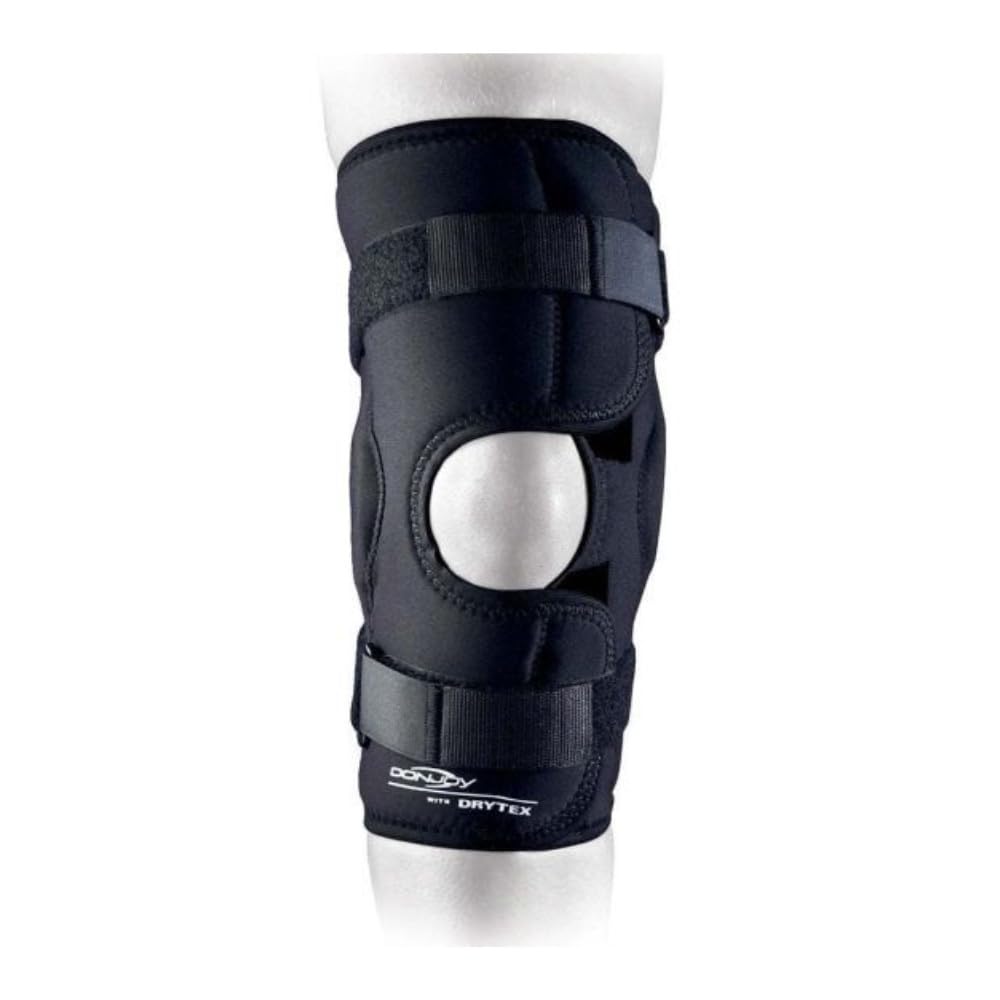
The Drytex Sport Wraparound solves the donning problem that plagues early-stage rehab. Because the entire brace opens flat, you can sit with your leg extended, lay the brace behind the knee, and pull the panels forward without flexing the joint. The bilateral hinges are polycentric, tracking the knee’s natural roll-glide mechanism rather than forcing a fixed arc, which reduces shear stress on the medial and collateral ligaments during walking. The Drytex fabric is noticeably lighter and more breathable than standard neoprene, making it a strong candidate for all-day wear during the sub-acute phase when the brace needs to stay on between activities.
Adjustable tension straps on the thigh and calf allow you to tune the compression gradient to your comfort tolerance — tight enough to prevent the brace from migrating during gait but loose enough to avoid a tourniquet effect behind the knee. The wraparound design also accommodates swelling fluctuations better than a pull-on sleeve; if your knee balloons in the afternoon, you can release the upper strap a notch without removing the brace entirely. Sizing is labeled Small through XXL based on thigh circumference measurement, so a tape measure is your co-pilot here.
This is not a post-op rigid frame. It lacks the ROM stops needed for locked-extension protocols. Instead, it shines for moderate sprains, patellofemoral pain, and the transition phase when you’ve graduated from a post-op brace but still need lateral hinge support during daily movement. The bilateral hinges provide medial-lateral control that a simple sleeve can’t offer, making it a solid mid-range bridge between full immobilization and return-to-sport.
Why it’s great
- Full wraparound design eliminates flexed-knee donning pain post-injury.
- Breathable Drytex fabric prevents the swamp effect of traditional neoprene.
Good to know
- No adjustable ROM stops — not suitable for strict post-op extension protocols.
- The open-back design provides less popliteal compression than pull-on sleeves.
4. Mueller 5401 Hg80 Hinged Knee Brace
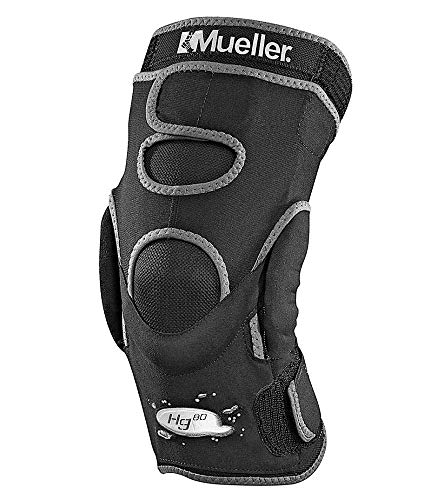
The Mueller Hg80 packs triaxial hinges into a pull-on neoprene chassis at a price point that undercuts most hinged competitors. Three-axis hinge geometry tracks the knee’s multi-planar motion better than single-axis alternatives, which reduces the hinge binding that can occur during deep flexion exercises like wall sits or step-downs. The HydraCinn fabric lining is Mueller’s proprietary moisture-wicking layer that pulls sweat away from the skin faster than raw neoprene, which makes a real difference when the brace is worn for multiple consecutive hours during home exercise programs.
Applying the brace requires sliding it over the foot and up the leg, which can be uncomfortable if the knee is acutely swollen or tender. Once in place, the combination of a compressive neoprene body and adjustable hook-and-loop straps over the thigh and calf provides a secure fit that resists migration during moderate activity. The brace fits either leg, and the sizing chart is based on mid-patella circumference, so users with significant swelling should size up to avoid a tourniquet effect at the popliteal crease. Mueller has been a staple in sports medicine for over sixty years, and the build quality reflects that legacy — the hinges are stitched into reinforced pockets rather than glued.
This brace targets the user who needs dynamic hinged support but is past the acute surgical phase where a wraparound or rigid frame is mandatory. It excels for arthritic instability, mild to moderate ligament sprains, and return-to-play conditioning for basketball, volleyball, and wrestling. The triaxial hinges provide a level of joint tracking that you don’t typically find at this tier, but the neoprene body can get warm during summer outdoor activities, and the pull-on application is a barrier for anyone with limited knee flexion.
Why it’s great
- Triaxial hinge tracking at a significantly lower barrier than premium competitors.
- HydraCinn lining reduces moisture buildup better than standard neoprene.
Good to know
- Pull-on donning is challenging with acute swelling or recent surgery.
- Neoprene body retains more heat than mesh or Drytex alternatives.
5. FUTURO Hinged Knee Brace, Adjustable

The FUTURO Hinged Knee Brace is the most accessible entry point for someone who has never worn a rehabilitation brace before. It uses bilateral hinges that are lighter and more flexible than the triaxial or polycentric options found on higher-tier braces, which means less structural control but also less bulk for daily living. The adjustable compression straps target the thigh and calf independently, so you can dial in tension without the brace squeezing the patellar tendon itself. The outer fabric is a soft, matte nylon blend that slides against pants without catching or rolling.
This brace is not designed for the heavy lateral loads of sport-specific drills or post-surgical protocols. The hinges prevent mild hyperextension and provide a subtle reminder to avoid full lockout during standing, but they lack the dampening cycle or leverage systems needed for moderate to severe instability. Application is straightforward — slide it up the leg and fasten the hook-and-loop panels — and the low-profile silhouette allows it to disappear under loose workout pants or jeans, which matters for users who need to wear it throughout the workday without drawing attention.
The real value is for the user navigating early conservative management: a minor MCL sprain, patellofemoral pain during squatting, or general age-related laxity that needs a little extra vigilance during walks. It bridges the gap between a simple compression sleeve that provides no lateral control and a hinged brace that overwhelms the user with straps and hardware. If your rehab needs evolve beyond basic stability, you will outgrow this brace quickly — but as a starter tool to understand what hinge assistance feels like, it serves its purpose.
Why it’s great
- Low-profile design fits discreetly under daily clothing for consistent wear compliance.
- Adjustable thigh and calf straps provide customizable tension without patellar compression.
Good to know
- Lightweight hinges cannot control moderate to severe ligament instability.
- Pull-on application is difficult if swelling restricts knee range of motion.
FAQ
Can I wear a rehabilitation brace while sleeping?
How do I measure for a hinged rehabilitation brace?
What is the difference between a rehabilitation brace and a prophylactic brace?
Final Thoughts: The Verdict
For most users navigating the sub-acute and strengthening phases of rehab, the knee brace for rehabilitation winner is the DonJoy Performance BIONIC FULLSTOP because its dampening hinge cycle trains better movement patterns while the anti-migration sleeve stays locked during dynamic activity. If you need strict post-operative ROM control with adjustable stops, grab the Breg T Scope Premier. And for a wraparound that doesn’t require bending your knee to put it on, the DonJoy Drytex Sport Hinged Wraparound offers the best balance of convenience and bilateral support.