Standing on a tile floor for eight hours straight isn’t just tiring — it’s punishing. Kitchen clogs are the only thing between your soles and a concrete subfloor, yet most options fail before the lunch rush hits. The right pair delivers slip-resistant traction on greasy surfaces, a shock-absorbing midsole that spares your lower back, and a closed-toe design that protects against hot spills and dropped knives.
I’m Emma — the founder and writer behind Baby Bangs. I’ve spent months cross-referencing outsole certifications, foam density reports, and insole arch profiles to separate the kitchen-ready clogs from the weekend garden shoes pretending to be work-ready.
This guide compares seven distinct models against the specific demands of commercial kitchens, healthcare floors, and foodservice shifts to help you find the right kitchen clogs for your twelve-hour standing shift.
How To Choose The Best Kitchen Clogs
Kitchen clogs are not shoes you can buy by color. The wrong outsole on a wet tile floor sends you sliding. The wrong midsole leaves your knees aching by the second hour. The wrong toe clearance invites hot oil burns. Here are the three specs that separate a twelve-hour clog from a two-week regret.
Outsole Compound — The Grip Decoder
A standard rubber outsole turns into a hockey puck on wet tile and grease. You want an outsole specifically tested to ASTM F2913 — the test that measures slip resistance on wet and oily ceramic surfaces. The material should be a heavily siped oil-resistant rubber blend, not the same flat rubber found on casual clogs. The siping pattern matters: widely spaced grooves clear water faster than tight herringbone patterns on smooth kitchen floors.
EVA Midsole Density and Arch Profile
Cheap clogs use low-density EVA foam that compresses to half its height within three weeks. High-density, compression-molded EVA retains its shape over a six-month shift cycle. For arch support, look for a clogs that has a contoured footbed with a built-in arch bump rather than a flat slab you soften over time. The sweet spot for all-day standing is a midsole with a durometer reading of 45 to 55 Shore C — firm enough to support your weight without feeling like wood.
Closed Toe and Heel Security
Closed toe means your metatarsals are protected from hot splashes, falling knives, and heavy pans. Some clogs offer a fully enclosed toe box that wraps around the toes rather than just covering the top. For heel security, a clog with a raised heel cup and a slight backstrap pull prevents your foot from sliding forward when you pivot on wet floors. A loose heel is a slipping hazard, not a comfort feature.
Quick Comparison
On smaller screens, swipe sideways to see the full table.
| Model | Category | Best For | Key Spec | Amazon |
|---|---|---|---|---|
| Crocs Bistro Pro LiteRide | Premium | Extended standing shifts | LiteRide foam insole — 58 Shore C | Amazon |
| Dansko Kaci Mule | Premium | Bio-based EVA / Lightweight | Bio-based EVA — 7.8 oz per shoe | Amazon |
| Klogs Dusty | Premium | All-day cushioning | Cushioned footbed — No heel | Amazon |
| Crocs Bistro Work | Mid-Range | Budget reliability | Croslite foam — closed toe | Amazon |
| Skechers Nampa Food Service | Mid-Range | EH-rated slip resistance | Electrical hazard rating — lace-up | Amazon |
| LIPROFE Chef Shoes | Budget | Entry-level work clog | Oil & water resistant outsole | Amazon |
| SECHRITEM Work Clogs | Budget | First-time buyer | Unisex waterproof design | Amazon |
In‑Depth Reviews
1. Crocs Bistro Pro LiteRide Clogs
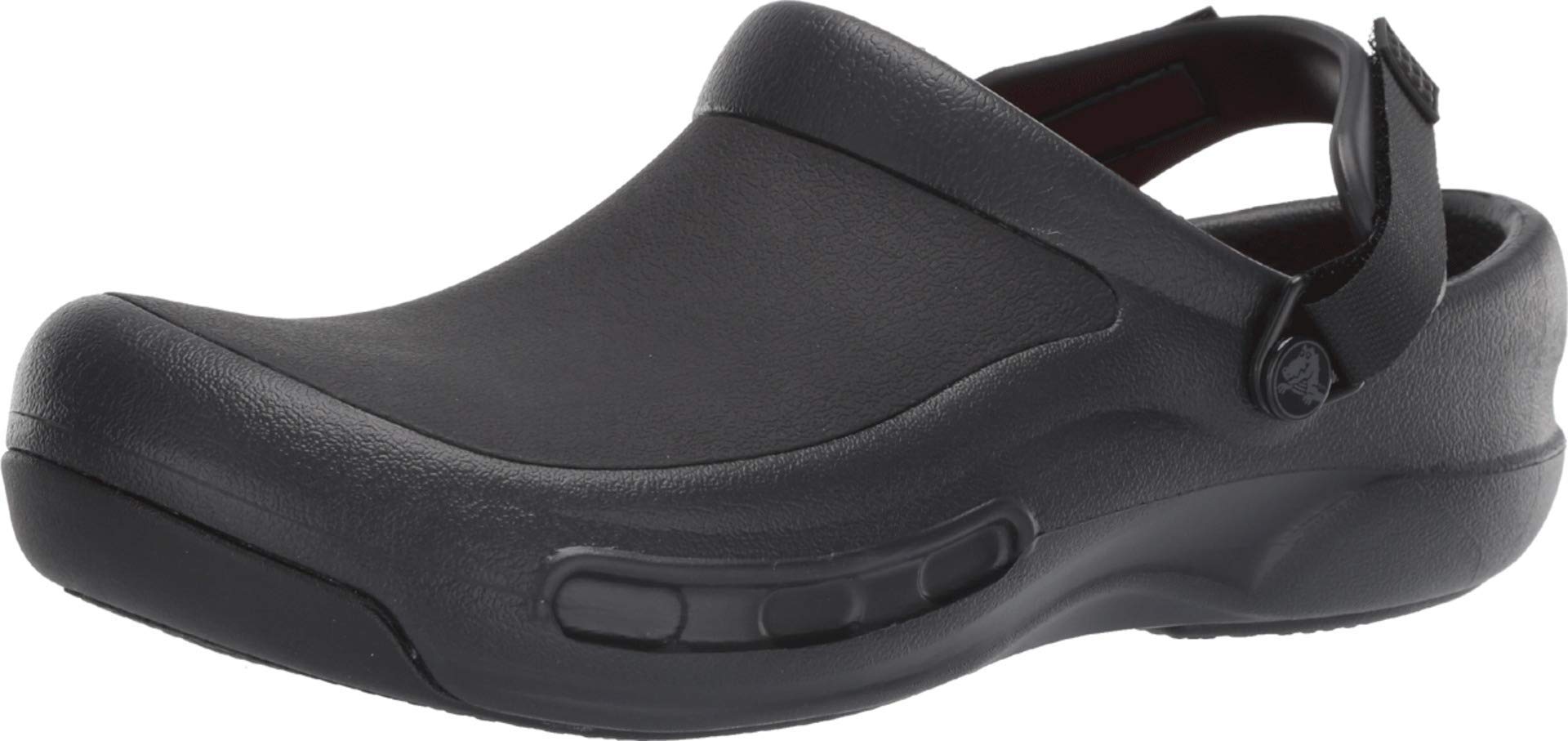
The Crocs Bistro Pro LiteRide takes everything the standard Bistro does and upgrades the footbed. Instead of the standard Croslite foam that flattens after a few months, LiteRide foam uses a proprietary blend that measures around 58 on the Shore C hardness scale — dense enough to support a full day of standing but soft enough to absorb heel strike shock. The outsole uses Crocs’ patented slip-resistant tread pattern certified for wet and oily surfaces.
The enclosed toe box fully wraps the front of the foot, which helps protect against hot liquid splashes and dropped utensils. The heel cup is deeper than the standard Bistro, giving your foot a secure seat without needing a backstrap. At 1.5 pounds per shoe for a size 9, they are heavier than the Dansko Kaci, but the weight comes from the thicker midsole that preserves energy return over a twelve-hour shift.
One trade-off: the LiteRide insole is not removable, so you cannot swap in a custom orthotic if you need high-arch support. For most cooks and nurses with neutral arches, the built-in contour is sufficient. The upper ventilation holes are minimal — these run warmer than the standard Bistro but trade airflow for liquid resistance and structural integrity.
Why it’s great
- LiteRide foam retains shape after six months of daily wear
- Slip-resistant outsole tested to ASTM F2913
- Fully enclosed toe box with deep heel cup
Good to know
- Non-removable insole limits orthotic users
- Runs slightly warm due to minimal ventilation
- Heavier than some premium EVA competitors
2. Dansko Kaci Occupational Mule

The Dansko Kaci Mule shifts the category forward by using bio-based EVA foam that reduces petroleum content without sacrificing durability. Each clog weighs about 7.8 ounces in a women’s size 8 — nearly half the weight of the Crocs Bistro Pro LiteRide. That weight savings becomes noticeable after four hours of continuous walking on tile or concrete. The outsole uses a siped pattern with a slip-resistant certification suitable for foodservice and healthcare environments.
The footbed has a molded arch support that sits higher than most EVA clogs in this tier. The platform heel adds about an inch of lift, which shifts your center of gravity slightly forward — helpful for cooks who lean into counter work. The closed toe is a full wrap with a rounded profile that gives your toes enough splay room to avoid pinch points. The upper is made from a single-piece molded EVA with no seams, which means no water ingress points during washdowns.
On the downside, the bio-based EVA is softer than the Crocs LiteRide foam, which means it compresses faster under heavy static loads — if you stand in one spot for long stretches, the midsole will feel less supportive by month four. The pull-on entry is easy, but the heel cup is shallow, so some users report slight heel slip during fast pivots. The water resistance rating is “not water resistant,” so standing in standing water for extended periods will eventually soak through the upper.
Why it’s great
- Bio-based EVA reduces petroleum content
- Extremely lightweight at under 8 oz per shoe
- Molded arch support for neutral to low arches
Good to know
- Softer foam compresses faster under static standing
- Shallow heel cup can cause slip during fast moves
- Upper not water-resistant for standing liquid exposure
3. Klogs Footwear Dusty Women’s Clog
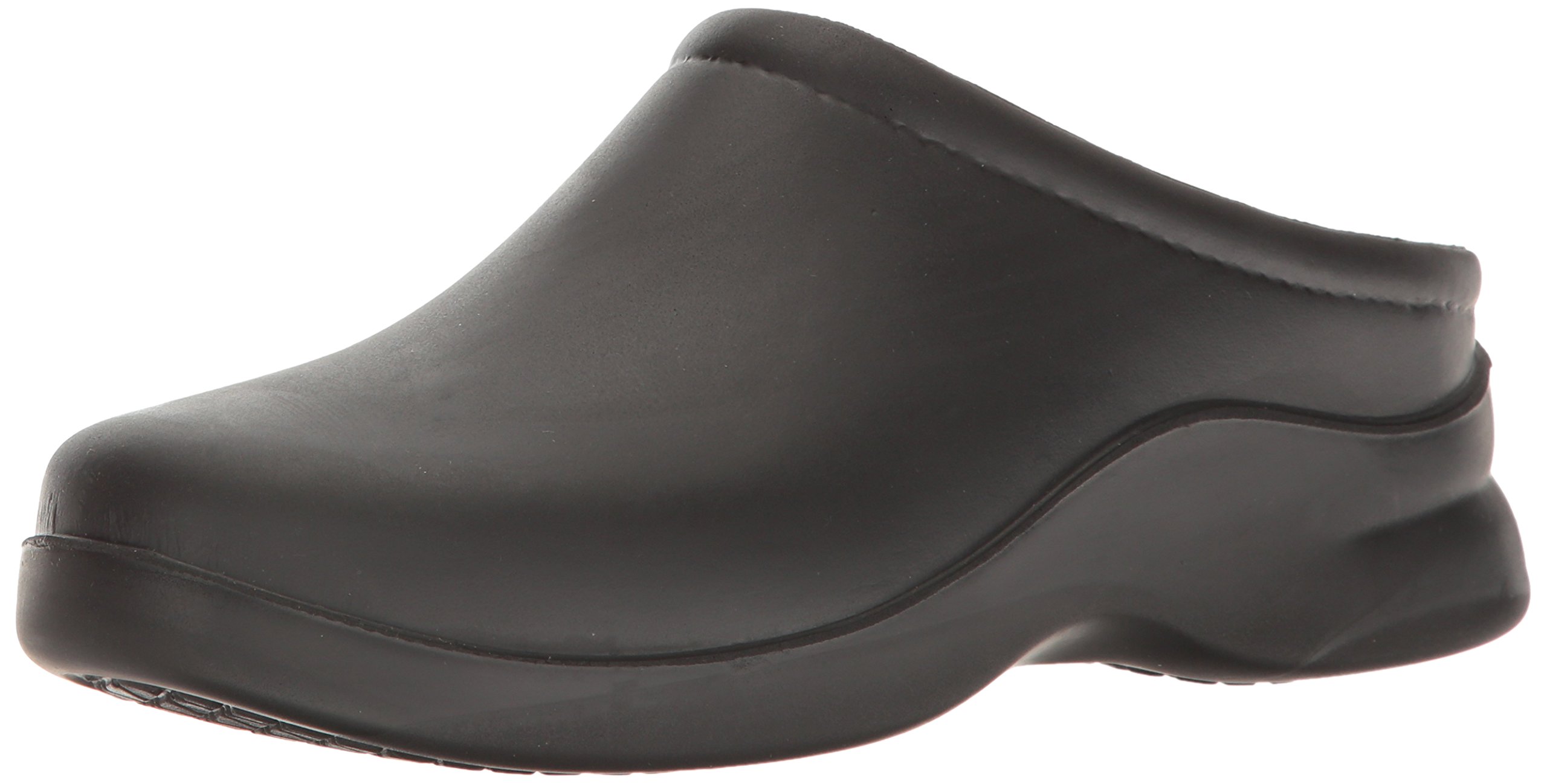
The Klogs Dusty has been a staple in healthcare and foodservice circles for years because it prioritizes one thing: a cushioned footbed that does not bottom out. The midsole uses a dual-density construction — a firm EVA base for stability and a softer layer directly under the foot for shock absorption. The outsole is a slip-resistant rubber compound that holds traction on wet tile, though the tread pattern is less aggressive than the Crocs Bistro Pro’s.
The closed toe is rounded and spacious, giving your toes room to splay naturally — a welcome feature for anyone prone to bunions or hammer toes. The upper is made from a smooth synthetic material that wipes clean with a damp cloth, which matters when you deal with flour, grease, and sauce splatters. The heel is flat (no platform), so your foot sits at a natural angle, which reduces calf fatigue compared to a raised heel.
The trade-off for that cushioning is a break-in period of roughly three to five shifts before the footbed molds to your foot. Users with high arches may find the initial arch support insufficient — the footbed is more neutral than contoured. The Dusty also lacks a backstrap, so if your foot is narrow, you might experience heel lift during fast moves. For medium-to-wide feet with neutral arches, this is a solid all-day clog that outlasts many cheaper alternatives in midsole durability.
Why it’s great
- Dual-density midsole resists compression for months
- Roomy closed toe accommodates wide feet
- Easy-to-clean synthetic upper
Good to know
- Requires 3-5 shift break-in period
- Neutral footbed lacks high arch support
- No backstrap — heel lift possible for narrow feet
4. Crocs Unisex-Adult Bistro Work Clogs

The standard Crocs Bistro Work Clog is the entry point for anyone trying kitchen clogs for the first time. It uses Crocs’ proprietary Croslite foam — a closed-cell resin that does not absorb water and resists grease penetration. The outsole has a deep siped tread pattern that has been tested on wet and oily surfaces, and the enclosed toe box provides basic protection against spills and dropped items. The fit is roomy — intentionally oversized to accommodate thick socks or custom insoles.
The Croslite foam is softer than the LiteRide version, which makes the Bistro very comfortable out of the box but also means it compresses faster. After four to six months of daily use, you will notice the midsole feeling thinner under the heel and metatarsals. The heel cup is shallow, and the clog lacks any arch support beyond a slight contour — users with flat feet or high arches will need to add an aftermarket insole. The ventilation holes on the top and sides allow airflow, which reduces foot sweat but also lets in fine debris and water droplets.
For the price point, the Bistro delivers dependable slip resistance and a closed-toe design that meets most kitchen safety requirements. It is not built for heavy static standing — the foam will pack out faster under 250+ pound loads. But for a prep cook or server who is constantly moving, the Bistro offers a low-risk entry to the clog category with a proven outsole that does not require a break-in period.
Why it’s great
- Roomier fit accommodates thick socks and custom insoles
- Proven slip-resistant outsole out of the box
- Breathable upper reduces sweat during long shifts
Good to know
- Soft Croslite foam compresses faster than premium versions
- Minimal arch support — flat feet need insoles
- Ventilation holes let in debris and water in wet stations
5. Skechers Men’s Nampa Food Service Shoe

The Skechers Nampa breaks the clog mold by using a lace-up closure instead of a pull-on design. This gives you a customizable fit around the midfoot — useful for cooks who need heel lockdown without toe pinch. The outsole is slip-resistant and carries an electrical hazard (EH) rating, meaning the sole provides a secondary layer of protection against live electrical circuits in wet environments. The low heel profile keeps your foot at a natural angle, reducing calf strain during extended standing.
The upper is a mix of synthetic leather and mesh, which breathes better than fully molded EVA clogs but also absorbs liquids more readily. The insole is removable, so you can swap in a high-arch orthotic if needed — a rarity in this category. The toe is closed and rounded, offering decent protection but not as much wrap-around coverage as the Crocs Bistro. The heel cup is stiffer than most pull-on clogs, which helps prevent your foot from sliding forward when you stop quickly.
The downside is the weight: at roughly 12 ounces per shoe in a men’s size 9, the Nampa is heavier than the Dansko Kaci and the Crocs Bistro. The lace-up design also means you cannot just kick them off at the end of a shift — you have to untie them. The mesh upper does not repel grease the way molded EVA does, so spills will soak in and require washing. For users who prioritize fit customization and a lace-up secure feel, the Nampa offers a unique alternative to the pull-on clog standard.
Why it’s great
- Lace-up closure allows customizable midfoot fit
- Removable insole supports orthotic swaps
- EH-rated outsole adds electrical hazard protection
Good to know
- Heavier than typical pull-on clogs
- Mesh upper absorbs grease and spills
- Requires untie/re-tie at each wear
6. LIPROFE Chef Shoes for Men & Women

LIPROFE’s Chef Shoe is a unisex pull-on clog designed for the entry-level work environment. The outsole is made from an oil-and-water-resistant rubber compound with a moderate siping pattern that provides decent traction on dry tile but loses grip on heavily greased surfaces. The upper is a synthetic material that mimics leather in appearance but weighs less and resists water absorption better. The closed toe has enough space for medium-width feet, though the interior volume is narrower than the Crocs Bistro.
The footbed is a flat EVA slab with minimal arch contour — essentially a basic cushion layer without active support. Users with flat feet may find the insole tolerable for short shifts, but by hour four the lack of arch structure becomes noticeable in the heel and lower back. The heel cup is soft and unstructured, which means your foot can slide around during fast lateral movements. The shoe does have a slight heel lift — about half an inch — which shifts weight toward the midfoot.
For the price point, the LIPROFE offers a functional closed-toe, slip-resistant clog that meets basic kitchen safety standards. The foam midsole will begin to show compression marks after two to three months of daily use, and the outsole siping can wear smooth faster than premium competitors. This shoe works best for light-duty kitchen work or as a backup pair for short shifts. For a heavier workload or twelve-hour standing, the Crocs Bistro at a nearby tier provides more durable foam.
Why it’s great
- Oil-and-water-resistant outsole for basic kitchen traction
- Synthetic upper resists water absorption
- Lightweight construction for easy travel
Good to know
- Flat footbed lacks arch support for long shifts
- Soft heel cup allows foot slide during turns
- Midsole compression visible after 2-3 months
7. SECHRITEM Work Clogs Unisex
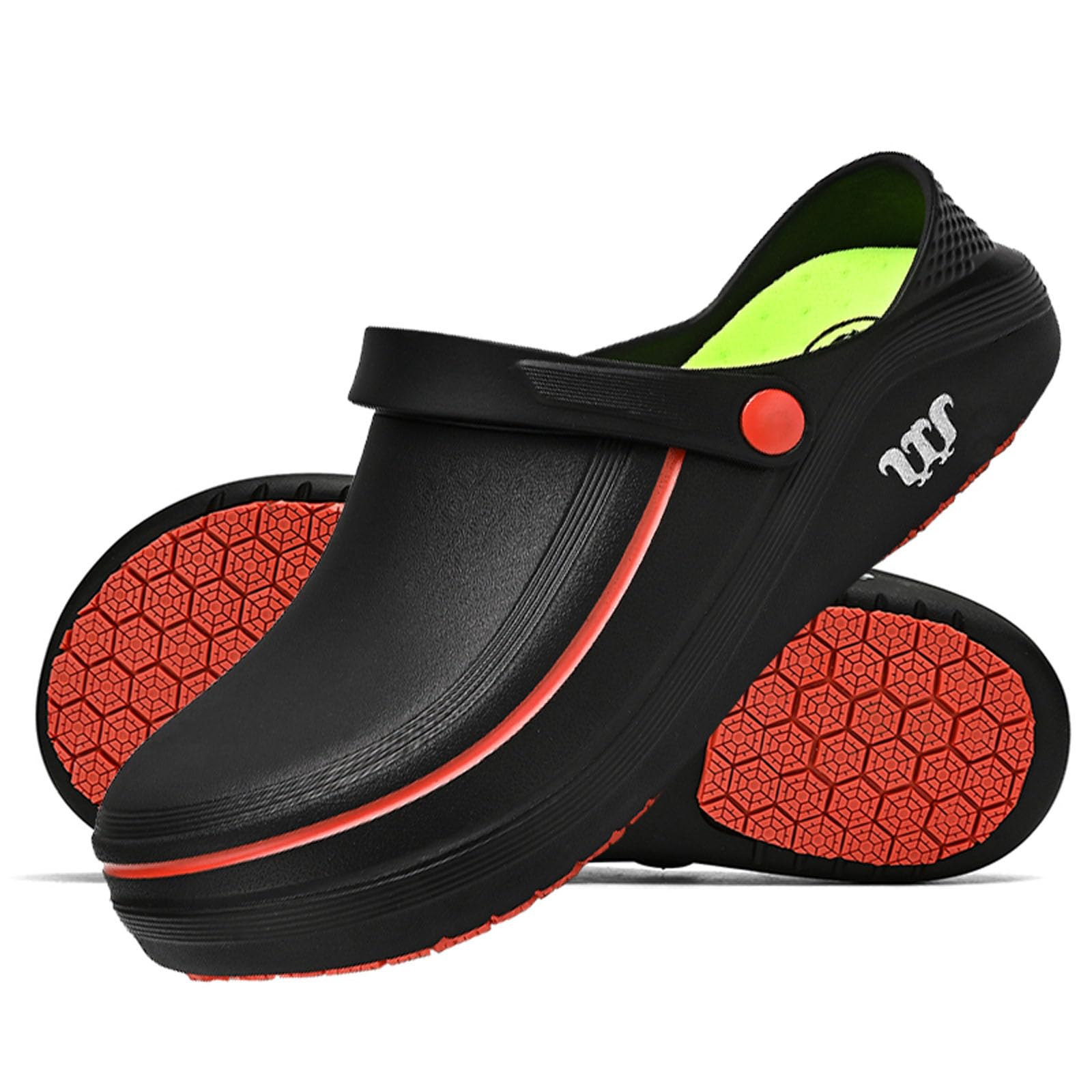
SECHRITEM’s unisex work clog is the most affordable option in this list, designed for users who need waterproof protection and basic slip resistance without the premium foam commitment. The upper is made from a molded rubberized material that is fully waterproof — you can hose these off at the end of a shift without worrying about moisture penetration. The outsole uses a wide siping pattern with deep channels that clear water efficiently on smooth tile floors.
The footbed is a thin EVA layer bonded directly to the outsole — there is no removable insole and very little arch contour. For short shifts under four hours, the cushioning is adequate. By hour five, the midsole feels compressed, especially under the heel. The closed toe is fully enclosed with a round profile that provides decent toe protection but feels snug for users with wide feet. The heel cup is shallow and flexible, offering minimal lateral lockdown.
The biggest trade-off at this entry point is foam longevity — the midsole will show significant compression within two to three months of daily heavy use, and the outsole siping may wear smooth by month four. The waterproof upper is genuine, making these a decent option for dishwashers or prep cooks who work in wet stations and rotate out quickly. For full-shift standing or heavy floor contact, the Crocs Bistro at the next tier up offers a significantly longer usable lifespan and better foot support.
Why it’s great
- Fully waterproof upper handles hose-down cleaning
- Deep outsole channels clear water efficiently
- Low-cost entry for wet-station work
Good to know
- Thin EVA midsole compresses quickly under load
- Snug toe box uncomfortable for wide feet
- Shallow heel cup offers minimal ankle support
FAQ
How often should I replace kitchen clogs used daily?
Can I wear kitchen clogs if I have plantar fasciitis?
Are pull-on clogs or lace-up clogs safer in a kitchen?
What makes a clog outsole truly oil-resistant?
Final Thoughts: The Verdict
For most users, the kitchen clogs winner is the Crocs Bistro Pro LiteRide because the proprietary LiteRide foam retains its support past the six-month mark, and the closed-toe, slip-resistant outsole meets every kitchen safety requirement without needing a break-in period. If you want a lightweight, eco-conscious pair for fast-paced movement, grab the Dansko Kaci. And for the tightest budget that still delivers a genuine slip-resistant outsole and waterproof upper for wet-station work, the Crocs Bistro Work Clog remains the unbeatable entry point into the category.