Every keystroke on a flat, standard keyboard forces your wrists into sustained ulnar deviation — the exact wrist angle known to compress the median nerve. For anyone managing carpal tunnel syndrome, that mild daily flexion is the difference between a productive workday and evening numbness that wakes you at 3 AM.
I’m Emma — the founder and writer behind Baby Bangs. I’ve spent the past fifteen years dissecting how desk hardware directly modulates repetitive strain injury risk, analyzing foam densities, tenting angles, and key-switch actuation forces the same way others study ergonomic chairs.
This guide isolates the seven most effective keyboards for carpal tunnel management. After combing through dozens of designs, I ranked them by structural tenting flexibility, split-keyboard separation, and wrist-rest integrit. The list defines what a true keyboard for carpal tunnel must deliver — measurable ulnar deviation reduction, not vague comfort claims.
How To Choose The Best Keyboard For Carpal Tunnel
Not every “ergonomic” keyboard actually unloads the carpal tunnel. Many simply add a gel rest to a standard layout — a fix that addresses wrist cushioning, not wrist angle. For genuine median nerve decompression, focus on three structural choices: split-frame separation, tenting adjustability, and switch type.
Split-Frame Separation Distance
A split keyboard allows each hand to rest at shoulder width, keeping the wrist straight (neutral) rather than bent outward. Look for models offering at least 8 to 10 inches of separation between the two halves. Without separation, your shoulders hunch inward and the ulnar deviation returns — even with a curved keywell.
Tenting Angle Control
Tenting elevates the inner edge of each keyboard half, rotating the palm upward so the wrist sits in a handshake position (neutral supination). Fixed-tent keyboards typically offer 10 to 15 degrees. Adjustable-tent models allow up to 30 degrees. The more tenting range, the more precisely you can offload median nerve pressure for your specific desk height and chair position.
Switch Actuation Force
Membrane keys often require 60 to 75 grams of force to register a keystroke — acceptable for short bursts but fatiguing over eight hours. Mechanical switches with lower actuation force (45 to 55 grams) reduce fingertip strain and the resulting tendon tension that travels up the forearm into the carpal tunnel. If you stay with membrane, ensure the key travel is short and cushioned.
Quick Comparison
On smaller screens, swipe sideways to see the full table.
| Model | Category | Best For | Key Spec | Amazon |
|---|---|---|---|---|
| KINESIS Freestyle2 | Split | Maximum adjustability | 9″ separation + VIP3 tenting up to 30° | Amazon |
| Logitech Ergo K860 | Split Curve | All-day office comfort | 54% more wrist support cushion | Amazon |
| MechLands Feker Alice98 | Mechanical Alice | Custom mechanical feel | Hot-swappable switches + VIA programmable | Amazon |
| ProtoArc XK03 | Foldable | Travel & portable use | Folding split layout + Bluetooth | Amazon |
| X9 Wireless Ergo | Split Membrane | Budget split entry | 110 ergo keys + cushioned wrist support | Amazon |
| Kensington Pro Fit | Wired Standard | Spill-proof office duty | MIL-STD-810H fluid resistance | Amazon |
| Lomiluskr Ergo Combo | Combo Set | Complete desk setup | Included mouse + PU leather wrist rest | Amazon |
In‑Depth Reviews
1. KINESIS Freestyle2 USB-A with VIP3 Lifters

The KINESIS Freestyle2 delivers what few keyboards dare promise: true independent positioning of each hand. With nine inches of separation between the two halves, your shoulders stay at natural width and your wrists remain dead straight — no ulnar deviation whatsoever. The included VIP3 lifters add gradual tenting up to 30 degrees, letting you rotate your palms into a neutral handshake posture that directly offloads median nerve pressure.
The key feel is low-force scissor-switch membrane, requiring roughly 55 grams of actuation — lighter than typical dome-switch boards and sufficient for sustained typing without finger fatigue. The USB-A connection ensures zero latency or pairing fuss. That said, the board is wired-only, so cable management requires attention, and the plastic build feels functional rather than luxurious.
For anyone with diagnosed carpal tunnel who needs maximal adjustability, this is the closest you get to a custom-split setup without a soldering iron. The 9-inch separation combined with the VIP3 tenting kit makes it the most structurally effective option for reducing wrist angle strain over eight-hour sessions.
Why it’s great
- True split halves with 9″ separation for perfect shoulder-width alignment.
- VIP3 lifters enable up to 30° tenting angle.
- Low-force scissor switches reduce fingertip strain.
Good to know
- Wired connection only — no wireless option.
- Build plastic feels light compared to premium mechanical boards.
2. Logitech Ergo K860 Wireless Ergonomic Keyboard

Logitech’s Ergo K860 is the most broadly recommended ergonomic keyboard for carpal tunnel because it balances split-frame geometry with genuine wrist support engineering. The keyframe splits hands by roughly three inches and curves each bank independently, reducing ulnar deviation compared to a standard slab. Where it really shines is the pillowed wrist rest: Logitech claims 54 percent more support surface than a basic gel pad, which translates to 25 percent less wrist bending during extended typing sessions.
The scissor-switch keys are quiet and require moderate actuation force — not as light as a low-force mechanical switch but significantly less fatiguing than a dome membrane. Bluetooth and USB dongle connectivity keep your desk cable-free, and the adjustable palm lift (0°, -4°, -7°) lets you fine-tune wrist angle relative to your desk height. The renewed model tested here showed zero cosmetic defects and performed identically to new units.
For the majority of office workers, developers, and writers managing early-stage carpal tunnel, the K860 delivers the best trade-off between structure and comfort. It won’t match a fully-split KINESIS for extreme adjustability, but its integrated wrist rest and wireless convenience make it the most practical day-to-day choice.
Why it’s great
- Pillowed wrist rest dramatically reduces wrist bending during typing.
- Split keyframe curves each hand independently for neutral alignment.
- Bluetooth + USB wireless with adjustable tilt legs.
Good to know
- Not a true split — hands stay on a single chassis.
- Renewed units may have minor packaging wear.
3. MechLands Feker Alice98 Custom Mechanical Keyboard
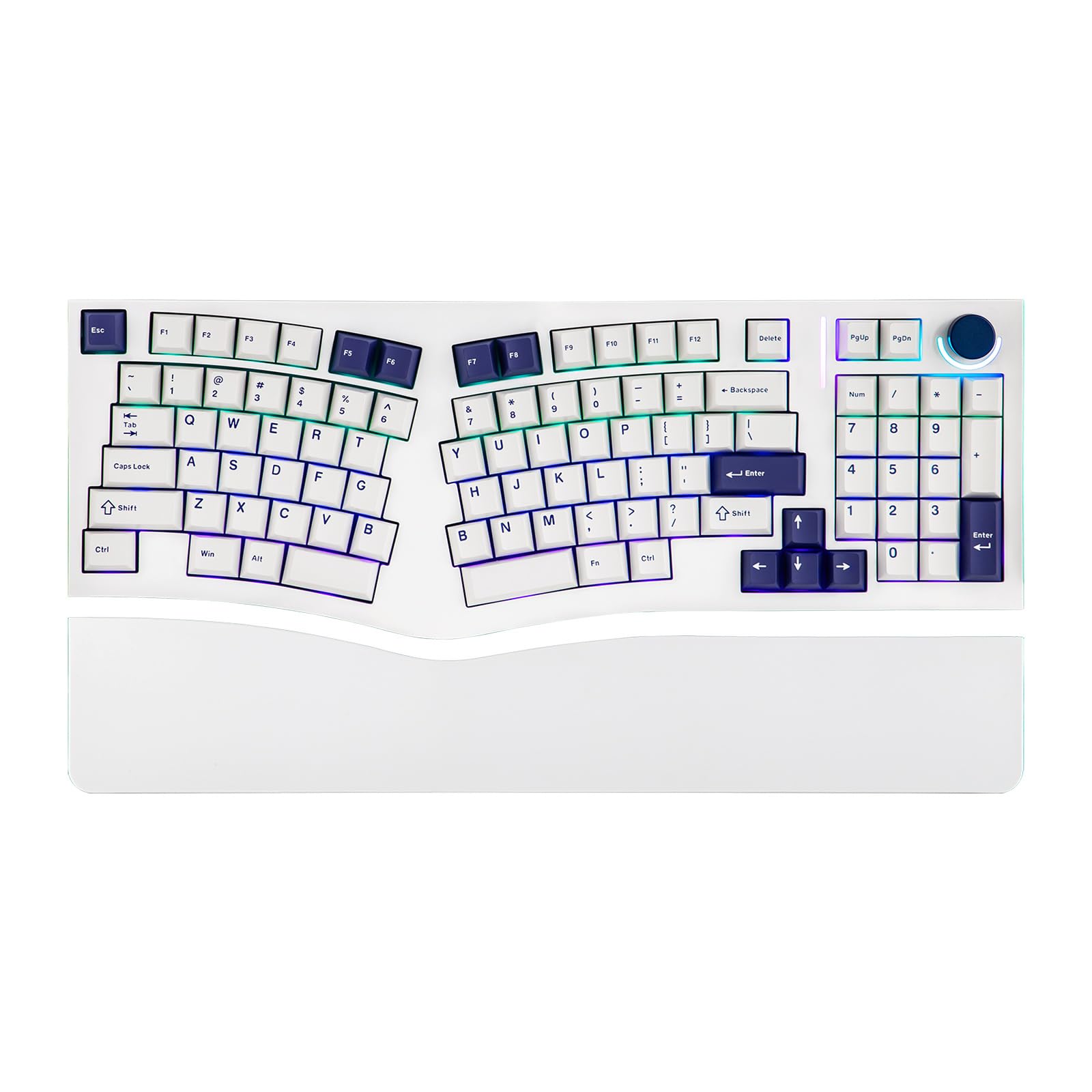
The Alice layout — an arced, semi-split keywell — has become a cult favorite among mechanical keyboard users with wrist concerns. The Feker Alice98 implements this geometry in a 98-key form factor, curving each key column so your fingers reach naturally rather than stretching laterally. While not a true split, the Alice design reduces the forearm pronation and wrist extension that trigger carpal tunnel symptoms during prolonged typing sessions.
Where this board differentiates itself is the hot-swappable switch socket. You can install linear switches with 45-gram actuation force to virtually eliminate fingertip fatigue, or swap in tactile switches if you prefer typing feedback. The five-layer internal padding dampens case ping and hollow reverb, producing a muted acoustic profile that won’t disturb a shared office. VIA programmability lets you remap any key — helpful for moving modifiers to thumb clusters to reduce pinky strain.
This is a mid-to-high-end mechanical board, so expect a heavier desk presence than a membrane ergo option. The wired USB-C connection ensures stability, but there is no wireless mode. For mechanical keyboard enthusiasts who refuse to compromise on switch feel while managing carpal tunnel, the Feker Alice98 is the closest you get to an ergonomic solution without leaving the custom mechanical world.
Why it’s great
- Alice curve reduces ulnar deviation and forearm pronation naturally.
- Hot-swappable switches allow 45g linear actuation for minimal finger force.
- VIA programmable for thumb-cluster modifier remapping.
Good to know
- Not a true split — hands remain on one board.
- Wired USB-C only; no Bluetooth option.
4. ProtoArc XK03 Foldable Split Keyboard
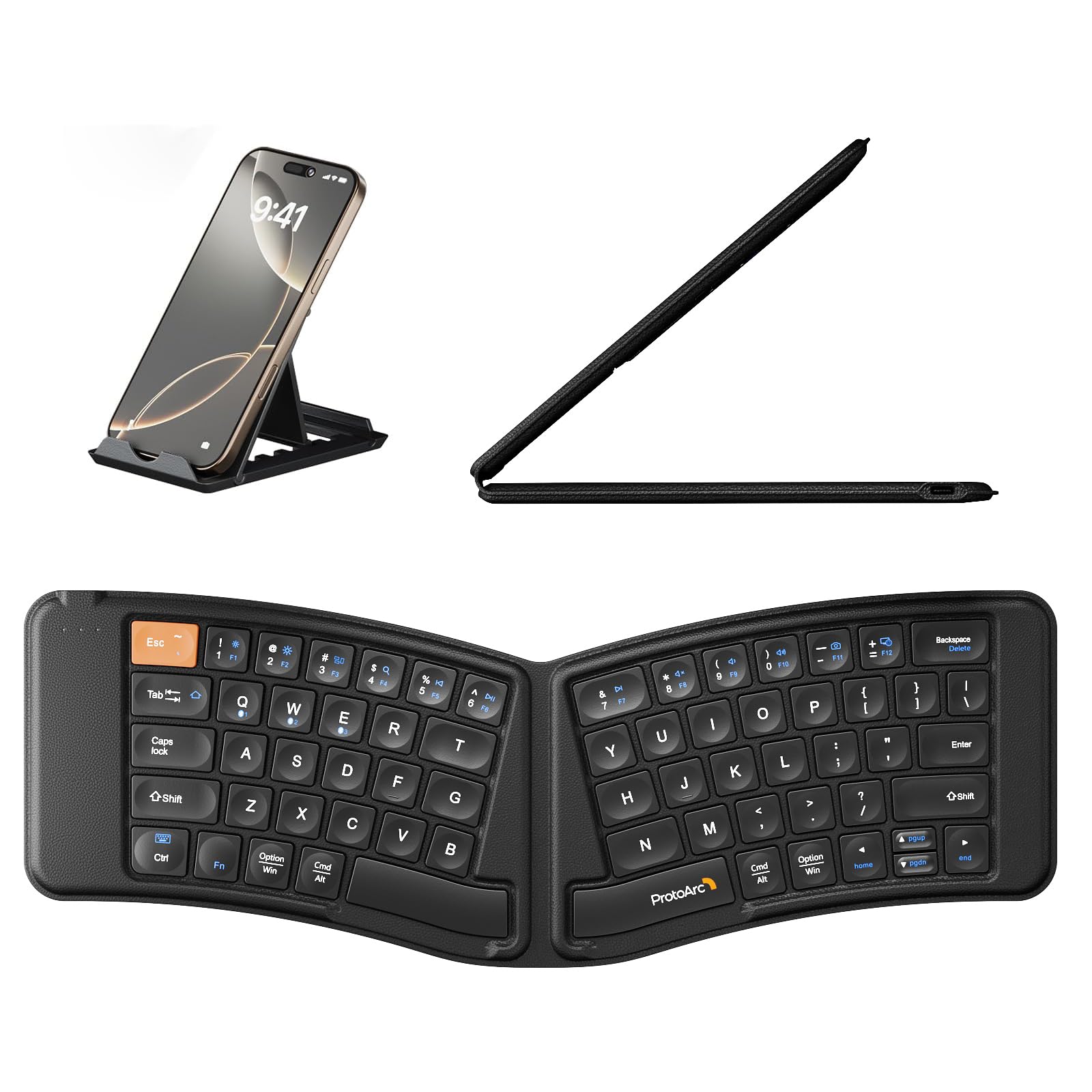
The ProtoArc XK03 solves a specific carpal tunnel problem: what happens when you need to work away from your primary ergonomic setup. This foldable split keyboard collapses into a compact package roughly the size of a tablet, letting you carry genuine split-frame geometry in a laptop bag. When unfolded, the two halves separate naturally, allowing your shoulders to relax into neutral width instead of hunching over a built-in laptop keyboard.
Bluetooth connectivity works seamlessly with iPad, iPhone, Android tablets, and laptops — covering the mobile-device gap that wired ergo boards ignore. The scissor-switch keys are low-profile and require modest actuation force, suitable for typing on coffee-shop tables or airplane tray desks. The ultra-slim profile (roughly 6 mm at its thinnest point) means you can slide it into a sleeve alongside a tablet without bulk.
The trade-off is that the XK03 lacks tenting adjustment and a built-in wrist rest, so you’ll want to pair it with a portable wrist pad or a rolled towel for neutral wrist angle on the go. The keys also lack backlighting, which may matter in dim environments. For the traveler who refuses to compromise wrist health outside the home office, this is the most effective portable split option available.
Why it’s great
- Folding split design fits in a tablet sleeve for true portability.
- Bluetooth connectivity works with iPad, iPhone, and Android.
- Low-profile scissor switches reduce finger fatigue during travel typing.
Good to know
- No tenting adjustment or integrated wrist rest.
- Keys lack backlighting for low-light use.
5. X9 Wireless Ergonomic Keyboard with Cushioned Wrist Support
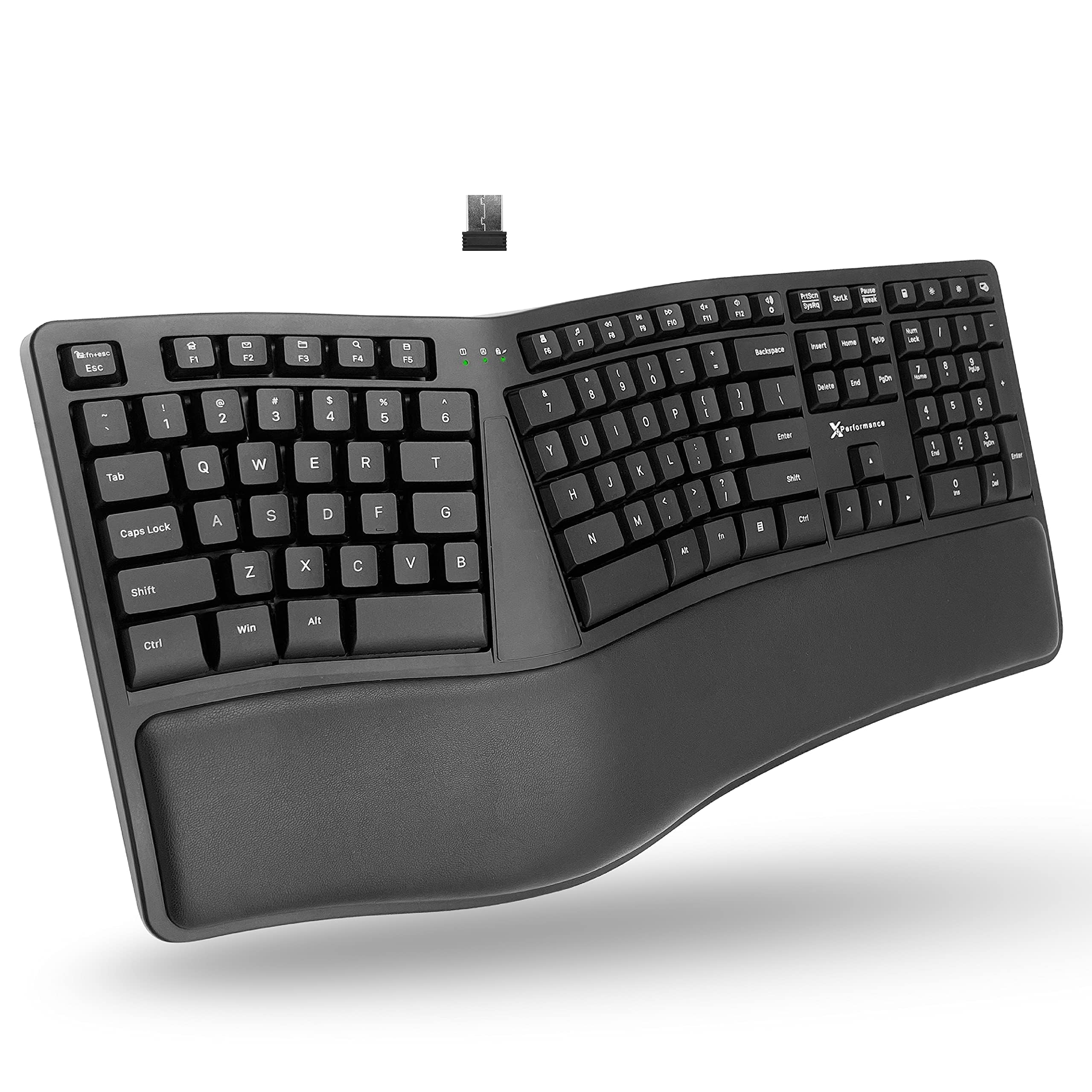
The X9 Wireless Ergonomic keyboard is the most cost-effective entry point into split-frame typing for carpal tunnel relief. Unlike many budget ergonomic boards that merely angle the keys, the X9 physically separates the alphanumeric cluster into two curved banks, allowing your wrists to maintain a straighter path from forearm to fingertip. The cushioned wrist support runs the full width of the typing area and uses a denser foam than typical gel pads, providing sustained support rather than bottoming out after an hour.
The membrane keys are appropriately quiet and require moderate actuation force — not the lightest in this roundup but significantly less fatiguing than a standard flat keyboard. The wireless connection uses a 2.4 GHz dongle (no Bluetooth), which keeps latency minimal and battery draw low. The 110-key layout includes a full number pad, useful for data-entry roles where number typing is constant.
Where the X9 reveals its budget positioning is build material: the plastic chassis feels hollow and the keycaps lack the crisp legends of higher-end boards. The wrist rest is fixed and non-removable, limiting desk customization. For the user who needs a functional split keyboard immediately without spending triple digits, the X9 delivers measurable ergonomic improvement at a price that makes it a low-risk trial.
Why it’s great
- Genuine split-frame design at an accessible entry price.
- Full cushioned wrist rest with dense foam support.
- 110-key layout includes number pad for data entry.
Good to know
- Plastic build feels hollow and less durable than premium options.
- No Bluetooth; 2.4 GHz dongle only.
6. Kensington Pro Fit Ergonomic Wired Keyboard

The Kensington Pro Fit takes a different approach to carpal tunnel relief: it doesn’t split the keyboard, but it aggressively optimizes standard keyboard geometry for neutral wrist alignment. The built-in wrist rest is contoured and cushioned to cradle the heel of your palm, reducing the wrist extension that happens when you hover over a flat board. The keyframe angles gently upward from front to back, encouraging a straighter wrist path than a conventional flat keyboard.
What makes the Pro Fit noteworthy for shared or clinical environments is its MIL-STD-810H fluid resistance rating. It withstands exposure to alcohol wipes, bleach solutions, and accidental coffee spills for at least 24 hours without electrical failure — a genuinely useful spec in medical offices, labs, and busy workstations where hygiene is non-negotiable. The quiet scissor keys produce minimal click noise, suitable for open-plan office cubicles.
This is not a board for users who need tenting adjustability or split-frame separation. It is a well-executed standard-ergo hybrid that reduces wrist extension through its rest and angle design without requiring a learning curve. For the office manager or healthcare worker who needs a durable, cleanable keyboard that is gentler on wrists than a standard slab, the Pro Fit is a reliable, low-fuss option.
Why it’s great
- MIL-STD-810H fluid resistant for easy cleaning with alcohol wipes.
- Built-in cushioned wrist rest reduces wrist extension during typing.
- Quiet scissor keys suitable for shared office spaces.
Good to know
- Standard unibody design — no split-frame or tenting.
- Wired USB only; desktop cable management required.
7. Lomiluskr Wireless Ergonomic Keyboard and Mouse Combo

The Lomiluskr combo is the only entry on this list that addresses both keyboard and mouse ergonomics in one package — important because carpal tunnel symptoms often originate from mouse use as much as typing. The keyboard uses a split-slopped design (angled upward from the center) that mimics a tented feel, and the integrated wrist rest is covered in PU leather over high-density foam, providing a solid landing for the palm without excessive sinking.
The membrane keys are low-force and require minimal activation pressure, which helps reduce fingertip fatigue for users who type at moderate speeds. The included mouse features 3-level DPI switching (1200/1600/2400) and a PU leather palm grip, encouraging a relaxed hand posture rather than a claw grip that aggravates the carpal tunnel. Both peripherals run on AAA batteries (included) and share a single USB receiver, minimizing port usage.
The key limitation is that the keyboard’s split slope is fixed — there is no actual physical separation between the two halves, so your wrists may still experience some ulnar deviation. The 2.4 GHz wireless is reliable but lacks Bluetooth, limiting compatibility with tablets and phones. For someone setting up a new desk on a tight budget who wants both keyboard and mouse ergonomics in one purchase, the Lomiluskr combo provides a complete starter kit without the premium pricing of individual ergonomic peripherals.
Why it’s great
- Includes ergonomic mouse with adjustable DPI and palm grip.
- PU leather wrist rest offers stable foam support for the palm.
- Low-force membrane keys reduce typing fatigue.
Good to know
- Fixed split-slope — no true physical separation of the halves.
- 2.4 GHz only; no Bluetooth for tablet or phone connection.
FAQ
Can a keyboard really help carpal tunnel or is that marketing hype?
Should I get a split keyboard or an Alice layout for carpal tunnel?
How important is tenting versus wrist rest cushioning?
Final Thoughts: The Verdict
For most users, the keyboard for carpal tunnel winner is the Logitech Ergo K860 because it balances genuine split-curve geometry with exceptional wrist support in a wireless, office-ready package. If you want maximum structural adjustability for managing active carpal tunnel symptoms, grab the KINESIS Freestyle2 with VIP3 Lifters. And for mechanical keyboard enthusiasts who refuse to compromise switch feel, nothing beats the MechLands Feker Alice98 for reducing wrist strain while preserving the custom keyboard experience.