The hunt for a toy that actually holds a toddler’s shifting attention is its own parenting endurance sport. You want a toy that sparks real cognitive development—color recognition, cause-and-effect, fine motor skills—without relying on a passive screen or a cheap speaker that distorts at the first drop. The right interactive toy for this age bracket bridges raw curiosity with structured, hands-on learning.
I’m Emma — the founder and writer behind Baby Bangs. I’ve spent hundreds of hours cross-referencing toddler developmental milestones against real-world hardware specs to separate the short-lived gimmicks from the daily drivers.
This guide cuts through the noise to identify the best interactive toys for toddlers that deliver genuine educational value without shortchanging durability or safety.
How To Choose The Best Interactive Toys For Toddlers
Not every brightly colored box with a sound chip belongs in your cart. The toys that make a real difference in a toddler’s development share three non-negotiable traits: they engage multiple senses, they grow with the child, and they survive the inevitable floor test. Here’s what to look for.
Material Safety & Structural Integrity
A toddler’s play style is essentially controlled demolition. Solid wood construction with hand-sanded edges, BPA-free ABS plastic with no sharp mold lines, and fabric with recycled polyester fill are the benchmarks. Avoid anything with small parts that aren’t securely tethered or battery compartments that don’t require a screwdriver to open.
Interactive Depth & Developmental Range
The best toys offer more than one mode of engagement. Look for features that layer cause-and-effect (a button press produces a light), vocal feedback (letter names, animal sounds), and motor challenges (sliding, spinning, pressing). A toy that still offers something new at 24 months that it couldn’t teach at 12 months is worth the investment.
Volume Control & Battery Accessibility
Two features that separate a daily driver from a drawer ornament: adjustable volume and a master power switch or auto-shutoff. A toy that blares at full clip from one angle or drains AAA batteries overnight is a liability, not a learning tool. Confirm the battery door is screw-secured before you buy.
Quick Comparison
On smaller screens, swipe sideways to see the full table.
| Model | Category | Best For | Key Spec | Amazon |
|---|---|---|---|---|
| Duchong Spin & Sing Zoo | Animal Learning | Letter & animal sound recognition | 6 learning modes, 26 animals | Amazon |
| HarVow LED Busy Board | Montessori Sensory | Fine motor & cause & effect | 13 switches, 24 LED lights | Amazon |
| LeapFrog 100 Words Book | Bilingual Book | Vocabulary & bilingual exposure | 100+ words, Spanish option | Amazon |
| VTech Busy Learners Cube | Activity Cube | Gross & fine motor combo | 5 sides, motion sensor | Amazon |
| Sesame Street Learning Elmo | Plush Interactive | Emotional & imaginative play | 50+ phrases, lights & music | Amazon |
In‑Depth Reviews
1. Duchong Spin and Sing Alphabet Zoo

The Duchong Spin & Sing Alphabet Zoo packs six distinct learning modes—A-Z letters, 26 animal sounds, interactive games, and soothing melodies—into a single rotating unit that feels substantial without being heavy. The letter and animal association mode is especially sharp for the 18-24 month sweet spot, where toddlers start connecting spoken words with visual symbols. The ABS plastic body has smooth edges and shows no flex during enthusiastic spins.
What sets this apart is the volume control and auto-shutoff feature that actually works predictably. The sound quality is clear enough for letter pronunciation to be intelligible, which is a real weak point in cheaper electronic toys. The 7.9 x 7 x 9.8 inch footprint is compact enough for a play mat but large enough that it won’t disappear under a couch cushion.
Parents report that the animal sound mode is the immediate hook, followed by the letter game as toddlers age into the second year. The toy’s weight distribution makes it stable during spinning play, and the BPA-free construction gives peace of mind during mouthing phases.
Why it’s great
- Six modes extend play longevity well past 18 months
- Clear audio that doesn’t distort animal sounds
- Durable ABS holds up to drops and throws
Good to know
- Size is slightly smaller than product photos suggest
- Young 12-month-olds may lose interest quickly
2. HarVow Wooden LED Busy Board
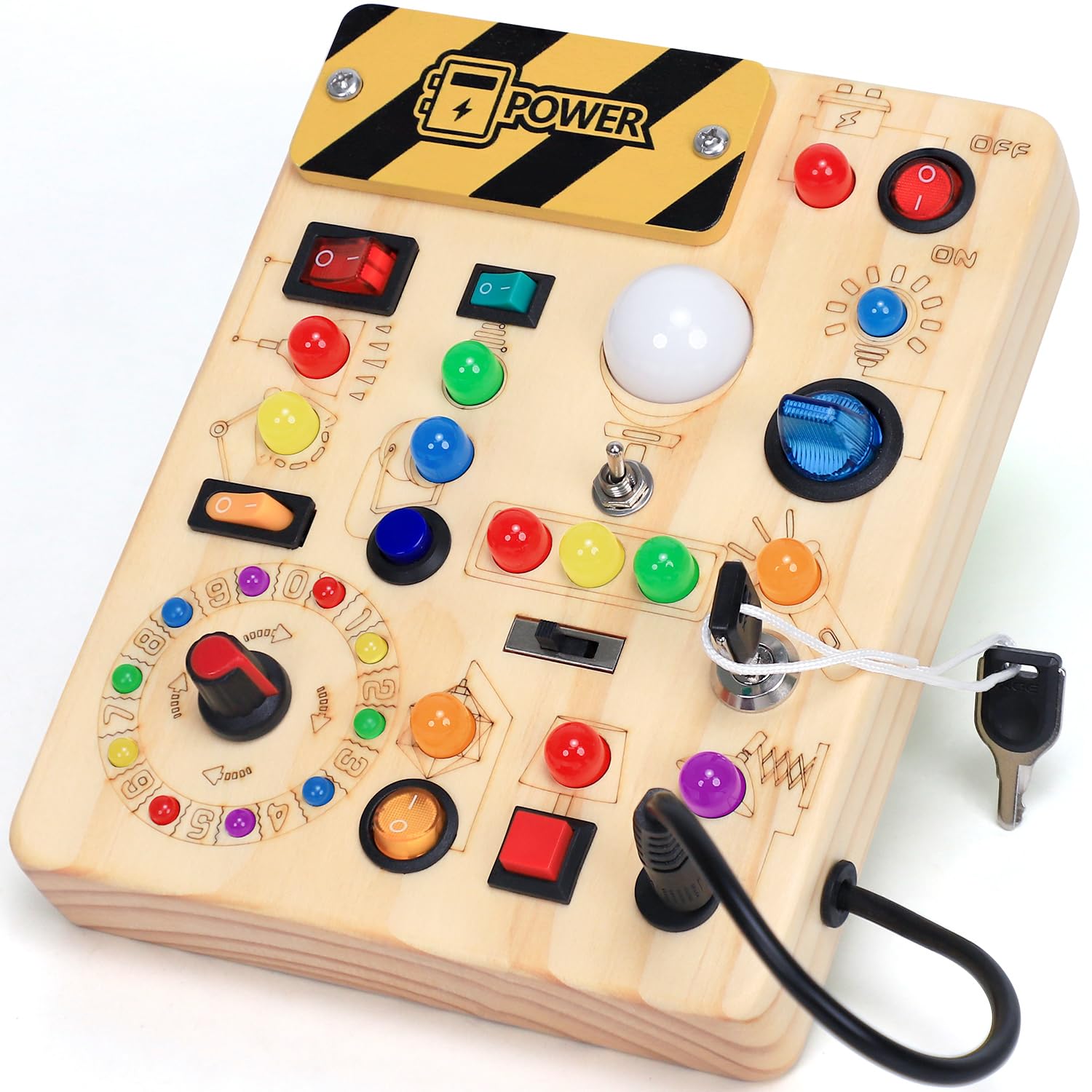
The HarVow Busy Board is a master class in Montessori-adjacent design: 13 distinct switch mechanisms connected to 24 LED lights, all housed in a solid natural wood frame with hand-sanded edges. Each switch type—toggle, push, slide, rotary—demands a different finger motion, which is exactly what builds the fine motor differentiation that prepares toddlers for writing tools. The backside embeds engraved A-Z letters and numbers for an extra tactile learning layer.
The brightness calibration is thoughtful—the LEDs are vivid enough to captivate but soft enough to avoid eye strain. The compact 6.7 x 5.3 x 1.1 inch size fits into a toddler’s grip and is light enough (under 12 ounces) to carry in a diaper bag. The master switch for one-click power-off extends battery life meaningfully, and the battery compartment is screw-secured.
Real-world feedback confirms the board engages children as young as 15 months up to 8 years, which is an unusually wide range. The tethered keys and screw-secure battery door address the two biggest safety pain points in this category. The only recurring note is that the main switch must be toggled off to avoid draining AAA batteries overnight.
Why it’s great
- 13 unique switch types build differentiated fine motor skills
- Solid wood construction with zero splinter risk
- Engages a wide 15-month to 8-year age range
Good to know
- Batteries not included (requires AAA)
- Must use master switch to preserve battery life
3. LeapFrog Scout and Violet 100 Words Book

The LeapFrog 100 Words Book solves a specific problem most electronic toys ignore: vocabulary growth in both English and Spanish. Touching any word on the thick, board-book-style pages triggers clear recordings of the word, a relevant sound effect, and a fun fact—all without needing a screen. The 100 words are organized into categories like pets, food, opposites, and outside, which helps toddlers build categorical thinking alongside vocabulary.
The brightness and responsiveness of the touch sensors are exceptional for a page-based format. Kids as young as 11 months can press the pages and get immediate audio feedback, while older toddlers (up to 3+ years) engage with the bilingual mode and the light-up star button that plays the Learning Friends theme song. The two-volume settings give parents control without sacrificing audio clarity.
The build quality is the star here: the thick plastic-coated pages wipe clean easily and survive the bent-page abuse of a determined toddler. At 1.5 pounds, it has reassuring heft without being too heavy to hold. Parents consistently report that this is the most-requested book during quiet time, and the Spanish mode makes it a rare true bilingual tool rather than an afterthought.
Why it’s great
- Full bilingual mode with clear pronunciation in both languages
- Thick plastic pages survive aggressive page turning
- Touch sensors respond reliably to small fingers
Good to know
- Requires 2 AA batteries (included for demo only)
- Heavier than a standard board book at 1.5 pounds
4. Sesame Street Plush Learning Elmo
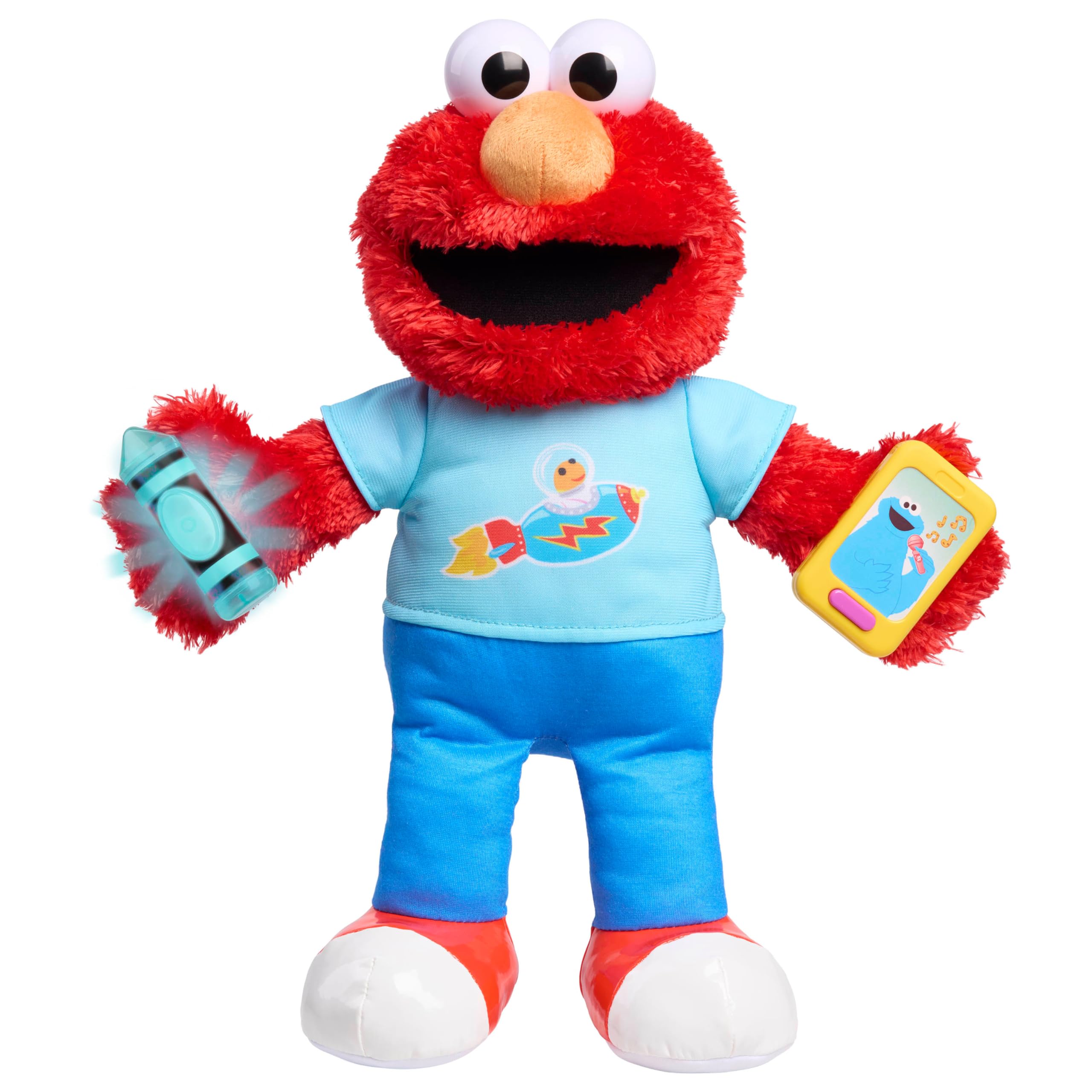
The Sesame Street Learning Elmo breaks the mold of rigid plastic interactive toys by embedding 50+ phrases, lights, and music into a genuinely soft, huggable 13-inch plush. Press Elmo’s left foot for numbers, right foot for letters, the crayon for colors, and the cell phone for songs like “Here We Go Loopy Loo.” The interactivity is woven into the cuddle experience, which makes it effective for emotional regulation and imaginative play alongside the academic content.
The audio quality is notably clear for a plush toy—voices don’t sound muffled through the fabric, and the music is loud enough to engage but adjustable via the switch on the back. The construction uses recycled polyester fill with a soft exterior that holds up to constant carrying and the occasional nap-time snuggle. The “Try Me” mode ships active, but flipping to “On” unlocks the full range of play.
Parents consistently report that the letter-learning mode is the real standout—Elmo recites the full alphabet in sequence, which toddlers mirror back. The 2-year-old demographic is where this toy shines brightest, combining educational content with the comfort of a beloved character. The only consideration is that Elmo doesn’t walk or move, which is fine for seated play but should be noted if motion is a priority.
Why it’s great
- Soft plush design combines comfort with learning functions
- Clear audio announces full alphabet and numbers
- Recycled polyester fill for eco-conscious families
Good to know
- No walking or motion feature—stationary seated play
- Battery door requires screwdriver for access
5. VTech Busy Learners Activity Cube

The VTech Busy Learners Activity Cube offers five distinct play sides—each with a different interactive element—that target everything from fine motor pincer grips to gross motor crawling. The motion sensor is the cleverest feature: when the cube is pushed or moved, it plays sounds that encourage pursuit, turning passive play into active crawling practice. Four light-up buttons introduce animal names, sounds, and shapes, and the whole unit is sized at 6.2 inches per side, perfect for small hands to rotate.
The durability here is no joke—parents report this cube surviving full-force throws and tumbles down stairs without cracking or losing sound function. The 25 playful songs and melodies cycle through without becoming grating, and the volume control plus auto-shutoff feature make it manageable for extended use. The purple color variant is vibrant without being visually overwhelming.
At 1.43 pounds, the cube has enough weight to stay put during seated play but is light enough for a toddler to carry. The recommended 6-month to 3-year range is accurate, though the highest engagement comes between 9 and 24 months. The battery compartment is secure, but the included demo batteries should be replaced immediately for consistent performance.
Why it’s great
- Motion sensor encourages crawling and active pursuit
- Five unique sides prevent boredom from repetition
- Remarkably durable construction for the price tier
Good to know
- Demo batteries included—replace before regular use
- Content may feel basic for children over 30 months
FAQ
What age is the right time to introduce interactive toys?
Are wooden interactive toys safer than plastic ones?
How do I know if an interactive toy has good audio quality for a toddler?
Final Thoughts: The Verdict
For most users, the best interactive toys for toddlers winner is the Duchong Spin and Sing Alphabet Zoo because it packs six learning modes into a durable, BPA-free body with clear audio and reliable auto-shutoff—delivering real educational range from 12 to 36 months. If you want uncompromising fine motor development with LED engagement, grab the HarVow Wooden LED Busy Board. And for a bilingual vocabulary tool that toddlers actually request during quiet time, nothing beats the LeapFrog 100 Words Book.