That sharp, grinding ache right across the top of your arch isn’t just fatigue—it’s your midfoot joints screaming for support every time you push off your toe. Unlike generic arch pain that responds to soft cushioning, midfoot arthritis demands a rigid structure that limits joint articulation across the tarsometatarsal (Lisfranc) region. The wrong insole—one that is too flexible—actually worsens the joint shear by allowing the forefoot to bend where it shouldn’t.
I’m Emma — the founder and writer behind Baby Bangs. I’ve spent years analyzing the biomechanical data behind foot orthotics, sifting through material science on carbon fiber layups versus EVA foam densities, and cross-referencing clinical outcomes with real consumer feedback to separate what actually stabilizes the midfoot from what just feels squishy in the store.
Down below you will find seven distinct solutions, each engineered for a specific type of midfoot arthritic presentation. Whether you need a full-contact rigid plate to halt big toe dorsiflexion or a metatarsal pad that offloads the ball of the foot to reduce torque across the midfoot joints, this guide to the insoles for midfoot arthritis delivers clear, spec-level direction without the marketing fog.
How To Choose The Best Insoles For Midfoot Arthritis
Midfoot arthritis is not a condition you can cushion away. The tarsometatarsal joints are load-bearing structures that transfer force from the forefoot to the hindfoot. When the cartilage wears down, any bending motion across the midfoot grinds bone on bone. Your insole must provide stiff resistance to that bending. Here is what separates effective orthotics from useless foam pads.
Rigidity Level: The Carbon Fiber Standard
Polypropylene and standard EVA flex under body weight. For midfoot arthritis you need a material that will not bend across the arch. 3K woven carbon fiber offers the highest stiffness-to-thickness ratio, allowing a thin profile (as low as 0.06 inches) that fits in most shoes while completely blocking unwanted dorsiflexion at the big toe and midfoot. Some premium designs sandwich carbon fiber between foam layers for comfort without sacrificing rigidity.
Morton’s Extension Versus Metatarsal Pad
A Morton’s Extension is a rigid platform that runs under the entire first toe, preventing it from bending upward during push-off. This is essential when arthritis has affected the first metatarsophalangeal joint (hallux limitus/rigidus), because toe bending transfers stress directly back to the midfoot. A metatarsal pad sits behind the ball of the foot and lifts the metatarsal heads, offloading the forefoot and decreasing torque across the midfoot. Many midfoot arthritis cases benefit from both mechanisms working in tandem.
Heel Cradle Depth and Arch Contour
A deep heel cradle locks the calcaneus in place and prevents excessive pronation that would twist the midfoot. The arch support should be firm but neutral—overly aggressive arch profiling can pull the midfoot into a varus position that aggravates arthritic joints. Look for a contoured flexible arch that matches the natural curve of your foot without forcing a correction.
Quick Comparison
On smaller screens, swipe sideways to see the full table.
| Model | Category | Best For | Key Spec | Amazon |
|---|---|---|---|---|
| PowerStep Carbon Fiber Orthotic | Premium Carbon Fiber | Hallux rigidus with midfoot spread | Carbon fiber plate + dual-layer cushion | Amazon |
| Tega Morton’s Extension Carbon | Pure Carbon Rigid | Maximum big toe joint immobilization | 100% 3K carbon fiber, 0.06″ thin | Amazon |
| PowerStep Pulse Plus Met | Met Offloading + Support | Metatarsalgia with midfoot arthritis | Total contact with met pad | Amazon |
| Cushwork Metatarsalgia Insole | Off-the-Shelf Orthotic | Collapsed arches with neuroma pain | Built-in met pad, neutral arch | Amazon |
| Kelaide Metatarsalgia Insole | Cushioned Support | Everyday wear with flat feet | Neutral arch + integrated met pad | Amazon |
| Welnove Running Insole | Forefoot Impact | High-mileage walking with neuroma | Elastic forefoot gel cushion | Amazon |
| MOVE All Day Comfort | Extra Plush Recovery | Full-day standing with back pain | X-Frame stability + Recharge foam | Amazon |
In‑Depth Reviews
1. PowerStep Morton’s Extension Carbon Fiber Orthotic Insole

This is the most complete solution for midfoot arthritis that has progressed into hallux rigidus. PowerStep layers a lightweight carbon fiber plate directly under the first toe to block dorsiflexion, then wraps the entire foot in a full-length contoured arch with a deep heel cradle. The carbon fiber is rigid enough to stop painful joint movement, but the dual-layer cushioning on top prevents the plate from feeling like you are walking on a board. Users report immediate reduction in big toe pain and the ability to walk, jog, and hike again without midfoot grinding.
The interior dimensions work well with deep shoe platforms like Hoka Arahi and Gaviota. The built-in arch is firm but neutral—it does not overcorrect, which is critical for arthritic midfoot joints that cannot tolerate aggressive pronation control. The top fabric also manages moisture and friction well, a practical detail for all-day wear. Reviewers note a short break-in period where laces need to be slightly looser, but after that, the support feels natural.
At this tier, you are paying for an engineered orthotic that combines podiatrist-recommended biomechanics with durable materials. The carbon fiber plate will not degrade or lose stiffness over time, and the cushioning layers can be replaced when compressed. For anyone with confirmed midfoot arthritis and big toe involvement, this is the strongest first-line option available.
Why it’s great
- Full carbon fiber plate stops all big toe dorsiflexion
- Dual-layer cushion prevents board-like feel
- Deep heel cradle stabilizes pronation
Good to know
- Requires break-in period with looser laces
- Premium tier may be overkill for mild arthritis
2. Tega Design Morton’s Extension Carbon Fiber Rigid Insole
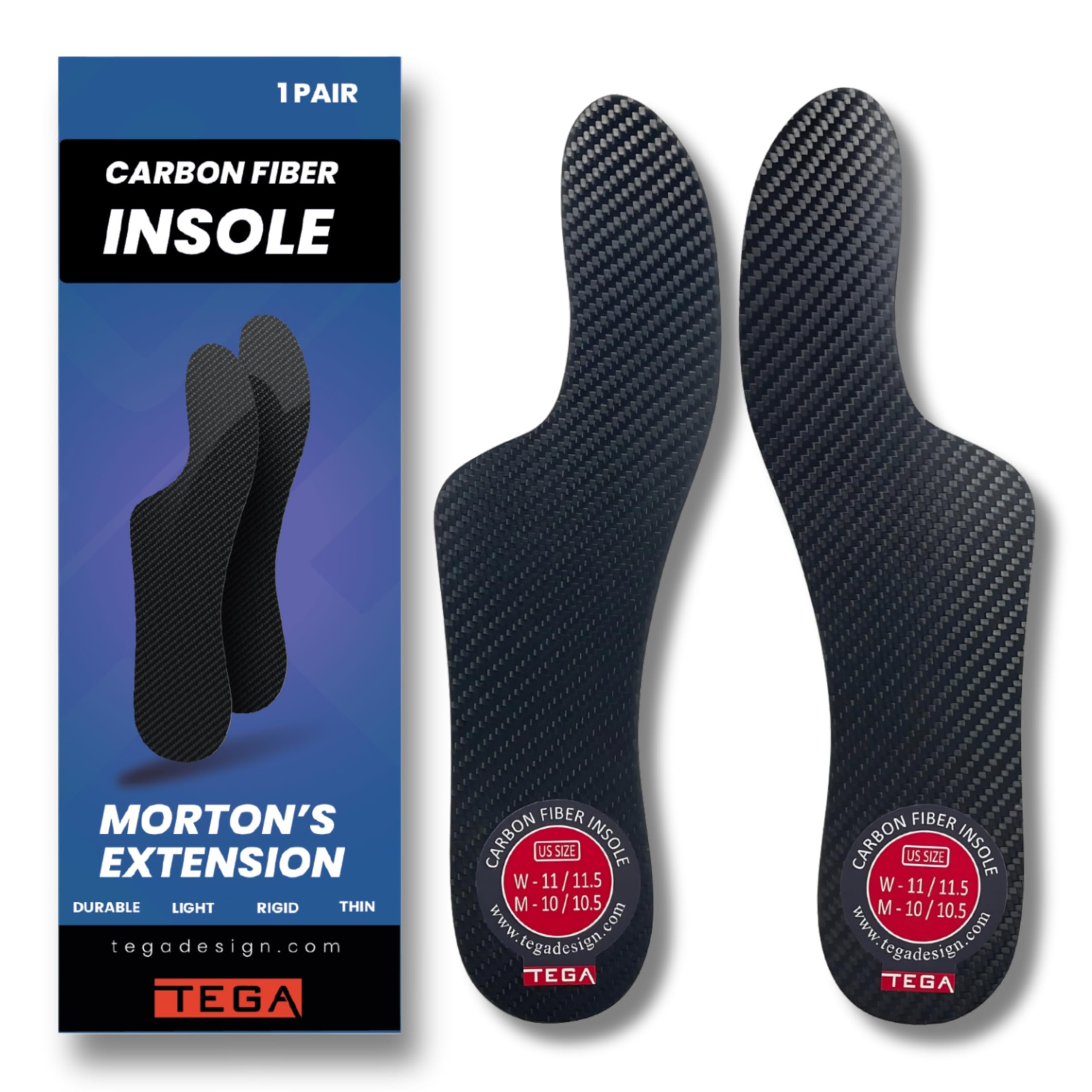
If your primary symptom is a jolt of pain every time your big toe bends upward during push-off, this pure carbon fiber insert delivers the most aggressive immobilization on this list. There is no foam overlay to soften the ride—it is a single piece of 3K woven carbon fiber, just 0.06 inches thick, that sits under the entire foot and extends rigidly under the first toe. The thin profile means it slides into dress shoes, sneakers, and even some cycling shoes without crowding the toe box.
Users with hallux limitus and hallux rigidus report a greater than 80 percent reduction in big toe pain, with some able to walk 18 holes of golf pain-free after weeks of struggle. The Morton’s Extension mechanism works exactly as designed: by preventing the first metatarsophalangeal joint from flexing, it eliminates the mechanical source of grinding at the midfoot. The downside is that it provides zero cushion or arch support, so you rely entirely on your shoe’s existing insole or a separate cushioned layer.
Sizing is critical here. Measure the length of your current insole and order a size that is roughly half an inch shorter than that measurement. If you order too large, the rigid plate will curl at the toes and cause discomfort. For the right user—someone who needs pure toe immobilization and already has good arch support in their shoe—this is the most effective tool per dollar spent.
Why it’s great
- Extremely thin; fits almost any shoe
- Uncompromising rigidity stops toe joint pain
- Lightweight (under 3 oz per pair)
Good to know
- No cushion or arch support included
- Sizing must be precise to avoid curling
3. PowerStep Pulse Plus Met Ball of Foot Pain Relief Insole
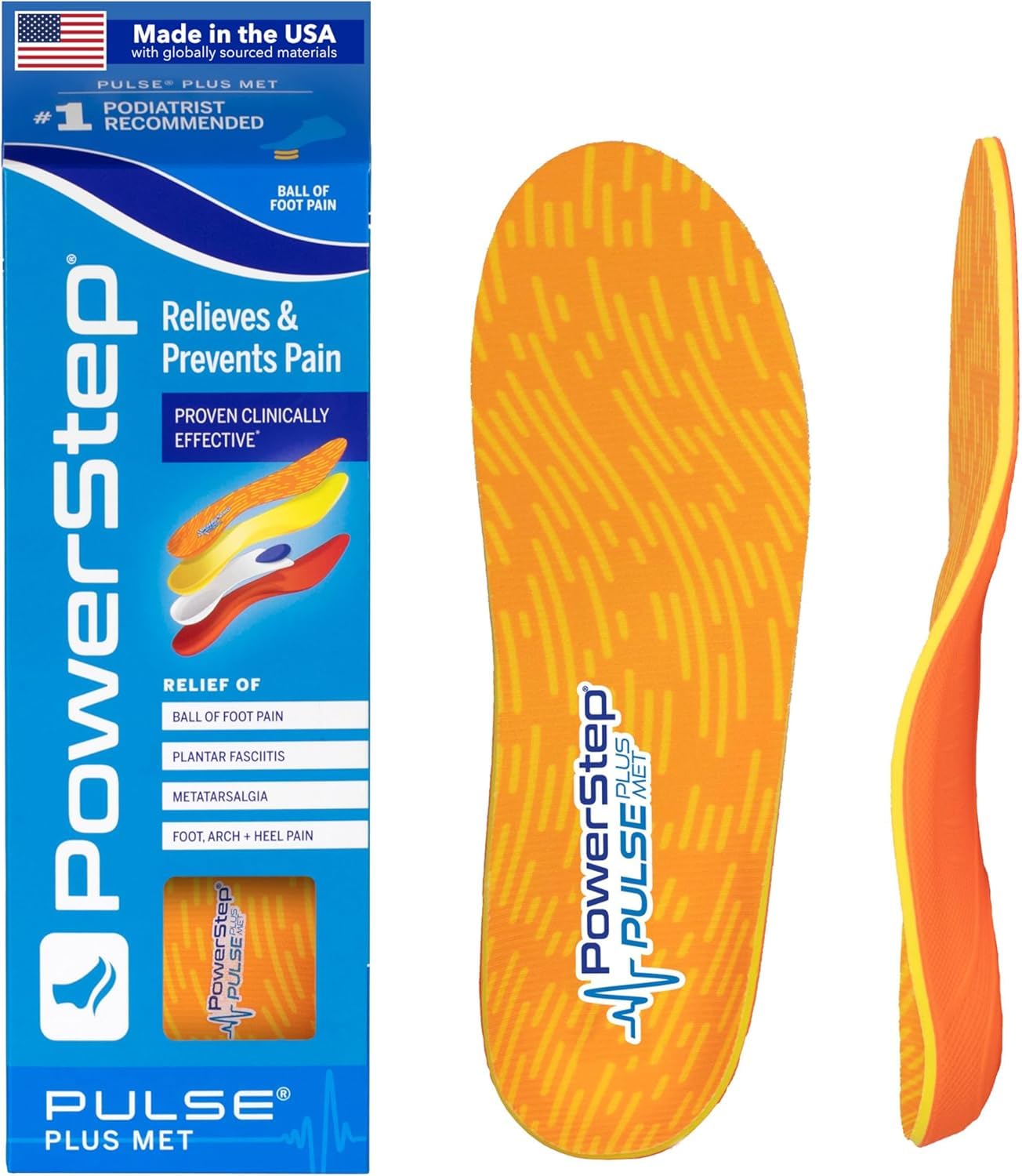
The Pulse Plus Met is the insole most frequently recommended by podiatrists for midfoot arthritis complicated by metatarsalgia or Morton’s neuroma. It combines a full-length total contact footbed with a pronounced metatarsal pad that lifts the metatarsal heads, reducing forefoot loading and the subsequent torque that travels back to the midfoot. The arch is firm and neutral, with a deep heel cradle that stabilizes the rearfoot and prevents excessive pronation.
The primary differentiator is the odor-control top fabric and the total contact design, which distributes pressure evenly across the entire plantar surface. Users with neuromas report that the pad lifts the ball of the foot enough to relieve pinching without feeling like a foreign object underfoot.
Sizing has a known quirk for sizes above 12—the supplied length runs short for larger feet. If you wear a size 13, you will likely need to order the 14-15 size and trim down. Otherwise, the construction quality is consistent with PowerStep’s reputation for durable orthotics that hold their shape through months of daily use.
Why it’s great
- Podiatrist-recommended brand with proven track record
- Integrated met pad reduces forefoot torque
- Odor-control fabric reduces heat and moisture
Good to know
- Runs small for size 12+; must size up
- Replace every 6 months for consistent support
4. Cushwork Metatarsalgia Insole for Ball of Foot Pain

The Cushwork insole is the strongest mid-range contender for people who need metatarsal offloading plus neutral arch support without the cost of a premium brand. It features a built-in metatarsal pad that lifts the neuroma or arthritic forefoot, combined with a firm but comfortable arch contour that stabilizes the midfoot without overcorrecting. Users with wide feet, collapsed arches, and bunions have reported that these insoles work better than custom orthotics costing ten times as much.
One of the most impressive reviews comes from a user who placed these in Brooks Ghost Max shoes and walked 2 miles immediately with no break-in pain. The metatarsal bump takes only minutes to adjust to, unlike some orthotics that require a week of gradual wear. The material quality is high—the foam does not bottom out after a few weeks, and the fabric resists pilling. It fits well in sneakers, work boots, and hiking boots, but is too thick for dress shoes.
The biggest drawback is the lack of a rigid plate. If your midfoot arthritis is severe enough that any bending across the arch causes sharp pain, the Cushwork insole will not provide the same immobilization as a carbon fiber option. It is best suited for the mild to moderate range where metatarsal offloading and arch stabilization are the primary needs.
Why it’s great
- Excellent value compared to custom orthotics
- Comfortable met pad with minimal break-in
- Fits wide feet and bunions well
Good to know
- No rigid plate; not for severe midfoot arthritis
- Too thick for dress or low-profile shoes
5. Kelaide Metatarsalgia Insole with Arch Support
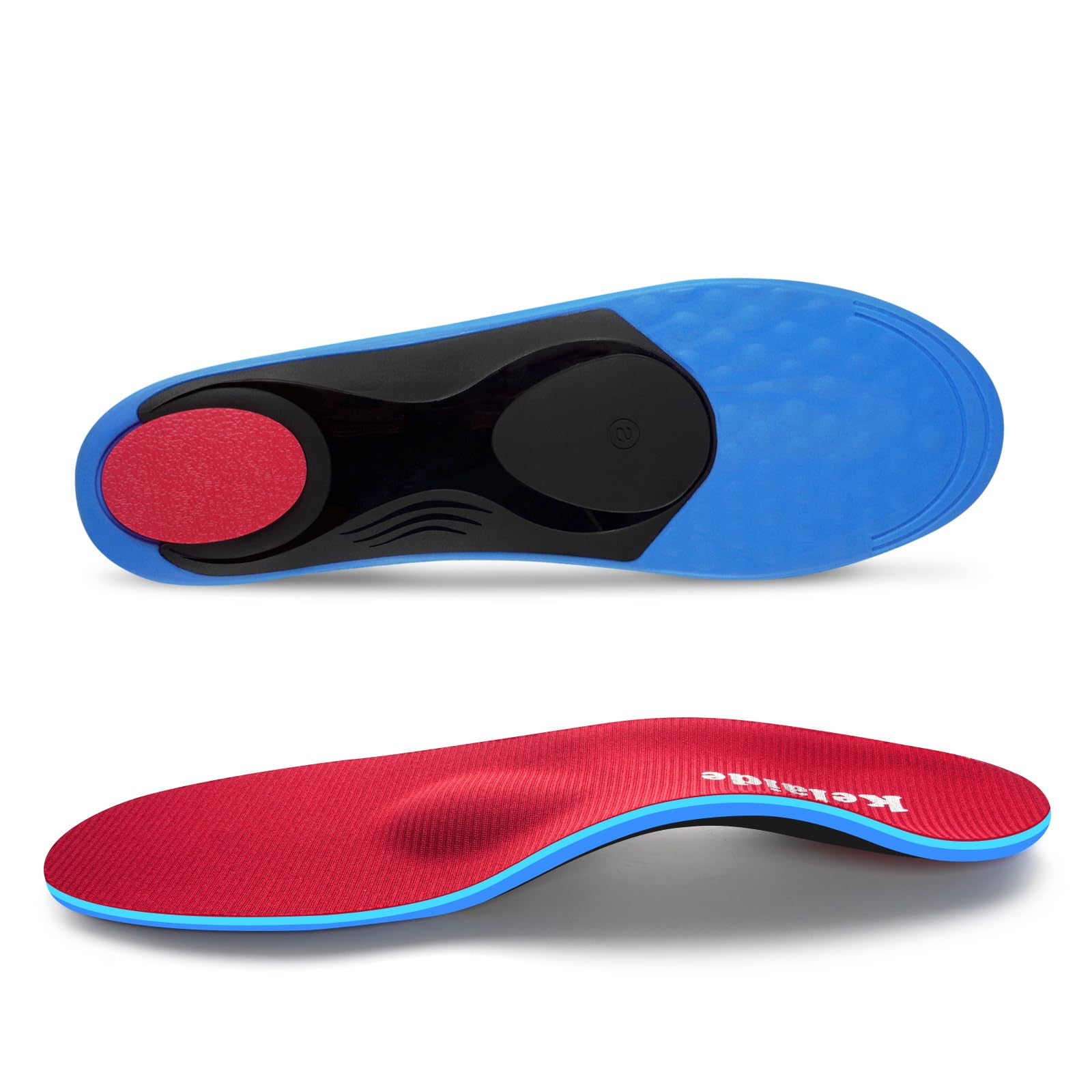
Kelaide’s offering sits at the intersection of affordability and effective biomechanics. It uses a neutral arch profile—neither flat nor aggressively high—and couples it with a metatarsal pad that targets the ball of the foot. This combination is well-suited for midfoot arthritis that manifests alongside plantar fasciitis or flat feet, where the arch needs some support but the primary pain driver is forefoot loading.
The heel wrap is deliberately low to maximize compatibility with athletic shoes, walking shoes, and casual footwear. Users have reported relief from toe pain, lower back pain, and general foot fatigue within days of switching to these insoles. The shock absorption layer is a premium foam that holds up well under daily use, though one reviewer noted that the metatarsal pad’s effectiveness diminished after about a month, suggesting the foam does compact with sustained pressure.
First-time metatarsal insole users may need a gradual break-in period—wearing the insoles for a few hours each day and increasing wear time. The arch support is firm enough to prevent pronation but not so rigid that it forces a correction. For someone on their feet all day who needs a balance of cushion and structure, this is a reliable mid-range choice.
Why it’s great
- Good balance of arch support and forefoot cushion
- Low heel wrap fits most athletic shoes
- Affordable entry to metatarsal support
Good to know
- Met pad may compress over a month
- Requires gradual break-in for new users
6. Welnove Running Insole with Metatarsal Pad
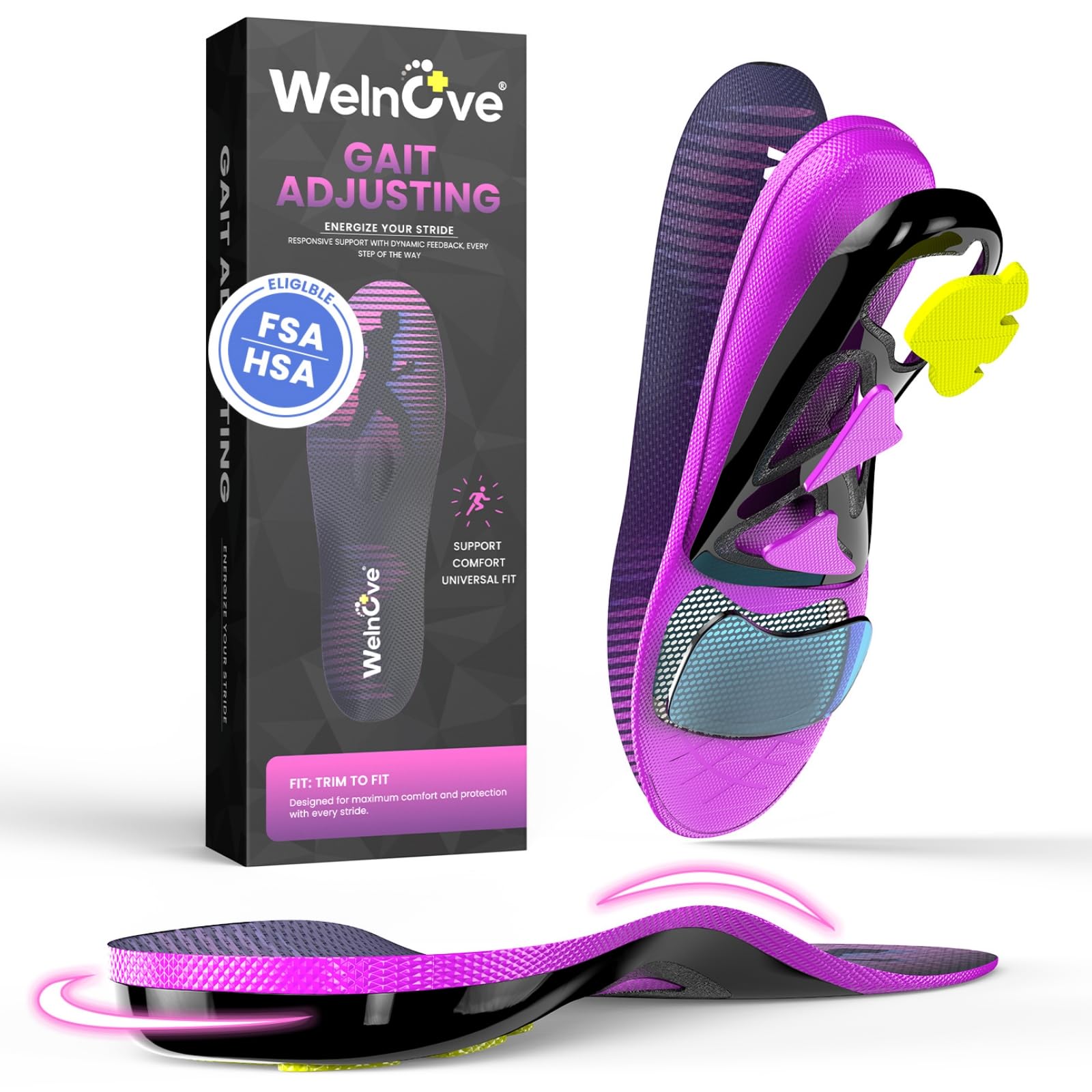
The Welnove insole is the most budget-friendly entry on this list, but it brings a surprisingly sophisticated feature for the price: a highly elastic forefoot gel cushion that absorbs impact across the metatarsal heads. The built-in metatarsal pad is lower-profile than the options from PowerStep or Cushwork, making it a good choice for users who find taller pads uncomfortable. The multi-density foam modules adapt to the arch contour dynamically, providing support for both flat and high arches.
One verified user walked 100 miles in a single week after inserting these and reported zero foot pain from a Morton’s neuroma and plantar fasciitis. That is an exceptional outcome for a sub-mid-range insole. The moisture-wicking fabric and ventilation technology keep feet dry during high-mileage use, and the non-slip gel base prevents the insole from migrating inside the shoe.
The trade-off is that the Welnove is designed primarily as a running insole. The gel cushioning is excellent for impact absorption but does not provide the rigid, total-contact stabilization that advanced midfoot arthritis requires. If your midfoot pain is accompanied by sharp toe-off pain, the lack of a Morton’s Extension means this insole will not address that mechanical issue. It works best for arthritis pain that is aggravated by high-impact walking or running rather than by joint bending.
Why it’s great
- Excellent impact absorption for forefoot
- Low-profile met pad for sensitive feet
- Moisture-wicking and breathable fabric
Good to know
- No rigid plate for toe-off immobilization
- Best for impact-related midfoot pain, not joint bending
7. MOVE All Day Comfort Insole
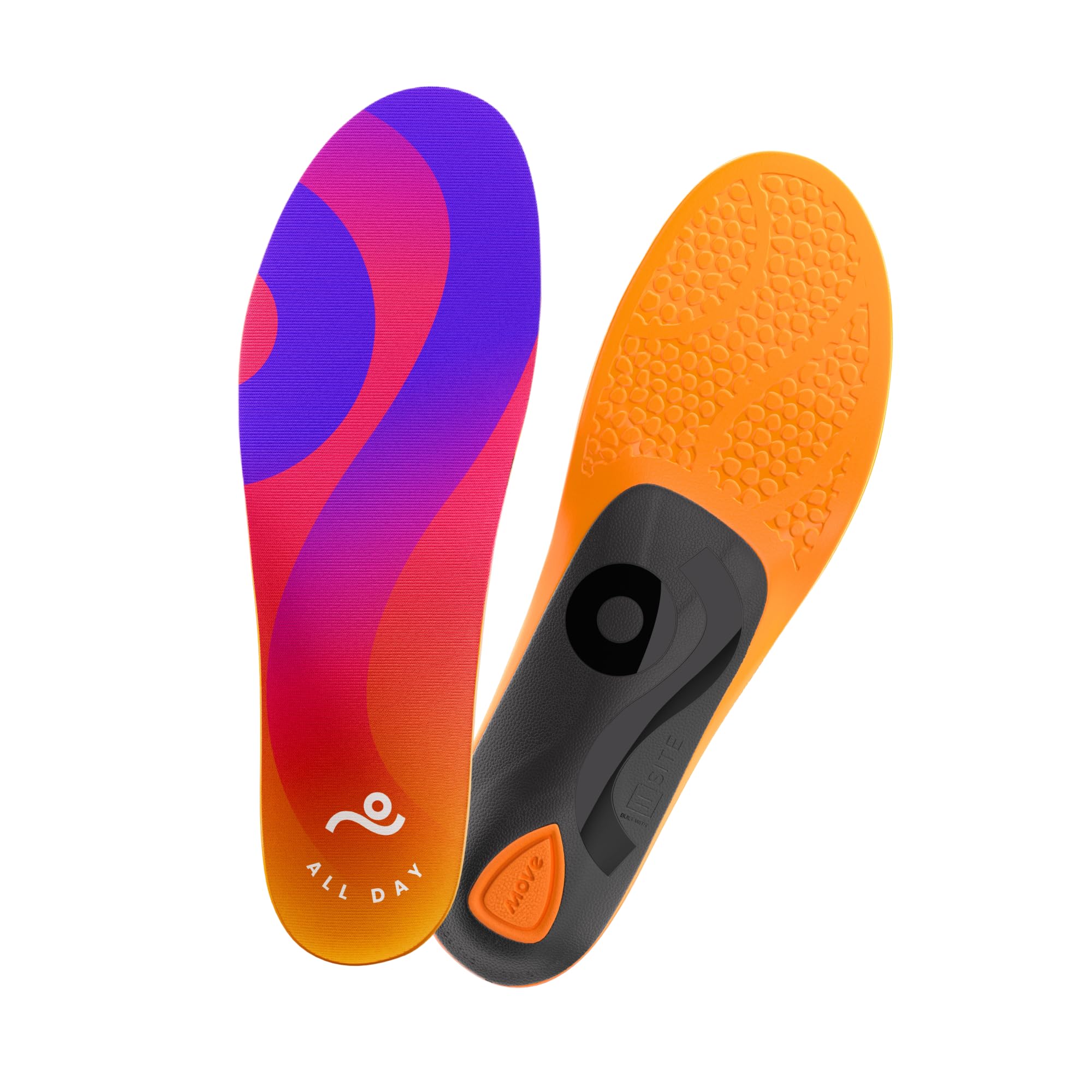
The MOVE All Day Comfort insole takes a fundamentally different approach to midfoot arthritis. Instead of rigid immobilization, it uses an X-Frame Torsional Support system that stabilizes the heel and midfoot while allowing natural movement. The Move Recharge Foam provides a plush, almost airbag-like cushion that reduces overall joint load. This design is better suited for users whose midfoot arthritis flares up after hours of standing rather than during push-off motion.
Active Heel Technology minimizes pressure on sensitive areas of the heel, which is helpful when arthritis has spread to the subtalar joint. The cushioning is noticeably thicker than standard insoles—it transforms stiff work boots and basketball shoes into all-day comfortable footwear. Verified users report that the insoles eliminated foot fatigue and made standing for entire shifts pain-free.
Where this insole falls short for midfoot arthritis is in the absence of a metatarsal pad or Morton’s Extension. If your primary pain point is the forefoot or the big toe joint, the MOVE insole will not target that specific mechanical issue. It is best used as a recovery-oriented cushioning layer underneath a carbon fiber plate for users who need both shock absorption and rigid stabilization.
Why it’s great
- Superior cushioning for full-day standing
- X-Frame adds midfoot stability without rigid plate
- Active Heel Technology reduces heel pressure
Good to know
- No met pad or toe extension for forefoot pain
- Thick profile; not for low-profile shoes
FAQ
Can a soft cushioned insole help midfoot arthritis?
What is the difference between a Morton’s Extension and a metatarsal pad?
How do I know which insole length is correct for a carbon fiber orthotic?
Will midfoot arthritis insoles fit in my dress shoes?
Final Thoughts: The Verdict
For most users, the insoles for midfoot arthritis winner is the PowerStep Carbon Fiber Orthotic because it combines a rigid Morton’s Extension with total-contact cushioning and a stable heel cradle—all in one insert that fits most deep sneakers and walking shoes. If you want uncompromising toe immobilization and already have good arch support in your shoe, grab the Tega Carbon Fiber Extension for its razor-thin profile and pure rigidity. And for mild to moderate midfoot arthritis where metatarsal offloading is the primary need, nothing beats the value and fit of the Cushwork Metatarsalgia Insole.