The agony of shifting your weight from one foot to the other during a night out, the dull ache in the ball of your foot that starts an hour in, and the silent countdown until you can kick off your pumps — this is the real price of wearing high heels. The wrong insole won’t just fail to help; it can create blisters, add bulk that makes your shoe fit wrong, or collapse entirely within weeks. What you need is a support system engineered for the specific biomechanics of a steeply angled foot.
I’m Emma — the founder and writer behind Baby Bangs. I’ve spent years filtering through orthopedic research and customer case studies on weight redistribution, arch mechanics, and material longevity in ultra-thin formats to separate the few functional insoles from the thousands of foam pads that simply feel soft in the box.
The market is flooded with gel cushions that flatten after a single wedding reception. This guide delivers a tightly curated list of insoles for high heels that actually redistribute pressure off the metatarsal heads and provide lasting arch support without ruining the fit of your favorite stilettos.
How To Choose The Best Insoles For High Heels
Selecting the wrong insole can lead to blisters, heel slippage, or a shoe that is simply too tight to wear. The goal is to find a unit that is thin enough to fit your existing shoes while providing targeted support where your foot needs it most — typically the arch and the metatarsal pad area.
Thickness and Profile: The Invisible Fit
High heels leave almost no room for extra material. An insole thicker than 3 millimeters in the forefoot will likely crowd your toes and cause your foot to slide forward, creating new pressure points. Look for insoles explicitly marketed as “ultra-thin” or “slim fit,” and check customer reviews from users with similar heel heights to confirm the fit is truly invisible.
Arch Support vs. Metatarsal Cushioning
Your foot in a high heel is in a plantar-flexed position, which changes how pressure distributes. A flat gel pad cushions the ball of your foot temporarily but does nothing for your arch, which is under tremendous strain. A superior insole combines a structured arch support that prevents your foot from rolling forward with a metatarsal pad that lifts and spreads the bones behind your toes. This dual-action approach is what actually reduces the burning sensation in the forefoot.
Material Longevity: Foam, Gel, or Medical-Grade Polymer
Standard gel cushions lose 40 percent of their shock absorption within two weeks of regular wear. Foam versions compress permanently in high-pressure zones like the ball of the foot. Premium insoles use a semi-rigid polymer shell or a high-density polyurethane blend that maintains its shape under the sustained load of a steep heel angle. If the insole folds easily in your hand, it will likely flatten inside your shoes.
Quick Comparison
On smaller screens, swipe sideways to see the full table.
| Model | Category | Best For | Key Spec | Amazon |
|---|---|---|---|---|
| SursilOrtho LadyBest | Orthotic | Weight redistribution & long wear | Medical-grade polymer shell | Amazon |
| Superfeet Casual Easyfit | Orthotic | High arch support in stilettos | Slip-resistant suede top | Amazon |
| Footminders Catwalk | Arch Support | Low arches & dress boots | Orthopedic arch support shell | Amazon |
| Pedag 121 Lady 3/4 | Ultra-Thin | Metatarsal pain & open-toe shoes | Breathable leather with met pad | Amazon |
| Pedag Lady Gel | Gel Cushion | Budget-friendly slip prevention | Thin gel with velour top | Amazon |
In‑Depth Reviews
1. SursilOrtho LadyBest High Heel Inserts

The SursilOrtho LadyBest is the most sophisticated option in this guide, employing a weight-shifting design that actively retrains your stride. Rather than simply cushioning the ball of your foot, its rigid medical-grade polymer shell redirects pressure back toward your arch and heel, fundamentally changing how your foot loads inside a stiletto. A physical therapist praised its ability to reposition flat feet, noting a genuine redistribution of weight away from the forefoot after an adjustment period of one to two weeks.
Unlike sticky gel pads that leave residue, this insole uses a non-adhesive slip-in design that grips securely through friction alone. It transfers cleanly between shoes without damaging the lining. The metatarsal pad is integrated into the shell rather than glued on top, meaning it won’t slide out of position even after months of wear. Customers consistently report it eliminates the “standing on your toes” sensation that makes long nights in heels unbearable.
The trade-off is a real adjustment period — your feet must adapt to the structured orthotic shape, which can feel rigid for the first several wears. It also performs best in closed-toe pumps or heeled boots; the medial curve is visible in strappy sandals. One user with size 10 feet found it added too much thickness for her shoes. This is a premium, purpose-built orthotic, not a universal pad.
Why it’s great
- Weight-shifting design reduces ball-of-foot pressure effectively
- Non-adhesive grip protects shoe lining and allows transfer
- Orthopedic-grade polymer shell maintains structure for years
Good to know
- Requires 1-2 week adjustment period for foot retraining
- Visible medial curve limits use in strappy sandals
- Structured rigid feel may not suit all foot shapes
2. Superfeet Casual Easyfit High Heel Insoles
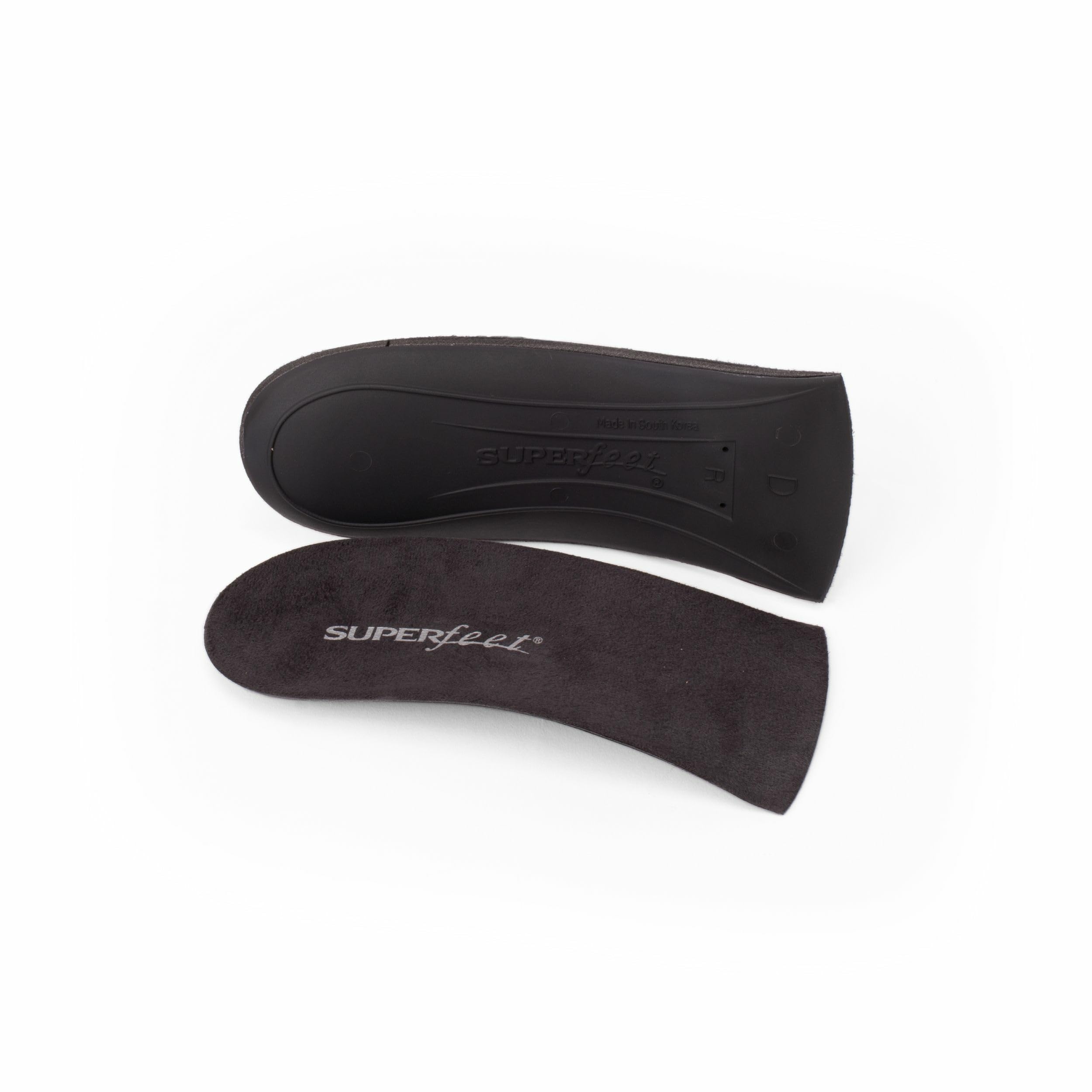
Superfeet brings its professional-grade orthopedic expertise to the high-heel format with the Casual Easyfit. This insole is built around a deep, high-profile arch that aggressively supports the foot’s natural structure, preventing the collapse that leads to plantar fasciitis pain. Users report it fits effectively inside 5-inch stilettos, with the continuous piece of material providing a unified support platform rather than a disjointed pad.
The slip-resistant suede top layer keeps your foot grounded inside the shoe, eliminating the forward sliding that crushes your toes into the toe box. Unlike most high-heel insoles, Superfeet rates its durability at 12 months or 500 miles — a clear indicator of the material density involved. The insole is marked left and right for correct anatomical placement, and the thin profile is designed specifically for dress shoes rather than athletic trainers.
The main drawback is the complete lack of forefoot padding. This is an arch-first product; if your primary pain is directly under the metatarsal heads, the Easyfit will shift your posture but not pad the impact. Some users also note the insole can shift slightly inside the shoe when removing it, and the fit can be tight if your shoe has a narrow toe box. It is ideal for those with diagnosed plantar fasciitis or high arches, not for general cushion seekers.
Why it’s great
- Aggressive high arch support prevents foot collapse
- Slip-resistant suede minimizes forward sliding in heels
- Rated for 500 miles of use with consistent density
Good to know
- No forefoot cushioning pad for metatarsal impact
- May shift slightly during shoe removal
- High arch profile can feel aggressive for flat-footed users
3. Footminders Catwalk Slim Fit Orthotic Arch Support Insoles

The Footminders Catwalk is designed as a full orthotic solution for women who suffer from low arches or flat feet when wearing heels. It combines a structured arch support shell with integrated cushioning under the metatarsal heads, providing a rare two-in-one approach in a slim profile. Users with extra high arches found it effective in stacked-heel boots, noting a significant reduction in forefoot stress during extended walking on varied surfaces.
The low-profile design allows it to fit into most fashion pumps and ballet flats, making it a versatile option for a rotating shoe wardrobe. The orthopedic shell is firm enough to provide corrective support, earning positive feedback from those with prior metatarsalgia issues. The insole is also lightweight at just over 2 ounces, a meaningful factor when every gram counts in a delicate heel.
Critically, the Catwalk is thicker than the ultra-thin gel options, which can cause heel slippage in certain tight-fitting pumps. Several users reported the arch support felt too solid and the forefoot pad too hard, leading to discomfort in narrower shoes. It works best in high-heeled boots or oxfords with a bit more internal volume. The one-size approach also limits fine-tuning for very small or large feet.
Why it’s great
- Combined arch support and metatarsal cushion in one unit
- Fits a wide range of fashion shoes including flats
- Lightweight orthopedic shell for corrective support
Good to know
- Thicker profile can cause heel slippage in snug pumps
- Firm arch may feel uncomfortable for low-arch users
- Limited customization for non-standard foot sizes
4. Pedag 121 Lady 3/4 Ultra Thin Leather Self Adhesive Insole

The Pedag 121 Lady is a masterclass in minimalist design. It is a 3/4-length insole made from breathable leather rather than synthetic foam, which prevents the sweaty, sticky feeling common in closed pumps. The integrated metatarsal pad sits precisely behind the toe bones to lift and spread the transverse arch, directly targeting the pressure that causes burning forefoot pain. Podiatrists have recommended this exact insole for metatarsalgia and “unfortunately-shaped feet.”
At less than 1 millimeter thick in the forefoot, this insole disappears completely inside the shoe — a critical feature for open-toe pumps and peep-toe heels where any overhang would be visible. The self-adhesive backing locks it in place permanently, preventing the shifting that ruins the support alignment. Users report it stops feet from sliding forward, easing the strain on the ball of the foot while keeping the heel seated correctly.
The permanent adhesive is a double-edged sword: once placed, you cannot transfer this insole to another shoe without damaging it. The support is also focused entirely on the metatarsal region with no heel pad, so it won’t help with general arch collapse or heel pain. Some users found the adhesive so strong that removal risked tearing the shoe lining. It is a single-purpose tool — exceptional for metatarsal relief, limited for everything else.
Why it’s great
- Breathable leather prevents moisture and odor buildup
- Ultra-thin profile fits invisible in open-toe pumps
- Precise metatarsal pad targets forefoot nerve pain
Good to know
- Permanent adhesive prevents transfer between shoes
- No heel pad or arch support for comprehensive relief
- Strong adhesion may damage delicate shoe linings on removal
5. Pedag Lady Gel Ultra Thin Gel Insole

The Pedag Lady Gel is the entry-point option for those who want a minimal barrier between their foot and the shoe without committing to a rigid orthotic. The German-made design uses a thin layer of pliable gel topped with a velvety velour surface that eliminates the sticky peeling noise that often plagues silicone pads. At just 3 millimeters thick, it adds negligible bulk, making it a viable option for narrow pumps and sandals.
The sticky gel backing adheres securely to the shoe’s footbed and can be washed to restore its grip, extending its usable life beyond standard drugstore pads. Multiple users noted it completely resolved the issue of sweaty feet sliding forward, and the cushioning provided surprising relief in low wedges. The ability to trim the insole means it can be custom-shaped to fit pointed or unusually shaped toe boxes.
The primary failure mode is material separation: the velour top layer has been reported to peel away from the gel substrate within two weeks of regular wear. The ridge that forms under the toes during this peeling process collects dirt and reduces the insole’s stickiness. Additionally, while it provides light cushioning, it offers no arch support or metatarsal lift — this is a comfort pad, not a structural correction tool. It works best as a quick fix for occasional wear.
Why it’s great
- Ultra-thin gel adds minimal bulk to tight shoes
- Velour surface prevents peeling noise and moisture
- Washable and trimmable for custom fit
Good to know
- Velour top can peel from gel within weeks
- No arch support or metatarsal correction
- Ridge under toes collects debris and reduces adhesion
FAQ
Can I use gel insoles in all my high heels?
How do I know if an insole will fit my specific heel height?
Why do some insoles need an adjustment period?
Will a 3/4 length insole work in peep-toe shoes?
Final Thoughts: The Verdict
For most users, the insoles for high heels winner is the SursilOrtho LadyBest because it is the only unit that actively retrains weight distribution off the forefoot using a medical-grade shell, providing genuine relief that lasts all night. If you want targeted metatarsal pressure relief in a nearly invisible profile, grab the Pedag 121 Lady. And for those needing aggressive high-arch support in stilettos, nothing beats the Superfeet Casual Easyfit.