Arthritic feet transform every step into a negotiation with pain. The stiffness, the swelling, the grinding sensation in the joints of your toes, midfoot, and heel — it dictates how far you walk, which shoes you wear, and whether you even want to stand up. The right insole changes this by redistributing pressure and stabilizing the foot’s bony architecture so the inflamed joints don’t have to bear the full load of your body weight.
I’m Emma — the founder and writer behind Baby Bangs. I’ve spent over a decade analyzing orthotic hardware, podiatric research, and customer outcomes to separate the rigid, supportive shells that actually realign the foot from the soft foam pads that simply feel good for a week.
After evaluating dozens of models against the specific biomechanical demands of arthritis, these seven stand out. This guide breaks down each one by the stiffness of its arch, the depth of its heel cup, and the material science that matters most when your joints are inflamed. Here is my analysis of the insoles for arthritic feet that actually deliver measurable relief.
How To Choose The Best Insoles For Arthritic Feet
Arthritis in the foot typically strikes the big toe joint (hallux rigidus), the midfoot, or the ankle. An insole that treats inflammatory arthritis like rheumatoid arthritis may differ from one that addresses osteoarthritis from years of wear. The key is to stabilize the joint so it doesn’t move into painful positions, and to cushion the surrounding soft tissue so the impact of each step isn’t transmitted directly into the bone.
Arch Support and Heel Cup Rigidity
For arthritic feet, a floppy insole is a waste of money. You need a semi-rigid or rigid base — usually a polypropylene or TPU (thermoplastic polyurethane) shell — that holds the foot in a neutral position. The heel cup must be deep enough to cradle the calcaneus and limit excessive inward or outward roll, which torques the midfoot joints. Look for a structural arch bridge that supports the navicular and prevents the foot from collapsing during weight-bearing.
Metatarsal Pad Position
Forefoot arthritis often involves the metatarsophalangeal joints. A strategically placed metatarsal pad lifts and separates the metatarsal heads, reducing pressure on the ball of the foot and the inflamed joints underneath. The pad’s position relative to your foot’s anatomy matters — too far forward or back and it becomes a pressure point instead of a relief zone. Variable positioning across different shoe types is a strong indicator of a well-designed insole.
Material and Shock Absorption
Arthritic joints cannot tolerate hard, unforgiving surfaces. While the base needs to be rigid, the top layer should be compliant. Look for a memory foam topper (like Plastazote) that molds to the contours of your foot over time, or a multilayer EVA setup that provides graduated cushioning. Avoid insoles that are only soft foam — they compress fully under body weight and offer zero structural support, transferring impact straight into the joint.
Fit and Trim-to-Fit Design
Arthritic feet are often swollen, especially in the evening. A trim-to-fit insole that you can size down for your current shoe is ideal. Also consider the drop — how much vertical space the insole takes up inside the shoe. Thicker insoles (>6mm at the forefoot) can make shoes feel tight and cause pressure on the top of the foot, which is a common complaint in arthritic feet with low dorsal clearance.
Quick Comparison
On smaller screens, swipe sideways to see the full table.
| Model | Category | Best For | Key Spec | Amazon |
|---|---|---|---|---|
| Protalus T-100 Lite | Alignment | Over-pronation & joint misalignment | Deepest heel cup on the market | Amazon |
| 10 Seconds Pressure Relief 3020 | Cushioning | Everyday cushioned comfort & diabetics | Plastazote memory foam topper | Amazon |
| VALSOLE Heavy Duty | Structural | Heavy users & high-impact activity | 220+ lbs TPU arch support | Amazon |
| Kelaide Metatarsalgia Insoles | Metatarsal | Morton’s neuroma & forefoot pain | Built-in metatarsal pad | Amazon |
| Pure Stride Professional 3/4 Length | Compact | Dress shoes & non-removable liners | 3/4 length polypropylene shell | Amazon |
| Bukihome Metatarsal Relief | Value | Ball-of-foot pain & Morton’s neuroma | Patented neuroma relief pad | Amazon |
| Bukihome Plantar Fasciitis Insoles | Work | Long shifts & heavy-duty standing | Thickened heel pad + anti-slip gel | Amazon |
In‑Depth Reviews
1. Protalus T-100 Lite Insoles

The Protalus T-100 Lite is built around a single, non-negotiable principle: alignment. The deepest heel cup available on the retail market locks your calcaneus in place and prevents the excessive pronation that torques the midfoot joints common in osteoarthritis. The dynamic arch support isn’t static — it stabilizes the foot as you transition from heel strike to toe-off, which matters enormously when arthritic joints can’t tolerate lateral shear forces.
This is the thinnest model in the Protalus line, so it fits into most active and casual shoes without raising your heel too high or compressing your toes against the toebox. Multiple users report that it eliminated chronic heel and arch pain within days, with several noting that their podiatrist specifically recommended it over custom orthotics due to the lab-proven pressure distribution. At around a 5mm forefoot thickness, it won’t crowd a swollen arthritic foot.
The firm polyurethane base is not for everyone — it’s noticeably stiff compared to memory foam options, and some users with very flat feet found it too unyielding during the first few days. But for an arthritic foot that needs structural correction rather than plush cushioning, this is the gold standard. It holds its shape well past the one-year mark, making the higher upfront investment cost-effective over time.
Why it’s great
- Deepest heel cup on the market locks the calcaneus firmly in place
- Patented dynamic arch support adjusts during the gait cycle
- Lab-tested pressure distribution reduces joint strain
- Maintains shape for up to a year of daily use
Good to know
- Very firm feel may require a short break-in period
- Not suitable for thin dress shoes or flats
- Higher upfront cost than most competitors
2. 10 Seconds Pressure Relief 3020 Ultra Cushioned

The 10 Seconds Pressure Relief 3020 takes the opposite approach from the Protalus — instead of rigidity, it relies on material science to absorb impact. The top layer is Plastazote, a closed-cell memory foam that molds uniquely to the shape of your foot over the first few wears. This is particularly beneficial for arthritic feet because customized pressure distribution reduces hotspots under the metatarsal heads and the heel, where joint inflammation concentrates.
Underneath the Plastazote, Poron strike pads at the heel and forefoot provide targeted shock absorption. Poron is a urethane foam that retains 95% of its thickness under repeated impact, so it doesn’t bottom out the way standard EVA or polyurethane foams do. The medium arch height is deliberate — it offers support without forcing the foot into a position that might aggravate a stiff midfoot joint. The medium arch is ideal for the majority of arthritic feet that aren’t flat but still need lift.
Users consistently report that these insoles transform hard floors and pavement into bearable surfaces, with multiple long-term customers saying they put a pair in every shoe they own. The trim-to-fit sizing is straightforward, and the 2-pack value makes outfitting multiple pairs of shoes practical. The main trade-off is that the Plastazote topper compresses slightly faster than a rigid shell, so heavy users (220+ lbs) may need replacement around the 6-month mark.
Why it’s great
- Plastazote memory foam molds to your specific foot shape
- Poron strike pads maintain 95% rebound after repeated impact
- Medium arch height suits a wide range of arthritic foot types
- 2-pack makes it affordable to outfit multiple shoes
Good to know
- Memory foam topper compresses faster than rigid TPU shells
- Not enough arch rigidity for severe over-pronators
- Thicker build may crowd some dress shoes
3. VALSOLE Heavy Duty Support Pain Relief Orthotics

The VALSOLE Heavy Duty is engineered specifically for the extra weight-bearing demands of larger body types, where arthritic joints in the foot are under higher compressive loads. The arch support is a TPU (thermoplastic polyurethane) shell that is both rigid and slightly flexible — it resists bending under pressure but doesn’t feel like a brick underfoot. The gradient cushioning layers soften on top but stay firm at the base, preventing the foot from sinking through and transferring impact directly into the joint.
Clinical feedback from users is consistent: this insole eliminates heel pain and reduces lower back and knee pain within a single shift. The deep U-cup heel wrap stabilizes the calcaneus and prevents the heel pad from flattening, which is a common source of arthritis-related heel pain. Several user reports from people with 12-16 hour standing jobs describe this as the “holy grail” for eliminating pain they had accepted as inevitable.
The main downside is the thickness — the forefoot is around 6-7mm, which can make some athletic shoes feel tight, especially if you have any swelling in the dorsal aspect of the foot. The firmness of the TPU shell also means there is a short break-in period of 2-3 days. For chronic pain sufferers who need a structural insole that can handle heavy use without collapsing, this is a remarkably effective option that outperforms many insoles at a higher price point.
Why it’s great
- TPU arch support rated for 220+ lbs without collapsing
- Deep U-cup heel stabilizes the calcaneus effectively
- Gradient cushioning prevents bottoming out under load
- Zero break-in needed for many users, immediate pain relief
Good to know
- Thick forefoot may not fit snug shoes or low-volume feet
- Firm shell can cause initial arch discomfort for some
- May not fit shoes with a narrow toebox due to volume
4. Kelaide Metatarsalgia Insoles

Kelaide’s metatarsalgia insoles are designed around a very specific biomechanical outcome: lifting and separating the metatarsal heads to relieve pressure on the ball of the foot. For arthritic feet where the metatarsophalangeal joints are inflamed, the built-in metatarsal pad shifts weight backward toward the midfoot, reducing the compressive force that causes that sharp, stabbing sensation at the front of the foot. The metatarsal pad is integrated into a full-length foam base, so it doesn’t slide out of position the way adhesive pads do.
The neutral arch support is a deliberate choice — it provides enough lift to stabilize the foot without forcing the arch into a high position that could irritate a stiff midfoot. The foam is breathable and the fabric is soft, reducing friction over swollen joints. Users with Morton’s neuroma report significant relief, with one user noting that these insoles eliminated pain that had persisted through custom orthotics. The medium-density foam provides a good midpoint between the rigid VALSOLE and the plush 10 Seconds.
There is a learning curve for first-time metatarsal pad users — the sensation of a lift under the ball of the foot can feel strange for the first week. The foam base, while comfortable, doesn’t have the same structural rigidity as a TPU shell, so heavy users may find the arch support compresses over several months. For daily casual wear and moderate walking, these are a highly targeted solution for forefoot-dominant arthritis pain.
Why it’s great
- Built-in metatarsal pad separates bone heads effectively
- Neutral arch suits both flat and medium-arched feet
- Soft, breathable fabric reduces friction over swollen joints
- Immediate relief for Morton’s neuroma and forefoot pain
Good to know
- First-time users need up to a week to adjust to the pad
- Foam base compresses faster than rigid shell insoles
- Not designed for heavy-duty or high-impact activities
5. Pure Stride Professional 3/4 Length Orthotics

The Pure Stride Professional is a 3/4-length orthotic, meaning it extends from the ball of the foot back to the heel but does not cover the toes. This is an important distinction for arthritic feet because many shoes (especially dress shoes, loafers, and some casual styles) don’t have removable full-length liners, and a full-length insole can crowd the toes in a way that aggravates hallux rigidus. The polypropylene shell provides a rigid structural base, while the top layers of EVA and breathable mesh add cushion without adding bulk.
Multiple user reviews confirm that podiatrists prescribe these as a cost-effective alternative to custom-molded orthotics. The 3/4-length design means they fit easily into shoes that don’t accommodate a full insole, and the polypropylene shell can be trimmed with scissors to fit the exact width of the shoe. Users with plantar fasciitis, heel spurs, and degenerative disc disease all report significant reduction in pain when wearing these daily.
The trade-off is that 3/4-length orthotics offer no toe support, which matters if your arthritis extends into the interphalangeal joints of the toes. They also sit slightly higher in the shoe at the arch due to the shell’s thickness, which can feel noticeable in low-cut shoes. For the specific use case of mild to moderate arthritis that requires correction under the arch and heel without disturbing the forefoot, this is a precise and podiatrist-trusted solution.
Why it’s great
- Podiatrist-recommended as an affordable alternative to custom orthotics
- 3/4 length fits dress shoes and non-removable liners perfectly
- Polypropylene shell provides rigid structural correction
- Four-layer construction balances support and breathability
Good to know
- No support for the toe joints and ball of foot
- May feel raised at the arch inside some low-cut shoes
- Not suitable for shoes with zero drop or very tight fit
6. Bukihome Metatarsal & Ball of Foot Relief Insoles
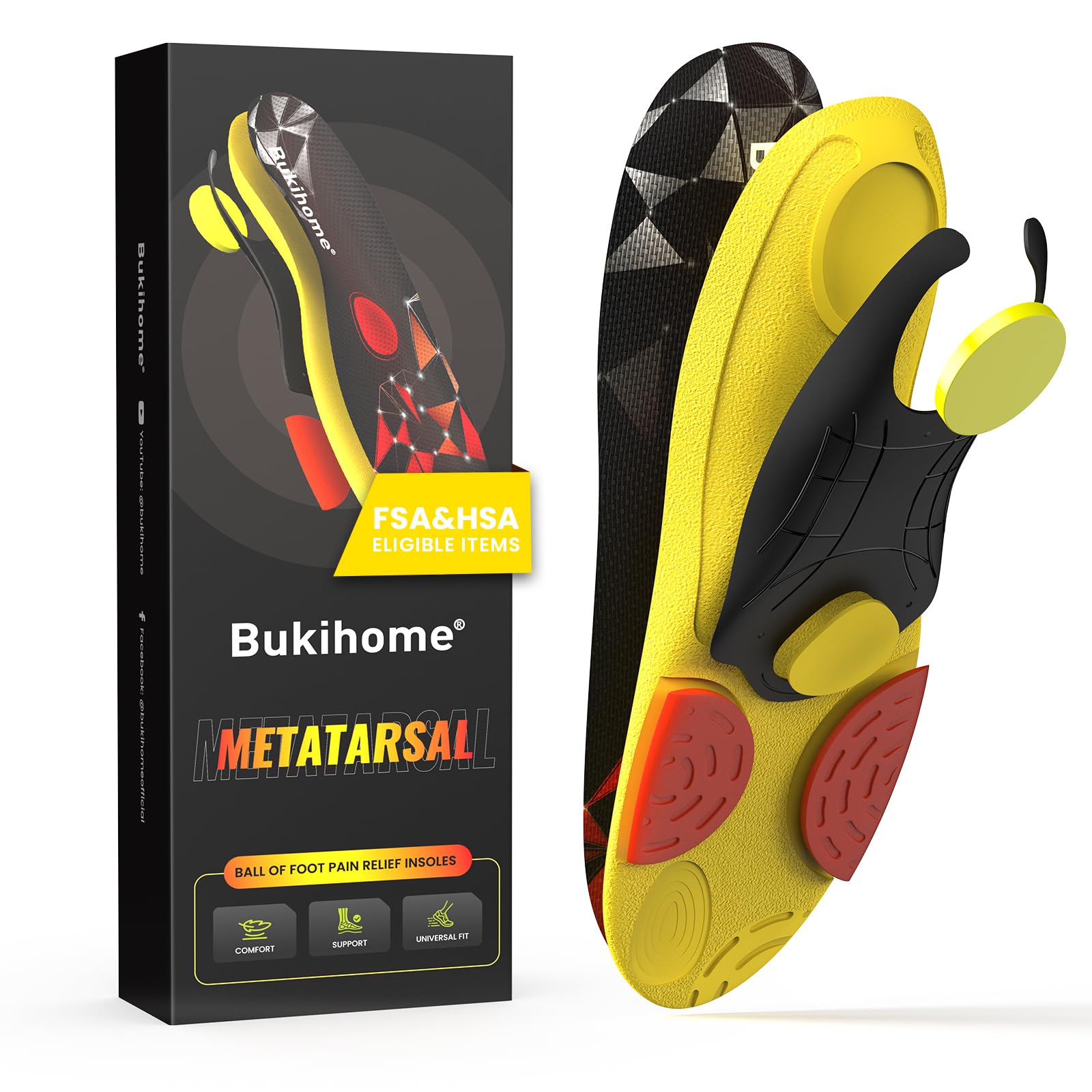
The Bukihome insole packs a surprising amount of engineering for the price point. The core feature is a patented neuroma relief pad that diffuses pressure across the 2nd-4th metatarsal heads, which is precisely where Morton’s neuroma and arthritis-related forefoot pain concentrate. The dual-density polymer matrix uses a TPU arch support rated for 220+ lbs, while the gradient EVA cushioning provides graduated shock absorption from the heel to the ball of the foot.
Users consistently report that these insoles reduced foot pain within days, with several noting that they delayed or eliminated the need for surgical intervention. The reinforced U-cup heel and biomechanical arch bridge are effective at preventing the foot from fatiguing during long standing periods, which is a critical factor for arthritic feet that stiffen with sustained pressure. The breathable moisture-wicking mesh with thermo-regulating fabric keeps feet dry, reducing the friction-related irritation that can exacerbate joint inflammation.
Fit is the main variable — some users found that the insoles required trimming to fit their shoes, and when trimmed, the arch support didn’t align perfectly with their foot’s anatomy. The flexible PU layer adapts to foot curves well, but the overall thickness is moderate, so it may not work in very low-profile shoes. For the price, this is an outstanding entry point into structural orthotics for forefoot-dominant arthritis.
Why it’s great
- Patented neuroma pad diffuses pressure across forefoot effectively
- Dual-density TPU arch support handles 220+ lbs loads
- Breathable mesh and thermo-regulating fabric reduce irritation
- Immediate pain relief reported by many users
Good to know
- Fit may shift after trimming, affecting arch alignment
- Moderate thickness may not suit very low-profile shoes
- Durability over 6 months is unverified by long-term reviews
7. Bukihome Plantar Fasciitis Insoles High Arch Support
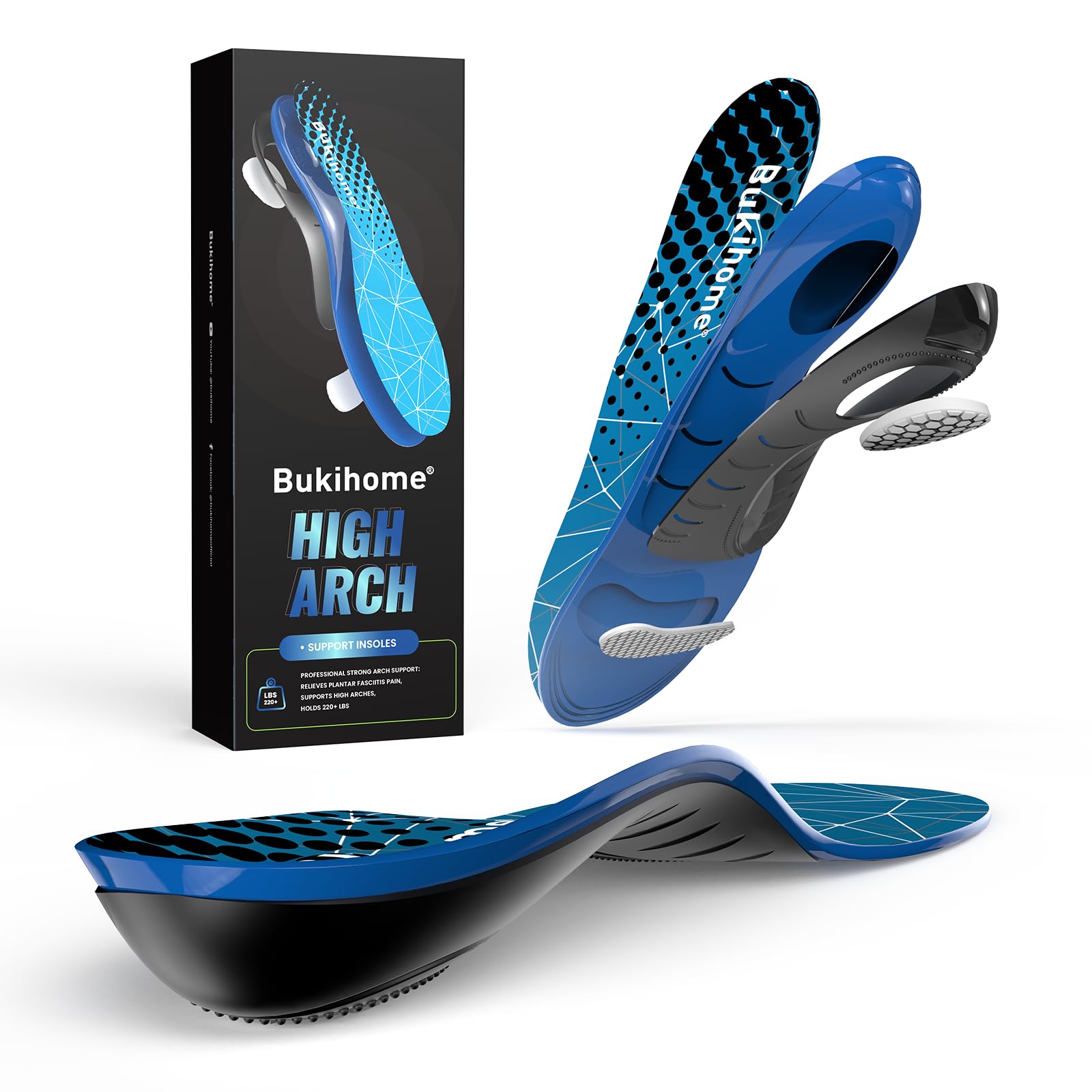
This Bukihome model differentiates itself with a high, firm arch support that is ideal for arthritic feet with collapsed or over-pronated arches. The reinforced TPU arch bridge prevents the foot from rolling inward during weight-bearing, which reduces torque on the midfoot joints. The thickened heel pad (around 8-10mm) absorbs the first point of impact during heel strike, protecting the calcaneus and the subtalar joint from repetitive shock that can exacerbate osteoarthritis.
The metatarsal support is mild rather than aggressive, making this a better fit for someone whose arthritis is concentrated in the heel and arch rather than the forefoot. The anti-slip gel pads at the forefoot and heel prevent the insole from shifting inside the shoe, which is a common annoyance that leads to discomfort. User feedback consistently highlights the stability provided by the gel grip — one reviewer noted that the insoles stayed perfectly in place during a 2.5-mile ruck with 50 lbs of added weight.
The high arch profile means this insole will not suit flat-footed arthritis sufferers. The firmness of the support also requires a 2-3 day break-in period for some users. The price sits at the lower end of the mid-range, which makes it accessible for those who need structural support but aren’t ready to invest in a premium tier product. For long shifts on hard floors, this is a reliable, no-nonsense option that delivers on its core promise.
Why it’s great
- High, firm arch support corrects over-pronation effectively
- Thickened heel pad absorbs impact at heel strike
- Anti-slip gel pads keep the insole securely in place
- Durable multilayer build resists flattening over time
Good to know
- High arch profile unsuitable for flat-footed arthritis sufferers
- Firm support may need a short break-in period
- Mild metatarsal pad not aggressive enough for severe forefoot pain
FAQ
Can I wear these insoles with dress shoes?
How long does it take to feel relief from arthritis pain?
Do I need a prescription for these insoles?
How often should I replace insoles for arthritic feet?
Final Thoughts: The Verdict
For most users, the insoles for arthritic feet winner is the Protalus T-100 Lite because the deepest heel cup on the market provides the structural correction that arthritic joints actually need to reduce pain during weight-bearing activity. If you want all-day plush cushioning that molds to your foot, grab the 10 Seconds Pressure Relief 3020. And for heavy users who need a rigid, load-bearing insole that won’t collapse, nothing beats the VALSOLE Heavy Duty Support.