That sharp, stabbing sensation at the back of your heel every time you push off your foot is the unmistakable signature of Achilles tendonitis. The tendon connecting your calf muscle to your heel bone is inflamed, and each step re-aggravates it. An insert designed specifically for this condition does one critical thing — it elevates the heel just enough to shorten the tendon, relieving tension at the insertion point and offloading the inflamed fibers.
I’m Emma — the founder and writer behind Baby Bangs. I’ve spent the last 15 years combing through market data on foot health products, analyzing biomechanical specs like heel lift height, impact force reduction percentages, and arch support rigidity to separate the inserts that actually work from those that just add cushion.
This guide breaks down the five strongest contenders for managing Achilles tendonitis, from podiatrist-designed heel lifts to full-length orthotic insoles. Finding the right inserts for achilles tendonitis means understanding which specific feature — heel elevation, impact absorption, or arch support — your daily pain pattern demands most.
How To Choose The Best Inserts For Achilles Tendonitis
Achilles tendonitis is an overuse injury characterized by micro-tears and inflammation in the tendon. The wrong insert — one that flattens the arch or provides no heel lift — can actually increase tension on the tendon. These three factors determine whether an insert will help or hinder your recovery.
Heel Lift Height: The Primary Mechanism
Every insert for Achilles tendonitis must raise the heel above the forefoot by at least 4 to 8 millimeters. This slight elevation reduces the dorsiflexion angle of the ankle, which in turn decreases the tensile load on the Achilles tendon during the stance phase of gait. A heel lift that is too low (under 3 mm) provides negligible relief, while one over 12 mm can alter gait mechanics and cause knee or hip discomfort. Podiatrist-designed inserts typically land in the 6–10 mm range — enough to offload the tendon without throwing your stride off balance.
Impact Force Reduction vs. Simple Cushion
Standard foam cushioning compresses under load and provides no structural offloading. What matters for Achilles tendonitis is impact force reduction — measured as the percentage of ground reaction force absorbed by the material before it reaches the calcaneus. The best inserts for this condition use viscoelastic polymers or proprietary materials like Absorbium that dissipate up to 94.7% of impact force. This prevents the heel strike shock wave from traveling up the Achilles tendon and re-injuring the fibers.
Arch Support and Foot Type Matching
Achilles tendonitis often co-occurs with overpronation (flat feet) or high arches, because both foot types alter the loading pattern of the Achilles tendon. If you have flat feet that collapse inward during gait, a rigid TPU arch support prevents overstretching of the tendon’s medial fibers. If you have high arches, a medium-contoured arch with shock-absorbing gel in the heel is more appropriate. A mismatched arch type can worsen the condition by forcing the foot into an unnatural position.
Quick Comparison
On smaller screens, swipe sideways to see the full table.
| Model | Category | Best For | Key Spec | Amazon |
|---|---|---|---|---|
| Heel Defender Sport | Heel Lift | Active relief during running & exercise | 94.7% impact force reduction | Amazon |
| QBK Arch Support Inserts | Full-Length Orthotic | Flat feet with overpronation | Rigid TPU arch with gel heel pad | Amazon |
| Welnove Achilles Insoles | Full-Length Orthotic | All-day wear with medium arches | Trim-to-fit with TPU waist support | Amazon |
| Heel Defender Comfort | 3/4-Length Heel Lift | Everyday relief for women & children | 94.7% impact reduction, 3/4-length | Amazon |
| VALSOLE Heavy Duty Support | Full-Length Orthotic | Heavy users over 220 lbs | High arch support, rigid construction | Amazon |
In‑Depth Reviews
1. Heel Defender Sport Achilles Tendonitis Inserts

The Heel Defender Sport is a podiatrist-designed heel lift that targets the exact mechanism of Achilles tendonitis: excessive impact force at heel strike. Its patented Absorbium material claims a 94.7% impact force reduction — a number backed by real-world user reports of immediate pain relief during running, hiking, and standing on hard floors. The 0.4-inch heel elevation is significant enough to shorten the tendon and reduce tension at the insertion point on the calcaneus.
The adhesive backing is a double-edged sword. Users who peel it and stick it in place report zero movement, making the insert feel locked into the shoe. Those who avoid the adhesive to transfer between multiple shoes report that the insert shifts position with each step, requiring frequent adjustment. The unit is sold as a pair and fits into athletic shoes, dress shoes, and casual footwear without adding noticeable bulk, thanks to its compact sport-profile design.
Long-term users consistently cite this as the only insert that resolved their pain — one reviewer with retrocalcaneal bursitis purchased it three times across different shoes. The lifetime warranty against manufacturing defects and the 30-day refund window reduce the financial risk if the 0.4-inch lift is too high for your particular gait.
Why it’s great
- Podiatrist-designed with 30+ years of clinical experience
- Absorbium material delivers genuine 94.7% impact force reduction
- Lifetime warranty and 30-day risk-free return policy
Good to know
- Adhesive backing is required to prevent movement inside the shoe
- Heel lift height may feel too pronounced in low-profile dress shoes
2. QBK Arch Support Inserts

The QBK Arch Support Insert is a full-length orthotic designed for the user whose Achilles tendonitis stems from overpronation — when the arch collapses inward during gait, the Achilles tendon twists and becomes overloaded on its medial side. The rigid TPU arch shell provides hard, unyielding support that prevents the foot from rolling inward, while the gel heel pad absorbs the impact of each step. This dual-action design addresses both the structural cause and the mechanical symptom of the injury.
At 0.71 inches of thickness, the QBK insert consumes significant volume inside the shoe. Users report needing to loosen laces or size up by half a shoe size to accommodate them. The sizing chart references men’s and women’s US sizes, but some users found the recommendation for their size was too large — cutting down along the unmarked trim line requires trial and error. The PU foam body holds its shape well over months of daily wear, resisting the flattening that affects cheaper EVA-based inserts.
Customer feedback highlights that this insert works best for users with flat feet who also experience knee and back pain, not just heel pain. One reviewer with bunion pain and overpronation reported significant improvement after switching to these in their work shoes. For those with high arches or supination, the aggressive arch contour may feel obstructively high — this insert is specialized, not universal.
Why it’s great
- Hard TPU arch support corrects overpronation at its source
- Combined gel heel pad offers two-zone shock absorption
- Durable PU foam resists compression flattening over weeks of use
Good to know
- Thick profile may require sizing up or loosening shoe laces
- No printed trim lines for size adjustment — requires trial-and-error cutting
3. Welnove Achilles Tendonitis Relief Insoles
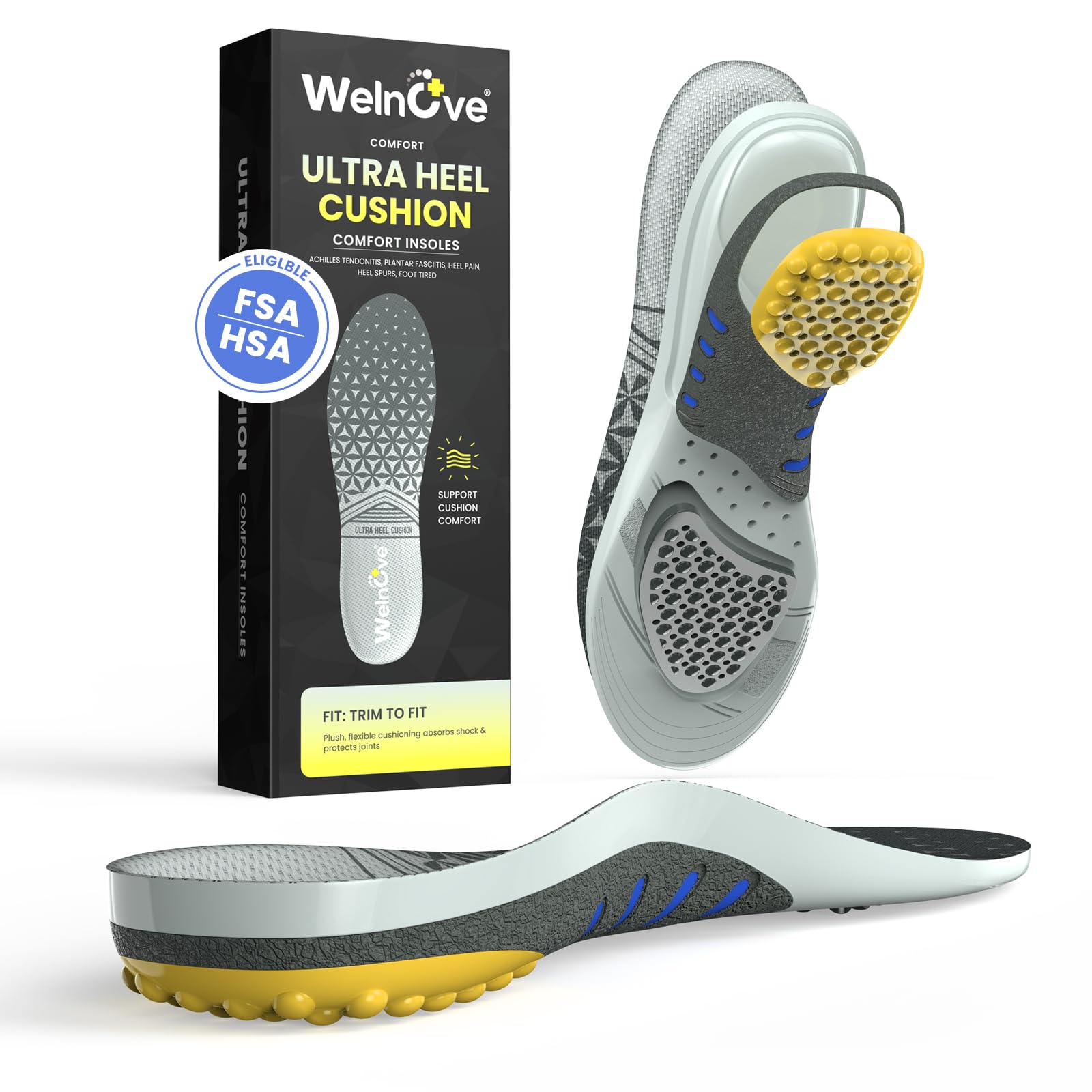
The Welnove Achilles Tendonitis Relief Insole is a full-length orthotic with a medium arch contour that suits the widest range of foot types — neither aggressively high like a flat-foot correction device nor absent like a basic heel lift. Its three-layer construction uses a shock-absorbing PU base, a stabilizing TPU waist support that prevents torsional twisting during gait, and a forefoot anti-slip gel pad that keeps the foot from sliding forward and loading the Achilles tendon during deceleration.
The trim-to-fit design allows customization for shoe sizes 12 through 14, but the initial few days bring audible squeaking as the gel material beds into the shoe liner. Users report that this noise fades after a short break-in period. The medium arch height worked for reviewers with both flat and normal arches, though users with extremely high arches found the support insufficient — a reminder that this is a versatile but not hyper-specialized insert.
Clinical results from real buyers show measurable improvement: one user with a micro meniscus tear and Achilles tendonitis reported significant pain reduction after two weeks of daily wear. Another with chronic insertional Achilles tendonosis found that wearing these combined with mild exercise pulled them out of a painful flare-up. The insert works best in roomier footwear like sneakers and hiking boots; users report instability in narrow-profile Merrell and other technical hiking shoes.
Why it’s great
- Medium arch contour suits most foot types without overcorrecting
- TPU waist support resists torsional twisting during lateral movement
- Trim-to-fit customization matches men’s and women’s larger shoe sizes
Good to know
- Audible squeaking during the first few days of wear until material settles
- Fits best in sneakers and boots; may cause instability in narrower hiking shoes
4. Heel Defender Comfort Heel Cups Alternative

The Heel Defender Comfort is the 3/4-length sibling of the Sport model, designed for women, children, and those with tighter shoe volume who cannot accommodate a full-length insole. Like the Sport, it uses the same Absorbium material that delivers a 94.7% impact force reduction — a clinical-grade biomechanical intervention rather than a simple cushion. The 3/4-length format extends from the heel to just behind the metatarsal heads, providing elevation and shock absorption without crowding the toe box.
The adhesive backing on this model has a known failure point: users report that the tacky layer degrades within a few weeks, at which point the insert begins to shift inside the shoe. One long-term reviewer recommended substituting hot glue to restore adhesion, which is an awkward but effective fix.
Medical professionals often recommend this specific model for insertional Achilles tendonopathy and retrocalcaneal bursitis, conditions where pressure directly behind the heel needs to be offloaded. One reviewer with a partially torn Achilles reported immediate pain reduction at the doctor’s suggestion. However, a minority of users with low-arched feet experienced worsened pain — the wedge-like shape created a sensation of walking in wedges, causing blistering at the heel and ball of the foot.
Why it’s great
- Doctor-recommended for insertional Achilles tendonopathy and bursitis
- Absorbium material provides genuine 94.7% impact force absorption
- 3/4-length design fits shoes with limited foot volume or narrow toe boxes
Good to know
- Adhesive backing may fail after weeks of use, requiring reapplication
- Wedge shape can cause discomfort for users with low arches or flat feet
5. VALSOLE Heavy Duty Support Pain Relief Orthotics

The VALSOLE Heavy Duty Support Orthotic is purpose-built for users over 220 pounds whose body weight compresses standard foam inserts into uselessness within weeks. Its rigid high-arch design is paired with a firm yet slightly spongy foam that provides immediate ground contact stability — no break-in period is needed. The result is a locked-in feel that prevents the foot from rolling inward and overloading the medial fibers of the Achilles tendon.
The insert requires more vertical space than standard insoles — users report needing to loosen laces or go half a size up to accommodate the thickness. At just over a quarter-inch of heel-to-toe drop, the lift is moderate compared to the Heel Defender products, but the rigid arch support compensates by reducing the eccentric load on the tendon during the mid-stance phase. One 6-foot-5, 235-pound reviewer reported zero foot or heel pain after the first day of wear, a claim repeated by a 12-to-16-hour shift worker with chronic heel pain.
For users with wide, flat feet, this insert provides the structural rigidity that prevents the arch from collapsing and the Achilles from twisting. The primary caveat is shoe compatibility — the thickness makes it unsuitable for low-profile sneakers and some dress shoes. Users with high arches may also find the contour too aggressive, as this is an orthotic optimized for pronation control, not for cushioning a high-arched foot that already absorbs shock poorly.
Why it’s great
- Rigid construction supports heavy users without compressing or flattening
- No break-in period required — immediate ground contact stability
- High arch contour prevents overpronation-linked Achilles tendon strain
Good to know
- Thicker profile may require sizing up or loosening laces in most shoes
- Overly aggressive arch contour for users with naturally high arches
FAQ
Can I use an Achilles tendonitis insert in my running shoes and dress shoes interchangeably?
How long does it take for an Achilles tendonitis insert to show results?
What is the difference between a heel cup and a heel lift for Achilles tendonitis?
Should I choose a soft or a rigid insert for Achilles tendonitis?
Can an Achilles tendonitis insert make my pain worse?
Final Thoughts: The Verdict
For most users, the inserts for achilles tendonitis winner is the Heel Defender Sport because its podiatrist-designed 0.4-inch heel lift combined with Absorbium’s 94.7% impact force reduction addresses both the mechanical offloading and shock absorption needs of a healing Achilles tendon. If you have flat feet and overpronation driving your tendon pain, grab the QBK Arch Support Inserts for their rigid TPU arch that corrects the root cause. And for heavy users over 220 pounds needing uncompromising support that won’t flatten, nothing beats the VALSOLE Heavy Duty Support Orthotics.