A pool is a magnet for curious toddlers and pets, but the surface can be deceptive—calm water hides the split-second danger of a silent entry. The right alarm doesn’t just float; it translates wave displacement into a decisive warning, separating a gentle breeze from a body hitting the water.
I’m Emma — the founder and writer behind Baby Bangs. Over the past four years, I’ve analyzed over 200 pool safety devices, cross-referencing ASTM F2208 certifications, sensor response times, and false-alarm triggers to help families choose a system that actually performs when it matters.
Whether you need a standalone unit for code compliance or a smart system with app alerts, this guide breaks down the engineering behind each option so you can confidently select a inground pool alarm that matches your pool size, noise tolerance, and daily routine.
How To Choose The Best Inground Pool Alarm
Inground pool alarms come in three main form factors: floating surface-wave detectors, poolside-mounted motion sensors, and submersion units that measure water pressure changes. Each type excels at different use cases, so matching the sensor technology to your pool’s size, surrounding environment, and daily traffic is the first step toward a system that works reliably.
Certification and Compliance
The ASTM F2208 standard is the only national benchmark for pool alarm performance in the United States. Alarms that carry this certification have been tested to detect a 15-pound object (roughly the weight of a one-year-old child) entering the water within a specific time window. Many local building codes now require this certification for new or renovated inground pools, so checking for the ASTM stamp on the product page or packaging can save you a costly retrofit later.
Receiver Range and Signal Penetration
A pool alarm is only useful if the indoor receiver can hear the pool unit through walls, stucco, brick, or metal studs. Manufacturers often advertise open-air range (100–500 feet), but real-world performance can drop to 25–50 feet through dense construction. If your pool sits far from the house or behind a thick wall, look for systems that offer a wired receiver option or a separate signal relay module to bridge the gap.
Swim Mode and False Alarm Management
Every pool owner will eventually deal with false alarms triggered by wind, rain, pool pumps, or solar covers. The best systems include a dedicated Swim Mode that temporarily disables the alarm while swimming and automatically re-arms after the water settles (usually 10–15 minutes of calm). Adjustable sensitivity is equally critical—being able to dial the detection threshold up or down helps filter out environmental noise without disabling the protection entirely.
Quick Comparison
On smaller screens, swipe sideways to see the full table.
| Model | Category | Best For | Key Spec | Amazon |
|---|---|---|---|---|
| ZapWay PS01 | Floating | 110dB dual siren coverage | 110dB siren both units | Amazon |
| Poolguard PGRM-2 | Submersion | ASTM F2208 compliance | 200 ft receiver range | Amazon |
| Lifebuoy BCONE | Smart Float | App + Alexa control | 3-year warranty | Amazon |
| Lifebuoy 10001 | Poolside Mount | Bluetooth app tuning | 3-year battery life | Amazon |
| Blue Wave NA4212 | Submersion | 18-pound detection threshold | 1/19 inch water rise trigger | Amazon |
| RoamRider Poolside | Motion Sensor | Quick 3M tape install | 85dB LED flash receiver | Amazon |
| Zuomeng Solar Wave | Solar Float | Zero-maintenance charging | Solar + 2.4GHz WiFi app | Amazon |
In‑Depth Reviews
1. ZapWay PS01 — 110dB Dual Siren Floating Alarm
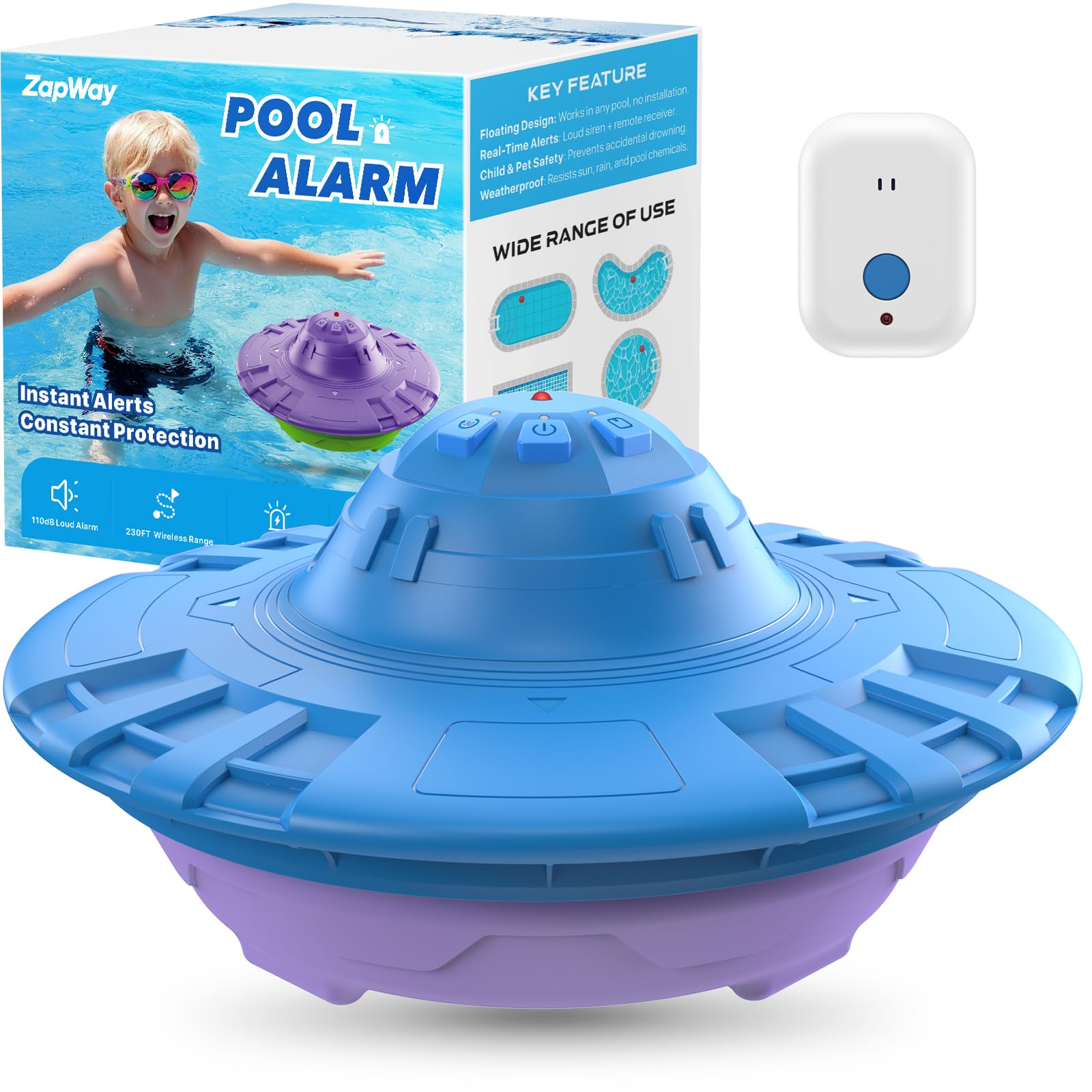
The ZapWay PS01 is a floating surface-wave detector that pairs an ultra-loud 110dB siren at the pool unit with a matching 110dB indoor receiver. This dual-siren setup means you hear the alarm whether you’re inside the house or standing next to the pool, eliminating the weak-link problem of a single, distant receiver. The UV-resistant polymer shell is built to handle full sun exposure across an entire swim season without fading or cracking.
Adjusting the sensitivity is as simple as rotating the base floater, allowing you to raise the threshold if your pool experiences frequent wind chop or lower it for calm, protected areas. The automatic Swim Mode pauses the alarm while you swim and re-arms after ten minutes of calm water surface, so you never have to remember to turn it back on. The unit fits inground and above-ground pools up to 20×40 feet, and multiple units can cover larger spreads.
Customer feedback consistently highlights the piercing volume—tested with a chair falling into the pool, the alarm was audible from a very far distance. The included 9V battery powers the whole season, and the no-drill installation takes seconds. The only operational note is that the alarm is very loud with no volume adjustment, which is ideal for safety but something to be aware of in noise-sensitive neighborhoods.
Why it’s great
- 110dB siren on both pool and indoor units ensures no blind spots
- Rotating base makes sensitivity adjustments tool-free and intuitive
- Swim Mode auto-reactivates after 10 minutes of calm surface
Good to know
- No volume adjustment — the alarm is aggressively loud by design
- Large pools over 20×40 feet may require a second unit for full coverage
2. Poolguard PGRM-2 — Submersion Sensor with 200-Foot Range

The Poolguard PGRM-2 is a submersion-style alarm that mounts directly into the skimmer opening or a dedicated fitting, measuring water pressure changes rather than surface waves. This design makes it inherently resistant to false alarms from wind and rain—one of the most common complaints about floating alternatives. It is NSF certified to ASTM F2208 and designed to detect an intrusion similar to a one-year-old child, making it a go-to for homeowners who need code compliance.
The in-house remote receiver has a rated range of 200 feet, and the unit is tamper-proof—removing it from the pool triggers an immediate alarm. A magnetic key is used for arming and disarming, and the system automatically wakes up and performs a self-test when reinstalled. It works on pools up to 20×40 feet or 800 square feet, and the 3-year warranty reflects the manufacturer’s confidence in the internal electronics.
Users report very few false alarms from rain or small critters, and the alarm is loud enough to be heard both inside and outside the house. The main learning curve is the install/removal process: it must be done slowly to avoid triggering the alarm, and the depth range is specific—some users needed a spacer for deeper skimmers. The unit is not fully waterproof, so it should be stored indoors when not in use.
Why it’s great
- Submersion sensor practically eliminates wind and rain false alarms
- 200-foot receiver range covers most residential house-to-pool distances
- Tamper-proof design alarms if the sensor is removed from water
Good to know
- Depth-specific installation may require a spacer for deep skimmer openings
- Not fully waterproof — unit should be removed and stored during off-season
3. Lifebuoy BCONE — WiFi Smart Alarm with Alexa Voice Control
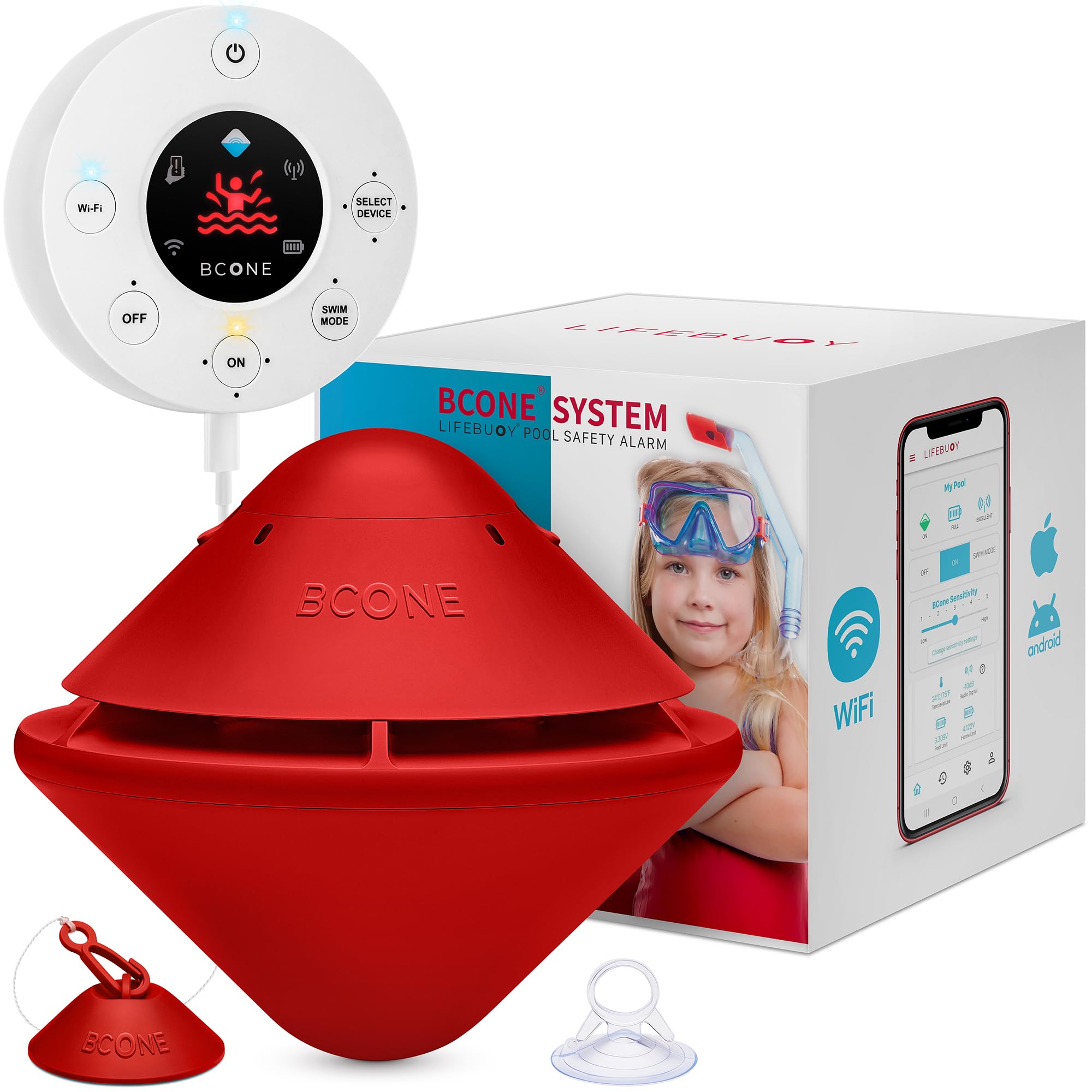
The Lifebuoy BCONE is a floating smart alarm that connects to your home’s 2.4GHz WiFi network, giving you remote control via a smartphone app and voice commands through Alexa or Google Assistant. This connectivity means you can arm, disarm, or check the system status from anywhere, which is a significant upgrade over passive alarms that only alert locally. The floating pool unit communicates wirelessly with an indoor home unit that sounds a 90dB siren.
An advanced detection algorithm is designed to filter out common false triggers like pool pumps and light wind, and you can adjust the sensitivity directly from the app. The Swim Mode feature temporarily disables the alarm and automatically re-engages after several minutes of no movement. Up to four pool units can pair with one home unit, making it scalable for large or multi-pool properties. The system is ASTM F2208 compliant and carries a 3-year manufacturer warranty.
Real-world users report detection within 2–5 seconds even at moderate sensitivity settings, and the indoor receiver is loud enough to hear across a typical home. The app interface is modern and intuitive, though some users experienced occasional WiFi connectivity loss that triggered a “lost contact” warning. The pool unit is IP68 waterproof certified, and the included mounting hardware makes installation straightforward, though the indoor unit requires a line-of-sight distance of roughly 50 feet for reliable signal.
Why it’s great
- WiFi app control allows remote arming and status checks from anywhere
- Voice control via Alexa and Google Assistant for hands-free operation
- Advanced algorithm reduces false alarms from pool equipment and wind
Good to know
- WiFi setup can be time-consuming if the home network has poor 2.4GHz coverage
- Indoor receiver range is roughly 50 feet through walls — test placement carefully
4. Lifebuoy 10001 — Bluetooth-Controlled Poolside Mount

The Lifebuoy 10001 is a poolside-mount alarm that uses a motion detection sensor to monitor the surface of the water, making it distinct from floating units that ride on the water itself. The sensor is attached to the pool deck or coping and points downward at the water, measuring disturbances in the reflection pattern. It uses a Bluetooth smartphone app (not WiFi) for sensitivity adjustments and siren duration settings, which keeps the system simple and battery-efficient.
The pool unit runs on a 9V lithium battery that can last up to three years under normal use, dramatically reducing maintenance compared to units that need monthly replacements. The indoor receiver (included) sounds an 85dB alarm and connects wirelessly up to 50 feet. The Swim Mode auto-reactivates after 10 minutes of calm water, and the system is designed for pools up to 20×40 feet. Multiple units can be paired to a single app for larger pools or separate spas.
Early reviews praise the easy setup and the loud indoor receiver, noting that the app makes sensitivity tuning trivial. However, several users reported the system failing after 6–12 months, with the alarm triggering immediately on power-up or not detecting falls at all. The manufacturer’s customer support is responsive—most users who contacted them received a free replacement under the warranty. The unit is not weather-resistant, so the receiver should be placed in a sheltered indoor location.
Why it’s great
- 3-year battery life on the pool unit minimizes ongoing maintenance
- Bluetooth app enables precise sensitivity and siren length control
- Poolside mount design avoids surface drift and debris interference
Good to know
- Bluetooth range limits app control to close proximity (50 feet line-of-sight)
- Some units failed after 6–12 months, though warranty replacements were provided
5. Blue Wave NA4212 — Submersion Alarm with 1/19 Inch Sensitivity

The Blue Wave NA4212 (Poolwatch) is a submersion-style alarm that measures water level rise at the pool edge, triggering when the water height changes by just 1/19 of an inch. This extreme sensitivity is designed to detect a child or pet entering the water before they have time to submerge fully. The unit is ASTM F2208 certified and uses a wired 110V AC receiver with a 9-volt battery backup, ensuring it stays operational during power outages.
The remote receiver has a 100-foot wireless range, and the system includes a D-cell battery backup for the receiver itself. The pool unit is designed to detect objects weighing 18 pounds or more, which aligns with the ASTM standard for toddler detection. Installation is straightforward—mount the sensor on the pool wall at the waterline, plug in the receiver inside the house, and test the calibration.
User feedback confirms that the alarm is very loud—neighbors could hear the test. The sensitivity is genuinely impressive, but the enclosure is not water-tight, and humidity can cause battery contact issues if the unit is left in place year-round. Several users reported that the product never worked out of the box due to jammed battery contacts, requiring manual adjustment. For best results, remove and store the sensor indoors when the pool is not in use.
Why it’s great
- Extremely sensitive detection at 1/19 inch water rise — catches small children
- AC-powered receiver with 9V battery backup provides uninterrupted operation
- ASTM F2208 certified for code compliance and legal protection
Good to know
- Enclosure is not humidity-sealed — must be stored indoors off-season
- Battery contacts can jam during installation, requiring manual adjustment
6. RoamRider Poolside — 85dB Motion Sensor with LED Receiver

The RoamRider Poolside Alarm uses a motion-sensing system that detects movement in the pool area rather than wave displacement on the water surface. This approach means the sensor can be mounted on the pool deck or a nearby wall, angled toward the water to monitor for falls. The installation is genuinely tool-free thanks to the included 3M adhesive tape, though a permanent screw mount option is available for concrete decks.
The system includes a remote receiver that emits an 85dB alarm with LED flashing when it detects an object over 13 pounds falling into the pool. The receiver has a rated range of 16 feet, which is very short—it is designed to be placed on a table or shelf near the pool area rather than inside a distant room. Three color-coded modes (yellow for sleep/swim, green for operational, red for alarm) with audio prompts make the status easy to read at a glance.
Users who mounted the unit within the short range found it effective and easy to set up, with the 3M tape holding well on smooth surfaces. The alarm is loud enough to hear from nearby rooms. However, the 16-foot range is a major limitation—if your pool is more than 50 feet from the house, the receiver may not pick up the signal. Additionally, the manual does not explain how to recalibrate or adjust sensitivity, which left some users stuck with continuous false alarms.
Why it’s great
- Tool-free installation with 3M tape — no drilling required for most pools
- Color-coded modes and audio prompts make status reading simple
- LED flashing receiver grabs attention even in noisy environments
Good to know
- Receiver range is only 16 feet — must be placed very close to the pool
- No sensitivity adjustment or recalibration options in the manual
7. Zuomeng Solar Wave — Solar-Powered WiFi Floating Alarm
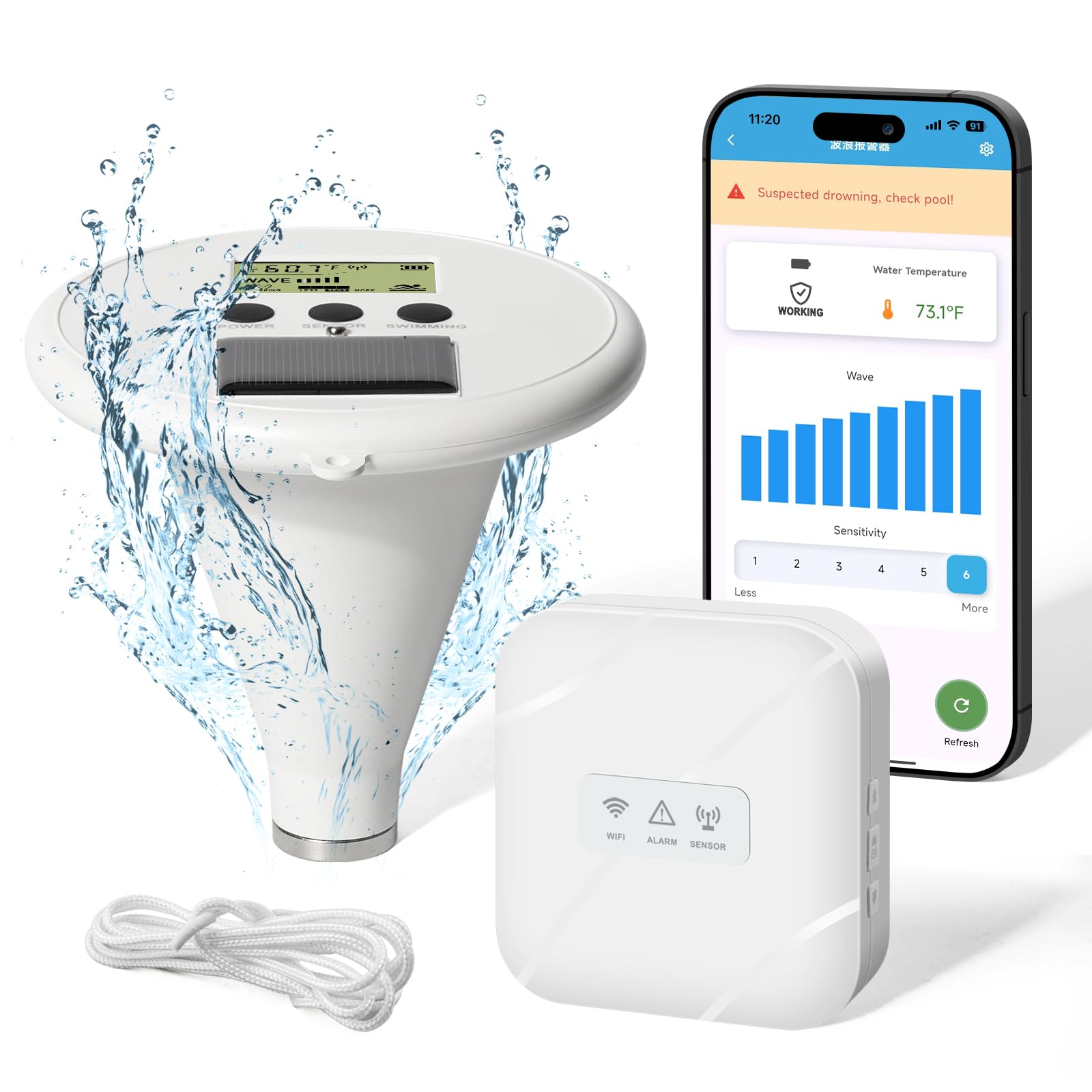
The Zuomeng Solar Wave is a floating pool alarm with an integrated solar panel that trickle-charges the internal battery, eliminating the need for manual charging or frequent battery swaps. It connects via 2.4GHz WiFi to a smartphone app, where you can adjust sensitivity, monitor water temperature, wave amplitude, and battery status from the LCD screen on the unit or the app interface. The system uses an ultrasonic sensor to detect water surface disturbances.
The alarm sounds an audible and visual warning at the pool unit while simultaneously pushing push notifications to your phone (SMS and phone call alerts are available but require a paid subscription). The unit automatically switches from Swim Mode to Working Mode after two hours of no movement, ensuring it never stays disarmed by accident. It has a 500-foot wireless range from the hub to the pool sensor and IP68 waterproof certification, making it suitable for all pool types including inground, above-ground, and ponds.
User experiences are mixed: the solar charging and app connectivity are convenient, but the sensor can trigger false alarms during rain, and the app sometimes struggles to synchronize with the unit. Several users reported the sensor stopping working after 2–3 months with no customer support available to troubleshoot. The hub must be plugged into power before the sensor is placed in the pool, and the signal range through stucco walls drops to under 25 feet. For the price, it offers a lot of features, but reliability over a full season is a concern.
Why it’s great
- Solar panel eliminates battery charging and replacement entirely
- Smart app shows water temperature, wave amplitude, and battery level
- Auto-switch to Working Mode after 2 hours of inactivity
Good to know
- Multiple users reported the sensor failing after 2–3 months with no support
- WiFi signal drops significantly through stucco walls (under 25 feet range)
FAQ
What is the difference between ASTM F2208 and other pool safety standards?
Can I use a floating pool alarm in a pool with a solar cover?
How often should I replace the batteries in my pool alarm?
Will a pool alarm work if the water is very choppy from wind or a pool pump?
Final Thoughts: The Verdict
For most users, the inground pool alarm winner is the ZapWay PS01 because it delivers 110dB dual-siren coverage, tool-free adjustable sensitivity, and an auto-rearming Swim Mode at a price that balances performance and value. If you need ASTM F2208 code compliance and hate false alarms from rain, grab the Poolguard PGRM-2. And for smart-home integration with app control and Alexa voice commands, nothing beats the Lifebuoy BCONE.