Infrared light therapy has moved from exclusive clinics to home devices, but the market is flooded with panels, pads, and masks that vary wildly in wavelength accuracy, power output, and build quality. A wrong pick means wasted time and zero cellular benefit.
I’m Emma — the founder and writer behind Baby Bangs. I’ve spent the last three years cross-referencing peer-reviewed studies on photobiomodulation with real-world customer data across budget, mid-range, and premium infrared light devices to separate the clinical-grade units from the gimmicks.
This guide examines seven distinct devices — from full-body panels to targeted wraps and facial masks — to help you find the most effective infrared light device for your specific recovery, skincare, or daily wellness goals.
How To Choose The Best Infrared Light
Photobiomodulation works when the correct wavelengths and enough power reach your cells. Three factors determine whether a device delivers genuine therapeutic benefit or just glows.
Wavelength Accuracy and Dual-Chip Design
Most credible home devices pair 660nm visible red light (targets skin surface, boosts collagen and circulation) with 850nm near-infrared (penetrates deeper into muscles and joints for pain relief and recovery). Premium units use dual-chip LEDs that emit both wavelengths from a single diode, ensuring uniform coverage across the treatment area — a clear advantage over single-chip panels that require separate bulbs for each wavelength.
Irradiance and Power Density
Irradiance, measured in milliwatts per square centimeter (mW/cm²), tells you how much therapeutic energy reaches your skin per second. A reading of 100 mW/cm² or higher at a distance of 3 inches is considered effective for home use. Lower irradiance units may require longer sessions or closer placement to achieve any cellular effect, while overly powerful units without proper cooling can cause discomfort.
Form Factor and Treatment Versatility
Floor-standing panels and flexible pads offer full-body or large-area coverage, making them ideal for back, knee, or shoulder recovery. Compact panels and face masks target smaller zones with higher precision. Consider your primary use case: a full-body panel suits athletes and chronic pain sufferers, while a facial mask is better for wrinkle reduction and skin tone improvement.
Quick Comparison
On smaller screens, swipe sideways to see the full table.
| Model | Category | Best For | Key Spec | Amazon |
|---|---|---|---|---|
| Hooga PRO300 | Premium Panel | Daily wellness & muscle recovery | 60 dual‑chip LEDs, 660nm/850nm | Amazon |
| BestQool Pro100 | High‑Power Panel | Full‑body modular setup | 100 dual‑chip LEDs, 170W, 4 wavelengths | Amazon |
| iRestore LED Face Mask | Facial Mask | Anti‑aging & skin rejuvenation | 360 LEDs, triple wavelength (635/830/415nm) | Amazon |
| LifePro BioHeal Panel | Mid‑Range Panel | Targeted pain relief & sleep support | 90 LEDs, 203 mW/cm² at 3 in | Amazon |
| Beurer IL60 Heat Lamp | Infrared Heat Lamp | Muscle tension & sinus relief | 300W incandescent infrared bulb | Amazon |
| Astarexin Panel with Stand | Entry‑Level Panel | Budget whole‑body introduction | 660nm/850nm, floor stand & wall mount | Amazon |
| Comfytemp Wearable Pad | Flexible Wrap | Portable joint & back relief | 242 lamp beads, 24″ x 12″, auto shut‑off | Amazon |
In‑Depth Reviews
1. Hooga Red Light Therapy Panel PRO300

The Hooga PRO300 delivers on every spec that matters for consistent photobiomodulation. Its 60 dual-chip LEDs alternate between 660nm red and 850nm near-infrared, providing a high-output, flicker-free beam with a measured irradiance that supports both surface collagen production and deep muscle recovery. The stand is sturdy enough for floor or tabletop positioning, and the built-in timer simplifies session management without needing a separate remote.
Users report noticeable improvements in skin complexion within two to three weeks of daily use, alongside faster recovery from muscle soreness and reduced joint stiffness. The panel runs cool thanks to adequate heat dissipation, and the low EMF rating addresses a common concern among buyers who plan extended daily sessions. The touch-sensitive side buttons are the only minor complaint — they can be bumped accidentally during position adjustments.
Backed by a three-year warranty and strong customer support, the PRO300 occupies a sweet spot where clinical-level performance meets a price that serious home users find reasonable. For anyone seeking a single, reliable device for both facial skincare and body recovery, this panel remains the benchmark.
Why it’s great
- Low EMF ensures safe daily use up to 30 minutes per area
- Flicker-free 660nm/850nm LEDs deliver consistent energy output
- Three‑year warranty reflects confidence in build quality
Good to know
- Touch‑sensitive buttons can be triggered accidentally when repositioning the panel
- Stand feels slightly less premium than the panel itself
2. BestQool Pro100 Red Light Therapy Panel

BestQool’s Pro100 stands out by offering four discrete wavelengths — red, near-infrared, and two transitional bands — through 100 dual-chip LEDs, giving you more control over which photo-acceptors in your cells get activated. The 170W power draw and 109 mW/cm² irradiance at 3 inches mean this unit hits deep tissue with serious energy density, and the 60-degree beam angle provides wider coverage than many comparable panels.
The modular design is the headline feature. Proprietary connection holes on the housing allow you to link two or more Pro100 units side by side, creating a full-body array without buying an oversized single panel. Users who started with one unit and later expanded report consistent results: reduced post-workout soreness within a week, improved joint mobility, and a visible glow in skin tone after continued use.
At a weight just over six and a half pounds, the panel is portable enough to move between rooms, and the smart control system includes automatic shut-off for safety. The absence of a stand in the base package means you’ll need to purchase one separately for floor use, but the low heat emission makes it comfortable for direct skin contact during shorter sessions.
Why it’s great
- Four‑wavelength output for versatile treatment targeting
- Modular connection allows easy expansion to full‑body coverage
- Powerful 170W output with wide 60‑degree beam angle
Good to know
- Does not include a stand; requires separate purchase for hands‑free use
- Larger footprint may be cumbersome for small apartment spaces
3. iRestore LED Face Mask

This is not a body panel — it’s a dedicated facial photobiomodulation system designed for the contours of the face and neck. The iRestore mask packs 360 LEDs across three clinically validated wavelengths: 635nm red for collagen stimulation, 830nm near-infrared for deeper tissue repair, and 415nm blue for acne-causing bacteria. You can activate red and blue simultaneously or run the infrared alone, giving you tailored protocols for morning brightness or evening calming.
The mask hovers off the skin, preventing heat buildup and allowing serums to absorb while the light works. Ten-minute sessions, three to five times per week, are all that’s needed — users report firmer skin, reduced fine lines, and a more even complexion within the first month. The lightweight build and dual-strap system keep it secure during use, and the included carrying case makes it travel-friendly.
At this price point, it competes directly with professional LED mask brands. The iRestore name brings twenty years of phototherapy R&D, and customer feedback consistently praises the visible difference in skin texture after consistent use. The blue light setting makes this a strong choice for anyone managing both signs of aging and occasional breakouts.
Why it’s great
- Triple‑wavelength system covers collagen, repair, and acne treatment
- Hands‑free mask design with serums‑under‑light compatibility
- Lightweight build with no heat discomfort during 10‑minute sessions
Good to know
- Only covers face and neck; no utility for body joints or muscles
- Mask must be positioned correctly before power‑on to avoid direct eye flash
4. LifePro BioHeal Red Light Therapy Panel
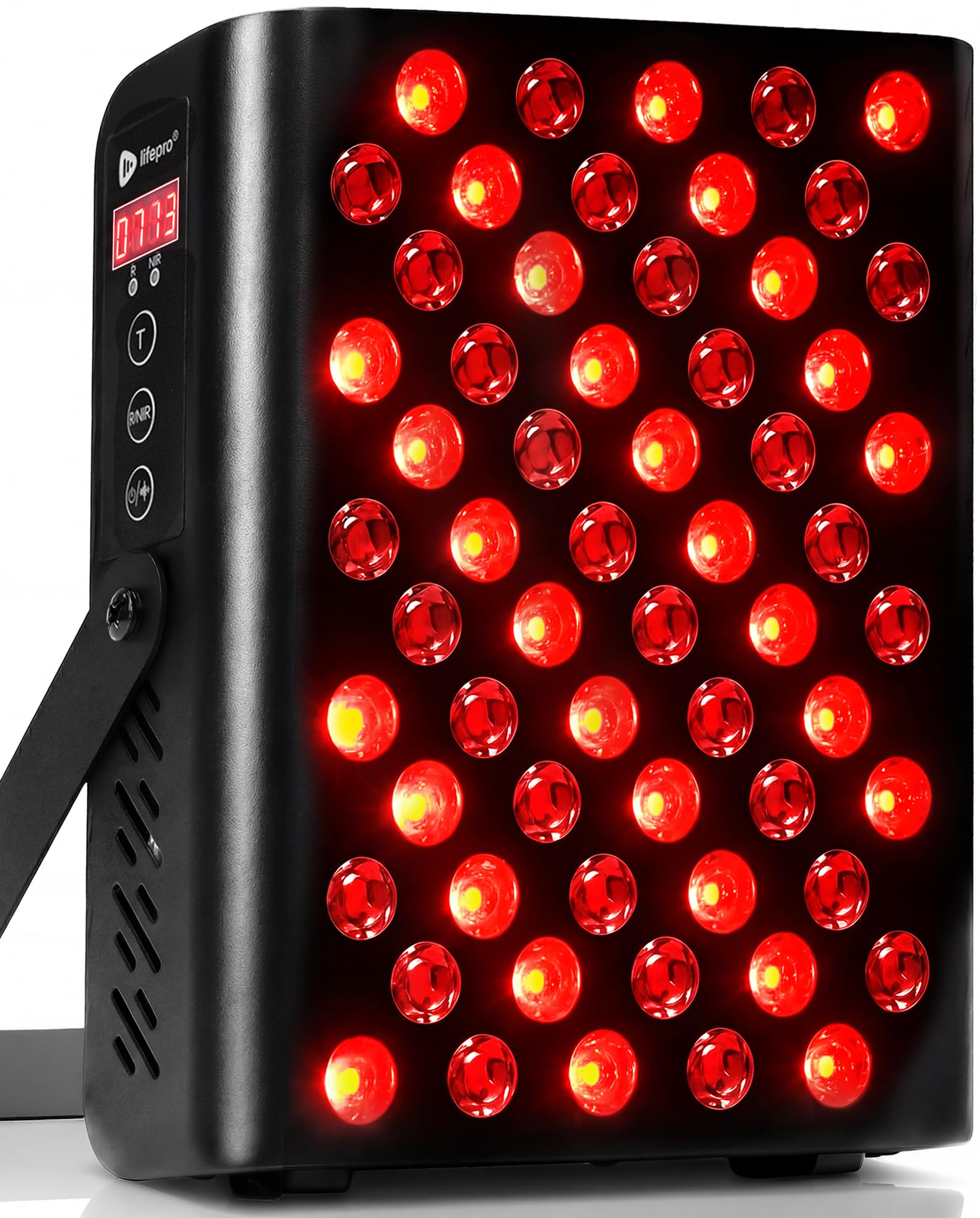
LifePro’s BioHeal panel offers one of the highest irradiance ratings in its class — 203 mW/cm² at a 3-inch distance — which means shorter sessions can achieve similar cellular dosing compared to lower-output competitors. Its 90 LEDs combine 660nm and 850nm wavelengths, and the pulsing mode (10 times per second) is designed to prevent photo-adaptation, keeping receptor sites responsive over long-term use.
Users dealing with cold feet from circulation issues noticed warmth and improved blood flow within the first week, and those using it for sleep support reported a calmer pre-bed routine. The auto 10-minute timer is convenient for beginners, though some users wished for a delay or an end-of-session beep. The included hanging kit and lightweight build (just over 5.7 pounds) make it easy to mount on a door or place on a tabletop for targeted treatment.
The panel is compact — roughly 10 by 9 inches — so it treats smaller areas like the face, neck, or knees effectively but requires repositioning for full-body sessions. LifePro backs the unit with lifetime customer support, a notable advantage over shorter warranty periods, though initial response times from customer service have drawn mixed feedback.
Why it’s great
- Highest irradiance (203 mW/cm²) in the mid‑range segment for efficient dosing
- Pulsing mode prevents cellular adaptation with consistent use
- Lifetime customer support adds long‑term ownership confidence
Good to know
- Compact panel requires repositioning for full‑body coverage
- No remote or session‑end alert; manual monitoring needed
5. Beurer IL60 Infrared Heat Lamp

The Beurer IL60 is a different approach — it uses a single 300W incandescent infrared bulb rather than LED arrays. The heat it generates penetrates tissues primarily through thermal effects, increasing local blood flow and relaxing tight muscles in a way that feels more like a sauna than a light panel. This makes it particularly effective for sinus congestion, stiff necks, and arthritic knees where deep warmth provides immediate symptomatic relief.
Built with a glass-ceramic cover that blocks UV rays and a timer adjustable from 1 to 15 minutes, the IL60 prioritizes safety and simplicity. The 0-to-40-degree tilt lets you angle the light precisely, and the push-button controls are straightforward enough for elderly users. The included protective eyewear is essential — the 300W bulb is bright and should never be viewed directly.
Users consistently report pain reduction after just two or three 15-minute sessions, particularly for knee inflammation and shoulder stiffness. The trade-off is that this is a heat-focused device, not a precise photobiomodulation tool. It emits a broad infrared spectrum rather than the narrow 660nm/850nm bands, so you get comfort and circulation benefits but not the targeted cellular effects of LED panels.
Why it’s great
- 300W infrared bulb delivers deep, soothing warmth for muscle and sinus relief
- Adjustable timer and auto‑shutoff prevent accidental overexposure
- Simple operation ideal for older adults or those new to infrared therapy
Good to know
- Broad‑spectrum heat, not narrowband 660nm/850nm light for cellular therapy
- Replacement bulbs required over time; not a long‑life LED solution
6. Astarexin Red Light Therapy Panel with Stand

Astarexin offers a genuine 660nm/850nm combination panel that comes with both a floor stand and wall-mount hardware, which is rare at this entry-level tier. The five brightness levels and steady/pulse modes give you session flexibility, and the total package weight of roughly 3.35 pounds means you can carry it from the living room to the bedroom with one hand. The included protective glasses are a welcome safety addition for facial use.
Customer reports highlight noticeable scalp stimulation (anagen phase hair regrowth), reduced joint inflammation, and improved skin smoothness within two to three weeks of consistent use. The panel is smaller than premium models — users note the lights are compact than expected — but the adjustable stand allows you to position it close to targeted areas for effective dosing. A minor design note: mounting bolts can loosen over time, so using two bolts instead of one is recommended for stability.
For a first-time buyer unsure whether red light therapy will become a long-term habit, the Astarexin panel provides an accurate wavelength experience without demanding a large upfront investment. It won’t match the power or coverage of a premium panel, but it follows the same science and delivers real, repeatable results.
Why it’s great
- True 660nm/850nm wavelengths at a budget‑friendly entry point
- Floor stand and wall mount included — uncommon at this price tier
- Lightweight enough to move between rooms easily
Good to know
- Smaller LED array means less coverage per session compared to premium panels
- Mounting hardware may loosen over time; double bolts recommended
7. Comfytemp Red Light Therapy Pad

The Comfytemp pad solves a positional problem that panels can’t address — it wraps around your body. At 24 inches by 12 inches, it’s large enough to drape across your entire back or shoulders, and the included 35-inch strap allows hands-free use around your waist or knees. The 242 lamp beads each contain two chips (660nm and 850nm), replicating the dual-wavelength strategy of rigid panels in a flexible fabric form.
Users recovering from surgery (including tummy tucks and abdominal repairs) report noticeable reductions in swelling and scar healing speed. Others use it for chronic back pain and post-exercise recovery, finding the warmth and light combination effective for daily soreness. The three intensity levels and four pulse modes provide variety, though the auto-shutoff triggers every 20 minutes to prevent overheating, which some find disruptive during longer relaxation sessions.
Build quality is good for a fabric device — the cotton-polyester blend holds up to regular use, and the Velcro strap stays secure. For best results, the manufacturer advises placing it against bare skin since clothing can block some of the near-infrared penetration. It is not as powerful as a high-output panel, but for targeted, on-the-go relief, the form factor is unmatched.
Why it’s great
- Flexible wrap design allows hands‑free use on back, waist, knees, and shoulders
- Large 24″ x 12″ coverage area treats multiple body parts per session
- Velcro strap enables secure positioning during movement or daily tasks
Good to know
- Auto‑shutoff every 20 minutes to prevent overheating may interrupt sessions
- Effectiveness significantly reduced when used over clothing
FAQ
Can I use an infrared light panel on my face every day?
How close should I sit to a 660nm/850nm infrared light panel?
Is a flexible pad as effective as a rigid panel for infrared therapy?
Final Thoughts: The Verdict
For most users, the infrared light winner is the Hooga PRO300 because it combines clinical-grade 660nm/850nm dual-chip LEDs, a robust stand, low EMF, and a three-year warranty into a package that covers both face and body without compromise. If you want modular expansion for full-body coverage and four wavelength options, grab the BestQool Pro100. And for targeted recovery wrapped around a sore joint or a daily back routine, nothing beats the portability of the Comfytemp Wearable Pad.