The moment you wake up from knee surgery, the ground feels a mile away. You need a mobility tool that doesn’t punish your armpits or wrists on day one — something that matches your height, your weight, and the reality of navigating a home full of doorways, rugs, and tight corners.
I’m Emma — the founder and writer behind Baby Bangs. I’ve spent years combing through rehabilitation hardware, analyzing aluminum alloy grades, weight limits, and adjustment ranges so you don’t waste money on a pair that leaves you sore and stuck.
Whether you’re recovering from an ACL repair or a partial knee replacement, choosing the right pair of crutches for knee surgery means the difference between a smooth recovery and weeks of unnecessary shoulder strain.
How To Choose The Best Crutches For Knee Surgery
Knee surgery recovery isn’t a one-size-fits-all situation. You need crutches that match your height, your weight, and your living space. The wrong choice leads to chafed armpits, sore wrists, or simply giving up on mobility. Here’s what to focus on before you click “buy.”
Underarm vs. Forearm: Which Frame Works for You
Underarm crutches (axillary) are the classic hospital-issue model — they transfer your weight to your torso via pads under your arms. They work well for short-term, non-weight-bearing recovery but can cause nerve irritation in the armpit if used for weeks. Forearm crutches (elbow/LOFstrand) use a cuff around your forearm and an ergonomic grip, directing load through your hands and arms instead. These are superior for longer recoveries, but they require a bit more upper-body coordination and core stability to use without wobbling.
Weight Capacity and Build Materials
Aluminum is the gold standard for crutches — it’s lightweight, doesn’t rust, and can handle 300 to 350 pounds without bending. Steel frames are heavier and cheaper but will wear you out fast if you’re moving around all day. Always check the listed weight capacity at the max adjustment height, because a frame that’s stretched to its tallest setting handles less load than it does at mid-range.
Height Adjustment Range
Crutches that are too tall push your armpits into the pads with every step; too short and you’ll stoop forward, straining your back and your good leg. Look for a range that covers your height plus a few inches for shoe height and terrain changes. Underarm crutches should be adjustable in one-inch increments — anything bigger than that and you’ll never get a perfect fit.
Portability and Foldability
If you ever need to get into a car, bus, or tight bathroom, a foldable crutch saves your sanity. Some models fold in half or collapse into two pieces, making them easy to stash. Non-folding models are typically sturdier and lighter, so weigh the trade-off between daily convenience and long-term durability.
Quick Comparison
On smaller screens, swipe sideways to see the full table.
| Model | Category | Best For | Key Spec | Amazon |
|---|---|---|---|---|
| PEPE Mobility Folding Crutches | Forearm Folding | Travel & compact storage | Folded length: 22.4 inches | Amazon |
| Antdvao Folding Forearm Crutches | Forearm Folding | Wrist pressure relief | Semi-enclosed arm cuff design | Amazon |
| McKesson Tall Underarm Crutches | Underarm | Tall adults (up to 6’5″) | Height range: 53 – 61 inches | Amazon |
| VEVOR Forearm Crutches | Forearm | High weight capacity (350 lbs) | 4-level adjustable upper cuff | Amazon |
| VEVOR Underarm Crutches | Underarm | Budget-friendly solid build | 13-level height adjustment | Amazon |
| Medline Aluminum Crutches | Underarm | Standard reliable recovery | 1-inch push-button increments | Amazon |
| BlessReach Knee Scooter | Knee Walker | Total non-weight-bearing comfort | Disc brake + shock absorbers | Amazon |
In‑Depth Reviews
1. PEPE Mobility Folding Crutches

These forearm crutches fold down to just 22.4 inches, making them the most portable option in this roundup. The aluminum frame keeps each crutch at 1.3 pounds, so you’re not hauling dead weight between the car and the clinic. The V-shaped open cuff secures your forearm without squeezing, and the 7-level handle adjustment accommodates users from about 5’4″ to 6’3″.
Post-knee surgery, the open-cuff design lets you release the crutch quickly when you need to sit or reach for something — no fumbling with closed cuffs. The crutch tips offer solid grip on tile and hardwood, though they can slide slightly on polished surfaces if you place them at an angle. The folding mechanism uses a push-button lock that feels secure once clicked into place.
The 220-pound weight limit is lower than some competitors, so heavier users should double-check their fit. For anyone planning to travel or navigate tight spaces during recovery, this is the most thoughtful design on the list for daily convenience.
Why it’s great
- Ultra-compact fold for car trunks and backpacks
- Lightweight aluminum construction reduces fatigue
- Quick-release cuff for easy transitions in and out of chairs
Good to know
- Maximum weight limit of 220 lbs is the lowest here
- Open cuff may feel less secure for users who prefer a snug wrap
2. Antdvao Folding Forearm Crutches

The semi-enclosed arm cuff on these crutches is the standout feature — it keeps your forearm straight and shares wrist pressure better than traditional underarm models. The 10-level height adjustment covers a range from 58 to 72.8 inches, which fits most adults comfortably. The foldable frame collapses without tools, making it a solid second pair for office or car use.
Users recovering from knee surgeries like ACL reconstruction report that the even weight distribution reduces shoulder strain compared to standard armpit crutches. The rubber handles have a contoured grip that doesn’t slip when your palms get sweaty. The anti-drop cuff elastic bands prevent the crutches from falling when you let go to unlock a door or carry a cup.
The Oxford base on the foot is wear-resistant and corrosion-proof, giving these crutches a longer service life than basic rubber-tipped models. A few users note that the foot can slide on super-smooth flooring if placed at an angle, so keep the base flat for maximum traction.
Why it’s great
- Semi-enclosed cuff reduces pressure on your wrists
- Anti-drop elastic bands keep crutches secure when you let go
- Wide height range fits tall users up to 6’1″
Good to know
- Rubber foot can slide on polished tile if angled
- Not intended for single-leg full weight bearing
3. McKesson Aluminum Frame Push Button Underarm Crutches
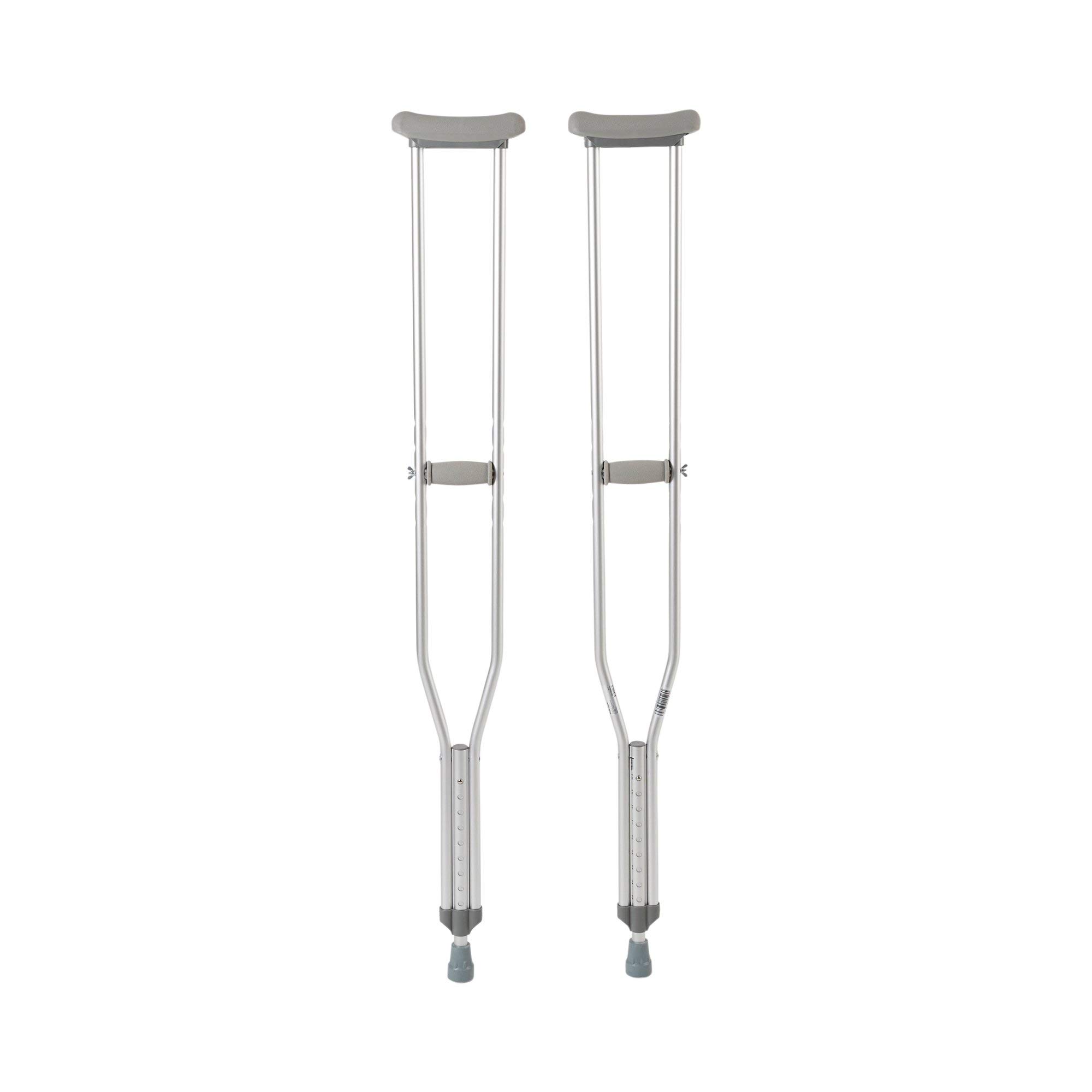
McKesson is a healthcare staple, and these underarm crutches are built for taller adults — adjustable from 53 to 61 inches in one-inch increments. The double-extruded center tube adds rigidity without making the frame feel heavy, and the 350-pound capacity gives you a generous safety margin. The synthetic rubber padding on the underarm rest is latex-free, which matters for anyone with sensitivities.
For knee surgery recovery where you need to keep weight off one leg entirely, the push-button adjustment system lets you tweak the height without fumbling with wing nuts — you can even do it one-handed while leaning on the other crutch. The vinyl contoured tips grip well on wet or slippery surfaces, which is a real safety plus for bathroom trips.
The biggest catch is sizing: the tall version (labeled for 6’1″ users) sometimes ships with a shorter frame, so double-check the height marking when it arrives. A few return experiences have been frustrating due to restocking fees from third-party sellers, so confirm the seller’s return policy before ordering.
Why it’s great
- High 350-pound capacity with reinforced center tube
- One-inch push-button adjustment for precise fit
- Latex-free padding safe for sensitive skin
Good to know
- Tall version sizing can be inconsistent in shipments
- Return policy may include restocking fees from some sellers
4. VEVOR Forearm Crutches

VEVOR brings their industrial-grade build to the forearm crutch category with a 350-pound capacity and a four-level adjustable upper cuff that adapts to different forearm lengths. The 11-level height adjustment suits users between roughly 55 and 67 inches. The aluminum alloy frame is lightweight at 3 pounds per pair, so carrying it from room to room doesn’t add to your fatigue.
The multi-point support system — adjustable cuff plus ergonomic PVC handle — distributes your weight away from your armpits and across your forearm. This makes a real difference during the second and third weeks of knee recovery when you’re using crutches for longer stretches. The rubber foot pads absorb shock better than basic plastic tips, reducing the jolt that travels up through your arm with every step.
A few users over 5’7″ report that the height range tops out a bit short for them, so taller individuals should measure carefully. The assembly is straightforward, but marking the optimal hole with a marker before taking them apart is a practical tip for quick readjustment.
Why it’s great
- 350-pound capacity in a forearm design at a great value
- 4-level adjustable cuff fits different arm lengths
- Shock-absorbing rubber feet reduce arm fatigue
Good to know
- Max height may be short for users over 5’7″
- PVC handle can feel firm without additional grip padding
5. VEVOR Underarm Crutches

These underarm crutches combine a 300-pound weight capacity with a 13-level height adjustment range (47.24 to 78.74 inches) — the widest sweep in this lineup. The aluminum alloy frame keeps them lightweight at under 4 pounds for the pair, and the soft TPR handle offers better grip than the standard foam that degrades after a few weeks.
For knee surgery, the enlarged non-slip TPR foot pads provide superior traction on uneven ground — think driveway gravel or wet grass when you need to get to the car. The curved support on the handle reduces the “pinch” feeling in your palm during extended use, and the soft underarm padding is thick enough to prevent nerve pressure without feeling bulky.
The 13-level adjustability means you can dial in a precise height no matter your body dimensions. The detachable design makes storage easy, and the construction feels more refined than typical hospital-issue crutches. A few users note that the padding could be plusher for all-day wear, but adding aftermarket gel pads solves that quickly.
Why it’s great
- Widest height adjustment range for custom fit
- Enlarged TPR foot pads for all-terrain stability
- Soft TPR handles resist wear and improve grip
Good to know
- Underarm padding could be thicker for long sessions
- Assembly requires using a marker to remember preferred height setting
6. Medline Aluminum Crutches
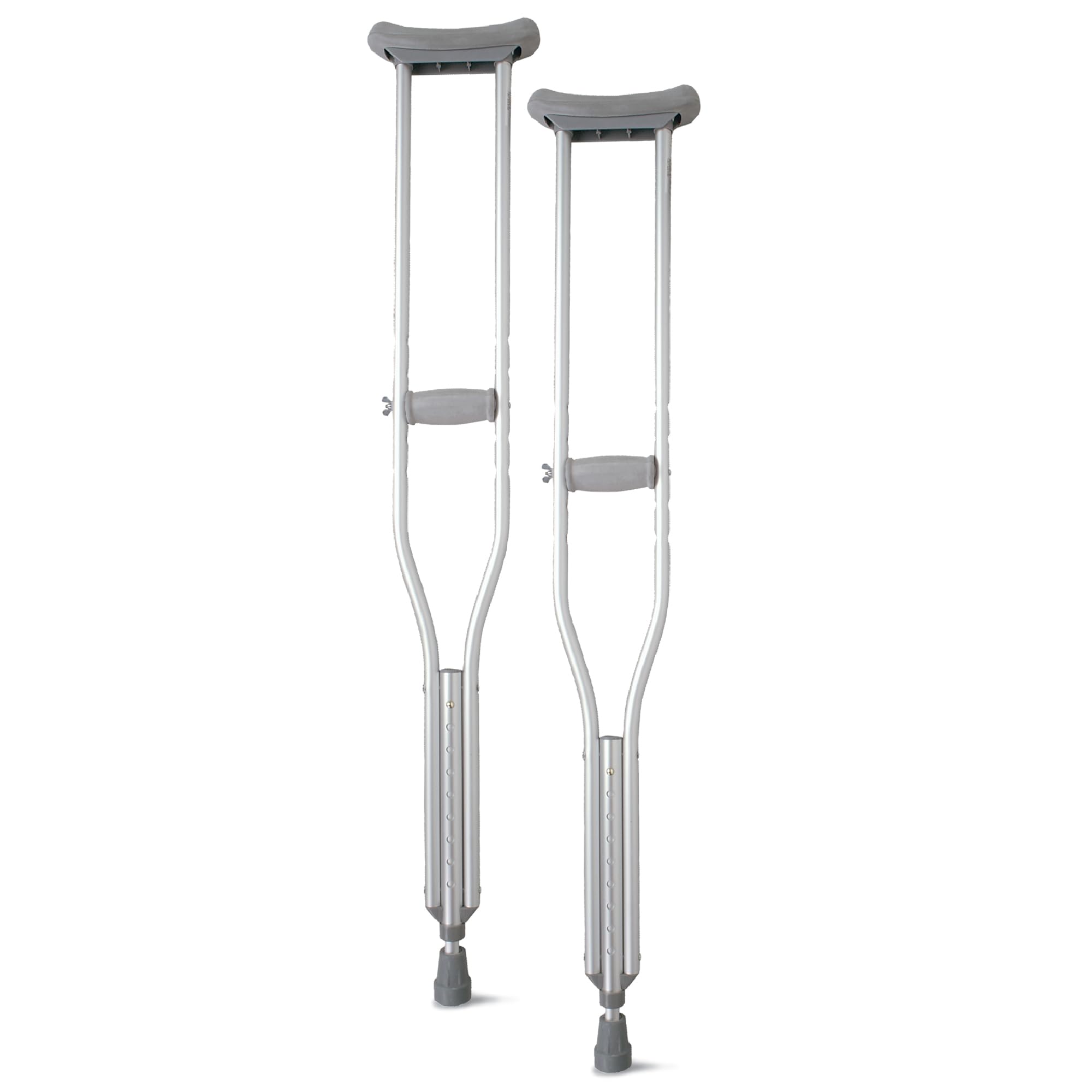
Medline is a go-to brand in hospitals, and these underarm crutches reflect that pedigree. The aluminum frame supports 300 pounds and adjusts in 1-inch increments via push-button for users between 5’2″ and 5’10”. The padded armpit cushions are adequate for short-term recovery, and the slip-resistant feet include stair deflectors that add an extra layer of safety on steps.
For knee surgery recovery, these work exactly as expected — they’re sturdy, easy to adjust, and lightweight enough to move around the house without feeling like a workout. The push-button mechanism is smooth and can be operated with one hand, which helps when you’re balancing on one leg. The design is straightforward, with no extra frills that could break or complicate things.
The main durability concern is the rubber soles: some users report they break down after about three weeks of indoor use, becoming slippery. Swapping in aftermarket crutch tips is an easy fix. The height range maxes out at 5’10”, so taller users should look at the McKesson or VEVOR instead.
Why it’s great
- Hospital-quality build with proven reliability
- One-inch push-button adjustment for precise fit
- Slip-resistant feet with stair deflectors for safety
Good to know
- Rubber soles may wear down after a few weeks of use
- Height range does not exceed 5’10”
7. BlessReach Knee Scooter
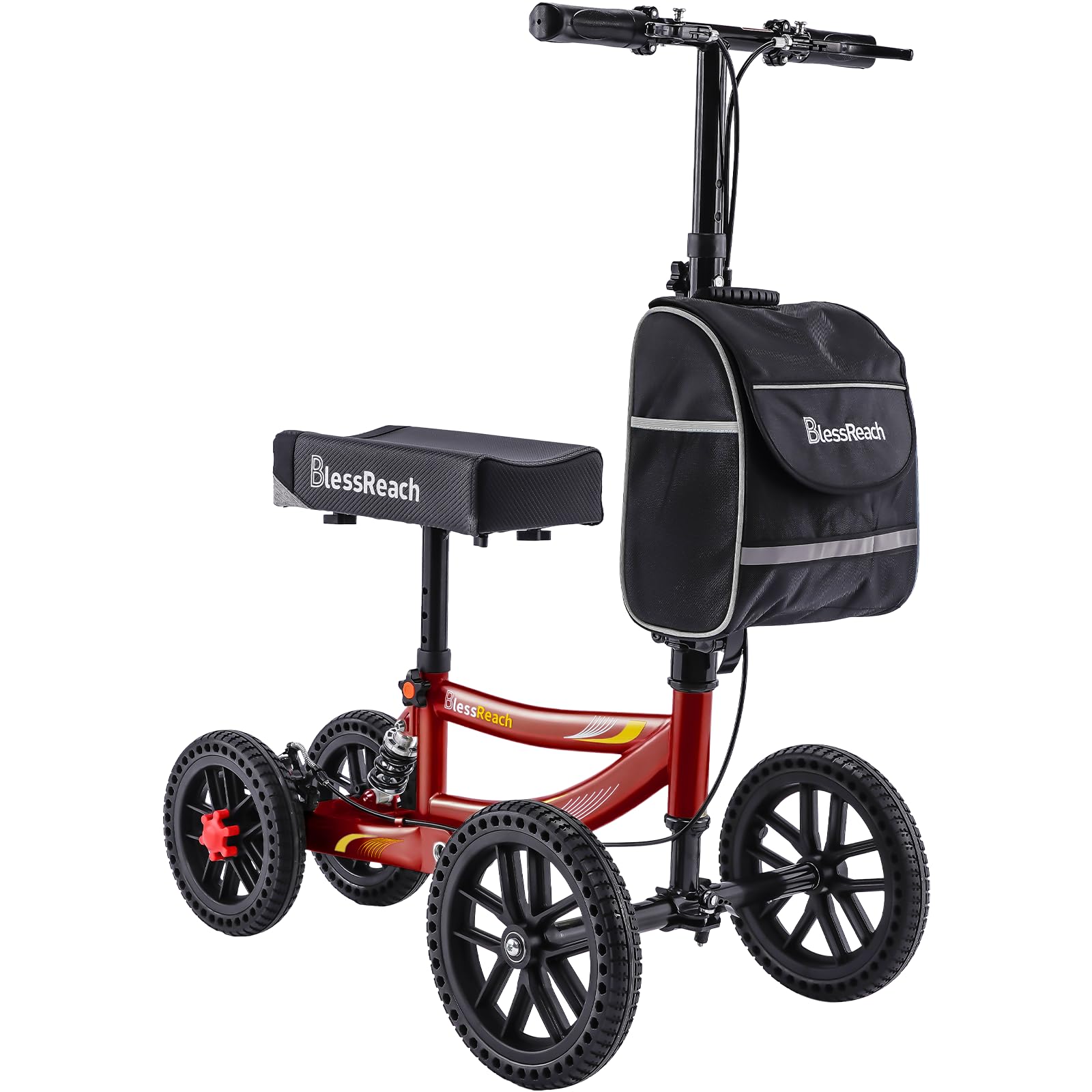
This is not a crutch — it’s a knee walker that completely eliminates armpit and wrist pressure. The BlessReach features a disc brake that stops 68% faster than standard brakes, 12-inch front and 10-inch rear airless tires for all-terrain stability, and custom shock absorbers that reduce vibration by 41%. The military-grade aircraft aluminum frame supports up to 350 pounds and folds for transport.
For anyone who must keep their knee at a 90-degree angle post-surgery (think ACL reconstruction or meniscus repair), this scooter lets you glide instead of hobble. The padded knee platform adjusts through six levels, and the handlebars fold with a quick release. The detachable front storage bag is handy for carrying your phone, wallet, and water bottle hands-free.
Assembly takes about 30 minutes and requires basic tools. The cushion may soften after a month of daily use, requiring a towel or extra foam pad. The scooter is heavier than crutches at 23 pounds, so lifting it into a car trunk requires some effort. For non-weight-bearing recovery, this is the most comfortable option by a wide margin.
Why it’s great
- Disc brake provides quick, reliable stopping
- Large airless tires handle grass, gravel, and cracks smoothly
- Shock absorbers reduce arm fatigue from road vibration
Good to know
- Heavy at 23 lbs — not ideal for carrying up stairs
- Cushion may compress after a month of daily use
FAQ
Should I use underarm or forearm crutches after knee surgery?
How tall should my crutches be for knee surgery recovery?
Can I use a knee scooter instead of crutches for knee surgery?
Why do my armpits hurt from crutches and how do I fix it?
Final Thoughts: The Verdict
For most users, the crutches for knee surgery winner is the VEVOR Underarm Crutches because of their unmatched 13-level adjustment range and sturdy TPR-handled build that works for almost any height and weight. If you want the convenience of a foldable frame for travel and storage, grab the PEPE Mobility Folding Crutches. And for non-weight-bearing recovery where you need total arm and shoulder relief, nothing beats the BlessReach Knee Scooter with its disc brake and all-terrain wheels.