Waking up three times a night to prick your finger or feeling blindsided by a mid-afternoon crash isn’t just inconvenient — it’s a sign that your current glucose tracking method lacks the data density you need. A continuous glucose monitor fills that gap by delivering real-time readings every few minutes, showing exactly how meals, sleep, and exercise shift your numbers.
I’m Emma — the founder and writer behind Baby Bangs. I have spent over a year cross-referencing sensor accuracy studies, app integration roadmaps, and user-reported reliability data across the major CGM platforms to separate marketing claims from measurable performance.
Whether you’re navigating prediabetes or managing insulin-dependent diabetes, picking the right device comes down to accuracy, wear time, and data integration. This guide compares the top models to help you find the best continuous glucose monitor for diabetes for your specific routine.
How To Choose The Best Continuous Glucose Monitor For Diabetes
Not all CGMs are built for the same user. Some prioritize real-time alerts for dangerous lows, while others focus on long-term trend analysis for non-insulin users. Understanding the three specs that matter most will save you from buying a device that doesn’t fit your actual needs.
Accuracy and MARD
The Mean Absolute Relative Difference (MARD) is the industry benchmark for CGM accuracy. A lower MARD percentage means the sensor reading is closer to your actual blood glucose value. For insulin-dependent users, a MARD under 10% is critical for safe dosing decisions. Over-the-counter units like Lingo and Stelo often have slightly higher MARD values, making them better suited for trend watching rather than precise bolus calculation.
Wear Time and Warm-Up
Wear time determines how often you have to swap sensors. Most modern CGMs last 10 to 15 days per sensor, with some offering a 12-hour grace period after the official expiration. The warm-up period — the time from sensor insertion to first reading — ranges from 30 minutes to 2 hours. Faster warm-up means less downtime, which matters if you rely on continuous data for morning fasting readings or post-meal analysis.
App Ecosystem and Data Sharing
A CGM is only as useful as its software. Look for apps that sync with Apple Health or Google Health Connect, allow PDF report generation for your doctor, and support real-time alarms for high and low thresholds. Some platforms offer food logging and activity tagging directly in the app, which helps correlate glucose spikes with specific meals. If you manage diabetes for a child or elderly relative, remote monitoring via a companion app is a non-negotiable feature.
Quick Comparison
On smaller screens, swipe sideways to see the full table.
| Model | Category | Best For | Key Spec | Amazon |
|---|---|---|---|---|
| Stelo by Dexcom | OTC CGM | Non-insulin users wanting lab-grade accuracy | 15 days per sensor, 12hr grace | Amazon |
| Lingo by Abbott | OTC CGM | Lifestyle optimization & prediabetes | 14 days per biosensor | Amazon |
| Accu-Chek FastClix | Blood Glucose Meter | Traditional finger-stick reliability | Bluetooth sync, 720-test memory | Amazon |
| Keto-Mojo GK+ | Dual Meter | Ketone + glucose dual tracking | Bluetooth, GKI calculation | Amazon |
| Garmin Index BPM | Blood Pressure Monitor | Comprehensive cardiovascular logging | Wi-Fi sync, 16 user profiles | Amazon |
| Wellue O2Ring | Pulse Oximeter | Overnight SpO2 and pulse tracking | 200Hz sampling, 24hr battery | Amazon |
| Contour Next Meter | Blood Glucose Meter | Budget-friendly spot checks | Quick reading, no app required | Amazon |
In‑Depth Reviews
1. Stelo Glucose Biosensor by Dexcom

The Stelo from Dexcom delivers a 15-day wear time per sensor plus a 12-hour grace period, making it the longest-lasting OTC CGM available without a prescription. Its waterproof rating of up to 8 feet gives you freedom to swim or shower without removing the sensor. The included overpatch and premium applicator reduce the risk of early detachment during high-activity days.
Accuracy is where Stelo separates itself from the OTC pack. Multiple user reports show readings within 8–15 mg/dL of finger-stick values during the first week, though accuracy can drift to 25–30 mg/dL off by day 10. The app provides 180 days of history with spike detection and pattern analysis, syncing with Apple Health, Google Health Connect, and Oura. Replacement sensors are handled via chat, and most users report a free replacement when a session ends early.
A few caveats: the app graph lacks a fine grid for precise reading, and support is limited to chat or email with no phone line. Some sensors failed to pair after replacement, requiring a full troubleshooting cycle. For non-insulin users who want lab-grade trend data and don’t mind the occasional glitch, Stelo is the current OTC leader.
Why it’s great
- Highest waterproof rating of any OTC CGM
- 15-day wear with 12-hour grace period
- Integrates with Apple Health, Google Health Connect, and Oura
Good to know
- Accuracy drifts after day 10 for some users
- Customer support is chat/email only, no phone line
- App graph lacks fine-resolution grid
2. Lingo Continuous Glucose Monitor by Abbott
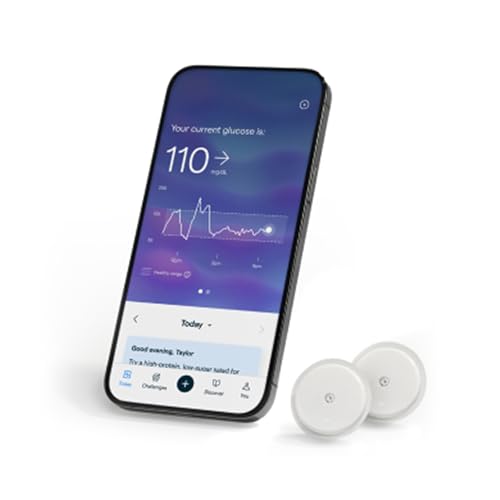
Lingo is Abbott’s direct-to-consumer CGM designed for people exploring how food, sleep, and exercise affect their glucose without needing a prescription. Each biosensor lasts up to 14 days, and the pack includes two sensors for 28 days of total coverage. The app focuses on a “Lingo Count” metric to gamify glucose management, showing you a score based on time spent in a healthy range (70–140 mg/dL).
Real-world accuracy falls roughly 10–20 points lower than a finger-stick device, which aligns with its positioning as a trend-tracking tool rather than a medical-grade meter. Users report the application is nearly painless and the sensor stays on without issues when combined with an optional overpatch. The app syncs with Apple Health and Health Connect, and Lingo offers a free replacement if a sensor stops working before 14 days, no questions asked.
Downsides include a lack of hypo/hyper alerts — Lingo is explicitly not designed for medical alerts — and some users dislike the Lingo Count display replacing a raw glucose number. A few customers experienced sensor pairing failures with certain phone models, and the app requires a significant amount of personal information during setup. For prediabetes or general wellness tracking, Lingo provides solid data without the need for a doctor’s involvement.
Why it’s great
- Painless application with no finger pricking required
- Free replacement for any sensor failure within 14 days
- HSA/FSA eligible, no prescription needed
Good to know
- No hypo/hyper alerts for dangerous lows or highs
- Reads ~10-20 points lower than finger-stick values
- App setup requires extensive personal information
3. Keto-Mojo GK+ Glucose & Ketone Testing Kit

The Keto-Mojo GK+ is not a continuous monitor — it’s a finger-stick meter — but it stands out by offering both glucose and ketone testing in one device. The kit includes 70 glucose strips and 70 ketone strips, a Bluetooth meter, a lancing device, and control solutions. It calculates your Glucose Ketone Index (GKI) automatically in the MyMojoHealth app, a metric used in over 100 clinical trials for metabolic health tracking.
Accuracy is clinically validated and trusted by healthcare professionals. Users report consistent readings that match lab results, and the Bluetooth sync eliminates manual logging. The app integrates with Apple Health, Cronometer, and Carb Manager, making it a strong choice for people on keto, carnivore, or intermittent fasting protocols who need both glucose and ketone data.
The main downside is the cost of replacement strips — each test consumes a strip, and the 140-strip bundle is a starter kit, not a long-term supply. The device requires a finger prick for each reading, which some users find less convenient than a CGM. For anyone who needs ketone data alongside glucose, the GK+ is the most efficient dual-tool on the market.
Why it’s great
- Dual glucose and ketone testing in one meter
- Bluetooth sync with automatic GKI calculation
- Clinically validated, used in over 100 trials
Good to know
- Replacement strips are expensive over time
- Requires finger-stick blood sample for each test
- Not a continuous monitor — manual testing only
4. Accu-Chek FastClix Glucose Monitor Starter Kit

The Accu-Chek FastClix starter kit delivers everything you need for reliable blood sugar testing in one box: a Bluetooth-enabled Guide Me meter, FastClix lancing device with 108 lancets in a drum, 100 Guide test strips, and control solution. The lancing device uses a 6-lancet drum so you never have to handle individual needles, and the 11 depth settings let you find the right stick for your skin type.
The meter requires only a tiny blood sample and rarely produces failed test strips — a common complaint with cheaper models. Bluetooth syncs automatically with the mySugr app, which logs readings, generates reports for your doctor, and offers challenges to keep you engaged. The large LCD display stores up to 720 test results, and the child-resistant battery door adds a layer of safety for households with kids.
Some users report error codes (4+6) that waste strips, and the lancet cylinder can be tricky to remove for replacement. The meter uses a traditional finger stick, so you won’t get the continuous trend data a CGM provides. But for a spot-check device with solid app integration and a painless lancet, this kit offers exceptional value for newly diagnosed or budget-conscious users.
Why it’s great
- Painless lancet drum eliminates needle handling
- Bluetooth sync with mySugr app and PRO access
- Large display stores 720 results plus 30 control records
Good to know
- Occasional error codes waste test strips
- Lancet cylinder removal can be cumbersome
- Not a continuous monitor — requires finger prick each time
5. Garmin Index BPM Smart Blood Pressure Monitor

The Garmin Index BPM is an FDA-cleared upper-arm blood pressure monitor that integrates directly into the Garmin Connect ecosystem. It automatically syncs readings via Wi-Fi and displays systolic, diastolic, and heart rate data on a built-in screen. The adjustable cuff fits arm circumferences from 9 to 17 inches, and the device supports up to 16 user profiles, each syncing to their own Garmin Connect account.
The one-touch 3X reading mode is ideal for mornings when you want multiple data points averaged into a single result. Users consistently report battery life of around 9 months on four AAA batteries. The Garmin Connect app generates 7-day, 4-week, and 1-year reports that can be exported as PDFs for your healthcare provider — a feature that eliminates manual logbooks.
On the downside, the initial Wi-Fi setup can be unintuitive and slow. A small number of users report reading inconsistencies compared to other monitors like Omron, though most find it matches clinic results. The device averages three readings into one data point, which some users dislike because they can’t see the individual systolic/diastolic pairs. For existing Garmin users who want unified cardiovascular data alongside their activity stats, this is a seamless add-on.
Why it’s great
- Seamless Wi-Fi sync with Garmin Connect ecosystem
- One-touch 3X reading mode for accurate morning averages
- Generates PDF reports for healthcare provider sharing
Good to know
- Initial Wi-Fi setup is unintuitive and slow
- Averages three readings into one data point
- Some units report inconsistent readings vs other monitors
6. Wellue O2Ring-S Oxygen Monitor

The Wellue O2Ring-S is a ring-style pulse oximeter designed for continuous SpO2 and heart rate monitoring, particularly during sleep. It samples data at 200Hz and records readings every second, storing up to 40 hours of data on the device. The vibration alert triggers when oxygen drops below or heart rate exceeds your preset thresholds, making it useful for overnight respiratory monitoring.
Battery life reaches roughly 24 hours per charge, and the silicone ring design prevents the sensor from falling off during movement. The free ViHealth app and O2 Insight Pro software produce detailed graphical PDF reports showing oxygen saturation, pulse rate, and body motion over time. Users confirm the device is accurate for tracking trends and catching desaturation events that standard fingertip pulse oximeters would miss during sleep.
Important caveat: this device is explicitly not a medical device — it’s classified for sports and aviation use. Some users find the one-size-fits-all ring uncomfortable for smaller fingers, and the proprietary USB-C cable means you can’t use a standard phone charger. The continuous Bluetooth EMF emission (~105 mW/m²) is a concern for a few users. For overnight oxygen and pulse trend tracking, the O2Ring-S provides hard data at a level of detail most fitness wearables can’t match.
Why it’s great
- 200Hz sampling captures detailed SpO2 and pulse data
- Vibration alert for low oxygen and high/low heart rate
- Generates PDF reports for sleep apnea screening
Good to know
- Not classified as a medical device
- Proprietary USB-C cable required, no standard charger
- One-size ring may be uncomfortable for small fingers
7. Contour Next Blood Glucose Meter
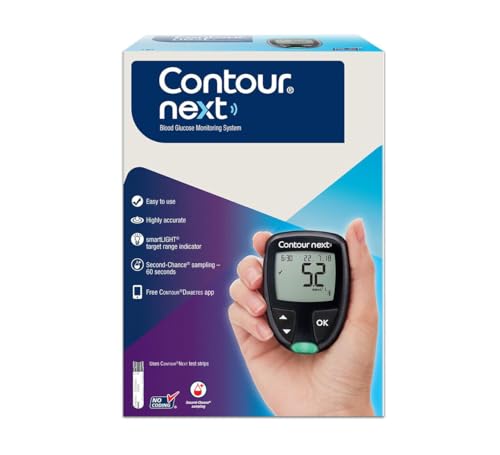
The Contour Next meter is a straightforward blood glucose monitor that prioritizes simplicity and reliable readings. The device works without requiring a smartphone app — perfect for users who prefer a no-frills testing experience. It uses widely available Contour Next test strips and delivers results in about 5 seconds with a small blood sample size.
Multiple international users report that the meter functions reliably and the interface is easy to navigate, even for those who aren’t tech-savvy. The compact design fits easily into a pocket or small bag, making it a practical travel companion. Some models come with Bluetooth capability for optional data syncing, though the core operation remains independent of any app.
The main drawback is that the device ships without test strips in some configurations, so you need to verify the package contents before purchase. It’s a spot-check meter, not a continuous monitor, so you won’t get trend data or real-time alerts. For a low-stakes backup device or for users who only need occasional readings, the Contour Next delivers dependable functionality at an accessible price point.
Why it’s great
- Compact and portable for travel or backup use
- Simple operation without requiring a smartphone app
- Quick 5-second reading with small blood sample
Good to know
- May ship without test strips, verify package contents
- Not a continuous monitor — no trend data
- Limited to basic spot-check functionality
FAQ
Can I use an OTC CGM if I take insulin?
How often do I need to calibrate a CGM with a finger stick?
Why does my CGM show a different number than my blood glucose meter?
Final Thoughts: The Verdict
For most users, the best continuous glucose monitor for diabetes winner is the Stelo by Dexcom because it combines the longest OTC wear time with waterproof design and deep app integration. If you want a no-prescription lifestyle tracker without alerts, grab the Lingo by Abbott. And for dual glucose and ketone tracking with clinical-grade accuracy, nothing beats the Keto-Mojo GK+.