Edema in the lower legs isn’t just uncomfortable—it’s a signal that your venous system needs mechanical help to push fluid back toward your heart. The right pair of graduated compression stockings applies the highest pressure at the ankle and gradually lessens it up the calf, creating a pressure gradient that actively counteracts gravity and reduces fluid pooling. Without that precise taper, you’re just wearing tight socks that can actually impede circulation rather than support it.
I’m Emma — the founder and writer behind Baby Bangs. I’ve spent years analyzing how fabric density, knit construction, and mmHg gradient profiles translate into real edema reduction for different body types and activity levels.
After evaluating dozens of stockings on compression consistency, material breathability, band-grip design, and how well they stay in place over a full work shift, I’ve narrowed the field to the five models that actually deliver measurable relief. This guide cuts through the marketing to reveal the best compression stockings for edema based on real-world performance and verified buyer feedback.
How To Choose The Best Compression Stockings For Edema
Edema demands a specific compression profile. The wrong stocking can actually trap fluid behind a tight band, creating more swelling and discomfort. Here’s what to prioritize.
Compression Level (mmHg) — The Non-Negotiable Variable
For edema management, 20-30 mmHg is the standard therapeutic range. This level is strong enough to prevent fluid from accumulating in the interstitial tissues but not so aggressive that it restricts arterial flow. Lower 15-20 mmHg stockings work for mild tiredness or travel but typically lack the gradient force needed to push established edema back up the leg. If you’re dealing with pitting edema or daily fluid buildup, skip the mild options and start at 20-30 mmHg.
Grip Band Design — The Make-or-Break Detail
A stocking that slides down by mid-afternoon has lost its therapeutic value and can create a constriction ring at the knee that actually worsens swelling below it. Look for a silicone grip band sewn into the top hem—this is the most effective mechanism for keeping the stocking anchored without needing to over-tighten. Some bands use a wide micro-silicone dot pattern rather than a continuous strip; this balances grip with breathability. Avoid stockings that rely solely on elastic band pressure—they dig in and fail to stay put.
Length and Toe Style — Match Your Swelling Pattern
Knee-high stockings cover about 80% of edema cases—where fluid collects around the ankle and lower calf. Thigh-high or pantyhose styles become relevant when the swelling extends above the knee or when you need additional compression for varicose veins higher up. On the toe question: closed-toe stockings provide full coverage and prevent foot swelling, while open-toe designs keep toes cooler and make fitting easier for longer feet. If your edema includes the feet, do not choose open-toe unless you add separate foot compression.
Measurement Precision — Don’t Trust Your Shoe Size
Compression stockings are sized by ankle circumference, calf circumference, and leg length—not by shoe size. Ordering based on your shoe size alone is the single most common mistake in this category. A stocking that is too short will bunch at the ankle, ruining the gradient. One that is too tight at the calf band will create a fluid dam. Measure your ankle at the narrowest point and your calf at the widest point in the morning before swelling peaks, then use the manufacturer’s specific size chart for each model.
Quick Comparison
On smaller screens, swipe sideways to see the full table.
| Model | Category | Best For | Key Spec | Amazon |
|---|---|---|---|---|
| Truform 20-30 mmHg | Knee High | Daily edema control | 20-30 mmHg gradient | Amazon |
| Bbfrey 20-30 mmHg 3-Pack | Knee High | Extended wear value | Flat toe seam | Amazon |
| Laubawck 20-30 mmHg Pantyhose | Pantyhose | Full leg + tummy control | Opaque 20-30 mmHg | Amazon |
| Doc Miller Thigh High 15-20 mmHg | Thigh High | Open-toe flexibility | 15-20 mmHg grad | Amazon |
| JOBST Relief 15-20 mmHg | Knee High | Physician-recommended mild support | 15-20 mmHg grad | Amazon |
In-Depth Reviews
1. Truform 20-30 mmHg Compression Stockings

The Truform 20-30 mmHg knee-high hits the therapeutic sweet spot for edema management with a graduated compression that starts full force at the ankle and tapers precisely up the calf. The 80/20 nylon-spandex knit gives a durable, medical-grade feel that resists pilling even after repeated machine washing. What sets this apart from cheaper options is the silicone grip band sewn into the top hem—reviewers consistently note it stays anchored all day without digging in or leaving red marks, a critical feature when you’re wearing them for ten-hour shifts.
The roomy comfort toe box uses a finer hosiery-style material that prevents the pinched-toe feeling common in lower-cost compression socks. This matters for edema because cramped toes can actually worsen fluid retention in the foot. The defined heel pocket ensures the stocking twists correctly onto the leg, maintaining the proper pressure gradient. Made in the USA and latex-free, it appeals to anyone with sensitivities. A few shorter-legged reviewers found the 16-inch length slightly generous—measure your calf length carefully if you are under 5’3″.
Where this model truly earns its spot is consistency: multiple buyers report replacing their pairs annually after daily use, and the compression stays effective through dozens of wash cycles. For anyone needing proven, repeatable edema control without flashy branding or unnecessary frills, this is the reliable choice.
Why it’s great
- Genuine 20-30 mmHg graduated compression maintained after many washes
- Silicone grip band prevents mid-day sliding without tight band discomfort
- Roomy comfort toe prevents foot swelling and pinched toes
Good to know
- Top band may feel too tight for some users despite correct sizing
- Length may run short for taller individuals with longer calves
2. Bbfrey Medical Compression Socks 20-30 mmHg 3-Pack
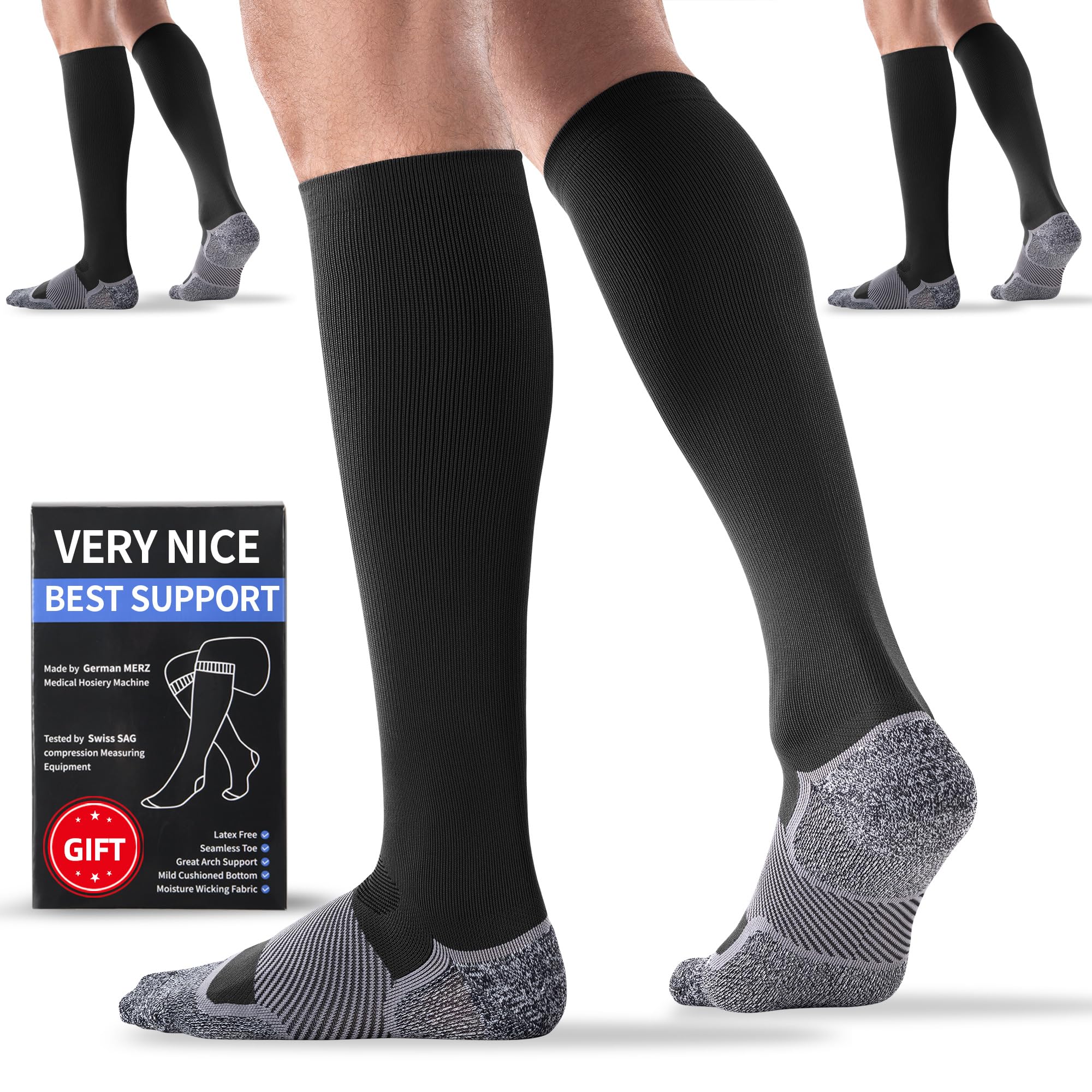
The Bbfrey 3-pack delivers serious 20-30 mmHg graduated compression at a cost-per-pair that makes daily rotation affordable. The fabric is substantial—reviewers praise the flat toe seam construction, which eliminates the bunching and irritation that can cause toe swelling in lower-tier socks. The graduated pressure profile is notably stronger at the foot and ankle, exactly where edema fluid pools first, and lightens noticeably at the top band, preventing the tourniquet effect that can trap fluid below the knee.
Fit accuracy is a highlight here: size S/M accommodates a women’s shoe size 10.5 and a 14.5-inch calf circumference without the band leaving indentations, while L/XL handles 16.5-inch calves comfortably. The socks are marked for right and left foot, a small detail that improves the pressure gradient’s anatomical alignment. Users report wearing them for 11+ hours during nursing shifts without the stockings slipping or the band irritating sensitive skin. The main tradeoff is limited color variety—you get functional beige and black, but no patterns or fashion-forward options.
For anyone managing edema who needs multiple pairs to rotate through laundry cycles, this set removes the barrier of buying one expensive pair at a time.
Why it’s great
- Three pairs provide rotation without losing compression effectiveness
- Flat toe seam prevents irritation and pinching at the toes
- Graduated compression stays strong at foot/ankle and lightens appropriately at top band
Good to know
- Limited color and pattern choices
- Some users may need to size up for a comfortable fit
3. Laubawck Compression Pantyhose 20-30 mmHg

The Laubawck pantyhose takes a different approach to edema management by extending graduated compression from the ankle all the way through the thigh and into the waistband. This matters when swelling creeps above the knee or when you need the additional support of tummy control—the waistband provides light abdominal compression that some users with post-pregnancy or post-surgical edema find helpful. The 20-30 mmHg gradient is consistent through the leg, and the opaque fabric offers enough coverage to wear under dress pants or skirts without showing every seam.
Reviewers consistently highlight the comfort and ease of pulling them on compared to medical-grade thigh-highs that require donning devices. The material is stretchy and secure, though the crotch runs noticeably short—taller women over 5’9″ report that the rise doesn’t reach as high as expected. For flights, the compression prevents ankle swelling effectively, and the full-coverage design eliminates the risk of the top band rolling down that knee-highs sometimes suffer. However, the see-through quality under bright light means they work best under darker bottoms or layered clothing.
This is a specialized pick for a specific need: when knee-high stockings aren’t enough because the edema extends higher, or when you want all-in-one leg and abdominal compression without layering multiple garments. For standard lower-leg edema, a knee-high is simpler, but for comprehensive fluid management, this pantyhose design covers more ground.
Why it’s great
- Full-leg compression from ankle through thigh and waist for comprehensive edema control
- Comfortable and relatively easy to put on for a full-coverage compression garment
- Opaque fabric and tummy control add versatility for daily wear
Good to know
- Crotch runs short for taller women, consider sizing up
- Material can be see-through in bright light under thin pants
4. Doc Miller Thigh High Open Toe Compression Stockings 15-20 mmHg

The Doc Miller thigh-high takes an open-toe approach that makes it a strong candidate for warmer climates or for users whose edema doesn’t extend into the foot itself. At 15-20 mmHg, it sits at the lighter end of therapeutic compression—better suited for mild to moderate edema, varicose veins during pregnancy, or post-workout recovery rather than established pitting edema. The thigh-high length provides support above the knee, which is useful if you have swelling that travels up the leg or if knee-high bands aggravate a sensitive popliteal area.
Material quality is solid: the knit is soft but strong, and users report it stands up to repeated wear without losing shape. The open-toe design keeps feet cool and makes fitting easier for longer foot lengths, but it does leave the foot uncompressed. If your edema includes significant foot swelling, pairing these with separate foot sleeves is necessary. One quirk: the sizing differs between colorways—the blue version runs smaller and tighter than the black, so if you order multiple colors, measure carefully for each. The top grip band stays in place reasonably well but can become itchy under the silicone strip after several hours of continuous wear.
This stocking fills a niche for those who need above-knee coverage but find full pantyhose too constrictive. The 15-20 mmHg level is accessible for first-time compression users who find 20-30 mmHg too aggressive, and the open-toe reduces the claustrophobic feeling some people experience in closed-toe medical stockings. For edema that stays below the knee, a knee-high at 20-30 mmHg is more effective.
Why it’s great
- Open-toe design keeps feet cool and accommodates longer feet comfortably
- Thigh-high length supports swelling that extends above the knee
- Soft, strong material that holds up well to daily wear
Good to know
- 15-20 mmHg is lighter compression, not ideal for significant edema
- Sizing varies between colorways—blue runs tighter than black
5. JOBST Relief Knee High Graduated Compression Socks 15-20 mmHg

JOBST holds the distinction of being the number one physician-recommended compression brand in the US, and this Relief model demonstrates why—the knit quality and pressure consistency are noticeably refined. At 15-20 mmHg, it’s designed for mild edema, tired aching legs, and travel-related swelling rather than severe fluid retention. The graduated compression is smooth and comfortable, avoiding the abrupt pressure drop that cheap stockings create. Users report wearing them from 7 AM to 10 PM without discomfort, and the closed-toe design provides full foot coverage that prevents mild foot swelling during long flights or standing shifts.
The unisex design fits both men and women, and the extensive size range in the chart means you can dial in a precise fit. The fibers are long-lasting—buyers note that a single pair holds its compression profile for months of daily wear without bagging out. The main limitation for edema-specific use is the compression level itself: 15-20 mmHg is adequate for maintenance and prevention but won’t effectively reduce established pitting edema. If you already have visible swelling that leaves an indent when pressed, you need the 20-30 mmHg version of this brand, not the Relief line.
For the price point—the highest per-pair in this roundup—you’re paying for brand trust, medical-grade manufacturing, and consistent sizing. If your edema is mild and intermittent, or if your doctor specifically recommended JOBST, this is a reliable choice. But for daily therapeutic edema management, the Truform or Bbfrey at 20-30 mmHg offer more compression for less cost.
Why it’s great
- Physician-recommended brand with consistent, medical-grade graduated compression
- Extremely comfortable for all-day wear from early morning to late evening
- Long-lasting fibers maintain compression profile through months of daily use
Good to know
- 15-20 mmHg is insufficient for significant or pitting edema—look for 20-30 mmHg
- Premium per-pair cost compared to multi-pack alternatives
FAQ
Should I wear compression stockings to bed for edema?
Why does my ankle swell even with the correct 20-30 mmHg stocking?
How often should I replace compression stockings for edema?
Can I wear 20-30 mmHg compression if I have diabetes or peripheral artery disease?
Does the color or style of the stocking affect its compression performance?
Final Thoughts: The Verdict
For most users managing daily edema, the best compression stockings for edema winner is the Truform 20-30 mmHg Knee High because it delivers therapeutic-grade graduated compression with a reliable silicone grip band and a roomy toe box at a reasonable per-pair cost. If you want the flexibility of rotating through multiple pairs without sacrificing compression quality, grab the Bbfrey 20-30 mmHg 3-Pack. And for comprehensive full-leg coverage when edema extends above the knee, nothing beats the Laubawck 20-30 mmHg Pantyhose.