A smoke and carbon monoxide combination alarm is the single most important safety device in your home—it watches for the two leading causes of fire‑related death: fast‑moving flames and the invisible, odorless gas that claims lives while you sleep. Choosing the wrong unit means either drowning in kitchen false alarms or, far worse, missing an early warning that buys your family the extra seconds to get out.
I’m Emma — the founder and writer behind Baby Bangs. Over years of analyzing home‑safety hardware, I’ve compared sensor technologies, battery chemistries, interconnect protocols, and UL standards so families don’t have to guess what actually protects their home.
This guide walks through the real‑world trade‑offs—photoelectric vs. ionization, voice alerts vs. simple beeps, sealed batteries vs. replaceable 9V—so you can confidently pick the combined smoke and carbon monoxide alarm that matches your home’s layout and lifestyle.
How To Choose The Best Combined Smoke And Carbon Monoxide Alarm
A combination alarm sounds the same in the aisle as it does on the ceiling—until the first midnight false alarm or, worse, the real event. The differences that matter are sensor type, power source, interconnect capability, and how clearly the unit communicates danger. Let’s break each one down.
Sensor Technology: Photoelectric, Ionization, or Dual?
Photoelectric sensors respond faster to smoldering fires (upholstery, bedding, wiring inside walls) and are far less prone to false trips from cooking steam or shower moisture. Ionization sensors react quicker to fast‑flaming fires but are notorious for nuisance alarms near kitchens. Most modern units in this category use photoelectric or “Precision Detection” that intelligently balances response, making them the smarter choice for placement in hallways adjacent to kitchens.
Power Source: Hardwired, Battery‑Only, or Sealed Lithium?
Hardwired units with AA battery backup are ideal for new construction or existing homes with 120V wiring—they don’t go silent during a power outage. Battery‑only models (powered by replaceable AA or 9V) install anywhere without an electrician but require annual battery swaps. Sealed 10‑year lithium batteries eliminate yearly maintenance entirely; the whole unit is replaced at end‑of‑life, which neatly aligns with the recommended replacement schedule for the sensors themselves.
Interconnection: Whole‑Home Alert in Seconds
A smoke or CO event in the basement must wake someone on the second floor. Hardwired interconnection runs a communication wire between units, while wireless interconnection uses RF signals to trigger all alarms when any one detects danger. Wireless systems (like X‑Sense’s SC06‑W) are simpler to retrofit in existing homes without running cable. If you have a multi‑story house, interconnection is not optional—it’s the difference between a fast escape and a dangerous delay.
Voice Alerts vs. Standard Beeps
A chirping alarm tells you something is wrong—but what? Voice alerts that announce “Fire!” versus “Warning, Carbon Monoxide” eliminate guesswork and speed up evacuation. For families with children, elderly members, or anyone who sleeps deeply, a voice‑capable alarm (like Kidde’s 30CUDR‑V) can be the difference between confusion and immediate action.
Quick Comparison
On smaller screens, swipe sideways to see the full table.
| Model | Category | Best For | Key Spec | Amazon |
|---|---|---|---|---|
| X‑Sense SC06‑W 6‑Pack | Wireless Interconnect | Whole‑home coverage, no wiring | 10‑year sealed lithium battery | Amazon |
| Kidde 30CUAR 2‑Pack | Hardwired | Homes with existing 120V wiring | AA battery backup, 85 dB | Amazon |
| Kidde 900‑CUDR‑V | Voice Alerts | Clear hazard identification | 24/7 self‑testing, photoelectric | Amazon |
| Kidde 30CUDR‑V | Voice & Budget | Compact, voice‑guided install | 85 dB alarm, AA batteries | Amazon |
| First Alert SMCO100 | Entry‑Level 2‑in‑1 | Simple battery replacement | AA powered, 10‑year warranty | Amazon |
| First Alert SMICO100 | 9V Battery | RV or secondary CO coverage | 9V powered, Precision Detection | Amazon |
| First Alert SMI105‑AC | Hardwired, Smoke Only | Smoke‑only replacement | 10‑year battery backup | Amazon |
In‑Depth Reviews
1. X‑Sense SC06‑W 6‑Pack
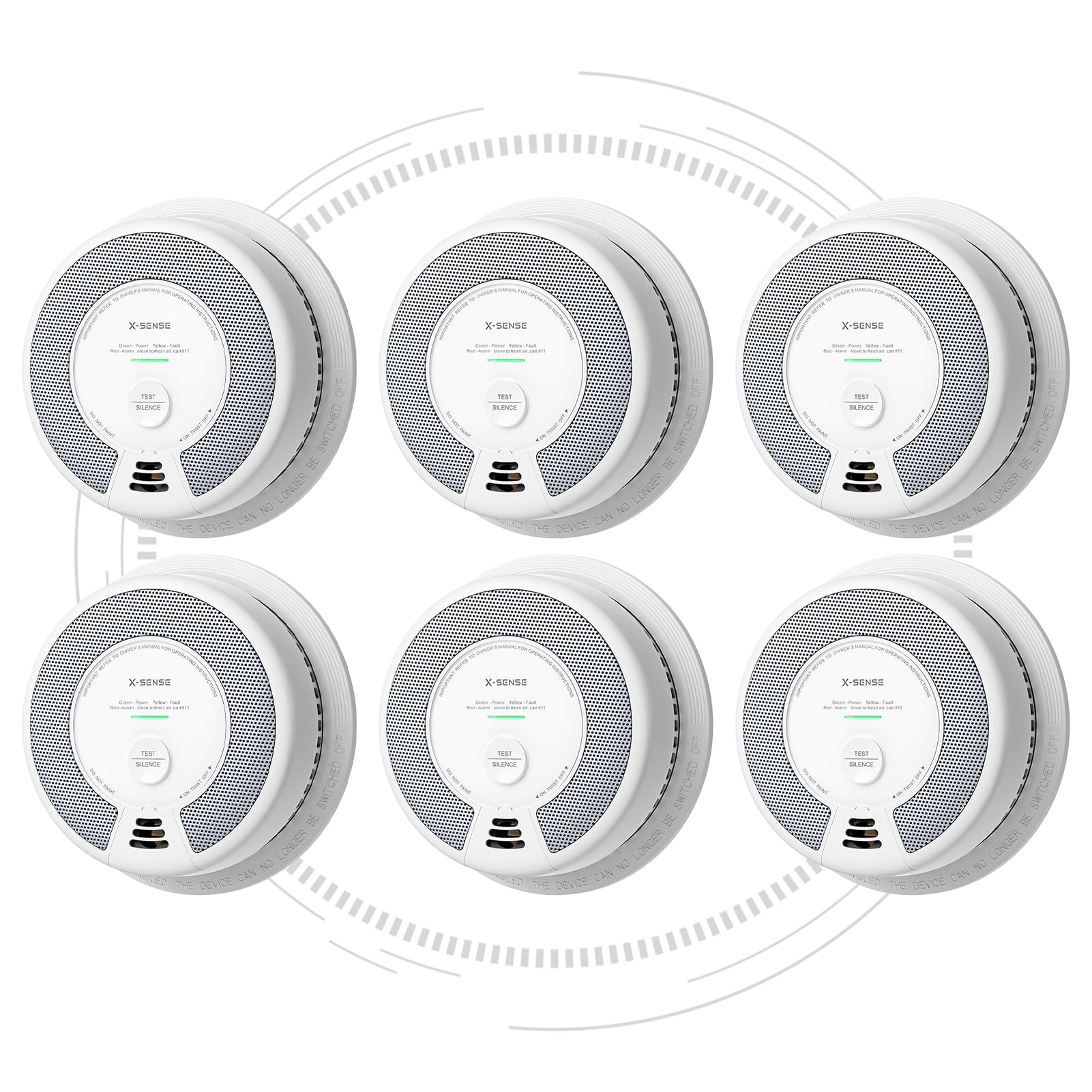
The X‑Sense SC06‑W is the gold standard for anyone who wants true whole‑home coverage without tearing into walls for hardwiring. Each of the six units carries a sealed 10‑year lithium battery—no battery swaps, no chirping at 2 a.m. The wireless interconnection is reliable and simple to set up; trigger any alarm and the entire suite sounds simultaneously. This is a photoelectric alarm certified to UL 217 9th Edition and UL 2034, meaning it meets the latest standards for smoke sensitivity and CO detection accuracy.
Installation is refreshingly straightforward. The included mounting hardware works on walls or ceilings, and pairing the units takes just a few pushes of the test button. Some users reported that factory pairing occasionally required a manual re‑pair, but the process is well documented and quick. At roughly the same per‑unit cost as a battery‑only First Alert, the convenience of a sealed 10‑year battery and wireless interconnect makes this pack a compelling buy for a three‑bedroom home plus basement.
One note: there is no voice alert, so the unit relies on a standard 85 dB pattern. For most families, the single drawback is the lack of hazard‑specific voice announcements. If you prioritize clear hazard differentiation and don’t need six units, a Kidde voice‑alert model may be more appropriate. But for sheer coverage and zero maintenance, this pack is unmatched in the combined‑alarm category.
Why it’s great
- Wireless interconnect triggers all alarms via RF — no wiring needed
- Sealed 10‑year lithium battery eliminates yearly swaps
- Certified to latest UL 217 and UL 2034 standards
Good to know
- No voice alerts — only standard beep patterns
- Factory pairing may need manual re‑setup for some users
2. Kidde 30CUAR 2‑Pack

The Kidde 30CUAR is purpose‑built for homes that already have 120V AC smoke alarm wiring in place. It uses enhanced sensing technology to cut false alarms from cooking, and the hardwired design means interconnection between units on the same circuit is automatic—when one detects smoke or CO, every alarm on the loop sounds. Two AA alkaline batteries provide backup coverage during power outages, so you’re protected even if a storm knocks out the mains.
The 85‑decibel alarm is genuinely loud, and the three‑LED status system gives you a quick visual: green for normal, amber for a sensor error, red for an active alert. The test and hush button is conveniently placed, and the unit meets UL 217 9th Edition and UL 2034 4th Edition. A few buyers noted that an adapter plug was needed for some older junction boxes, so check your existing bracket compatibility before ordering.
What this pack doesn’t have is voice alerts—you get a standard beep pattern rather than a spoken “Fire” or “Carbon Monoxide.” If you have a multi‑story home with existing hardwiring and want reliable interconnect without the complexity of wireless setup, the 30CUAR 2‑pack is one of the most dependable options available.
Why it’s great
- Hardwired interconnection with AA backup — always active
- Enhanced sensing reduces nuisance alarms from cooking
- Very loud 85 dB alarm, clearly audible from other rooms
Good to know
- No voice announcements for hazard type
- May need a bracket adapter for older junction boxes
3. Kidde 900‑CUDR‑V

The Kidde 900‑CUDR‑V brings voice alerts to the battery‑powered segment without jumping to the premium interconnect tier. Its photoelectric sensor is ideal for detecting slow, smoldering fires—think upholstery or wall wiring—while the electrochemical CO sensor watches for carbon monoxide. When either hazard is detected, the unit speaks clearly: “Fire!” for smoke or “Warning, Carbon Monoxide” for CO. That verbal distinction is a genuine safety upgrade, especially for households with sound sleepers or kids.
The self‑testing feature checks internal electronics 24/7, alerting you with an amber LED and chirp if something is wrong (though the manual test button should still be used weekly). Two included AA batteries power the unit, and the mounting bracket allows four installation orientations. The LED indicator system is intuitive: green for normal, amber for error, red for an event.
A few users reported false alarms triggered by steam from an adjacent bathroom, which is common with any sensitive photoelectric sensor near a shower. If you can place this unit at least 10 feet from bathrooms or kitchens, the false‑alarm rate drops significantly. For the price of a single unit, the voice guidance is excellent value.
Why it’s great
- Voice alerts clearly announce “Fire” or “Carbon Monoxide”
- Photoelectric sensor excels at smoldering fire detection
- Continuous self‑testing checks internal components
Good to know
- Can false‑alarm from nearby steam or shower moisture
- No wireless interconnect — single‑room coverage only
4. Kidde 30CUDR‑V

The Kidde 30CUDR‑V is essentially the same voice‑alert technology as the 900‑CUDR‑V but in a more compact 5‑inch housing that fits tighter ceiling spaces or older mounting brackets. It also uses enhanced sensing technology engineered for over 25% faster smoke detection, according to Kidde’s internal testing, and it meets UL 217 10th Edition and UL 2034 5th Edition standards. The voice announcements are identical—clear “Fire” and “Warning, Carbon Monoxide” phrases—and the 85‑decibel alarm is paired with a red LED strobe.
This model runs on two AA alkaline batteries, and the mounting hardware is included. The test/silence button is responsive, and the self‑testing feature monitors the unit continuously. A few early buyers noted that the first batch had some false‑alarm sensitivity to steam, which aligns with the same photoelectric sensor behavior seen in the 900‑CUDR‑V.
What pushes the 30CUDR‑V ahead for some buyers is its price point—it lands in the accessible mid‑range, delivering voice alerts without a premium hike. If you’re replacing an older Kidde unit that uses the typical 3‑inch mounting center, this slides right in. It’s a dependable workhorse for single‑floor homes or as a secondary alarm in a larger system.
Why it’s great
- Voice alerts distinguish fire from CO hazard
- Compact 5‑inch profile fits tight spaces
- Enhanced sensing claims 25% faster smoke detection
Good to know
- Sensitive to steam from nearby bathrooms
- No interconnect option — standalone only
5. First Alert SMCO100

The First Alert SMCO100 is a no‑frills entry point into combination detection. It uses First Alert’s Precision Detection technology, which reduces cooking nuisance alarms, and the entire unit is powered by standard AA batteries—easy to find, easy to swap. The test/silence button works as expected, and the end‑of‑life warning chirps when the whole alarm needs replacing after its 10‑year service life. At just over 5 inches in diameter and less than 2 inches thick, it’s one of the slimmer options on this list.
What you won’t get here is voice guidance or any interconnect capability. This is strictly a standalone detector for a single room or hallway. The ionisation sensor (listed in specs) means it reacts quickly to fast‑flaming fires, but may false‑alarm more near kitchens than a photoelectric unit. Most user reports, however, mention zero false alarms after installation, suggesting the Precision Detection algorithm does a decent job filtering out cooking steam.
The SMCO100 is a solid choice for a budget‑minded homeowner who wants a basic 2‑in‑1 smoke/CO alarm without extra features. If you only need coverage for a single floor or a rental unit, this gets the job done. Just be aware that the 10‑year warranty applies to the alarm hardware, not the battery performance—you’ll still need to replace AA batteries annually.
Why it’s great
- Affordable entry‑level 2‑in‑1 detection
- Compact, slim housing fits tight spaces
- Precision Detection reduces nuisance cooking alarms
Good to know
- No voice alerts — standard beep pattern only
- Ionization sensor may false‑alarm near kitchens
- No interconnect — standalone coverage
6. First Alert SMICO100

The First Alert SMICO100 is essentially the SMCO100’s sibling, but it runs on a 9V battery instead of AA alkalines. That distinction matters for two reasons: 9V batteries are still common in older homes and RV setups, and the larger battery capacity can extend replacement intervals depending on the alarm’s current draw. Like the SMCO100, it uses Precision Detection to minimize false alarms from cooking, and it includes the same test/silence button and end‑of‑life warning.
The ionization sensor is identical to the SMCO100, so the same fast‑flame sensitivity and potential kitchen false‑alarm behaviour apply. A few buyers noted that the unit did not fit previous First Alert mounting bases, meaning you’ll likely need to drill new holes if replacing an older model. The included 9V battery was also reported as a generic Chinese brand by some users—consider replacing it with a trusted alkaline or lithium backup from day one.
Where this unit shines is as a secondary CO detector in an RV, garage, or basement bedroom where you don’t have AC wiring and don’t want to buy a pack of AA batteries every year. The 10‑year warranty is a solid peace‑of‑mind feature, but the real value is the flexibility of 9V power in a compact, reliable chassis.
Why it’s great
- 9V battery power suits RVs and older wiring layouts
- Precision Detection reduces false alarms in everyday use
- Compact footprint fits tight wall or ceiling spaces
Good to know
- May not fit previous First Alert mounting bases
- Included 9V battery is generic — swap for a reliable brand
- No voice alerts or interconnect capability
7. First Alert SMI105‑AC

The First Alert SMI105‑AC is a hardwired smoke‑only alarm, not a combination unit. It earns a spot on this list because many homeowners already have a separate CO detector and only need a reliable smoke alarm replacement. It features Precision Detection to cut nuisance alarms, a 10‑year sealed battery backup that keeps the unit running during power outages, and interconnect capability via hardwiring—when one unit trips, all compatible alarms sound.
The ionization sensor is optimized for fast‑flaming fires, and the unit is designed as a simple twist‑off replacement for older First Alert detectors. Users consistently praise how easily it snaps into existing brackets without rewiring. The green LED backlight is a subtle but appreciated touch, providing a visual “all‑clear” at night. The end‑of‑life chirp begins after 10 years, prompting replacement.
Keep in mind this detects smoke only—you’ll need a separate CO detector or a combination unit elsewhere in the home to cover both hazards. If you’re already satisfied with your CO detection and just need a reliable, hardwired smoke alarm with a long‑life battery backup, the SMI105‑AC is a safe, straightforward upgrade.
Why it’s great
- Hardwired with 10‑year sealed battery backup
- Precision Detection reduces false alarms
- Simple twist‑off replacement for older First Alert models
Good to know
- Smoke only — no carbon monoxide detection
- Ionization sensor may false‑alarm near kitchens
FAQ
How do I stop my combined alarm from false alarming near the kitchen?
Can I replace an old wired alarm with a battery‑only combination unit?
How often should I replace the batteries in a 9V or AA powered alarm?
What does end‑of‑life warning sound like on a First Alert or Kidde alarm?
Final Thoughts: The Verdict
For most users, the combined smoke and carbon monoxide alarm winner is the X‑Sense SC06‑W 6‑Pack because it delivers wireless whole‑home coverage with a sealed 10‑year battery, no annual swaps, and the latest UL certifications. If you want voice alerts that clearly distinguish “Fire” from “Carbon Monoxide,” grab the Kidde 900‑CUDR‑V. And for hardwired homes that need effortless interconnected protection, the Kidde 30CUAR 2‑Pack is a rock‑solid choice.