Cardio is often the first thing to go when your knees start talking back to you. The jarring impact of running or the repetitive pressure of a treadmill can turn a healthy habit into a painful ordeal, leaving you stuck between staying active and protecting your joints. The right machine changes that equation entirely by delivering a heart-pumping workout that spares your knees, hips, and ankles from the daily punishment most cardio equipment demands.
I’m Emma — the founder and writer behind Baby Bangs. I’ve spent years evaluating fitness equipment through the lens of biomechanics and joint health, analyzing stride geometry, resistance systems, and frame stability to separate machines that genuinely protect tender knees from those that merely claim to.
In this guide, I break down nine machines specifically vetted for knee-friendly performance, from recumbent bikes to elliptical hybrids. Read on to find the ideal cardio machine for knee pain that fits your home, budget, and recovery needs.
How To Choose The Best Cardio Machine For Knee Pain
Selecting a machine that genuinely protects your knees requires looking past marketing spin and focusing on a few non-negotiable mechanical details. Not all low-impact claims are created equal — a poorly designed machine can still force your knee into compromised positions that aggravate existing pain or create new issues. Here is what to prioritize.
Resistance Type: Magnetic vs. Friction vs. Hydraulic
Magnetic resistance is the gold standard for knee-friendly cardio because it delivers smooth, consistent tension without the jerky starts or uneven load of friction-based systems. Friction brakes and hydraulic pistons can introduce sudden resistance spikes that force your knee to compensate mid-stroke, something you want to avoid. Magnetic systems also operate silently, which matters if you exercise early or late in shared living spaces.
Seat and Stride Adjustability
A fixed seat or a non-adjustable stride length forces your knee into a single arc of motion, which can be problematic if your unique anatomy doesn’t match that arc. Look for machines with at least fore-aft seat adjustment and, ideally, multiple seat tilt positions. For recumbent bikes, the ability to slide the seat forward or backward by several inches ensures your knee never hyperextends at the bottom of the pedal stroke or compresses uncomfortably at the top.
Weight Capacity and Frame Stability
A wobbly frame forces your body — and your knees — to engage stabilizing muscles just to stay upright, adding unnecessary strain. Machines rated for 300 pounds or more typically use thicker steel tubing and wider bases that remain planted during vigorous use. If a machine feels light or flexes when you step on it, your knees will pay the price over time.
Foot Platform vs. Pedal Design
Ellipticals and steppers with oversized, non-slip foot platforms distribute pressure more evenly across the sole, reducing the need for your foot to grip the pedal — a motion that can torque the knee. Recumbent bikes benefit from pedals with adjustable toe cages or straps that keep your foot centered without requiring ankle tension. Avoid machines with undersized or slippery pedals that force you to brace with your legs.
Quick Comparison
On smaller screens, swipe sideways to see the full table.
| Model | Category | Best For | Key Spec | Amazon |
|---|---|---|---|---|
| 3G Cardio Elite RB X | Recumbent Bike | Premium knee recovery | 350 lb capacity, 25 seat positions | Amazon |
| Teeter FreeStep | Recumbent Stepper | Zero-impact PT motion | 11″ patented stride, 13 resistance levels | Amazon |
| Sunny Health & Fitness Elite | Recumbent Cross Trainer | Full-body recumbent training | 16 electromagnetic resistance levels | Amazon |
| MERACH S19 | Recumbent Bike | Bluetooth-connected knee rehab | 330 lb capacity, 8 seat positions | Amazon |
| YOSUDA 3-in-1 | Elliptical Climber | Space-saving incline trainer | 45° incline, 15.5″ stride, 16 levels | Amazon |
| Gazelle Glider Edge | Elliptical Glider | Budget full-body motion | 18″ stride, 10 resistance levels | Amazon |
| pooboo E399 | Elliptical Machine | Quiet entry-level elliptical | 350 lb capacity, 16 magnetic levels | Amazon |
| XTERRA SB120 | Recumbent Bike | Compact recumbent value | 24 resistance levels, 250 lb capacity | Amazon |
| Kawnina Recumbent | Recumbent Bike | Budget-friendly rehab bike | 400 lb capacity, 16 magnetic levels | Amazon |
In‑Depth Reviews
1. 3G Cardio Elite RB X

The 3G Cardio Elite RB X represents the pinnacle of recumbent bike engineering for knee pain sufferers. Its narrow Q-factor — the distance between the pedals — keeps your legs in a natural hip-width alignment, eliminating the splay that can torque the knee joint during extended rides. The oversized seat offers five tilt positions and 25 fore-aft adjustments, allowing you to dial in a leg extension that never forces your knee into full extension or bottomed-out compression.
Commercial-grade steel construction gives the Elite RB X a planted feel at 115 pounds, with a weight capacity of 350 pounds that accommodates larger users without frame wobble. The 16 levels of magnetic resistance are supplemented by 12 pre-programmed workouts and three heart-rate-controlled programs, giving you structured progression without needing to stare at a tablet. FreeSync FTMS Bluetooth connects to third-party fitness apps for those who want virtual coaching, but the bike functions perfectly as a standalone unit — no membership required.
The airflow mesh backrest keeps your spine cool during sweat sessions, and the included wireless heart rate strap provides more reliable data than handlebar sensors. Assembly requires two people about an hour, but the main frame arrives largely pre-assembled. The warranty is unmatched in this category: lifetime frame, seven-year parts, and one-year in-home labor from a US-based company with responsive phone support.
Why it’s great
- Narrow Q-factor keeps knees in natural alignment during pedaling
- 25 seat positions and 5 tilt options for precise knee-angle adjustment
- Lifetime frame warranty and US-based customer support
Good to know
- At 115 pounds, moving it to another floor requires effort
- Console is basic compared to app-connected competitors
- Premium price tier requires serious commitment
2. Teeter FreeStep Recumbent Cross Trainer Stepper

The Teeter FreeStep breaks away from the circular pedal motion of traditional recumbent bikes, replacing it with a patented natural stepping motion licensed from physical therapy equipment. Instead of forcing your knee through a fixed radius, the FreeStep’s stride allows your legs to track in a more linear, stair-climbing path that aligns the hip, knee, and ankle without compressive forces. Users with arthritis, meniscus issues, or post-surgical recovery consistently report less knee strain than on standard recumbent cycles.
The seat sits higher than most recumbent machines — about 30 inches off the ground — which makes mounting a consideration for shorter users but also means your hips stay above your knees in a position that reduces patellar pressure. UltraGlide bearings ensure frictionless motion startup, eliminating the initial resistance jolt that can catch weak knees off guard. The 13 levels of magnetic resistance are adjusted via a simple grip dial, letting you change intensity mid-workout without breaking your stride rhythm.
The total body workout is a genuine advantage: the moving handlebars engage your upper back, chest, and arms in sync with your legs, distributing the workload and taking direct pressure off the knee extensors. The battery-operated digital console tracks time, distance, speed, and calories, and the Teeter Move app provides free trainer-led classes. At 110 pounds, it occupies about the same footprint as a medium armchair — 54 by 38 inches — and rolls easily on transport wheels.
Why it’s great
- Patented PT-derived stepping motion reduces compressive knee forces
- 13 smooth magnetic resistance levels with instant adjustment
- Total body motion distributes workload away from knees
Good to know
- Seat height may require a step stool for shorter users
- Assembly is detailed and takes two people about two hours
- Seat cushion is firm; aftermarket padding helps on longer sessions
3. Sunny Health & Fitness Elite Recumbent Cross Trainer

The Sunny Health & Fitness Elite combines the seated support of a recumbent bike with the full-body engagement of an elliptical cross trainer, making it a strong contender for those who need both knee protection and upper body conditioning. The electromagnetic resistance system delivers 16 levels of tension that engage and disengage without mechanical clunking, so your knees never experience a sudden load shift mid-pedal stroke. The recumbent position with a contoured mesh backrest keeps your spine supported while your legs move through a natural elliptical path.
What sets this machine apart from standard recumbent bikes is the moving handlebars that work your arms in opposition to your legs — your right arm pulls back as your left leg pushes forward, creating a coordinated cross-body pattern that stabilizes the pelvis and reduces lateral knee wobble. The easy on-off design with minimal obstruction between the seat and handlebars makes it accessible for users with limited mobility. Twelve pre-programmed workouts plus four customizable user programs give serious variety for long-term rehabilitation without boredom.
The SunnyFit app provides over 1,000 trainer-led workouts and 10,000 virtual scenic tours at no extra cost, which is a significant value-add over competitors that charge monthly fees. The digital monitor tracks speed, RPM, distance, watts, calories, and heart rate, with the option to use either the handlebar pulse sensors or a wireless chest strap. At 113 pounds with a 71-inch length, it is a substantial machine that demands dedicated floor space but rewards that commitment with gym-grade stability — even at maximum resistance, the frame remains eerily quiet.
Why it’s great
- Moving handlebars distribute effort across upper and lower body
- Free SunnyFit app with thousands of guided workouts
- Electromagnetic resistance for smooth, knee-safe tension changes
Good to know
- Large footprint requires permanent floor space of 71 by 33 inches
- Handlebar pulse sensors are sensitive to hand placement and moisture
- Some users report misaligned bolt holes in the seat bar assembly
4. MERACH S19 Recumbent Exercise Bike
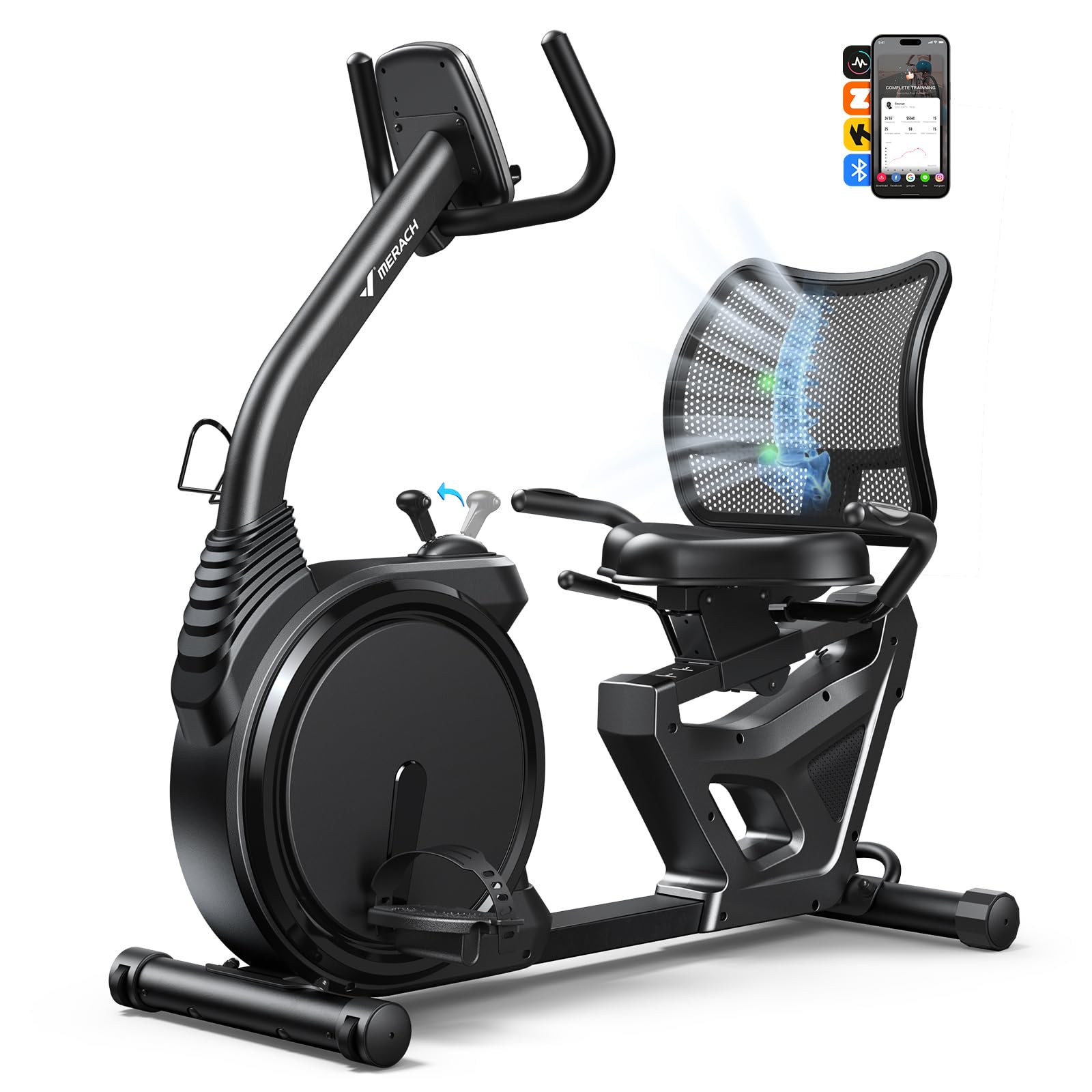
The MERACH S19 brings smart connectivity to the recumbent bike category at a mid-range price point that undercuts many similarly equipped competitors. The magnetic resistance system uses a car-style shift lever for eight levels of intensity, allowing quick transitions without the guesswork of a digital keypad. The 6.6-pound perimeter-weighted flywheel delivers enough inertia for smooth pedal rotation at low RPMs, which is critical for knee rehab where slow, controlled motion is more beneficial than high-speed spinning.
The seat adjusts to eight positions with a simple handle, accommodating leg lengths from about 28 to 35 inches. The breathable mesh backrest keeps your lower back ventilated during extended sessions, and the frosted handlebars offer a non-slip grip that resists sweat accumulation — a thoughtful detail for longer cardio workouts. The LCD display shows time, distance, speed, calories, and heart rate, with the latter captured via sensors embedded in the stationary handlebars.
Bluetooth connectivity links to the MERACH self-developed app and the FantomFite app, which gamifies your cycling with interactive courses and challenges. Riders recovering from knee surgery or managing chronic pain report the recumbent position with lumbar support allows 45-minute sessions without knee aggravation, something many upright bikes cannot deliver. The 84.9-pound unit is roughly 48 inches long, making it one of the more compact recumbent options for apartment dwellers, and assembly clocks in at about 30 minutes thanks to 80 percent pre-assembly.
Why it’s great
- Bluetooth app connectivity gamifies rehab workouts
- Compact 48-inch length fits small spaces
- Frosted handlebars prevent sweat slippage during long sessions
Good to know
- Seat firmness is a common complaint — extra cushion recommended
- Handlebar heart rate sensors do not stay upright for all users
- Display scrolls constantly without a freeze option for steady readings
5. YOSUDA 3-in-1 Elliptical Climber Stepper
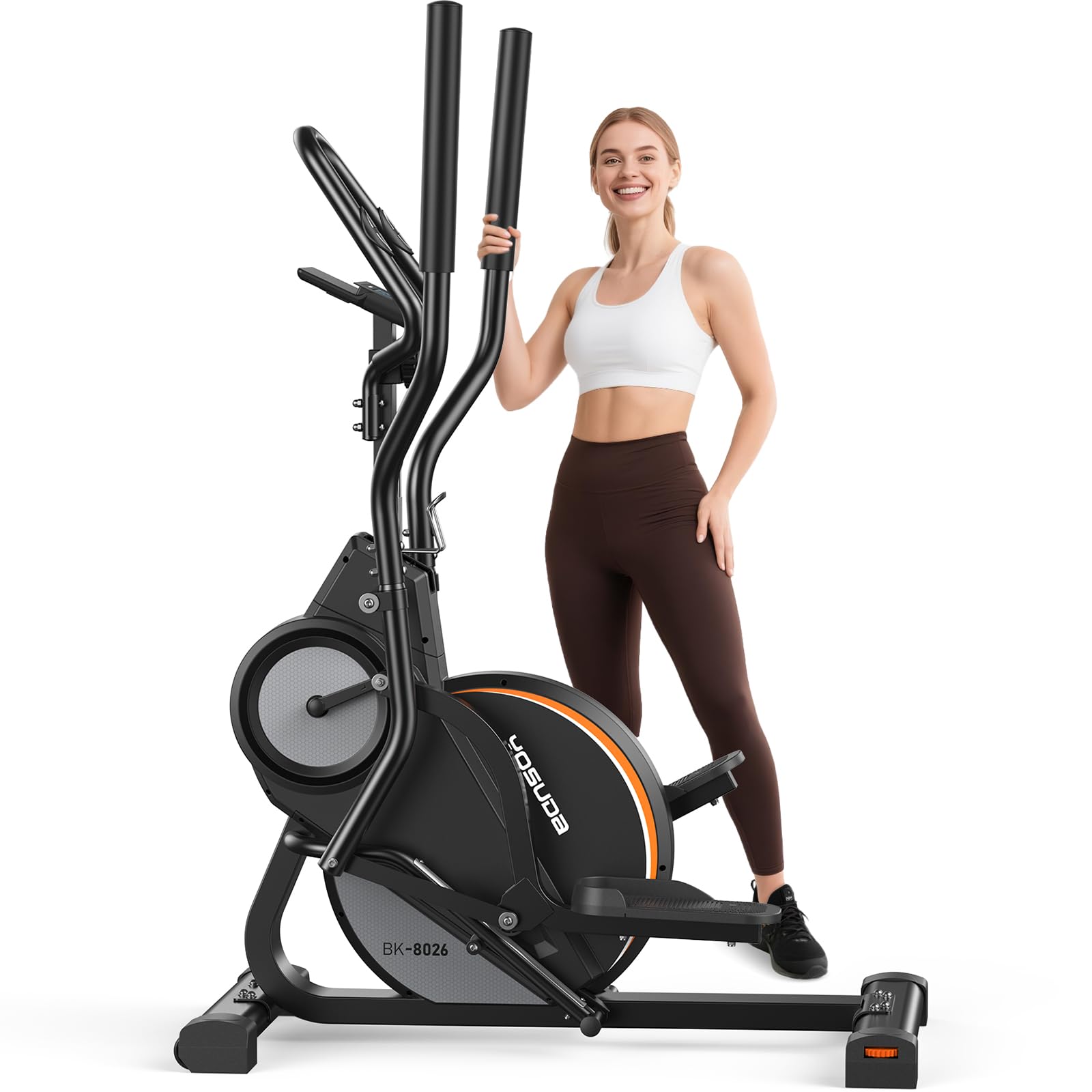
The YOSUDA 3-in-1 is not a traditional elliptical — it integrates the functions of an elliptical, stair stepper, and cardio climber into a single compact frame with a 45-degree incline. This angled motion shifts your center of gravity forward slightly, which can reduce the shear forces on the patellar tendon compared to a flat elliptical stride. The 15.5-inch stride length works well for users up to about 6 feet 5 inches, and the oversized non-slip pedals provide a stable platform that prevents your foot from sliding during incline work.
The 18-pound flywheel creates substantial inertia for smooth stride transitions, with 16 levels of magnetic resistance controlled by a simple dial. The H-type mechanical support structure keeps the machine planted during intense climbing intervals — even at maximum resistance, the frame does not rock or shift. The magnetic silent control system keeps operation below audible disturbance levels, making it suitable for early morning or late-night sessions in shared living spaces.
Bluetooth connectivity pairs with Kinomap and Fed apps for interactive training experiences, while the digital monitor independently tracks calories, time, speed, distance, odometer, and pulse. The machine occupies only about 5.4 square feet of floor space and includes front transport wheels for repositioning. At 94.6 pounds, it is lighter than the Sunny or Teeter options but feels heavier due to its compact, dense construction. Assembly is straightforward with 90 percent pre-assembly, though the wave washer placement on the pedals can confuse first-time builders.
Why it’s great
- 45-degree incline reduces patellar shear forces compared to flat ellipticals
- Compact 5.4 sq ft footprint fits tight home gym spaces
- 18-pound flywheel provides smooth inertia for controlled knee motion
Good to know
- Some users receive misaligned bolt holes or missing parts
- Assembly instructions are confusing; video guides are more helpful
- At 94.6 pounds, it is heavy to move up stairs solo
6. Gazelle Glider Edge

The Gazelle Glider Edge is a throwback design that remains relevant for knee pain sufferers because its low-impact gliding motion eliminates all vertical shock. The 18-inch stride length is generous for a compact machine, allowing your legs to extend naturally without hitting a mechanical stop that could jar the knee. The padded handlebars move in coordination with the foot platforms, engaging the arms and core while keeping the lower body in a continuous fluid loop that mimics cross-country skiing without the balance demands.
The hydraulic resistance system delivers 10 levels of tension, which is less granular than magnetic systems but sufficient for steady-state cardio and light strength endurance. The steel frame is rated to handle up to 136 kilograms, and the anti-slip foot platforms provide secure footing even during faster-paced gliding. The built-in fitness computer tracks time, distance, speed, and more, giving you real-time feedback without needing a separate device or app.
Where this machine truly shines is its foldable storage — it collapses flat to about 8.5 inches wide, making it the most space-efficient option on this list. Users recovering from achilles tendon issues or knee surgery describe the motion as gentler than standard ellipticals because the feet remain flat on the platforms rather than being forced through a circular pedal stroke. Some initial assembly confusion is common due to sparse instructions, but the low part count makes the process manageable.
Why it’s great
- 18-inch stride length keeps knees from feeling cramped
- Folds flat to 8.5 inches for closet or under-bed storage
- Foot platforms stay flat, reducing ankle and knee torsion
Good to know
- Hydraulic resistance can feel less smooth than magnetic systems
- Assembly instructions are minimal and sometimes confusing
- Left side may develop intermittent squeaks over time
7. pooboo E399 Elliptical Machine
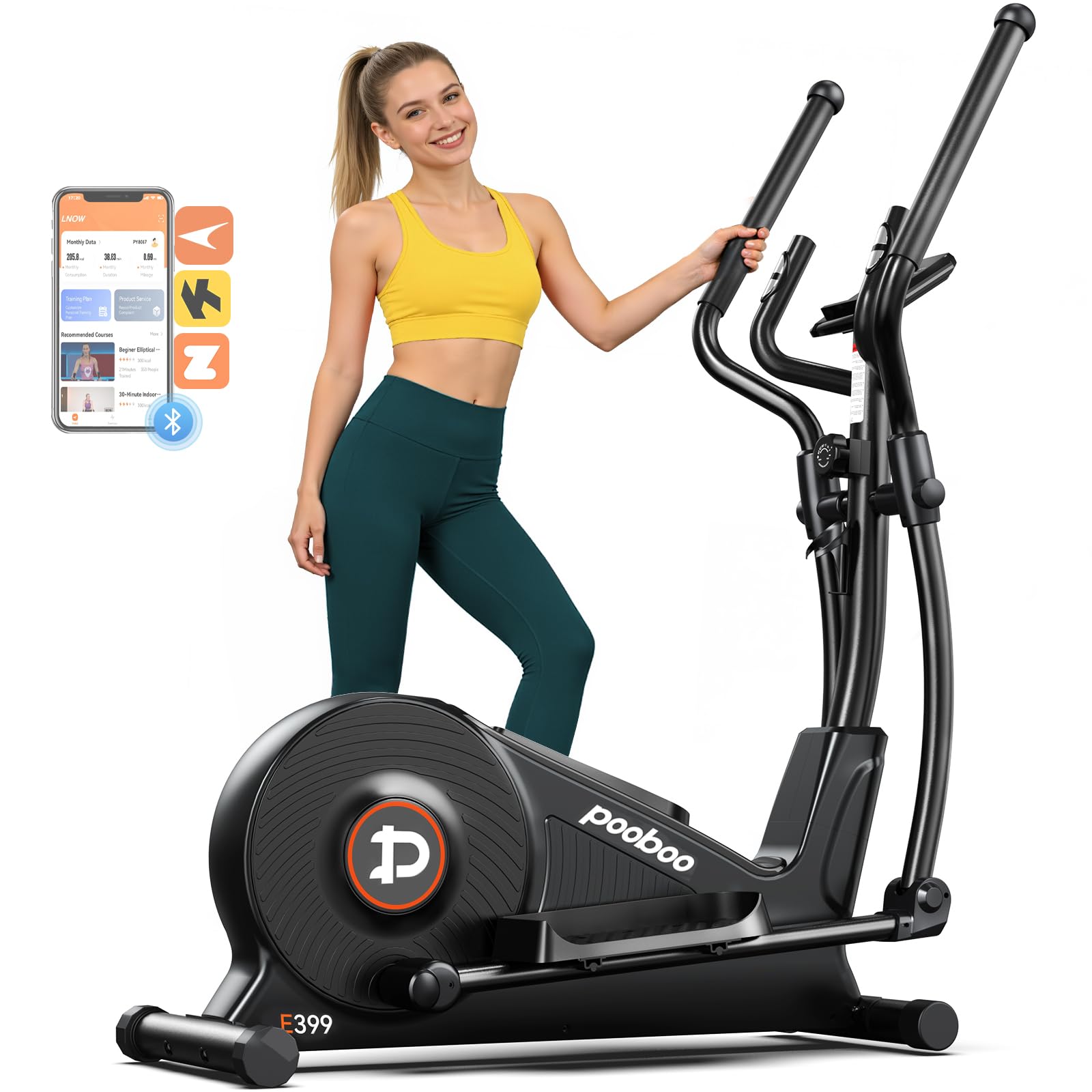
The pooboo E399 delivers a surprisingly solid elliptical experience at a budget-conscious price point, making it accessible for those who want knee-friendly cardio without a major financial outlay. The rear-drive magnetic system uses a 16-pound flywheel and produces noise levels around 20 decibels, which is whisper-quiet enough for shared wall apartments. The 15.5-inch stride is on the shorter side but works well for users up to 6 feet 5 inches, and the forward-and-reverse motion allows you to vary muscle recruitment patterns to avoid repetitive strain on the same knee structures.
The thickened steel pipe frame supports up to 350 pounds, which is impressive at this price tier and ensures the machine remains stable during vigorous use. The 16 resistance levels are divided into three zones — soothing, moderate, and high-intensity fat burning — providing clear progression markers for rehab patients. The LCD monitor tracks time, speed, distance, calories, pulse, and odometer, giving a full data suite without needing external sensors or apps.
Bluetooth connectivity pairs with Kinomap and ZT apps, adding interactive training options that extend the machine’s life beyond basic steady-state cardio. The foldable design with transport wheels allows the E399 to tuck into corners or roll between rooms, solving the space problem that plagues larger ellipticals. Some users report initial noise from joints that resolves with WD-40, and the display unit may emit random beeps, but the customer service team responds quickly with replacement parts when needed. The lifetime service guarantee is a standout value-add for budget equipment.
Why it’s great
- Whisper-quiet 20 dB rear-drive system for apartment use
- 350-pound weight capacity at a budget-friendly cost
- Lifetime free replacement parts service included
Good to know
- 15.5-inch stride feels short for taller users wanting full leg extension
- Display and bottle holder sit low, requiring a bend to read
- Some initial assembly noise resolves with lubricant application
8. XTERRA SB120 Recumbent Bike

The XTERRA SB120 is a straightforward recumbent bike built around a wide, padded seat and a step-through frame that minimizes the hip and knee flexion required to mount and dismount. The 24 resistance levels give you more granularity than most bikes in this range, allowing small incremental increases that keep your knees from being shocked by a jump in tension. The belt drive system keeps operation smooth and silent, and the multi-grip padded handles offer multiple arm positions to reduce shoulder fatigue on longer rides.
The seat adjusts to fit riders from 4 feet 10 inches to 5 feet 10 inches, which covers most average-height users but may leave taller individuals wanting more leg extension. The built-in transport wheels make moving the 53-pound unit manageable, and the compact dimensions — 45.7 inches long by 9 inches wide — allow it to fit in spaces where longer recumbent bikes cannot. The bright display shows time, distance, speed, calories, and heart rate via handlebar sensors, with 12 preset programs providing structured workout variety.
The 250-pound weight capacity is lower than most competitors on this list, which limits its suitability for heavier users with knee pain. Some customers report packaging damage during shipping — a cracked plastic shield or bent metal neck — though performance is usually unaffected after cosmetic repairs. The heart rate monitor requires clean, damp hands and consistent contact to produce accurate readings, which can be frustrating during high-intensity intervals. For its price, the XTERRA delivers a solid build and smooth operation that competes favorably against budget recumbent options from lesser-known brands.
Why it’s great
- 24 resistance levels allow precise tension adjustments for knee safety
- Step-through frame reduces hip and knee flexion during mounting
- Compact 45.7-inch length fits tight home gym layouts
Good to know
- 250-pound weight capacity is below average for this category
- Packaging can arrive damaged despite product being intact
- Heart rate sensors require consistent hand moisture to function
9. Kawnina Recumbent Exercise Bike for Seniors
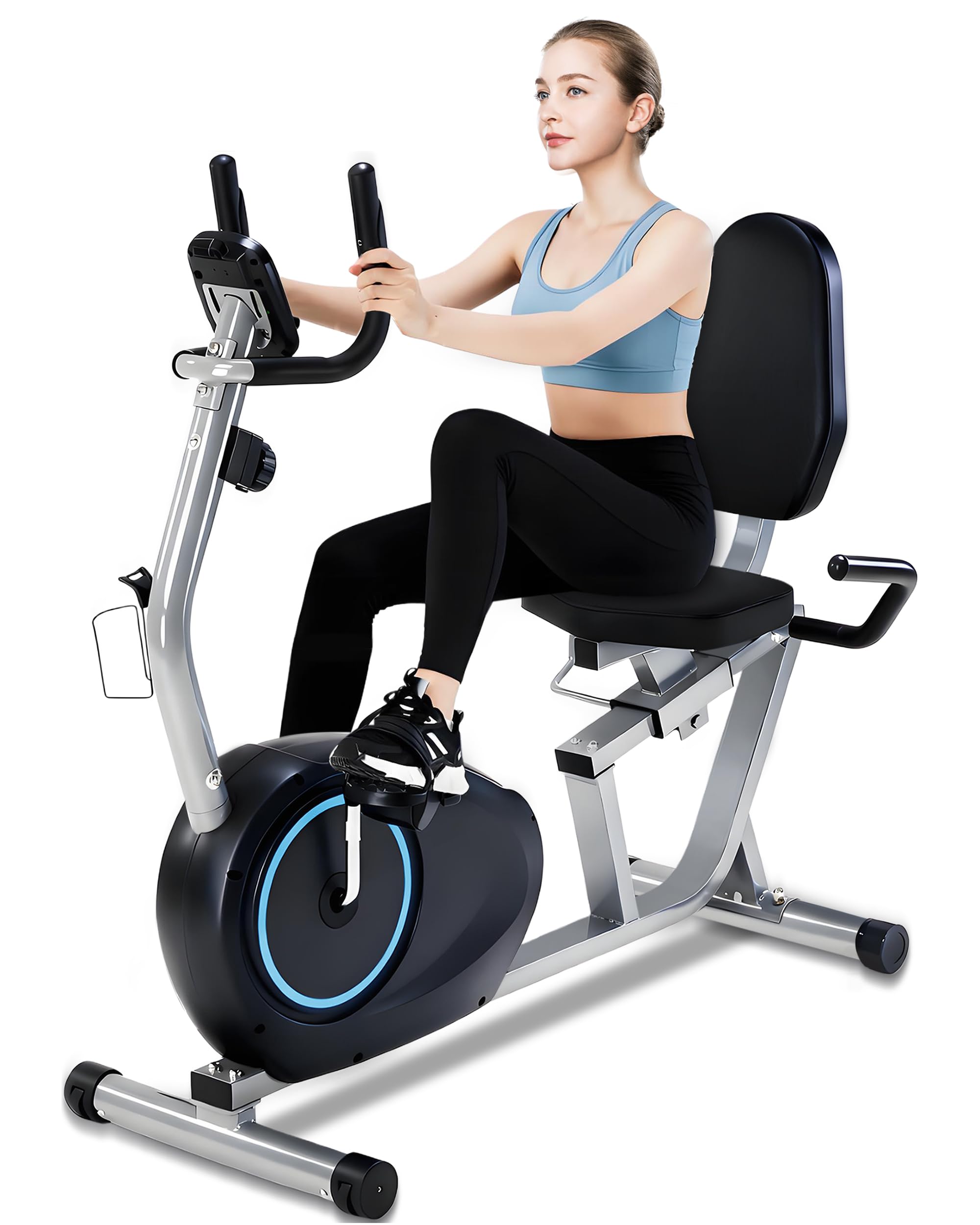
The Kawnina Recumbent Bike was designed with direct input from rehabilitation professionals, and that clinical influence shows in details that matter for knee protection. The seat and backrest use a high-density sports sponge with a 10-degree forward tilt that positions your hips slightly above your knees — a setup that reduces patellar compression compared to flat recumbent seats. The 16-level magnetic resistance system operates at noise levels as low as 5 decibels, which is virtually silent and ideal for shared living situations or early-morning rehab sessions.
The step-through frame opens wide enough for users with limited hip mobility to mount without twisting or lifting the leg high, and the 400-pound weight capacity is the highest on this list, accommodating bariatric users who often struggle to find knee-safe cardio options with adequate frame support. The LCD monitor tracks speed, distance, time, calories, odometer, and pulse via built-in sensors, and the included iPad holder lets you follow physical therapy videos or entertainment during long sessions. The seat slides forward and backward on a rail mechanism to accommodate different leg lengths, though some users report needing lubricant for smooth adjustment.
Assembly is straightforward with 85 percent pre-assembly, with most users finishing in under 30 minutes. The commercial-quality steel frame shows no flex during use, and customers describe the pedaling motion as natural and fluid — essential for maintaining proper knee tracking during extended cardio. The comprehensive 12-month protection plan provides peace of mind for the price, though the lack of Bluetooth or app connectivity limits the machine’s utility for data-driven users who want to track progress over time.
Why it’s great
- 400-pound weight capacity — highest in this review
- 10-degree forward seat tilt reduces patellar compression
- Near-silent 5 dB operation ideal for shared spaces
Good to know
- No Bluetooth or app connectivity for workout tracking
- Seat cushion may feel firm for some users without extra padding
- Seat rail adjustment can require periodic lubrication
FAQ
Are recumbent bikes better than upright bikes for knee pain?
Can I use an elliptical if I have severe knee arthritis?
How many resistance levels do I actually need for knee rehab?
Should I prioritize Bluetooth connectivity in a knee-safe cardio machine?
How much floor space do I need for a recumbent bike?
Final Thoughts: The Verdict
For most users, the cardio machine for knee pain winner is the 3G Cardio Elite RB X because its narrow Q-factor and 25-position seat adjustment allow you to set up a knee angle that is specific to your anatomy rather than forcing you to adapt to a fixed geometry. If you want the patented physical therapy stride that mimics clinical rehab equipment, grab the Teeter FreeStep. And for a budget-conscious entry point with the highest weight capacity in the category, nothing beats the Kawnina Recumbent Bike.