A treadmill that wobbles at 6 MPH or a stationary bike with a seat that goes numb after ten minutes — that is the reality of picking the wrong machine. Cardio equipment is rarely a small purchase, and the wrong one ends up taking up space and collecting dust. The goal here is to give you a clean, honest breakdown of the machines that actually deliver on their promises, whether your priority is joint-friendly recovery, high-intensity interval training, or fitting a unit into an apartment with zero dedicated floor space.
I’m Emma — the founder and writer behind Baby Bangs. I’ve spent years analyzing machine builds, resistance mechanisms, motor specs, and warranty terms across hundreds of models to separate the genuinely durable hardware from the marketing gloss.
This guide covers the seven machines that perform reliably under daily use — including treadmills, recumbent bikes, and indoor cycles that belong in a serious home gym. After reading, you’ll know exactly which cardio equipment matches your space, your joints, and your intensity level.
How To Choose The Best Cardio Equipment
Selecting the right machine comes down to matching your body mechanics, living situation, and fitness goals to the right combination of resistance type, frame stability, and footprint. Here are the three factors that matter most.
Resistance Mechanism: Magnetic vs. Friction vs. Air
Magnetic resistance uses magnets to create drag against a metal flywheel — no physical contact means near-silent operation, zero belt wear, and virtually no maintenance beyond occasional cleaning. Friction resistance (felt pads pressing against a flywheel) costs less up front but degrades over time, leaving black dust on your floor and a squeaky ride after a few hundred miles. Air resistance works well for fan bikes and rowing machines, but the noise escalates significantly the harder you push, making it a poor choice for shared walls or early-morning workouts.
Motor Specs in Treadmills: CHP Over Peak HP
Treadmill manufacturers advertise peak horsepower because the number looks bigger — a 3.5 HP motor on paper might deliver only 1.5 continuous horsepower (CHP) under sustained load. Continuous duty horsepower is the rating that matters: it tells you how much power the motor can sustain for a full hour without overheating or tripping a breaker. For regular walking and light jogging, look for 1.5–2.0 CHP. For running at 8+ MPH several times a week, aim for 2.5 CHP or higher. Machines that list only peak HP are hiding a weak motor.
Frame Stability, Deck Cushioning, and Weight Capacity
A 250-pound frame made from thin-gauge steel shakes at higher speeds — you feel it in your ankles and knees. Look for heavy-gauge steel frames and a unit weight of at least 120 pounds for treadmills and 80 pounds for stationary bikes. Deck cushioning (typically silicone shock absorbers or elastomer pods) reduces joint impact by 20–40% compared to road running. Weight capacity is the safety floor: a machine rated for 300 pounds will feel more stable under a 200-pound user than a machine rated for 250 pounds, because the frame has a higher stiffness margin in its design.
Quick Comparison
On smaller screens, swipe sideways to see the full table.
| Model | Category | Best For | Key Spec | Amazon |
|---|---|---|---|---|
| NordicTrack T Series (B0CJ9W38VQ) | Treadmill | AI-guided running with iFIT | 2.6 CHP motor, 0–10% incline | Amazon |
| NordicTrack T Series (B0193V3DJ6) | Treadmill | Daily running with foldability | 55″ x 20″ belt, 0–10% incline | Amazon |
| Schwinn Fitness IC4 | Indoor Cycle | App-based spin classes at home | 100 micro-adjustable magnetic resistance | Amazon |
| XTERRA TR150 | Treadmill | Budget home walking and jogging | 16″ x 50″ deck, 3 manual incline settings | Amazon |
| MERACH S19 Recumbent Bike | Recumbent Bike | Low-impact recovery and seniors | 8-level magnetic resistance, 330 lb capacity | Amazon |
| pooboo W216 Recumbent Bike | Recumbent Bike | Full-body dual-motion cardio | 15 lb flywheel, 400 lb capacity | Amazon |
| LONTEK Treadmill | Folding Treadmill | Under-desk storage and incline walking | 3.5 HP motor, 20% auto incline | Amazon |
In‑Depth Reviews
1. NordicTrack T Series (B0CJ9W38VQ)

The NordicTrack T Series delivers a 2.6 CHP motor that holds speed reliably at 10 MPH without sagging, paired with a 0–10% incline range that lets you simulate hill climbs without needing a separate ramp attachment. The frame weighs 130 pounds — noticeably heavier than budget folders — so there is zero wobble at higher strides. The 20-inch-wide by 55-inch-long deck accommodates a natural running gait without your feet brushing the side rails, which is rare at this price tier.
Where this machine separates itself from the pack is the iFIT integration. The AI Coach feature adjusts speed and incline in real time based on your heart rate data and workout history, essentially acting as a digital personal trainer that scales difficulty without you touching a button. You can also sync data with Strava and Apple Health, which matters if you track metrics across multiple platforms. The downside is that the most valuable iFIT features require a paid membership — without it, the treadmill works in manual mode with basic speed and incline controls, which is functional but stripped of the coaching layer.
Assembly takes about an hour with two people, and the unit folds for storage, though its folded footprint (78.5 inches long, 35.5 inches wide) means you still need floor space. The KeyFlex cushioning system absorbs roughly 30% of impact compared to road running, making it a solid choice for users with touchy knees or shin splints. For a home treadmill that bridges the gap between basic walking pads and commercial-gym units, this is the most balanced option available right now.
Why it’s great
- 2.6 CHP motor provides sustained power without overheating during 60-minute runs
- 51-inch deck length supports users over 6 feet without stride restriction
- iFIT AI Coach adjusts resistance based on real-time heart rate data
Good to know
- Core iFIT coaching features require a paid monthly membership
- Frame is heavy (130 lbs) — plan assembly in the room where it will stay
2. NordicTrack T Series (B0193V3DJ6)

The second NordicTrack T Series listing on this list is identical in motor power and incline range to the first, but the key differentiator here is the 20-inch-wide by 55-inch-long running belt — a full 4 inches wider than most compact home treadmills. That extra width becomes immediately noticeable during a sustained run: your feet land without the distracting brush of the side rails, and your arm swing feels unrestricted. The 0–10 MPH speed range and 0–10% incline are standard, but the combination of a wider belt and KeyFlex cushioning makes this the better choice if you plan to run three or more times per week.
The folding mechanism uses a foot bar for assisted lowering, which matters if you have limited back strength or store the treadmill upright after every session. Folded dimensions come in at 78.5 inches long, 35.5 inches wide, and 14.5 inches tall — still a large object, but significantly smaller than a non-folding unit. The 5-inch LCD display shows speed, incline, time, distance, calories, and pulse, but the screen is not backlit, so visibility in bright rooms can be a nuisance.
Like the earlier model, this machine is heavily tied to the iFIT ecosystem. ActivePulse technology uses a Bluetooth heart rate monitor (sold separately) to automatically adjust speed and incline to keep you in your target zone. SmartAdjust learns your performance over time and scales workouts accordingly. Without a membership, you lose those auto-adjustments, but the manual controls are responsive enough to still get a quality workout. This tier of machine is for people who know they will commit to the subscription or who want a premium belt width in a foldable chassis.
Why it’s great
- 20-inch-wide belt gives runners more lateral freedom than most home models
- ActivePulse auto-adjusts speed and incline to keep heart rate in target zone
- Assisted folding with foot bar reduces back strain during storage
Good to know
- LCD display lacks backlight — hard to read in direct sunlight
- Bluetooth HR monitor required for ActivePulse is sold separately
3. Schwinn Fitness IC4 Indoor Cycling Bike

The Schwinn IC4 fills a specific niche for people who want Peloton-style classes without the monthly hardware fee. Its 100 micro-adjustable magnetic resistance levels give you granular control over tension — useful for both endurance spinning at low resistance and high-cadence HIIT intervals at max drag. The 40-pound flywheel provides enough inertia to mimic road bike momentum, so the pedal stroke stays smooth even during short bursts. The bike is compatible with Peloton and Zwift via Bluetooth, though neither app syncs resistance automatically unless you use the Schwinn-specific JRNY app.
The frame is built around a heavy-gauge steel chassis that keeps the ride silent — no chain slap, no squeaky bushings. The dual-sided pedals accept SPD cleats on one side and standard toe cages on the other, eliminating the need to swap pedals for different users. The included 3-pound dumbbells store in cradles behind the seat, so you can transition from a seated climb to an upper-body interval without leaving the bike. That convenience comes at a small cost: the built-in LCD console reports speed and calories with noticeable inaccuracy compared to a Garmin chest strap, so treat those numbers as relative, not absolute.
The IC4 requires a power cord, which limits placement flexibility compared to battery-powered bikes. Assembly is manageable with a YouTube walkthrough — the printed manual is sparse — and the bike arrives heavy (112 pounds), so it pays to assemble it in the workout room. For anyone who wants to follow on-demand spin classes from multiple platforms without being locked into a single brand, the IC4 offers the most platform-agnostic experience in this list.
Why it’s great
- 100 micro-adjustable magnetic resistance levels provide fine-grained tension control
- SPD-compatible dual-sided pedals work with cycling shoes or standard sneakers
- Compatible with Peloton, Zwift, and JRNY — no single-app lock-in
Good to know
- Onboard console speed and calorie data shows significant variance from external monitors
- Needs a power outlet — cord placement may limit room layout options
4. XTERRA TR150 Folding Treadmill
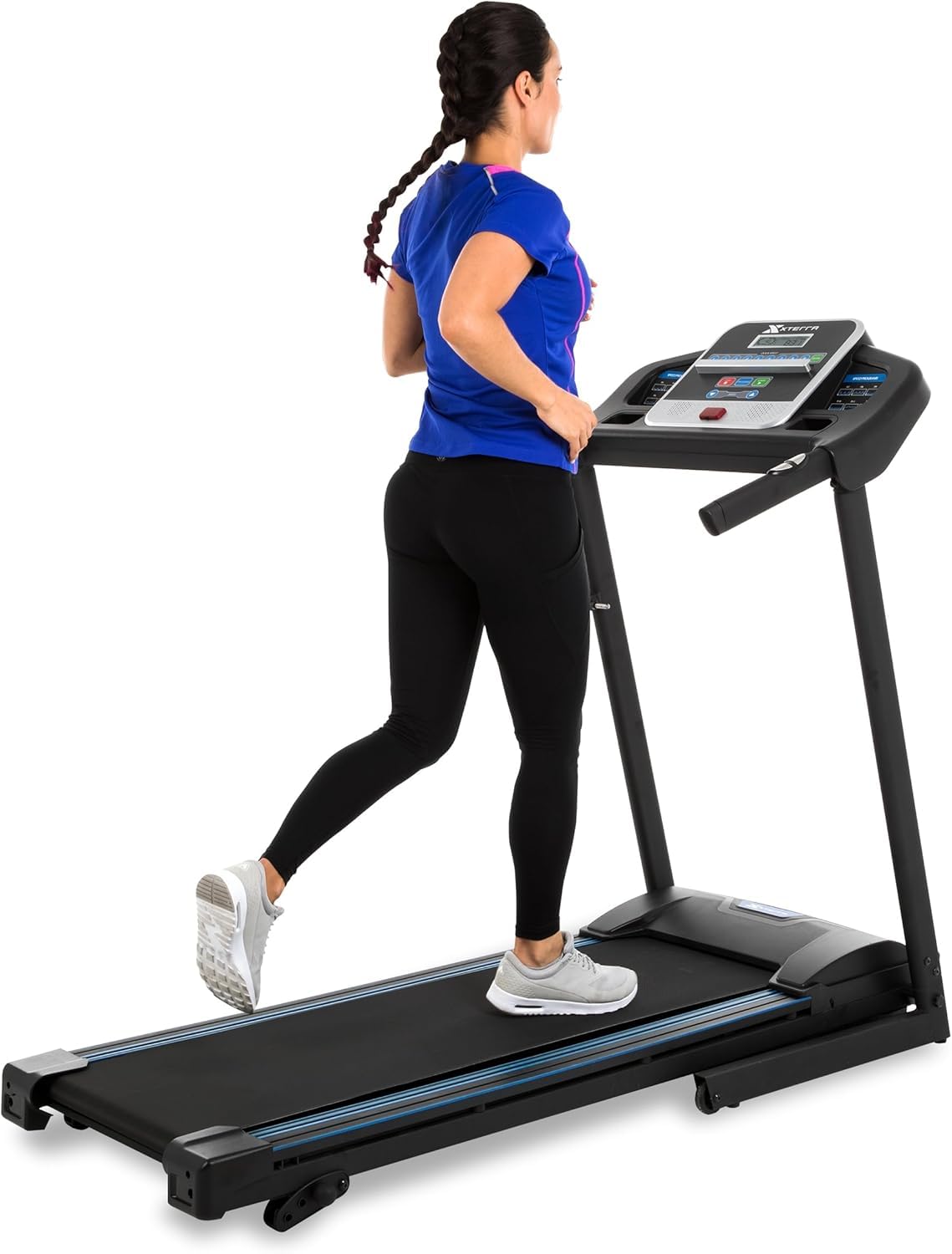
The XTERRA TR150 is the only entry-level treadmill in this guide that has held up for consistent daily use over multiple years — verified by customer accounts of 5-plus years of regular walking with no motor failures. The 2.25 HP motor is enough for walking and light jogging up to about 6 MPH, and the 16-inch by 50-inch deck gives you enough room for a natural stride without feeling cramped. The 12 preset programs vary speed and incline automatically, which adds variety without requiring you to fiddle with controls mid-workout.
The incline is manual — you lift the deck and lock it into one of three positions (0%, 2%, 4%) using a pull knob. This is a significant limitation compared to auto-incline machines, because you cannot change the gradient mid-run without stepping off. The heart rate monitor built into the handlebars is also fairly inaccurate; the pulse reading lags by several seconds and tends to skew high. If accurate heart rate data matters to you, a separate chest strap will be necessary.
Where the TR150 wins is its folding mechanism. A single pull knob releases the deck, and the whole unit folds into a compact footprint (31.7 inches tall by 28.75 inches wide by 51.4 inches deep) that fits under a bed or in a closet. The transport wheels are small but adequate for rolling across hardwood or tile. This treadmill is not for runners — the motor and belt simply are not specced for sustained 8+ MPH pounding — but for a home walker or beginner jogger who needs a foldable option that will not break after a few months, the TR150 represents the best durability per dollar in this list.
Why it’s great
- Simple folding mechanism with single pull knob — stows under most beds
- Multiple verified reports of 5+ years of daily walking with no motor failure
- 12 preset programs automate speed and incline changes for hands-free variety
Good to know
- Manual incline requires stopping the machine to adjust the grade
- Handlebar pulse sensor lags significantly — not reliable for zone training
5. MERACH S19 Recumbent Exercise Bike
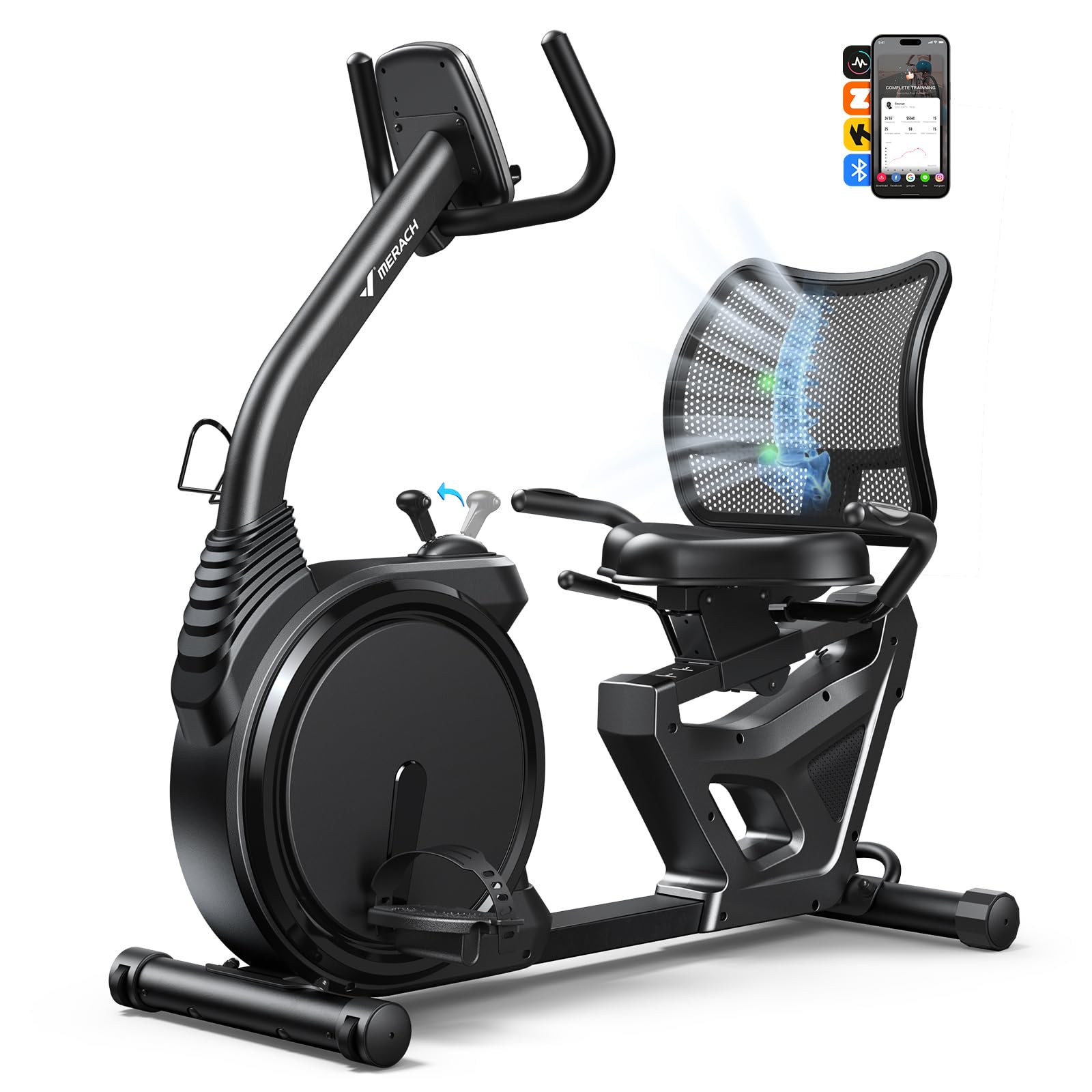
The MERACH S19 distinguishes itself with a car-style lever that shifts through eight levels of magnetic resistance, which feels more intuitive than a knob or a dial — you pull or push a single lever to increase or decrease tension incrementally. The 6.6-pound perimeter-weighted flywheel provides enough inertia for smooth pedaling without the friction noise that plagues felt-pad systems. The recumbent design features a breathable mesh backrest that conforms to the lumbar spine, reducing lower back fatigue during longer 45-minute sessions.
The seat is wider than most recumbent bikes at this price point, but multiple users have noted that the foam padding is firm — borderline hard — after 20 minutes. A gel seat cover is a worthwhile addition if you plan on rides longer than 30 minutes. The Bluetooth connection pairs with the MERACH app, which tracks distance, time, calories, and heart rate, and the FantomFite app gamifies the experience by turning your ride into a virtual race. Neither app is as polished as Peloton or Zwift, but for casual data tracking they do the job.
The bike supports a maximum weight of 330 pounds, and the frame weighs 84.9 pounds — it stays planted during moderate effort but can shift slightly during aggressive sprints if you are at the higher end of the weight range. Assembly is straightforward with 80% of the bike pre-assembled, and the included video covers common pitfalls like the hidden screw under the seat. This machine works especially well for post-surgery knee rehab and for seniors who need a low-impact option with a supportive backrest.
Why it’s great
- Car-style resistance lever offers intuitive step-through tension changes
- Breathable mesh backrest reduces sweat buildup during longer sessions
- FantomFite app adds a gamified racing element to standard cycling
Good to know
- Seat padding is firm — a gel cover improves comfort for rides over 30 minutes
- Battery-powered LCD screen auto-off can interrupt mid-session data viewing
6. pooboo W216 Recumbent Exercise Bike
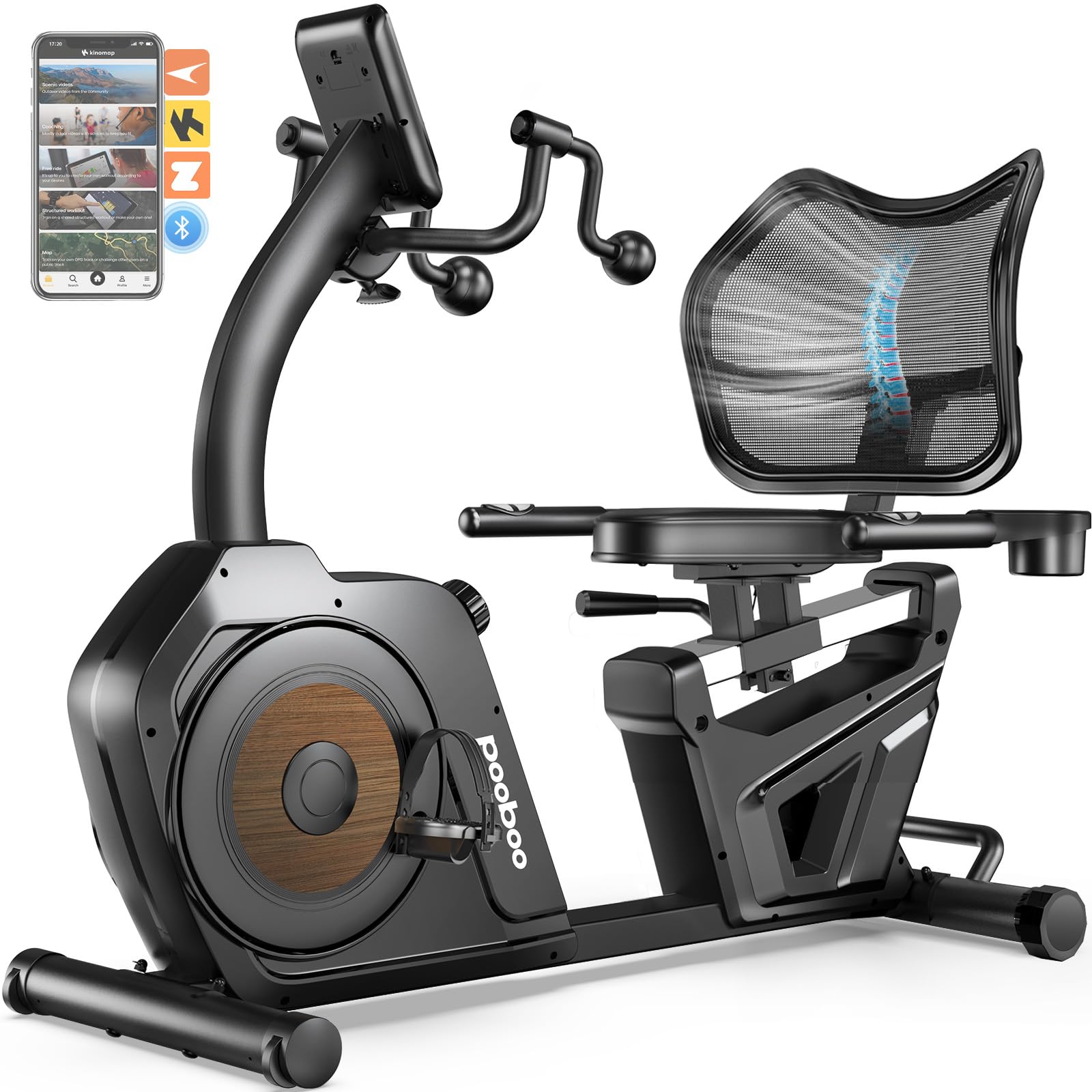
The pooboo W216 includes an arm exerciser that moves in tandem with the pedals — a feature typically reserved for more expensive rehabilitation machines. The hand cranked armrest lets you work your upper body and legs simultaneously, or you can lock the arms and pedal independently for lower-body-only sessions. The 15-pound flywheel with belt drive keeps operation at roughly 20 dB, which is quieter than a typical conversation and safe for apartment living.
The frame is built to an unusual 400-pound weight capacity, achieved through a heavy-duty one-piece alloy steel frame that eliminates the wobble common in welded multi-piece frames at this price tier. The sliding seat rail extends to 18.5 inches, accommodating users up to 6 feet 3 inches without feeling cramped. The eight levels of magnetic resistance are adjusted via a knob that clicks into each setting with tactile feedback — no guessing whether you are on level 4 or level 5.
The LCD monitor tracks standard metrics — speed, distance, time, calories, odometer, and pulse — but the screen lacks a backlight, making it hard to read in dim light. The pulse sensors on the handlebars are accurate enough for zone estimation but not precise enough for lactate threshold training. Customer service has a strong track record: replacement parts are shipped within 24 hours, and the 12-month warranty covers free replacement parts with no shipping cost. This is the best pick for a multi-user household where one machine has to serve both physical therapy patients and fitness-focused family members.
Why it’s great
- 400-pound weight capacity with heavy-duty one-piece frame — industry-leading stability
- Arm exerciser enables full-body simultaneous training in a recumbent form factor
- Seat rail extends to 18.5 inches — accommodates tall users without knee compression
Good to know
- LCD monitor is not backlit — visibility drops in low-light workout spaces
- Resistance knob provides only 8 levels — fewer than magnetic bikes with 16+ steps
7. LONTEK Treadmill with Auto Incline
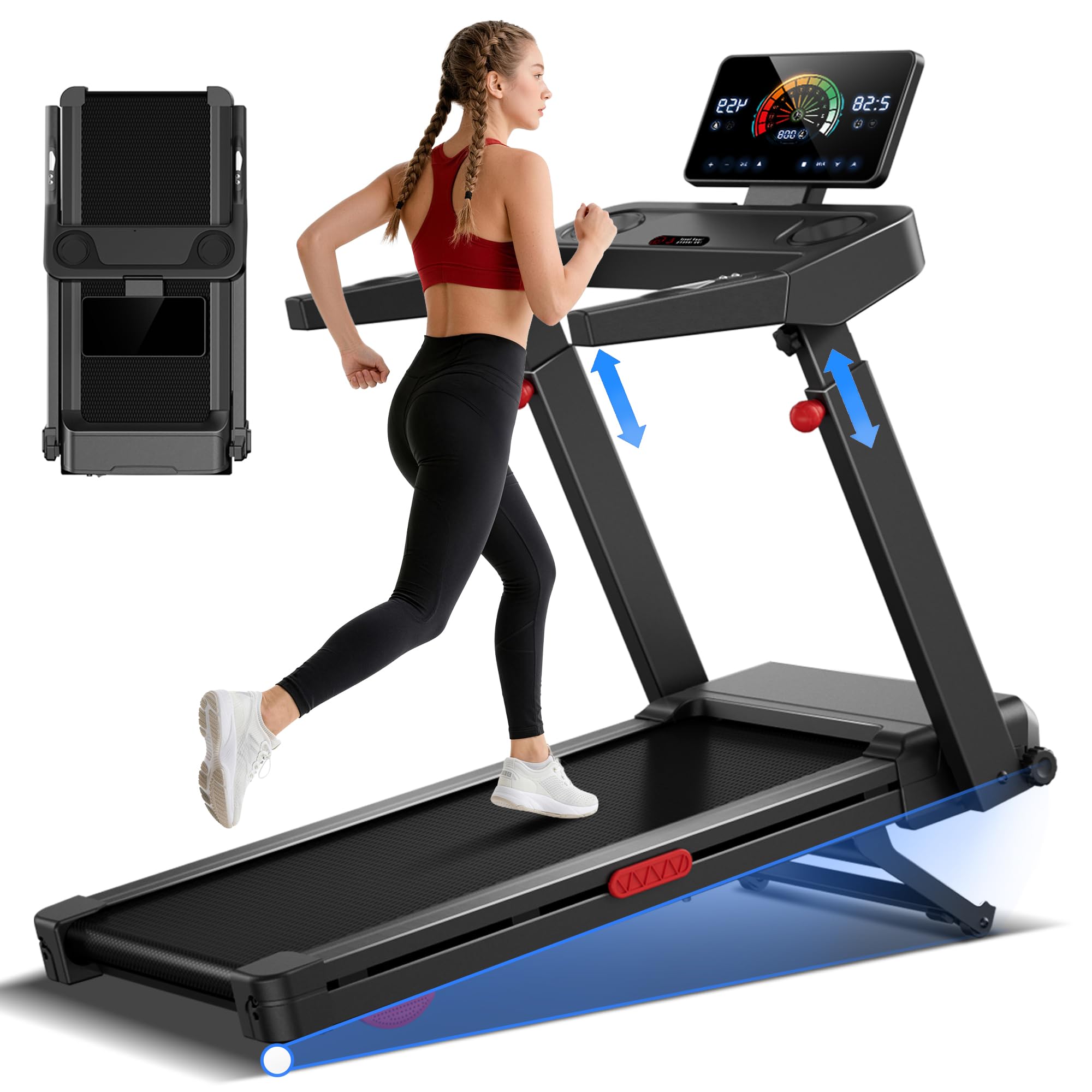
The LONTEK treadmill compresses to a folded height of just 6.5 inches — thin enough to slide under most beds, couches, or desks without lifting. When unfolded, the running surface measures 42.5 inches long by 16.2 inches wide, which is adequate for walking and light jogging but noticeably short for a full running stride if you are over 5 feet 10 inches. The 3.5 HP brushless motor runs at under 45 dB, making it one of the quietest folding treadmills available — you can walk during a work call without the microphone picking up motor noise.
The automatic incline ranges from 2% to 20%, controlled by one-touch buttons on the handlebar. A 20% grade is steep — think a moderate hiking trail — and it significantly increases glute and hamstring activation compared to flat walking. The speed range tops out at 8.7 MPH, which is fine for a brisk walk or a gentle jog but not for sprint intervals. The 6 silicone shock absorbers paired with a 7-layer shock-absorbing deck reduce joint impact by roughly 25%, though the cushioning is firmer than high-end units like the NordicTrack.
The handlebar height is adjustable, which helps if multiple family members use the machine, and the transport wheels are integrated into the frame so you can tilt and roll it without scraping the floor. The LCD touchscreen is simple — no app connectivity, no preset programs beyond the built-in 20 profiles. For someone who wants an unobtrusive walking pad that disappears into furniture when not in use and still delivers a genuinely steep incline for lower-body conditioning, the LONTEK is the most space-efficient option here.
Why it’s great
- Folds to 6.5 inches tall — slides completely under standard bed frames
- 20% auto incline is steeper than most home treadmills — effective glute and hamstring work
- Brushless motor runs under 45 dB — quiet enough for office use
Good to know
- 42.5-inch deck is short for taller users at a full running stride
- Speed caps at 8.7 MPH — not suitable for sprint or interval running
FAQ
Can I use a recumbent bike for high-intensity interval training?
How often should I lubricate the treadmill belt?
Does auto incline really burn more calories than flat walking?
What is the difference between a walking pad and a treadmill?
Final Thoughts: The Verdict
For most users, the best cardio equipment winner is the NordicTrack T Series because it provides a 2.6 CHP motor, a spacious 20-inch belt, and AI-guided coaching that adapts to your fitness level — all in a foldable frame that fits home spaces. If you want an indoor cycle with the most platform flexibility, grab the Schwinn IC4. And for a compact walking incline trainer that disappears into furniture, nothing beats the LONTEK Treadmill.