Dragging a heavy, noisy gas generator to a quiet campsite defeats the entire purpose of getting away. A dedicated camping solar generator swaps the fumes and fuel cans for silent, emission-free power that keeps your fridge cold, your lights on, and your phone charged from dusk until dawn.
I’m Emma — the founder and writer behind Baby Bangs. I analyze battery chemistry, inverter efficiency, and solar input curves to find the gear that actually holds up under a weekend canopy or a week of off-grid living.
After testing dozens of units against real-world camping loads, I’ve narrowed the field down to nine models that deliver reliable electrons without the hassle. Here is the definitive guide to the best camping solar generator for every type of outdoor trip.
How To Choose The Best Camping Solar Generator
Picking the right power station for camping comes down to three hard decisions: how much gear you bring, how long you stay away from an outlet, and how much weight you want to carry from the car to the site. A generator that works for a weekend at a state park might feel limiting on a week-long boondocking trip, so start by matching capacity to your real load.
Start With Watt-Hours, Not Peak Watts
Watt-hours (Wh) tell you the total energy stored, while peak watts tell you the surge a device needs to start. A 600Wh unit can run a 60W fridge for about 10 hours, but a 1200W coffee maker demands a higher inverter rating even if you only run it for ten minutes. For camping, aim for a unit that covers your continuous load plus a safety margin of at least 20% above the largest appliance start-up draw.
Chemistry Lifespan Affects Real Cost
Standard lithium-ion packs degrade after 500 cycles, which might last three years of frequent trips. LiFePO4 (LFP) cells typically offer 2,000 to 4,000 cycles before reaching 80% capacity, making the higher upfront cost cheaper over a decade of use. If you plan to use a generator monthly, LFP pays for itself by year four.
Solar Input Speed Determines Off-Grid Usability
A built-in MPPT controller extracts more power from a given panel than a basic PWM controller, especially under partial shade. Look for a generator that accepts at least 200W of solar input so you can recharge a depleted 1000Wh unit in 5 to 7 hours of direct sun. Units with 100W max input will take two full sunny days to refill, which is slow for daily use.
Quick Comparison
On smaller screens, swipe sideways to see the full table.
| Model | Category | Best For | Key Spec | Amazon |
|---|---|---|---|---|
| BLUETTI AC70 | Premium | Fast recharge & app control | 768Wh / 1000W inverter | Amazon |
| AFERIY Nomad1800-A | Premium | Ultra-fast UPS & app control | 1024Wh / 1800W inverter | Amazon |
| Anker SOLIX C1000 | Premium | Bundle with 200W panel | 1056Wh / 1800W inverter | Amazon |
| BLUETTI AC180 | Premium | High-power bundle kit | 1152Wh / 1800W inverter | Amazon |
| GRECELL EB1000 | Mid-Range | Budget-friendly 1000W | 999Wh / 1000W inverter | Amazon |
| GRECELL 999Wh | Mid-Range | Wireless charging & value | 999Wh / 1000W inverter | Amazon |
| EBL 1000W | Mid-Range | Wireless charging pad | 999Wh / 1000W inverter | Amazon |
| Jackery Explorer 300 | Mid-Range | Ultra-light kit | 292Wh / 300W inverter | Amazon |
| VTOMAN Jump 600X | Mid-Range | Car jump start & expandable | 299Wh / 600W inverter | Amazon |
In‑Depth Reviews
1. BLUETTI AC70 Portable Power Station

The BLUETTI AC70 hits a sweet spot few units manage: 768Wh of LFP storage paired with a 1000W inverter that can lift up to 2000W for short bursts. That means it handles a 12V fridge, a CPAP with heated humidity, and a laptop dock simultaneously without tripping. The real win is the AC recharge speed — a single cable pushes 950W, taking the battery from zero to 80% in just 45 minutes, so a quick lunch stop at a diner can refill your power bank before you head back to the trail.
Solar input tops out at 500W, which refills the full 768Wh in around two hours under good sun. The BLUETTI app adds remote monitoring and discharge scheduling, letting you set a charge window if you park near a cabin outlet overnight. At 22.5 pounds, the AC70 is dense but still liftable with one hand, and the front-facing ports keep your cable management tidy inside a tent or van.
Customer reports confirm the unit ran a 100W guitar amp and pedalboard for over eight hours while drawing only 30W AC, estimating nearly 20 hours of runtime. The UPS switchover happens in under 20ms, protecting sensitive gear during a brownout.
Why it’s great
- 950W AC input refills in 1.5 hours
- 3000+ life cycles on LFP cells
- App control for charge/discharge scheduling
Good to know
- No bundled solar panel in base kit
- Plastic chassis feels durable but not ruggedized
2. AFERIY Portable Power Station Nomad1800-A
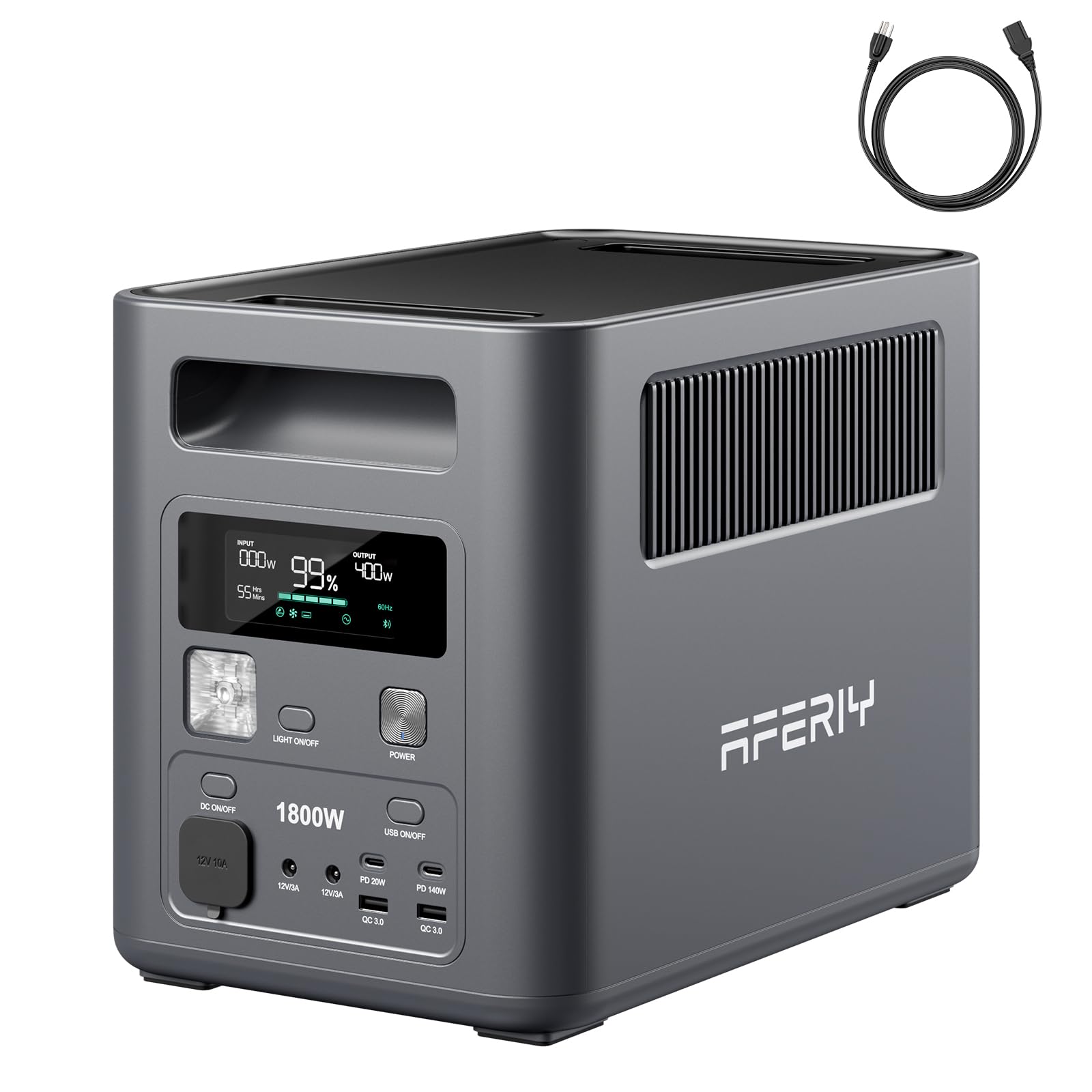
The AFERIY Nomad1800-A packs 1024Wh into a frame that is 16% smaller and 25% lighter than comparable 1000Wh-class stations, weighing just 25.6 pounds. The 1800W inverter (3600W peak) supplies four AC outlets, and the built-in UPS switches in under 10ms — twice as fast as many competitors — which keeps a desktop PC or security camera running through a grid flicker without a hiccup.
Charging options are unusually flexible: AC input recharges 0-80% in 55 minutes, while combining AC and solar cuts that to 35 minutes. The dual-fan system stays below 30dB in most use cases, quiet enough for a tent at night. The companion app provides remote monitoring and scheduling, though one reviewer noted it lacks battery temperature readouts. The LED light offers steady, SOS, and strobe modes, turning the station into a campsite beacon.
With 4000+ cycles on the LFP chemistry, this unit is built for a decade of regular use. One camper reported running a 1500W kettle and grinder from a single solar panel generating over 200W at midday. The 7-year support period adds long-term peace of mind that budget units rarely offer.
Why it’s great
- Under 10ms UPS transfer speed
- 4000+ cycle LFP battery lifespan
- Four AC outlets plus 140W USB-C PD
Good to know
- Solar panel sold separately
- App lacks detailed battery thermal data
3. Anker SOLIX C1000 with 200W Solar Panel

The Anker SOLIX C1000 delivers 1056Wh and 1800W continuous output (2400W via SurgePad), and the kit version includes a 200W solar panel that adjusts to four angles for optimal sun absorption. The panel itself carries an IP67 waterproof rating, meaning it survives heavy rain and dust storms while the station stays under cover. AC recharging hits 80% in 43 minutes with UltraFast mode toggled in the app — one of the fastest wall-charge times at this capacity.
The 11-port array includes six AC outlets, making it easy to power multiple kitchen appliances at a campsite. One user reported running a fridge and deep freezer for over five hours from a 98% charge. However, at 27.6 pounds, the C1000 is one of the heavier units in its class, and the single 200W panel may feel insufficient for heavy daily use, especially in cloudy weather. The panel also ships separately, so expect staggered delivery.
The LFP battery is rated for 3000 cycles, backed by a 10-year lifespan claim. Reviewers praised Anker’s customer support, with one receiving a replacement panel after a mildew issue, but noted that the unit’s capacity is better suited for low-draw devices over long weekends than high-wattage off-grid living.
Why it’s great
- 200W IP67-rated solar panel in the box
- UltraFast AC recharge to 80% in 43 min
- Six AC outlets for multi-device camping
Good to know
- Panel and station ship separately
- One panel may not refill quickly on cloudy days
4. BLUETTI AC180 Solar Generator with 200W Panel

The BLUETTI AC180 is the largest unit in this roundup at 1152Wh with a 1800W inverter that can surge to 2700W for high-draw appliances like a toaster oven or electric griddle. The bundled 200W solar panel refills the full battery in roughly 5 to 9 hours, depending on sun angle. AC flash charging pushes 1440W through a single cable, achieving a full charge in just one hour — a lifesaver when you have limited time at a paid hookup site.
The 11 outlets include four AC ports, USB-C PD, and a 12V car port. One cross-country traveler ran a fridge, lights, laptops, and fans for 21 consecutive days, recharging via car, solar, and wall outlets. The UPS switchover is rated at 20ms, which is adequate for most gear but slower than the <10ms found on the AFERIY or newer BLUETTI models. The unit weighs around 35 pounds, which is manageable for RV campers but heavy for backpack-in sites.
The LFP pack offers 3000+ cycles, and the BLUETTI app provides remote monitoring and output scheduling. Some customers noted that shipping for the solar panel took two weeks and arrived separately, so plan ahead for staggered delivery.
Why it’s great
- 1152Wh capacity with 2700W power lifting
- 1440W AC flash charge in one hour
- 200W solar panel included for turnkey off-grid
Good to know
- Heavier than similar-capacity units at ~35 lbs
- Solar panel ships separately, sometimes delayed
5. GRECELL Portable Power Station 1000W (EB1000)
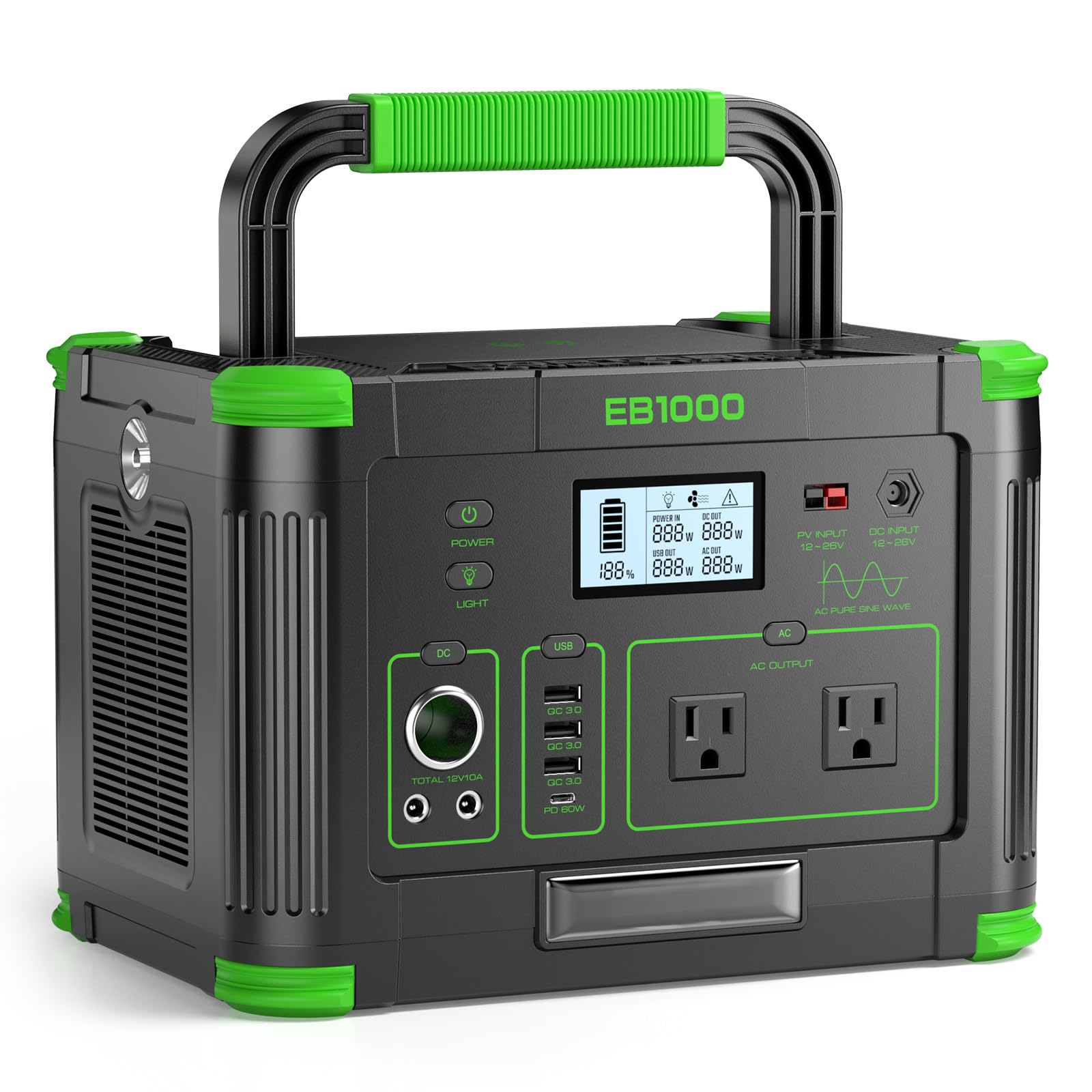
GRECELL’s EB1000 delivers 999Wh and a 1000W continuous inverter (2000W peak) in an olive-green chassis that weighs just 17 pounds — one of the lightest in the 1000Wh class. The 10-port layout includes a USB-C PD 60W port, three USB-A QC 3.0 ports, two AC outlets, and a 10W wireless charging pad on top. Individual switches for each port group let you cut standby drain, and the bright LCD shows real-time wattage, battery percent, and runtime estimates.
The triple MPPT controller accepts up to 800W of solar input, which is unusually high for this price tier. Pass-through charging means you can top off the station while running lights and a cooler simultaneously. AC recharge takes 8 to 12 hours at 100W-120W, which is slower than premium units, but the solar input speeds up off-grid refills considerably. The built-in dual cooling fans run silently in most conditions.
Buyers report using the EB1000 to power speakers, mixers, and fans for five hours with less than 25% battery drain indoors, though outdoor drain increases under direct sun and higher ambient temps. At under , this unit offers the best watt-hours-per-dollar ratio in the list, making it a strong choice for budget-conscious campers who don’t need sub-1-hour AC charging.
Why it’s great
- 17 lbs for nearly 1kWh of capacity
- 800W MPPT solar input for fast off-grid refill
- Wireless charging pad and independent port switches
Good to know
- AC recharge takes 8-12 hours
- Only two AC outlets may limit high-draw setups
6. GRECELL 999Wh Solar Generator 1000W

This second GRECELL entry shares the same 999Wh LFP core and 1000W inverter as the EB1000 but wraps it in a slightly different port layout and a higher weight of 23 pounds. The unit supports up to ten devices simultaneously via two AC outlets, three USB-A QC ports, a USB-C PD port, two 12V DC ports, a 12V car port, and the same 10W wireless charging pad. The LCD display provides clear real-time power stats, and the built-in LED offers flashlight and SOS modes.
The upgraded BMS includes automatic shutoff when devices reach full charge, short-circuit protection, and thermal management via silent dual cooling fans. The MPPT controller squeezes maximum power from connected solar panels, though the AC input stays on the slower side at 8-12 hours for a full charge. One reviewer noted using three GRECELL units for home backup, praising the long hold time and stable power delivery to small appliances after months of seasonal use.
At 23 pounds, it’s six pounds heavier than the EB1000 variant but still manageable for car camping. The olive-black color scheme is rugged-looking, and the folding handle is comfortable for one-handed carry. Given the identical capacity and inverter, the choice between the two GRECELL models comes down to weight preference and port layout.
Why it’s great
- 999Wh capacity at a competitive price
- 10-device simultaneous charging capacity
- Built-in MPPT for efficient solar harvesting
Good to know
- Slower AC recharge than premium competitors
- Heavier than the EB1000 version of same capacity
7. EBL Portable Power Station 1000W
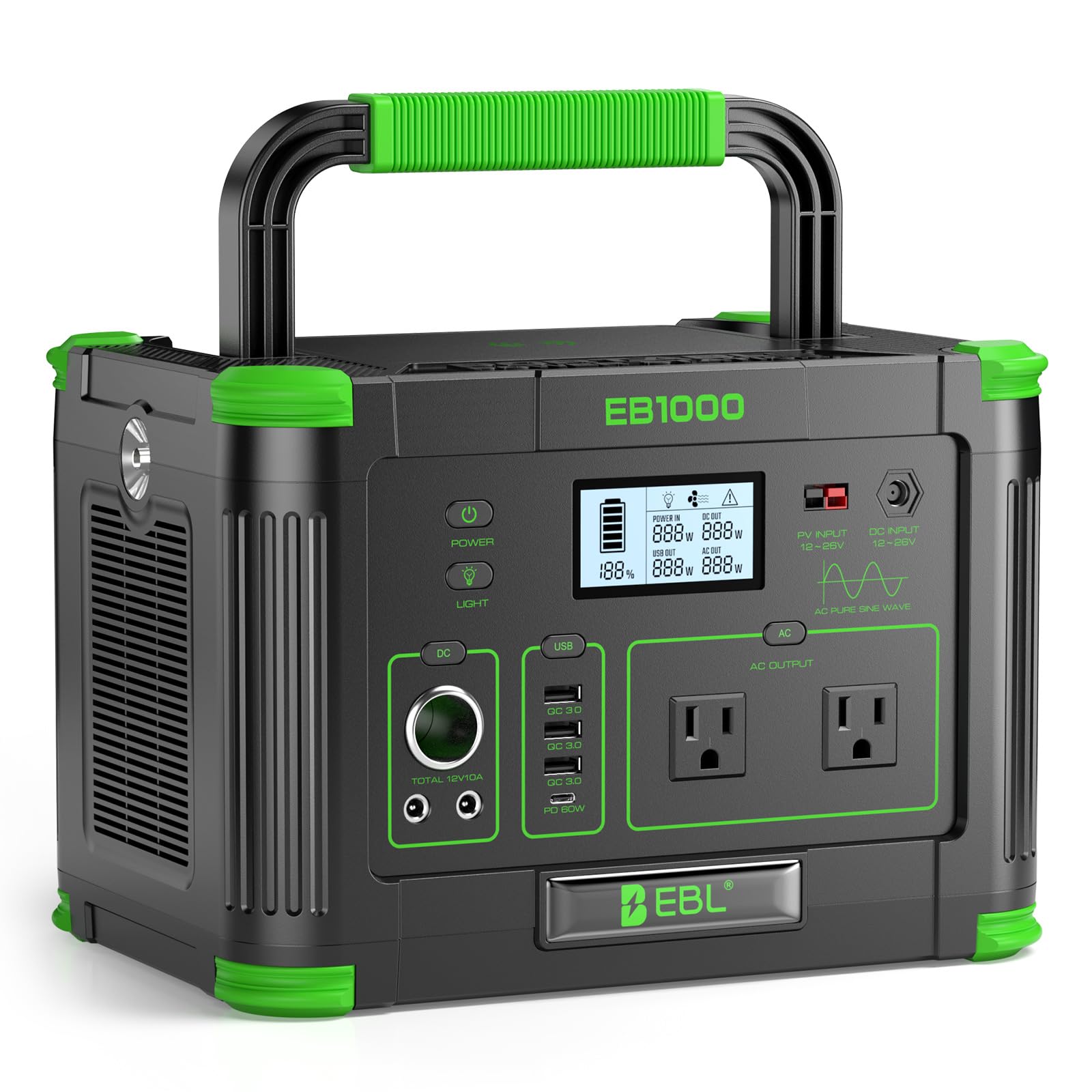
The EBL 1000W station offers 999Wh capacity with a 1000W pure sine wave inverter (1100W overload protection) and a clean black-and-green design. The port selection includes a single AC outlet, two 12V DC ports, a 12V car port, USB-C PD 60W, multiple USB-A QC 3.0 ports, and a 5W wireless charging pad. The LCD screen features a 20-second auto-sleep to preserve battery, and a hibernation mode kicks in after eight hours of low load (below 5W) to avoid parasitic drain.
Solar charging accepts 12-26V input at 8A max, while AC charging takes 7-8 hours and car charging 9-11 hours. Weighing 21 pounds, the unit is portable but a bit dense for its size. The pass-through charging function is convenient for running devices while recharging at a campsite with a solar panel. One camper successfully ran a CPAP for a full 12-hour night, though they noted the unit is heavy and requires a button press to enable AC output each time.
Reviewers appreciated the quiet fan operation and the foldable carrying handle. The lack of a bundled solar panel is a common complaint, and the single AC outlet means you’ll need a power strip to run multiple large devices. For light camping loads like phones, tablets, and a 12V cooler, the EBL delivers reliable power without breaking the bank.
Why it’s great
- 999Wh capacity with pure sine wave output
- Wireless charging pad and multiple USB ports
- Pass-through charging for convenience
Good to know
- Only one AC outlet
- Heavier than similar-capacity units from competitors
8. Jackery Solar Generator 300 with 40W Panel
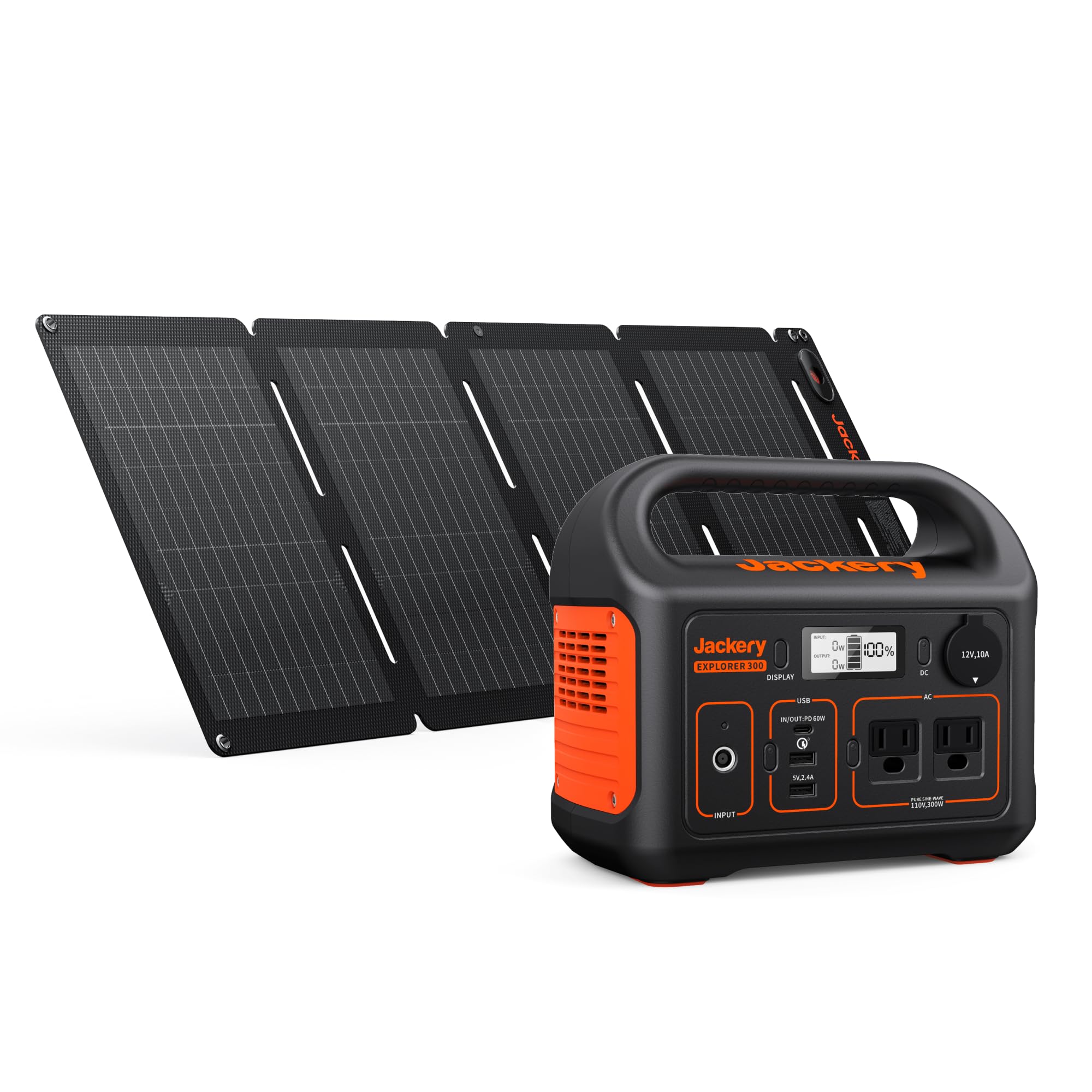
The Jackery Explorer 300, paired with a 40W SolarSage panel, sits at the lightweight end of the spectrum: the station alone weighs 7.5 pounds, and the panel is barely heavier than a laptop bag. The 292Wh LiFePO4 battery offers 4000+ cycles — more than double the cycle life of older Jackery lithium-ion models — and the 300W inverter (600W surge) handles small gear like a USB fan, phone, tablet, and a laptop. With two AC outlets, a 100W USB-C PD port, and two USB-A ports, you can charge six devices simultaneously.
Solar refill is slow with the included 40W panel: expect 80% charge in about 7.5 hours under direct sun. Pairing with a 100W panel cuts 80% time to 2.8 hours. One van-dweller reported running a USB fan, phone, and laptop for 2-3 days on a single charge, but noted that recharging from empty via solar takes a full day. The station supports wall charging (3 hours) and car charging (3 hours) for faster refills on the road.
At , this kit is ideal for backpackers, car campers on short trips, and drone photographers who need a light power source for charging batteries and phones. It will not run a full-size fridge or CPAP with humidifier overnight, but for ultralight setups, nothing else in this list matches the weight-to-power ratio.
Why it’s great
- 7.5 lbs with a compact 40W solar panel included
- 4000+ cycles on LiFePO4 battery
- 100W USB-C PD for fast laptop charging
Good to know
- 292Wh is only enough for phones, lights, small laptops
- 40W panel is slow; upgrade to 100W for serious off-grid use
9. VTOMAN Jump 600X Portable Power Station

The VTOMAN Jump 600X is a 2-in-1 device that combines a 299Wh portable power station with a car jump starter, saving trunk space for campers who also want roadside emergency capability. The 600W inverter (1200W surge) powers small appliances up to 600W continuously, while the LiFePO4 battery offers 3000 life cycles. The unit features two AC outlets, a 60W USB-C PD port, three USB-A outputs, two regulated 12V DC ports, and a 12V car port, all accessible while the station charges via pass-through.
A standout feature is the expandable capacity: an optional VTOMAN extra battery (sold separately) boosts total capacity to 939Wh, making this a scalable system that grows with your needs. The regulated 12V DC output delivers stable power for CPAP machines, portable tire inflators, and 12V coolers, unlike unregulated ports that fluctuate with battery voltage. Recharge to 80% takes 2.7 hours via DC input, while a full AC wall charge takes about 3 hours.
Buyers report running a CPAP for 10 hours plus phone charging with battery to spare, and the jump start function instantly started a Dodge Ram from a 9% charge. The built-in LED with five modes serves as a campsite light. At under , it is the most affordable entry point into the LFP camping generator space, with the added bonus of car rescue capability.
Why it’s great
- 2-in-1 power station and car jump starter
- Expandable from 299Wh to 939Wh
- Regulated 12V DC output for CPAP and coolers
Good to know
- 299Wh base capacity needs expansion for multi-day trips
- Slow solar input (100W max); larger panels recommended
FAQ
Can a camping solar generator run a CPAP machine all night?
How long does it take to charge a solar generator from a solar panel?
What is the difference between LiFePO4 and standard lithium-ion for camping?
Final Thoughts: The Verdict
For most campers, the best camping solar generator winner is the BLUETTI AC70 because it combines 768Wh of reliable LFP storage with class-leading 950W AC recharge and app-controlled smart features in a 22-pound package that fits any car camping or van setup. If you want the fastest UPS protection and the longest battery lifespan for heavy weekend use, grab the AFERIY Nomad1800-A. And for the best value-to-capacity ratio on a tight budget, nothing beats the GRECELL EB1000 at 17 pounds with 999Wh of storage and MPPT solar support.