A severe bleed from a car accident, a fall on jagged rock, or a kitchen knife that slips the wrong way — seconds disappear fast. While standard gauze and band-aids handle scrapes, they offer zero defense against arterial hemorrhage. A dedicated kit built for this exact threat bridges the gap between injury and advanced medical care.
I’m Emma — the founder and writer behind Baby Bangs. I analyze bleeding control hardware, tourniquet mechanics, and hemostatic agent consistency, and I sort kits by the real specs that decide whether a field intervention succeeds or fails.
Whether you are building a go-bag, equipping a vehicle, or stocking a home emergency drawer, knowing which components actually matter separates smart preparation from false security. This guide walks through the essential criteria for choosing the best bleeding control kit for your specific environment and skill level.
How To Choose The Best Bleeding Control Kit
Not all trauma kits deliver equal capability. The difference between a cheap pouch full of packaging and a field-ready intervention system comes down to three decisions: the type of tourniquet, the presence of hemostatic agents, and the overall carry format. Each factor shifts how quickly and effectively you can manage a life-threatening bleed.
Tourniquet Type: Windlass vs. Strap-Based
The tourniquet is the single most important component in any kit designed for extremity bleeds. A windlass style (like the CAT or SOF-T) uses a rod to twist the band tight, mechanically occluding blood flow. These are CoTCCC-approved and the standard for military and EMS use. Strap-based options like the SWAT-T are more versatile — they can double as a pressure bandage — but require more training to apply with sufficient tension for full arterial occlusion. For maximum reliability on limb injuries, a windlass tourniquet is the safer default.
Hemostatic Gauze vs. Plain Gauze
Standard gauze soaks up blood; hemostatic gauze actively accelerates clotting. Kaolin-based gauze (found in QuikClot) triggers the body’s natural coagulation cascade, while chitosan-based alternatives (like Celox) create a physical barrier independent of clotting factors. For junctional wounds — the groin, armpit, or neck — or deep wounds where direct pressure is insufficient, a kit that includes hemostatic gauze moves from good to genuinely life-saving. Skip kits that only contain plain rolled gauze if your primary threat involves stab wounds, gunshot wounds, or heavy industrial lacerations.
Kit Format and Access Speed
A bleeding control kit is useless if you cannot access it under duress. Vacuum-sealed packs keep components sterile and organized, but tamper-proof plastic can delay deployment if no tear notch is present. Pouch-based kits with Velcro closures or MOLLE compatibility allow you to attach the kit directly to a duty belt, backpack strap, or vehicle seatback where it remains seconds away. Also consider the inclusion of trauma shears — removing clothing to access a wound is impossible without them — and a permanent marker for recording tourniquet application time.
Quick Comparison
On smaller screens, swipe sideways to see the full table.
| Model | Category | Best For | Key Spec | Amazon |
|---|---|---|---|---|
| Stop The Bleed Basic Kit | Premium | Rapid hemorrhage control | C-A-T Gen 7 tourniquet | Amazon |
| CAT + Rigid Tourniquet Case | Premium | Duty belt carry | NAR CAT Gen 7 + MOLLE case | Amazon |
| Adventure Medical Kits Trauma Pak Pro | Premium | Compact pocket trauma | QuikClot kaolin gauze | Amazon |
| MediTac Basic Bleeding Control Pack | Mid-Range | Complete single-use pack | SWAT-T + Israeli bandage | Amazon |
| Vital House 346-Piece Kit | Mid-Range | General first aid + trauma | 346 pieces including tourniquet | Amazon |
| Rescue Essentials Pocket Trauma Kit | Mid-Range | EDC pocket carry | SWAT-T tourniquet | Amazon |
| SOF Tourniquet Gen 5 | Mid-Range | Individual tourniquet | Metal windlass, CoTCCC | Amazon |
In‑Depth Reviews
1. Stop The Bleed Basic Kit with CAT Tourniquet

This is the kit that follows the official Stop The Bleed curriculum, and it shows in every component choice. The C-A-T Gen 7 tourniquet is the current CoTCCC-recommended standard — it includes a one-handed windlass rod, a self-adhering band, and a securing clip that locks the windlass in place after application. The vacuum-sealed, tamper-proof pouch keeps everything sterile and organized, with a clear front panel that lets you visually confirm the contents without breaking the seal.
Inside you get two pairs of latex-free gloves, a pair of 7.5-inch trauma shears, an emergency bandage, two Z-fold rolls of hemostatic gauze dressing, and a permanent marker for documenting tourniquet time. The hemostatic gauze is the critical upgrade over basic kits — it contains kaolin, which accelerates clotting at the wound site. This distinguishes the kit from cheaper alternatives that rely solely on pressure and plain gauze.
Because it is officially licensed in partnership with the U.S. Department of Defense, the manufacturing standards align with military and EMS procurement requirements. The vacuum bag includes tear notches, so you can rip it open quickly under stress. The only compromise is the single-use format — once the seal is broken, the contents lose their sterile shelf-life protection, so this kit is best suited for a go-bag or vehicle where you can rotate it annually.
Why it’s great
- C-A-T Gen 7 is the CoTCCC gold standard for extremity tourniquets
- Includes Z-fold kaolin hemostatic gauze for deep wound packing
- Tamper-proof vacuum seal maintains sterility and component integrity
Good to know
- Single-use packaging — once opened, contents are no longer sealed sterile
- No pouch or carrying case; the vacuum bag is the only container
2. CAT + Rigid Tourniquet Case Value Combo
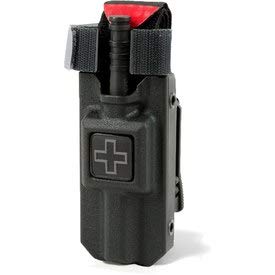
This combo strips away everything except the two items that matter most: a genuine NAR Combat Application Tourniquet Gen 7 and a rigid Eleven 10 RIGID TQ Case. The CAT Gen 7 is the same tourniquet used by U.S. military forces and recommended by the Committee on Tactical Combat Casualty Care. The nylon-reinforced case adds a hard plastic shell that protects the windlass from impacts and keeps the tourniquet from unrolling inside a pack.
The case measures 7.5 inches tall and features a MOLLE/PALS-compatible back panel plus a belt loop, so you can mount it vertically or horizontally on a duty belt, plate carrier, or backpack strap. A buckle closure keeps the tourniquet secured during movement, and the gray cross on black case design makes it visually distinct from other pouches at a glance.
Because this is a tourniquet-and-case-only setup, you are responsible for sourcing your own hemostatic gauze, gloves, and shears. That makes it ideal for professionals who already carry a full IFAK and simply want a redundant or primary tourniquet accessible on the belt. For civilians building a complete kit from scratch, you will need to supplement this with a wound packing component and trauma shears to have a truly functional bleeding control system.
Why it’s great
- Genuine NAR CAT Gen 7 — not a counterfeit or unknown-brand copy
- Hard-shell rigid case protects windlass from breakage during daily carry
- MOLLE and belt-loop compatible for multiple mounting configurations
Good to know
- No gauze, gloves, or shears included — must be purchased separately
- Case is designed specifically for CAT form factor; other TQ brands may not fit
3. Adventure Medical Kits Trauma Pak Pro with QuikClot

The Trauma Pak Pro crams a serious bleeding control capability into a package that squeezes into a BDU pocket. The centerpiece is the QuikClot Flexible Gauze, which uses kaolin to accelerate natural clotting — this is the same active ingredient used in combat gauze. The kit also includes a SWAT-T tourniquet that doubles as a pressure bandage, a trauma pad, nitrile gloves, and duct tape for field-expedient chest seal construction.
The outer pouch uses a Velcro closure and has a small loop on the back for belt carry. At this size, it disappears into a cargo pocket or a backpack admin panel. The included trauma response instructions are printed on the pouch itself, removing the need to fumble with a separate card. The SWAT-T tourniquet is the key trade-off — it is multi-use but requires significantly more tightening force than a windlass tourniquet to achieve arterial occlusion. Users comfortable with SWAT-T mechanics will find it adequate; novices may struggle to reach full occlusion under stress.
The kit ships with a smaller QuikClot roll rather than the full Z-fold combat gauze size preferred by military medics. Several users report replacing the included gauze with a longer Z-fold roll and adding a pair of shears and a marker. Consider this a strong foundation kit that benefits from a few targeted upgrades depending on your threat model and training level.
Why it’s great
- Includes authentic QuikClot kaolin gauze for active hemorrhage control
- Ultra-compact Velcro pouch fits in a cargo pocket or small pack
- Instructions printed on pouch eliminate the need for a separate guide
Good to know
- SWAT-T TQ requires more training for proper occlusion vs. a windlass
- QuikClot roll is smaller than standard Z-fold combat gauze
4. MediTac Basic Bleeding Control Pack

MediTac builds this pack around three hemorrhage control tools — a SWAT-T tourniquet, an Israeli-style emergency bandage with a pressure applicator, and two compressed crinkle-weave gauze dressings. The combination covers both extremity and junctional bleeding scenarios. The Quick Tear feature on the non-resealable package allows fast access, which is critical when fine motor skills degrade under stress.
Beyond the core bleeding components, the kit adds a mylar emergency blanket (preserving 90 percent of body heat to manage shock), a 7.5-inch pair of shears, one pair of large nitrile gloves, three antiseptic wipes, and a permanent marker. The inclusion of the mylar blanket is a smart addition — hypothermia accelerates coagulopathy in trauma patients, so keeping the patient warm is a legitimate medical priority.
At roughly 14 ounces total weight, this pack is heavier than a minimalist pocket kit but still fits into a standard IFAK pouch or medium-sized backpack. The SWAT-T tourniquet remains the same limitation as other kits using strap-style TQs — it works but demands deliberate training. The shears are functional for cutting through clothing and bandages, though users looking for premium shears might swap in a pair of titanium-bladed trauma shears.
Why it’s great
- Includes an Israeli pressure bandage with a dedicated pressure applicator
- Mylar blanket addresses hypothermia alongside hemorrhage control
- Quick Tear packaging for rapid deployment under stress
Good to know
- SWAT-T tourniquet requires practice to apply with full occlusion tension
- Non-resealable pack — contents lose sterile protection once opened
5. Vital House 346-Piece First Aid Kit with Tourniquet
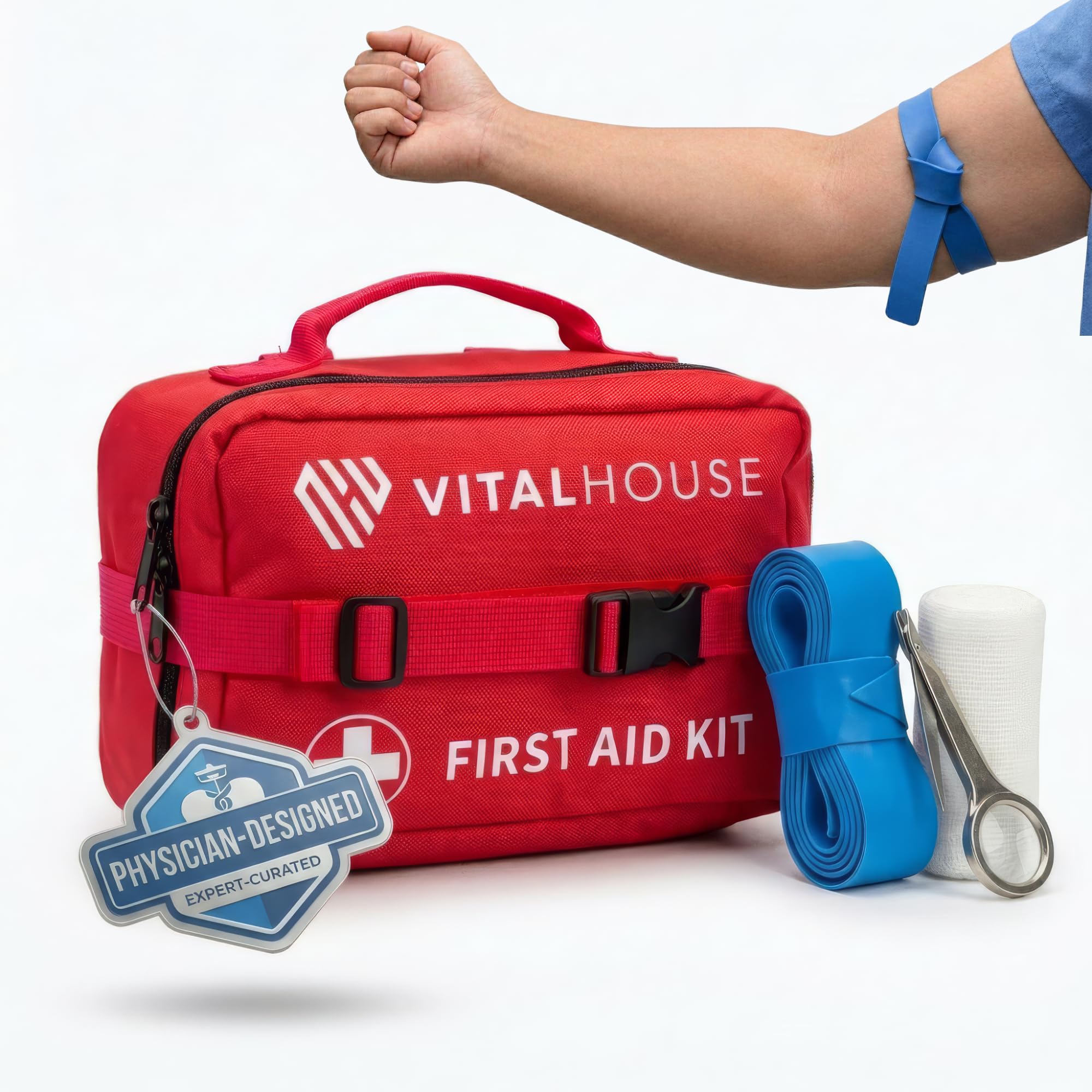
This physician-designed kit bridges the gap between a standard first aid kit and a dedicated trauma response system. The 346 pieces include a TPE tourniquet, Steri-Strips, sterile gauze, wound dressings, a CPR mask, instant cold packs, burn care supplies, and a battery-free emergency flashlight. The breadth of components makes it a true general-purpose kit that also addresses life-threatening bleeds.
The water-resistant nylon case is TSA-friendly and organized with multiple internal compartments. The included step-by-step first aid guide is laminated and color-coded, which helps untrained family members locate the right tool during an emergency. For bleeding control specifically, the TPE tourniquet is functional but not CoTCCC-approved — it lacks the windlass-and-strap design of the CAT or SOF-T. It will slow venous bleeding but may not achieve full arterial occlusion in all limb sizes.
For a family car kit or home emergency drawer, this is an excellent multi-purpose option that covers everything from splinters to serious lacerations. However, if your primary threat environment involves gunshot wounds, heavy machinery, or wilderness scenarios where arterial bleed risk is high, supplement this kit with a dedicated CAT or SOF-T tourniquet and a roll of hemostatic gauze to close the gap between general first aid and true hemorrhage control readiness.
Why it’s great
- Comprehensive 346-piece kit covers everyday injuries and trauma scenarios
- Water-resistant nylon case with organized compartments for quick access
- Designed by a physician with step-by-step printed guide included
Good to know
- TPE tourniquet is not CoTCCC-approved for arterial hemorrhage
- No hemostatic gauze — bleeding control relies on pressure and bandaging alone
6. Rescue Essentials Pocket Trauma Kit

The Rescue Essentials Pocket Trauma Kit is designed for officers and civilians who need a bleeding control solution that fits in a front pocket or patrol bag without adding noticeable bulk. At only 3 ounces and measuring roughly 5 by 7 inches, it is among the most compact complete kits available. The vacuum-sealed packaging with tear notches protects the contents from moisture and dirt while enabling quick deployment.
The contents include a SWAT-T tourniquet, Z-fold gauze dressing, one pair of nitrile gloves, and three feet of duct tape — just four components, each selected for simplicity. The SWAT-T can function as a tourniquet, a pressure bandage when combined with the Z-fold gauze, or as an elastic wrap for securing dressings. The duct tape can be used to create an occlusive dressing for chest wounds or to secure bandages in place.
This is a pure minimalist trauma kit. It contains no hemostatic agent, no shears, and no marker. The SWAT-T requires deliberate training to apply correctly for arterial occlusion. For users who already carry a separate tourniquet and want a pocket-sized supplemental kit for wound packing and pressure dressings, this fills a niche. For someone buying their first bleeding control kit, the lack of a windlass tourniquet and hemostatic gauze represents a capability gap that should be addressed with a more comprehensive option.
Why it’s great
- Extremely lightweight (3 oz) and compact for front-pocket everyday carry
- SWAT-T doubles as tourniquet and pressure bandage for multiple uses
- Vacuum-sealed with tear notches for protected, rapid deployment
Good to know
- No hemostatic gauze — wound packing relies on plain Z-fold dressing
- SWAT-T requires dedicated training for effective arterial occlusion
7. SOF Tourniquet (Generation 5) by TacMed Solutions
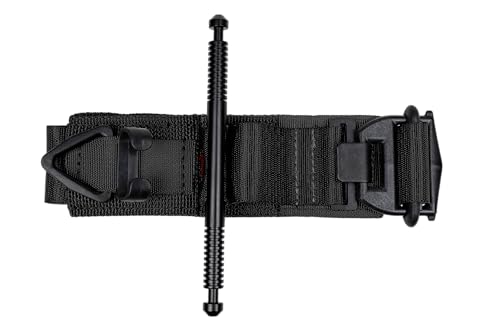
The SOF Tourniquet Gen 5 is one of the few CoTCCC-approved windlass tourniquets on the market, alongside the CAT. It uses a metal windlass rod instead of plastic, which some users prefer for durability and consistent torque application. The band is wider than the CAT and incorporates a friction-adaptive buckle that resists slipping even when the band gets wet or blood-soaked.
At 3.68 ounces, it is slightly lighter than the CAT Gen 7 and has a lower profile when stowed, making it easier to fit into compact IFAK pouches. A clear area on the band is provided for writing the application time with a permanent marker, which is critical for medical handoff. The one-handed application procedure is similar to the CAT — thread the band through the buckle, tighten, twist the windlass, and secure the rod in the windlass clip.
Because this product is sold as a single tourniquet with no additional components, it is best suited for professionals or prepared civilians who already maintain a dedicated IFAK or bleeding control pouch. If you are starting from scratch, you will need to add hemostatic gauze, gloves, shears, and a marker to build a complete bleeding control system. The metal windlass adds confidence in extreme temperatures and repetitive use, but for a single-use emergency kit, the plastic windlass of the CAT performs identically.
Why it’s great
- CoTCCC-approved with a proven track record in military and tactical use
- Metal windlass provides consistent torque and resists breakage
- Lower profile than CAT for compact IFAK storage
Good to know
- Single component only — no gauze, gloves, or carrying case included
- One-handed application requires practice to match CAT speed
FAQ
How do I know if the tourniquet in my kit is CoTCCC approved?
Can I reuse a bleeding control kit after the vacuum seal is broken?
Do I need hemostatic gauze or will plain gauze work for severe bleeding?
What is the shelf life of a vacuum-sealed bleeding control kit?
Final Thoughts: The Verdict
For most users, the bleeding control kit winner is the Stop The Bleed Basic Kit because it includes a CoTCCC-approved C-A-T Gen 7 tourniquet and kaolin hemostatic gauze in a tamper-proof vacuum package — no compromises on the two components that determine field success. If you want instant belt-ready access without the need for a separate pouch, grab the CAT + Rigid Tourniquet Case Combo. And for the most compact pocketable setup that still packs QuikClot kaolin gauze, nothing beats the Adventure Medical Kits Trauma Pak Pro.