Every rattle, crinkle, and squeak shapes a newborn’s neural pathways faster than any screen ever will. The right developmental toy engages multiple senses at once, building motor control, language recognition, and spatial awareness during the critical first 18 months. Choosing poorly means lost opportunities — and a bored baby who finds the box more interesting than the toy itself.
I’m Emma — the founder and writer behind Baby Bangs. I analyze pediatric development research alongside real-world parent reviews to separate Montessori-approved essentials from the plastic clutter that ends up in the donation bin by month three.
This guide breaks down five parent-tested picks that target specific developmental windows, from kick mats that teach cause and effect to walkers that build balance. baby toys for development need to hit the right sensory and motor targets without overwhelming a tiny nervous system.
How To Choose The Best Baby Toys For Development
Not every colorful plastic object qualifies as a developmental tool. The best options target a specific milestone — tummy time stamina, pincer grasp precision, or cause-and-effect logic. A toy that does one thing well beats a noisy battery-fest that does ten things poorly.
Match the Toy to the Developmental Window
A 3-month-old needs high-contrast visual stimulation and easy-grasp rattles, not shape sorters. By 9 months, stacking cups and pull-string toys strengthen the fine motor control needed for self-feeding. Buying too far ahead risks frustration; buying too late misses the neural plasticity window. Check the manufacturer’s minimum age and the specific skill each toy targets.
Prioritize Material Safety Over Flashy Features
Babies mouth everything — literally everything. Food-grade silicone, BPA-free ABS plastic, and organic cotton construction matter more than app connectivity or light shows. Look for CPSIA compliance and ASTM F963 certification. Soft vinyl and painted surfaces can hide phthalates and lead; stick with brands that publish their third-party lab results.
Look for Open-Ended Play Potential
The best developmental toys don’t have a single “correct” use. Stacking blocks become nesting cups become bath scoops become building towers. Toys with multiple modes or growth-adaptive features extend useful life from weeks to months. A kick pad that works on the crib, during tummy time, and later as a seated floor toy earns its shelf space.
Quick Comparison
On smaller screens, swipe sideways to see the full table.
| Model | Category | Best For | Key Spec | Amazon |
|---|---|---|---|---|
| Plunack 6-in-1 Montessori Set | Premium Bundle | Multi-skill development 6–12 months | 27 pieces including food-grade silicone teethers | Amazon |
| VTech Sit-to-Stand Walker | Premium Walker | Balance and early walking skills | Two-speed control + removable activity panel | Amazon |
| Baby Einstein Kick & Explore Pad | Mid-Range | Cause-and-effect through kicking | 5 kick buttons with lights and 3-play modes | Amazon |
| Urban Kiddy Alphabet Cards | Mid-Range | Language exposure and letter recognition | 26 soft cotton cards with zippered case | Amazon |
| Qirptey Montessori 4-in-1 Set | Budget Bundle | Shape sorting and stacking for 6–18 months | Food-grade silicone blocks + shape sorter bin | Amazon |
In‑Depth Reviews
1. Plunack 6-in-1 Montessori Baby Toys Set
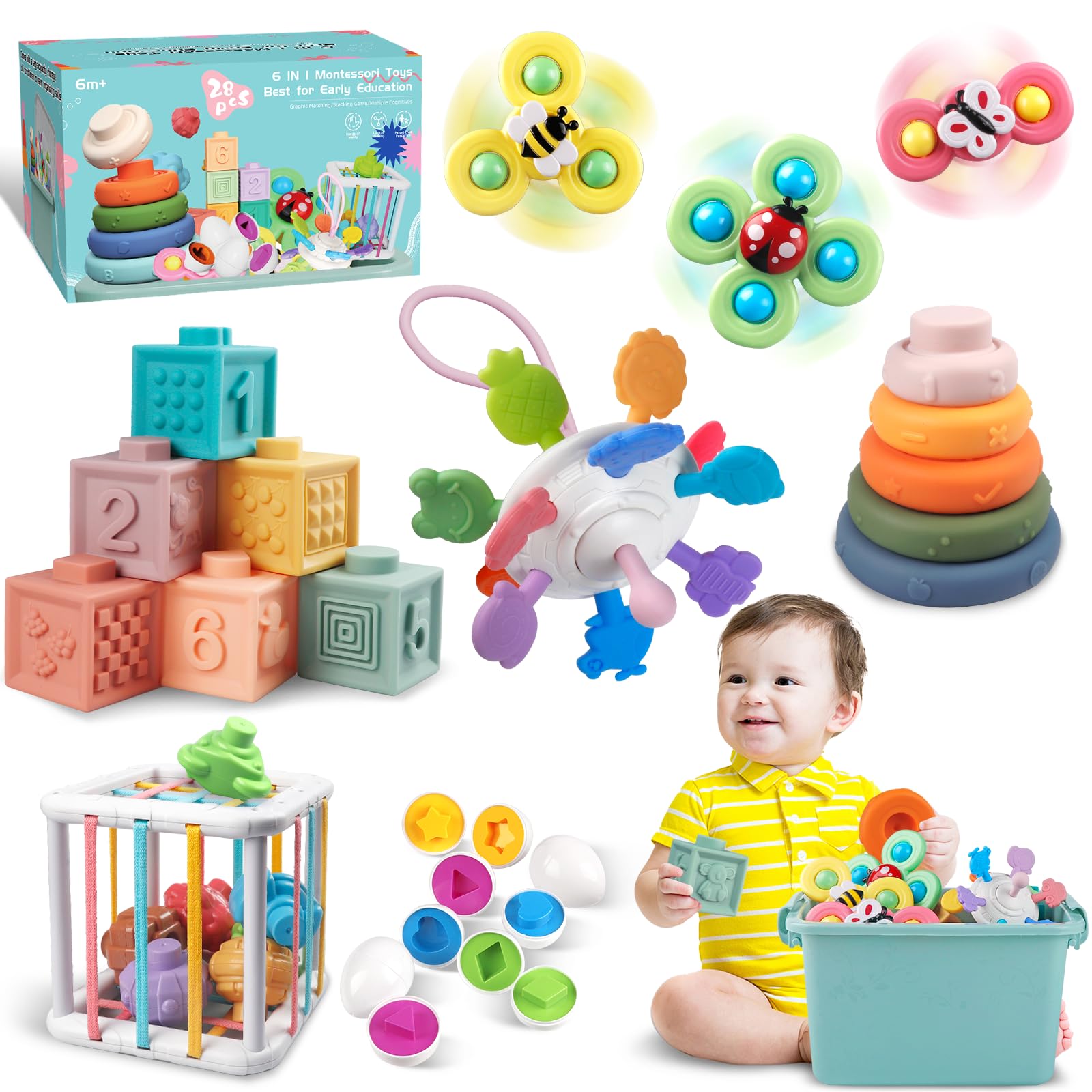
This 6-in-1 bundle packs more developmental value into one box than most parents will buy across two birthdays. You get 12 matching eggs for shape and color sorting, 6 soft blocks, 5 stacking rings, 3 suction cup spinners, a pull-string sensory toy, and an exploration bin that doubles as storage. Every piece is crafted from food-grade silicone or BPA-free ABS plastic, certified to CPSIA and ASTM F963 standards — so teething babies can gnaw without risk. Pediatric OTs specifically recommend the pull-string component for strengthening the pincer grasp starting at 6 months.
The suction cup spinners stay put on highchair trays and bathtub walls, keeping babies engaged during meals and bath time. The shape sorter eggs teach 12 colors across 6 distinct shapes, building spatial reasoning through trial and error. Real parents report that the set occupies babies for long stretches while the included storage bin keeps all 27 pieces organized for travel or daycare. The only minor complaint involves the teething ball shape being slightly flat on the ends, but seven of the eight included toy types receive consistent 5-star reviews.
For a single purchase that covers stacking, sorting, pulling, spinning, and sensory exploration from 6 to 12+ months, this set eliminates the need for separate toy purchases. The storage bin alone justifies the premium over piecemeal alternatives. It’s the most complete developmental toolkit in this guide, backed by third-party safety testing and genuine Montessori-inspired design principles.
Why it’s great
- 27-piece set covers 6+ distinct developmental skills in one purchase
- Food-grade silicone and BPA-free plastic with third-party lab certification
- Suction cup spinners work on highchair trays, windows, and bath walls
- Storage bin keeps everything organized and portable for travel
Good to know
- Teething ball shape is flatter than expected — some babies prefer rounded options
- Set may be overwhelming for parents who prefer fewer pieces initially
2. VTech Sit-to-Stand Learning Walker

The VTech Sit-to-Stand Learning Walker earns its reputation as the gold standard for transition from crawling to walking. Its wide wheelbase and integrated wheel stoppers prevent sliding on hardwood and carpet, giving cautious first-steppers a stable platform. The detachable activity panel works as a floor toy for seated play, then reattaches for on-the-go fun. Five piano keys teach musical notes, while a telephone handpiece encourages pretend-play conversations that build language skills.
Three shape sorters, light-up buttons, and colorful spinning rollers target fine motor development and hand-eye coordination. The two-speed control switch lets parents adjust rolling resistance as baby gains confidence — slow for early wobblers, faster for experienced cruisers. The panel teaches letters, numbers, and colors through interactive songs and phrases, keeping babies engaged from 6 months through the toddler years. Real parents consistently report that the walker helped their children walk independently earlier than expected, with one grandmother noting her granddaughter cruised at 9.5 months.
Assembly takes under 15 minutes with included batteries. The plastic construction feels sturdy without sharp edges, and the 35-pound weight limit accommodates most toddlers well past their walking debut. The only trade-off is size — this walker requires floor space and doesn’t collapse flat for storage. But for a tool that serves as a floor activity center, stationary stand, and rolling walker in one, the footprint is a fair compromise.
Why it’s great
- Wheel stoppers prevent sliding on hardwood and tile surfaces
- Two-speed control adjusts resistance as walking skills improve
- Removable panel works as floor toy for seated play
- Teaches letters, numbers, colors, and music through interactive play
Good to know
- Large footprint requires dedicated floor space — doesn’t fold flat
- Battery compartment requires screwdriver for access
3. Baby Einstein Ocean Explorers Kick & Explore Pad

The Neptune’s Kick & Explore Musical Kick Pad turns baby’s natural kicking reflex into a cause-and-effect lesson. Five kick buttons activate lights, music, and sounds that teach cause-and-effect logic — baby kicks, something happens. Three distinct play modes offer different learning tracks: Melody Mode plays pre-composed tunes, Piano Mode lets baby create original marimba sounds, and Discovery Mode teaches colors, numbers, and shapes in three languages.
The soft, colorful mat adapts to three physical positions: attach to a crib for reclined kicking play, detach for tummy time floor use, or set flat for seated exploration. This multi-position design extends the toy’s useful life from the newborn stage through crawling. Real parents note that the ocean theme and gentle music kept babies engaged longer than expected, with one reviewer reporting continued interest at 12 months. The kick pad is also lightweight enough to pack in a diaper bag for travel or restaurant entertainment.
The primary drawback is the missing volume control — several parents describe the sound level as intrusive, especially in small apartments or during nap transitions. The toy requires 3 AA batteries, and there’s no auto-shutoff feature, so batteries drain faster if baby leaves lights on. Despite these quirks, the cause-and-effect training and multi-language exposure make this a strong pick for parents who want to introduce early STEM concepts through gross motor play.
Why it’s great
- Teaches cause-and-effect logic through kicking and tapping
- Three positions: crib, tummy time, and seated floor play
- Discovery Mode teaches colors, numbers, and shapes in 3 languages
- Lightweight and portable for travel or diaper bag storage
Good to know
- No volume control — sound level may be loud for small spaces
- Batteries drain faster with no auto-shutoff feature
4. Urban Kiddy Zoo Alphabet Cards

The Urban Kiddy Zoo Alphabet Cards trade paper flashcards for soft, cotton construction that survives chewing, throwing, folding, and bending. Each of the 26 cards features a letter paired with a zoo animal illustration, turning early literacy into a tactile experience. The 4.75 by 4.25-inch size fits perfectly in small hands, and the zippered crate-style case keeps the set organized for diaper bag travel or car rides.
The educational objective covers cognitive skills, language skills, and motor skills simultaneously. Babies build vocabulary by associating letters with animals, while the physical act of picking up and turning cards strengthens fine motor control. The cotton fabric is machine-washable — a critical feature for daycare facilities or teething toddlers who drool on everything. Real parents report that the cards hold up to daily use in preschool classrooms, with tight stitching that prevents fraying even after repeated wash cycles.
The storage case fabric is noticeably thinner than the cards themselves, which some daycare reviewers flagged as less durable than expected. The case does zip shut securely, but heavy washing may shorten its lifespan. The cards themselves are near-indestructible, and the unisex animal theme works equally well for boys and girls. For parents seeking screen-free language exposure before preschool, these soft cards offer a washable, chewable alternative to board books.
Why it’s great
- Machine-washable cotton construction survives chewing and bending
- 26 cards pair letter recognition with zoo animal vocabulary building
- Compact zippered case keeps set organized for travel or daycare
- Safe for teething babies — no sharp edges or choking hazards
Good to know
- Storage case fabric is thinner than cards — may not survive heavy washing
- Case zipper could be more robust for frequent classroom use
5. Qirptey Montessori 4-in-1 Baby Toys Set
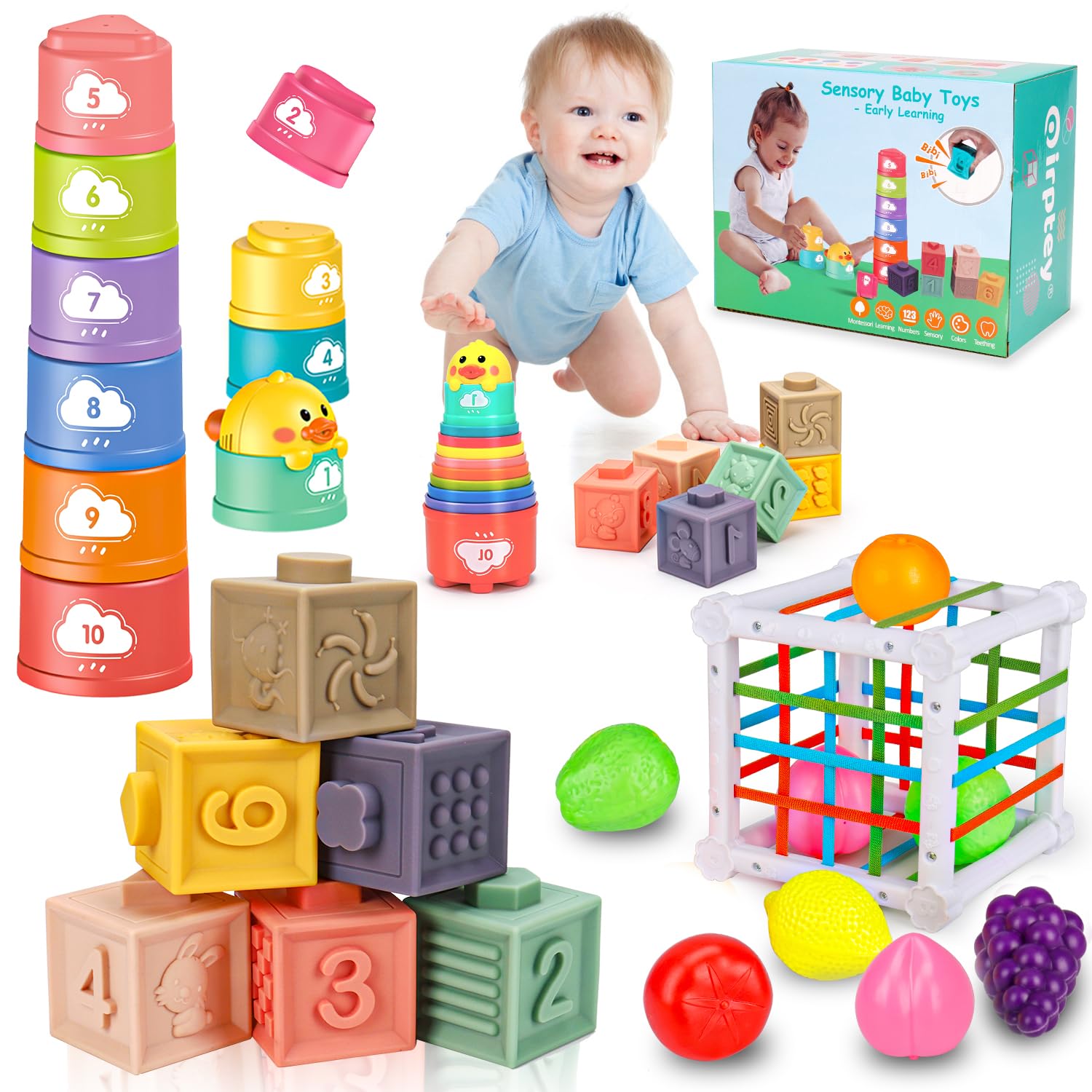
The Qirptey 4-in-1 Montessori set bundles stacking blocks, stacking cups, a shape sorter bin, and teething toys into one package designed for babies 6 to 18 months. The stacking blocks feature embossed animal textures and numbers on the bottom, adding a matching-game layer to the stacking activity. The shape sorter bin uses fruit-shaped pieces — guava, orange, peach, tomato, lemon, grape — to teach color and shape recognition through a playful produce theme.
The food-grade silicone construction and high-quality ABS plastic pass basic safety checks, and the pieces are large enough to pass the choke tube test. The cups double as bath toys, and the blocks can be nested inside each other for space-saving storage. Real parents highlight the bright colors and variety of textures as key engagement factors, with one mother noting that the set kept her 9-month-old son entertained for extended independent play sessions. The teething toys soothe sore gums while building oral motor strength.
The stacking cup height is slightly shorter than some competing sets, and the shape sorter box uses a lightweight plastic that may crack if dropped repeatedly from a highchair. The block count is lower than the Plunack set, making this a better fit for parents who want targeted stacking and sorting without the full 27-piece collection. For its price point, this set delivers solid Montessori-aligned play value, though the box construction could be more robust for the long haul.
Why it’s great
- Four play types (stacking, sorting, teething, cups) in one bundle
- Food-grade silicone and BPA-free ABS construction for safe mouthing
- Fruit-shaped sorting pieces teach color and shape recognition
- Cups and blocks double as bath toys and nesting containers
Good to know
- Shape sorter bin is lightweight plastic — may crack with rough handling
- Cup height is shorter than some competing stacking sets
FAQ
How many toys does a baby really need for proper development?
Can electronic toys like the VTech walker replace traditional wooden Montessori toys?
At what age should I introduce shape sorters and stacking cups?
How do I clean soft cloth toys like the Urban Kiddy alphabet cards?
Final Thoughts: The Verdict
For most users, the baby toys for development winner is the Plunack 6-in-1 Montessori Set because it covers stacking, sorting, pulling, spinning, and sensory exploration in one safely certified bundle. If you want dedicated walking support with interactive learning features, grab the VTech Sit-to-Stand Walker. And for cause-and-effect training that grows from crib to tummy time to seated play, nothing beats the Baby Einstein Kick & Explore Pad.