A stuffy nose at 2 AM, a scrape from a wobbly first step, a fever that spikes without warning — when your baby is uncomfortable, every minute of fumbling for the right tool feels like an hour. The difference between a calm response and a frantic search often comes down to one thing: having a dedicated, baby-first kit within arm’s reach.
I’m Emma — the founder and writer behind Baby Bangs. I’ve spent years analyzing infant health product specifications, from nasal aspirator suction strength to the clinical safety of diaper rash formulations, so you don’t have to guess what actually works for your little one.
After comparing the top contenders on the market, this guide delivers a clear, no-fluff breakdown of the very best baby first aid kit options that equip you for everything from mild sniffles to minor cuts.
How To Choose The Best Baby First Aid Kit
Most first aid kits you find at big-box stores are designed for scraped knees and splinters — not for a newborn’s first fever, an infant’s gas pain, or a congested nose that prevents feeding. A true baby first aid kit must prioritize the unique anatomy and medication safety of infants. Here are the specific factors to weigh.
Infant-Specific Tools Over Generic Bandages
A standard 100-piece kit loaded with assorted bandages is useless if you lack a bulb syringe or nasal aspirator, an infant-safe rectal thermometer, and a pacifier-style medicine dispenser. Prioritize kits that include these specialty items — they solve the actual emergencies of babyhood, not paper cuts.
Medicine Formulation and Dye-Free Status
Look for kits that specify that included medications (pain relievers, gas drops, diaper creams) are free from artificial dyes like Red 40 and Yellow 5, and contain no saccharin or baby aspirin. Many premium baby-first kits now include acetaminophen in infant-appropriate concentrations, which is a genuine lifesaver during late-night fevers.
Organization Under Stress
When your baby is crying, a jumbled pouch of loose items adds panic. A high-quality kit uses layered compartments, clear pouches, or silicone straps that let you grab a thermometer in seconds. The best designs also include a carrying case that can strap to a stroller or fit inside a diaper bag without adding bulk.
Expiration Date Awareness
Every kit with medications or creams has an expiration date. The more perishable items — antibiotic ointments, pain relievers, saline drops — typically expire within one to two years. A smart buyer checks the manufacturing date and simply replaces these items annually, keeping the durable tools (thermometer, aspirator, scissors) for years.
Quick Comparison
On smaller screens, swipe sideways to see the full table.
| Model | Category | Best For | Key Spec | Amazon |
|---|---|---|---|---|
| Frida Baby Mobile Medicine Cabinet | Premium Kit | All-in-one baby travel health | NoseFrida + MediFrida + 10-sec thermometer | Amazon |
| Little Remedies New Baby Essentials | Mid-Range | Infant medicine & symptom relief | 6 items: gas drops, saline, butt paste, gripe water | Amazon |
| The Life Safety Pro Kids Kit | Mid-Range | Child injury & outdoor safety | CPR shield + trauma shears + cold pack | Amazon |
| First Aid Only 298-Piece | Budget | High-volume home/car supplement | 298 pieces including medications & moleskin | Amazon |
| Ever Ready First Aid Fanny Pack | Budget | On-the-go lifeguard/rescue | 72 pieces incl. adult & child CPR masks | Amazon |
In‑Depth Reviews
1. Frida Baby Mobile Medicine Cabinet Travel Kit

This kit earns the top spot because it doesn’t just throw random supplies into a bag — it solves the three most stressful infant health scenarios from a single, well-organized case. The star is the NoseFrida SnotSucker, the nasal aspirator that pediatricians recommend over bulb syringes because you control the suction with your own mouth through a hygienic filter, clearing airways instantly without traumatizing the nasal passage. The MediFrida pacifier-shaped medicine dispenser is equally clever: it directs liquid medication to the inner cheek, reducing spit-ups and making nighttime dosing battles far less frequent.
The included rectal thermometer delivers a fast 10-second reading with a backlit display — essential for those 3 AM fever checks when you need accuracy without fumbling for a light switch. The carrying case uses a silicone strap system that lets you stack two or three layers, keeping the thermometer, aspirator, and dispenser separated so you grab exactly what you need under pressure. The entire unit is compact enough to toss into a diaper bag or stroller caddy.
The only real consideration is that this kit focuses on tools and dispensers rather than a massive supply of bandages or creams. You get the core diagnostic and relief instruments (thermometer, aspirator, medicine delivery) but will still want a separate small stock of infant acetaminophen, diaper cream, and bandage strips for the road. That said, for the pure infant-first “I need to handle a fever, stuffy nose, or medicine dose right now” scenario, nothing else matches this design.
Why it’s great
- Hospital-recommended NoseFrida aspirator with hygiene filters that create a sealed, sanitary system
- Innovative MediFrida dispenser minimizes infant medicine spit-up by targeting the cheek pocket
- 10-second backlit rectal thermometer stores 10 previous readings for fever tracking
- Stackable silicone strap case keeps every tool visible and accessible instantly
Good to know
- Does not include any medications or topical ointments — you must supply your own
- Lacks traditional bandages and gauze for cuts and scrapes
- Replacement filters for the NoseFrida are sold separately and need periodic restocking
2. Little Remedies New Baby Essentials Kit
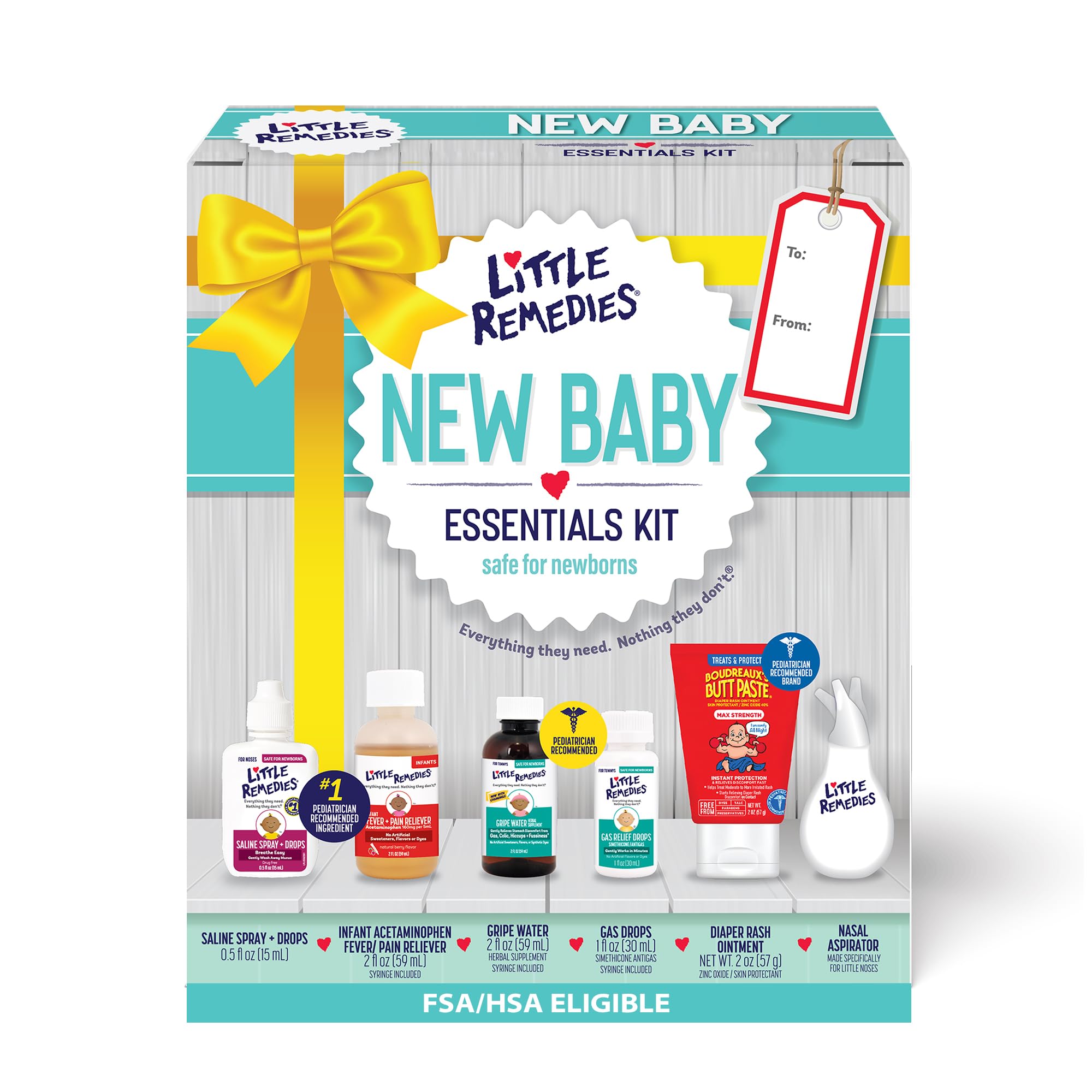
This kit is the closest thing to a “starter pharmacy” for a newborn — it bundles the six most-requested infant relief products into one box, making it the ideal shower gift for first-time parents who don’t yet know what they’ll need. The star inclusions are the Saline Nasal Spray and Drops, the Baby Gas Relief Drops (simethicone-based for colic and gassiness), and the Gripe Water, which together cover the most common sources of infant discomfort in the first three months. The saline helps thin mucus for easier suctioning with a separate aspirator, while the gas drops work quickly to break up trapped bubbles that cause crying fits.
What elevates this kit above a random shelf grab is the ingredient integrity. Every single product is explicitly free from baby aspirin, ibuprofen, saccharin, artificial flavors, and the three most common artificial dyes (Red 40, Yellow 5, Yellow 6). That matters because an infant’s system is far more sensitive to these additives, and many parents actively avoid them. The kit also includes Boudreaux’s Butt Paste Maximum Strength diaper rash cream, which contains 16% zinc oxide — a clinically effective concentration for preventing and healing irritation.
The travel-size bottles mean you can test each product before committing to full-sized versions, and the compact packaging fits easily into a diaper bag or nursery drawer. The limitation is that this is purely a “medicine and relief” kit — you won’t find a thermometer, nasal aspirator, bandages, or any first aid tools here. You’ll still need a separate tool pack (like the Frida Baby kit above) to complete your preparedness system.
Why it’s great
- All six products are free from artificial dyes, saccharin, and baby aspirin — infant-safe formulation
- Includes both gas relief drops and gripe water for comprehensive tummy comfort
- Boudreaux’s Butt Paste provides clinical-grade diaper rash protection with 16% zinc oxide
- Travel-size bottles make it easy to try each product without buying full-size bottles
Good to know
- No tools included — you need a separate nasal aspirator and thermometer
- Bottles are small and will run out faster than standard retail sizes
- Does not contain any bandages, gauze, or wound care items
3. The Life Safety Pro Portable First Aid Kit for Kids

Designed by a firefighter-paramedic who is also a dad, this kit shifts the focus from general first aid to injury scenarios that specifically apply to mobile toddlers and young children. Inside the water-resistant, double-stitched case you’ll find a CPR face shield (a rarity in baby-focused kits), trauma shears, an instant cold pack, sterile eye pads, and burn dressing — items that matter when a child falls off a bike, gets a splinter at a campsite, or burns a finger on a camp stove. The inclusion of a full-color treatment booklet written by the designer gives real confidence to parents who freeze in emergencies.
The kit is smartly organized with well-labeled, see-through pockets and a front zipper compartment that can hold emergency medication like infant acetaminophen or antihistamine. It meets TSA carry-on guidelines, so it can travel on a plane or live permanently in a stroller caddy. The case itself is made with strong double-stitched fabric and a durable handle, plus mounting straps that let you attach it to a bike, backpack, or golf cart for outdoor adventures. The cute bandage designs help reduce a toddler’s fear during treatment.
At this price point, you’re paying for the thoughtful curation of trauma-appropriate supplies and the paramedic-level quality of each component. It’s thicker and more rugged than typical baby kits — less of a nursery companion and more of a true field-ready first aid pack. The trade-off: it does not include any medication or infant-specific relief items (no gas drops, no saline, no thermometer), so you will need to supplement for fevers and congestion.
Why it’s great
- Paramedic-designed kit with trauma shears, CPR shield, burn dressing — not just bandages
- Water-resistant, double-zipper case with mounting straps attaches to strollers or bikes
- Full-color treatment booklet reduces panic during real emergencies
- TSA-approved size fits in diaper bags, backpacks, and under airplane seats
Good to know
- No infant medications or fever tools — primarily an injury-focused kit
- Bulky compared to slim medicine pouch kits; takes up dedicated space in a bag
- Bandage count is modest; heavier on trauma tools than adhesive supply
4. First Aid Only 298-Piece All-Purpose Emergency Kit

This massive 298-piece kit is the antithesis of a curated baby-first kit — it’s a volume play designed for the car, home, or office, and its strength lies in sheer supply count. You get roughly 100 adhesive bandages in various sizes, plus antibiotic ointment packets, BZK antiseptic towelettes, burn cream packets, gauze rolls and pads, wound closures, an instant cold pack, and even adult pain relievers (acetaminophen, aspirin, ibuprofen). The soft-sided zippered case opens into two organized layers with clear plastic pockets, making it easy to find a specific item.
For a parent, this kit functions best as a “refill station” that sits in a cabinet and replenishes your diaper bag or stroller kit. It is not baby-specific — the medications are adult-strength, there is no infant thermometer, no nasal aspirator, and no gas relief. But its value lies in having a massive backup of sterile wound care supplies that you can restock into smaller daily kits. The moleskin included is excellent for blisters developed from new baby shoes, and the scissors and tweezers (though the tweezers are plastic and weak) are helpful for splinter removal.
The main drawback for a baby-focused household is that many items expire within a year, including the ointments and oral medications. You will need to rotate these annually. Additionally, the kit contains no child-dosage labeling, so you must separate any medication before it accidentally gets used on an infant. If you view this as a bulk consumables pack rather than a baby-ready emergency solution, it delivers tremendous value for the money.
Why it’s great
- High piece count with ~100 bandages, gauze, ointments, and cold packs — great for restocking smaller kits
- Includes both acetaminophen, aspirin, and ibuprofen for adult use in the household
- Two-layer zippered case with clear pockets allows easy visual scanning for items
- Compact enough for a glove box or emergency drawer despite the volume
Good to know
- Completely lacks infant-specific tools like a thermometer, nasal aspirator, or gas drops
- Medications are adult strength and packaged without child-dosage instructions
- Plastic tweezers are weak and may fail on deep splinters
- Many consumable items expire within one year, requiring annual rotation
5. Ever Ready First Aid Fanny Pack with CPR Combo Masks

This 72-piece fanny pack leans heavily into the “outdoor responder” role, with a red-and-white design that is instantly recognizable and a three-compartment water-resistant shell. Its standout feature is the inclusion of both adult and child CPR combo masks — a critical addition for any parent who spends time near water, at the park, or in any environment where a drowning or choking incident is possible. The mask bag detaches from the fanny pack and clips to a belt or strap, keeping rescue equipment immediately accessible while the main pack stores the rest of the supplies.
The 72 pieces include standard wound care items (bandages, gauze, gloves, antiseptic wipes) plus trauma-oriented gear like a space blanket, a splint, and burn dressing. The adjustable strap with a quick-release buckle makes it easy to put on or remove one-handed — useful when you are holding a child or managing a scene. The water-resistant zippers and heavy-duty fabric mean this pack can survive a splash at the beach or a rainstorm without the interior contents getting soaked.
For a baby-specific household, this kit is overkill in some areas (it is designed for lifeguards and pool rescues) and lacking in others (no infant thermometer, no medication, no baby-specific tools). It is best used as a specialized “pool day” or “hiking” supplement to your main baby first aid kit. The fanny pack format is genuinely convenient for keeping on your body while pushing a stroller — you never have to set it down or lose track of it. The plastic tweezers and the absence of an instant cold pack are noted omissions in user feedback.
Why it’s great
- Includes separate adult and child CPR masks — a critical safety feature missing from 90% of baby kits
- Water-resistant three-compartment design with quick-release buckle, ideal for poolside or beach days
- Detachable mask pouch clips to a strap for immediate access during an emergency
- Sturdy construction survives drops, overstuffing, and water exposure
Good to know
- Lacks infant-specific items like a thermometer, bulb syringe, gas drops, or any medication
- No instant cold pack or tweezers included in the standard 72-piece configuration
- Fanny pack format may feel bulky or unfashionable for everyday nursery use
- Some supplies (non-waterproof) require plastic baggies for true poolside durability
FAQ
Can I use a standard adult first aid kit for my baby?
How often should I replace the items in a baby first aid kit?
What is the most important item missing from most baby first aid kits?
Final Thoughts: The Verdict
For most users, the baby first aid kit winner is the Frida Baby Mobile Medicine Cabinet because it solves the three most stressful baby health emergencies — fever, congestion, and medication refusal — with tools designed specifically for infant anatomy. If you want comprehensive medication coverage from day one, grab the Little Remedies New Baby Essentials Kit for its dye-free, doctor-trusted relief lineup. And for outdoor adventures or trauma readiness, nothing beats the paramedic-designed Life Safety Pro Kids Kit with its CPR shield and trauma shears.