The split-second difference between panic and action defines every choking emergency. Standard abdominal thrusts remain the first-line protocol, but when an obstruction refuses to budge or the victim is too frail for forceful thrusts, a dedicated anti-choking device becomes the critical backup that shaves seconds off rescue time.
I’m Emma — the founder and writer behind Baby Bangs. I’ve spent years analyzing emergency airway products, from suction-based rescue devices to comprehensive airway kits, breaking down the seal integrity, suction power, and sizing features that separate reliable gear from shelf clutter.
This guide cuts through the noise to compare the most trusted options for home, travel, and professional kits, helping you confidently choose the best anti-choking device for your family’s safety plan.
How To Choose The Best Anti-Choking Device
Not every anti-choking device works the same way. Some create active suction to pull an obstruction out; others provide a clear airway seal for rescue breathing after the blockage is cleared. Understanding the mechanism and your intended environment — home, car, or professional medical bag — shapes the right choice.
Active Suction vs. Airway Adjuncts
A suction-based device like the LifeVac uses a non-powered piston to create negative pressure, literally pulling the stuck object back into the mouth. Airway adjunct kits (like oropharyngeal airways and CPR masks) are used *after* the airway is cleared to keep it open and support rescue breaths. Decide which function you need most: rescue from active choking or post-blockage airway management.
Mask Sizing and Seal Quality
A poor seal means lost suction pressure and failed rescue. Premium devices include separate masks for children (ages 1+) and adults, with soft, pliable bladder edges that conform to facial contours. One-way valves with bacterial filtration efficiency (BFE) ratings above 99% prevent exhaled air from re-entering the rescuer’s mouth, a non-negotiable safety feature.
Portability and Storage
Choking emergencies happen in restaurants, at parks, and in cars — not just in the kitchen. Compact hard cases with belt clips or wrist straps encourage you to carry the device daily. If you travel frequently or split time between homes, a travel-sized kit with a soft pouch fits easier in a diaper bag or glove compartment.
Quick Comparison
On smaller screens, swipe sideways to see the full table.
| Model | Category | Best For | Key Spec | Amazon |
|---|---|---|---|---|
| LifeVac Home Kit | Suction Device | Primary home rescue | Suction piston, adult & child masks | Amazon |
| LifeVac Travel Kit | Suction Device | On-the-go carry | Suction piston, yellow travel case | Amazon |
| LifeVac Home 2-Pack | Suction Device | Multi-location families | Suction piston, 2 complete units | Amazon |
| Endure Complete Airway Kit | Airway Kit | Medical professionals | 9 OPA sizes, 3 NPA sizes | Amazon |
| WNL CPR Mask 5-Pack | CPR Mask Kit | Training & emergency use | Adult & infant mask, one-way valve | Amazon |
| MCR Medical CPR Mask 5-Pack | CPR Mask Kit | Pocket carry, bulk storage | Latex-free mask, hard case | Amazon |
| KeepGoing Travel First Aid Kit | General First Aid | Everyday bumps & scrapes | 130 pieces, latex-free bandages | Amazon |
In‑Depth Reviews
1. LifeVac Home Kit
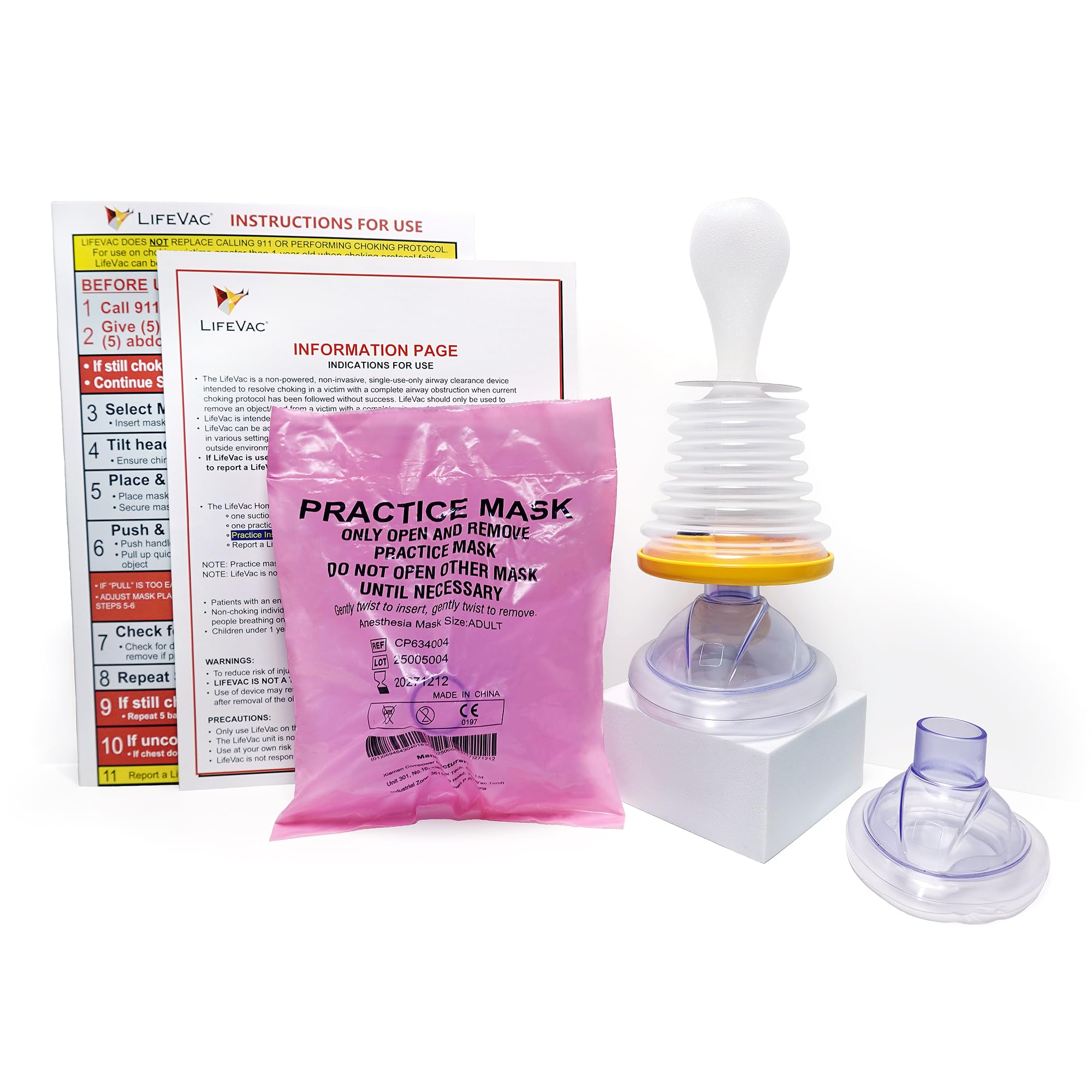
The LifeVac Home Kit is the gold standard for active choking rescue. Its non-powered suction piston generates enough negative pressure to dislodge a complete airway obstruction when back blows and abdominal thrusts fail. The kit includes two mask sizes — one for adults, one for children ages 1 and older — so a single unit covers the whole household.
The one-way valve incorporates a filter that meets ASTM BFE 99% standards, meaning bacteria and particulates stay trapped during the push-and-pull rescue action. At 6.7 ounces total, the device stores easily in a kitchen drawer or quick-grab cabinet. Thousands of documented saves reinforce its real-world reliability, and the clear instruction sheet mounted to the case removes guesswork under duress.
As a second-line treatment, LifeVac explicitly directs users to call 911 and attempt standard protocols first. This positioning keeps it as a true backup rather than a replacement for CPR training. The device requires no batteries, no assembly, and has no expiration date — just periodic mask replacement after use.
Why it’s great
- Proven suction piston with thousands of reported saves
- Dual adult/child masks in one ready-to-go kit
- Battery-free, zero-maintenance design for long shelf life
Good to know
- Higher upfront investment than basic CPR mask packs
- Masks are single-patient use and require replacement after a rescue
- A home kit for each floor of your house is advisable
2. LifeVac Yellow Travel Kit
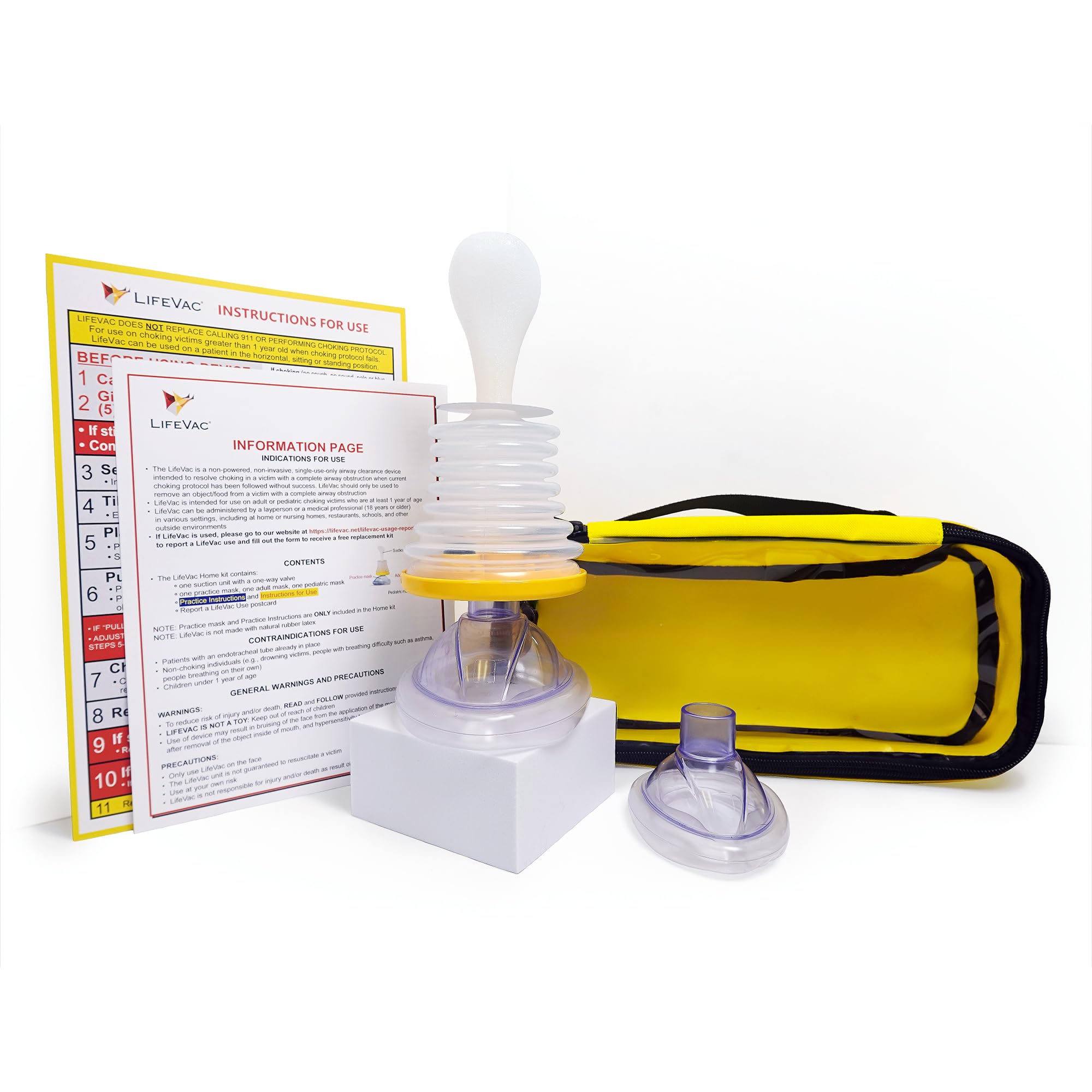
The Travel Kit packs the identical LifeVac suction piston and dual adult/child masks into a slimmer yellow case that fits a backpack, glove compartment, or diaper bag. Weighing just under 11 ounces, it sacrifices nothing in rescue capability while gaining a form factor that encourages daily carry. The bright yellow color aids quick visual location in cluttered bags.
All safety specs match the Home Kit: ASTM-compliant one-way valve filter, latex-free materials, and the same simple push-pull user interface that requires zero prior training. The travel designation simply changes the packaging — the internal mechanism is interchangeable with the home version, so spare masks bought for one work with the other.
Families who split time between multiple residences or travel frequently find this kit eliminates the risk of leaving safety at home. Paramedic reviews in the feedback highlight that the device’s non-invasive design works reliably on elderly patients with fragile ribs who cannot tolerate abdominal thrusts, broadening the rescue population significantly.
Why it’s great
- Identical life-saving mechanism in a portable package
- High-visibility yellow case for quick spotting
- Compatible with LifeVac replacement masks and accessories
Good to know
- Same price point as the home kit despite reduced case size
- Travel case does not accommodate extra mask storage
- Still requires user to be trained on Heimlich as first-line response
3. LifeVac Home Kit 2-Pack
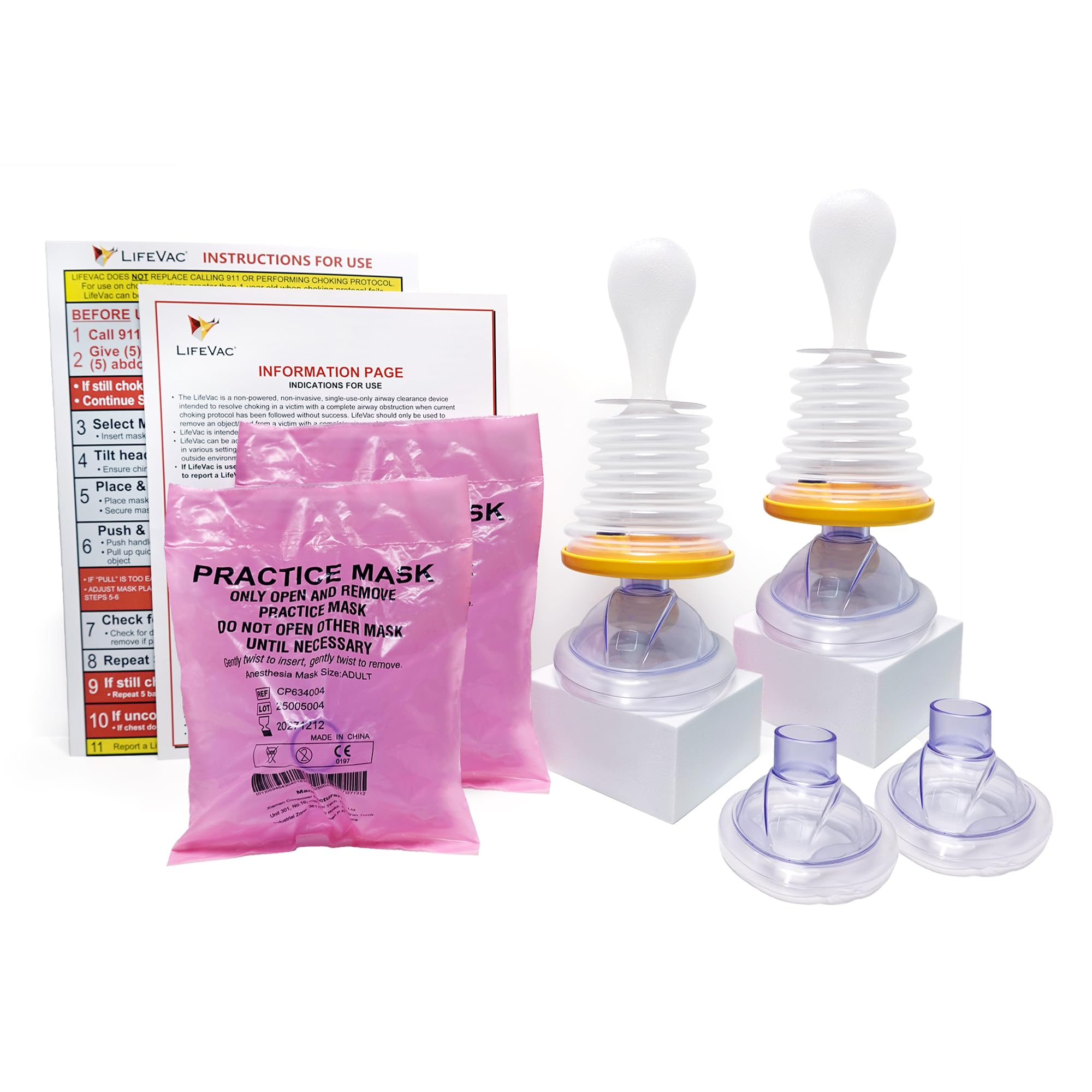
The 2-Pack solves the biggest practical hurdle with suction rescue devices: location coverage. Most families need one unit in the kitchen, another in the master bedroom or upstairs, and ideally one in the car. This bundle delivers two full Home Kits — each with its own adult and child masks — at a lower per-unit cost than buying singles.
Every unit uses the same validated suction piston and one-way valve with bacterial filtration. Because the devices are identical, caregivers do not need to learn different interfaces when moving between floors. The 1.15-pound package weight per unit remains manageable for wall mounting or drawer storage near high-risk areas like dining tables.
Customer feedback consistently mentions placing one in the kitchen and one in the car, mirroring the two most common locations for adult choking incidents. The 2-Pack’s value proposition becomes clear when you consider that a single device sitting in a drawer is useless during a choking event on a different floor — distributed access is the real safety feature.
Why it’s great
- Lower total cost than two separate Home Kits
- Complete coverage for multi-level homes or car+home use
- No need to relocate the single device during dinner prep
Good to know
- Largest upfront investment in this guide
- Not necessary if you live in a single-room apartment
- Each unit uses the same mask size range — no specialization
4. Endure Complete Airway Emergency Kit
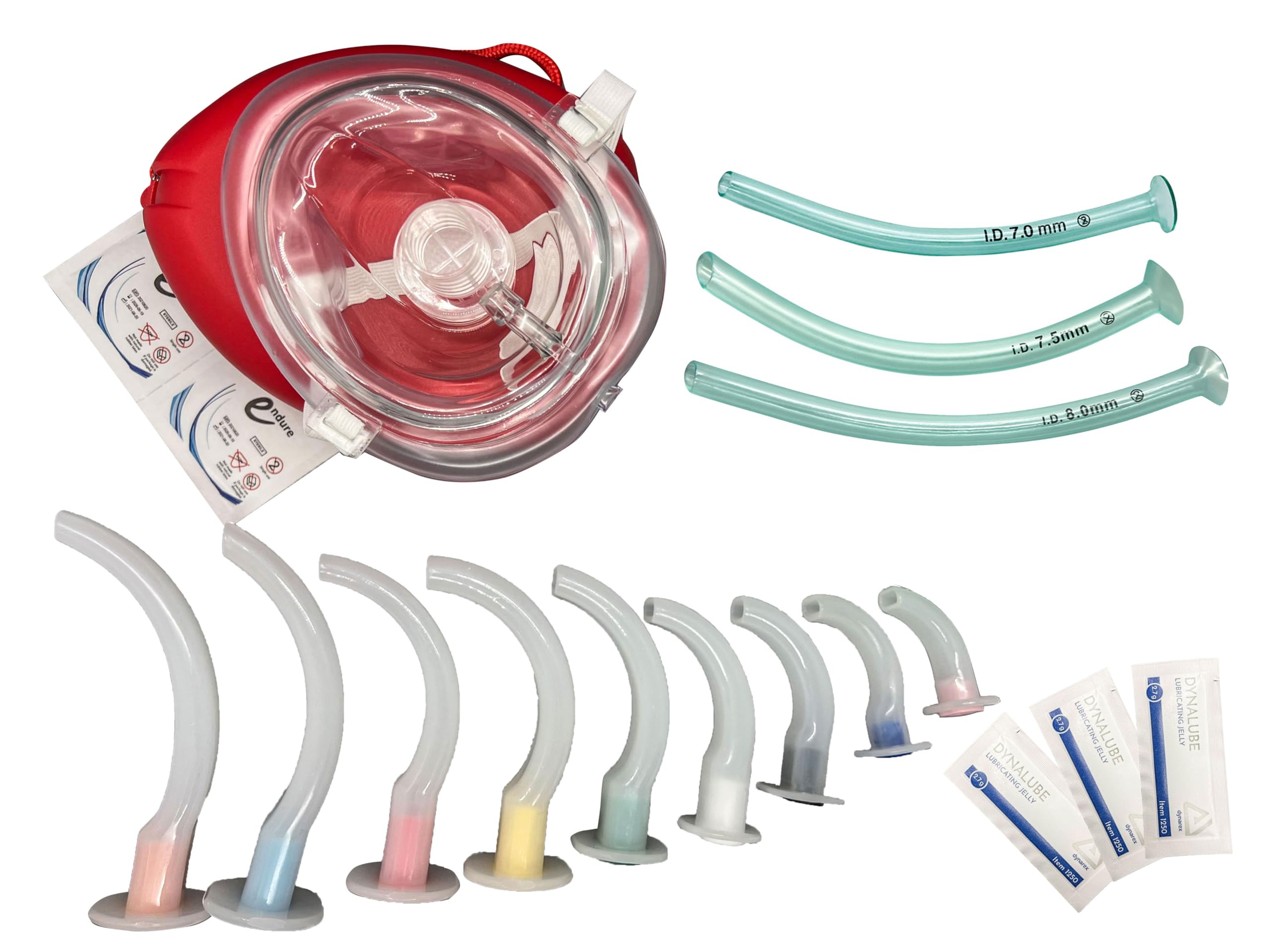
The Endure kit is a different tool from the suction-based devices above. It supplies 9 sizes of Guedel oropharyngeal airways and 3 sizes of nasopharyngeal airways, plus lubricating jelly, a CPR mask, gloves, and alcohol wipes — everything a trained responder needs to maintain an open airway *after* an obstruction is cleared. This is professional-grade gear for EMT bags, not a grab-and-go home rescue unit.
Each component is sterile and individually wrapped, a critical detail for clinical environments. The red soft case organizes airway adjuncts by size, so a trained user can rapidly select the correct OPA gauge without fumbling. Latex-free materials and hypoallergenic lubricant expand the safe patient population to include latex-sensitive individuals.
This kit does not generate suction. If your goal is to rescue someone actively choking, the Endure kit belongs in a responder’s bag alongside a suction device, not as a standalone home solution. For medical professionals teaching ACLS or managing airways in the field, the breadth of OPA and NPA sizes justifies the compact 16-piece footprint.
Why it’s great
- Comprehensive size range covers pediatric through large adult
- All items individually sterile-wrapped for clinical use
- Red case with logical organization for rapid deployment
Good to know
- Requires medical training to use OPA and NPA safely
- Does not clear active airway obstructions — not a choking rescue device
- Case is too compact to rebag all items if resealed
5. WNL Products CPR Rescue Mask 5-Pack
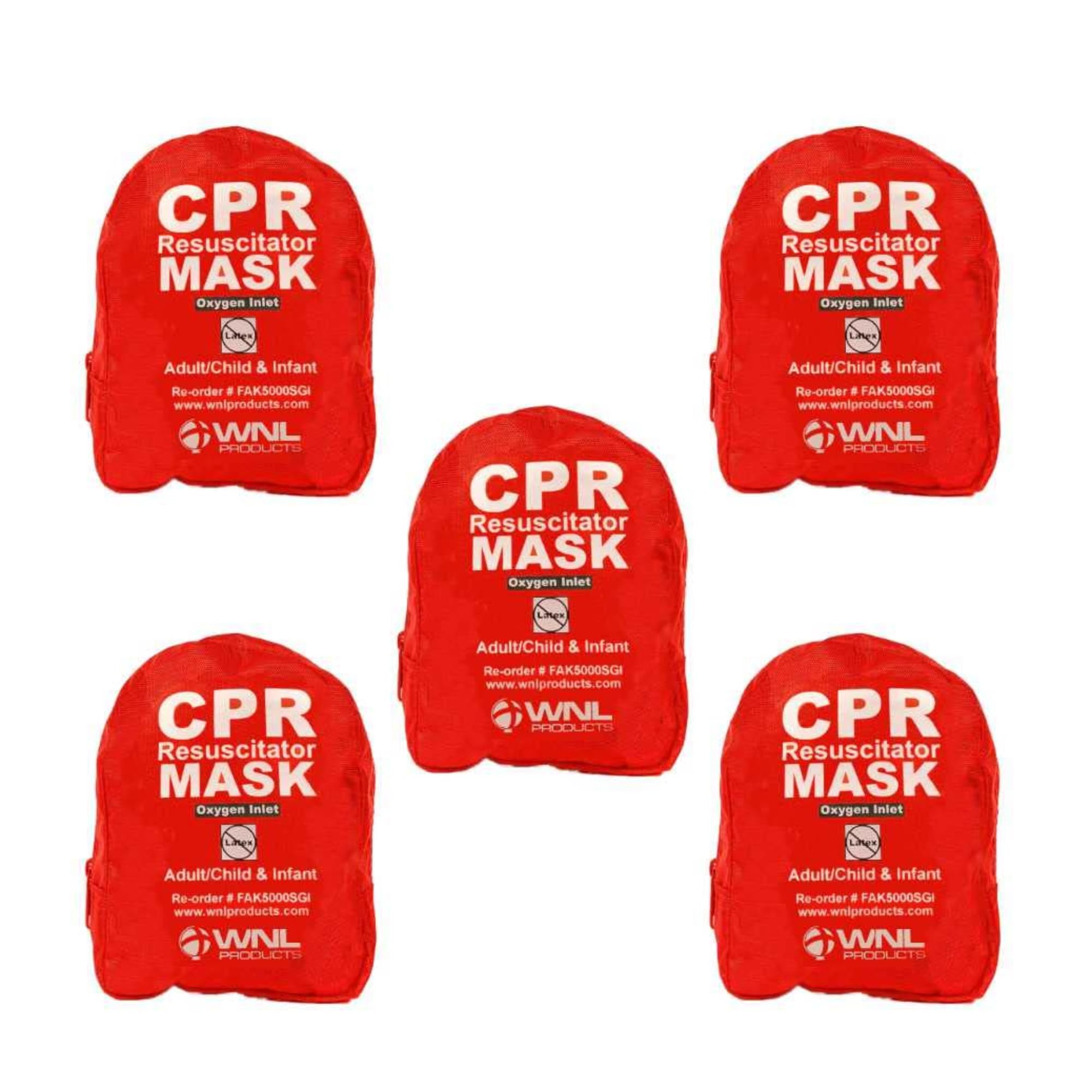
WNL Products delivers a 5-pack of CPR masks designed for both real emergencies and manikin training. Each soft case kit includes an adult resuscitator mask, an infant mask, a one-way disposable valve with an ASTM-certified filter, nitrile gloves, an alcohol wipe, and an instruction sheet — all secured in a nylon case with a belt loop and clip.
This kit bridges the gap between a single-use pocket mask and a full airway kit. The dual adult/infant masks within each of the five units make it easy to distribute throughout a facility, school, or volunteer emergency response team. The soft pliable bladder on the clear mask allows rescuers to monitor lip color and chest rise while maintaining the seal.
The valve filter material meets ASTM F2101-14 for bacterial filtration efficiency, and the instructions emphasize discarding the valve after each patient use. For training environments, WNL sells compatible Practi-VALVES that simulate real resistance without wasting the single-use rescue valves, extending the life of the kit for practice sessions.
Why it’s great
- Five complete kits ideal for distribution to multiple bags or vehicles
- Infant mask included in every unit, not sold separately
- Belt-clip case keeps the mask accessible without occupying hands
Good to know
- Single-use valve and mask require restocking after each rescue
- Not a suction device — does not help with choking clearance
- Cases are soft nylon lacking rigid impact protection
6. MCR Medical CPR Rescue Mask 5-Pack

MCR Medical’s 5-pack focuses on the core essentials: a latex-free rescue mask with one-way valve, a hard case with wrist strap, and a pair of gloves with a cleaning wipe inside each unit. There is no separate infant mask here — this is an adult/child pocket resuscitator designed for one-time emergency use or as a bulk addition to workplace first aid stations.
The hard case is the defining differentiator. Measuring roughly 5.75 x 4.5 x 2 inches, it withstands being tossed in a backpack or kit bag without crushing the mask or compromising the valve seal. The wrist strap ensures the case stays attached to the rescuer’s hand while both hands perform chest compressions or airway positioning.
Each unit is individually packaged, preserving sterility until needed. Multiple customers note the case’s robustness when stuffing it into already-cramped go-bags. The trade-off for that durability is the absence of an infant mask — this is squarely a teen/adult rescue tool, best paired with a pediatric kit for younger populations.
Why it’s great
- Rigid hard case prevents mask damage during storage
- Wrist strap keeps the case tethered during rescue sequence
- Individually sealed units support long-term shelf storage
Good to know
- No infant mask included — not suitable for small children
- Single-use design requires replacement after one patient contact
- Case size prevents pocket carry in slim pants pockets
7. KeepGoing Travel First Aid Kit for Kids
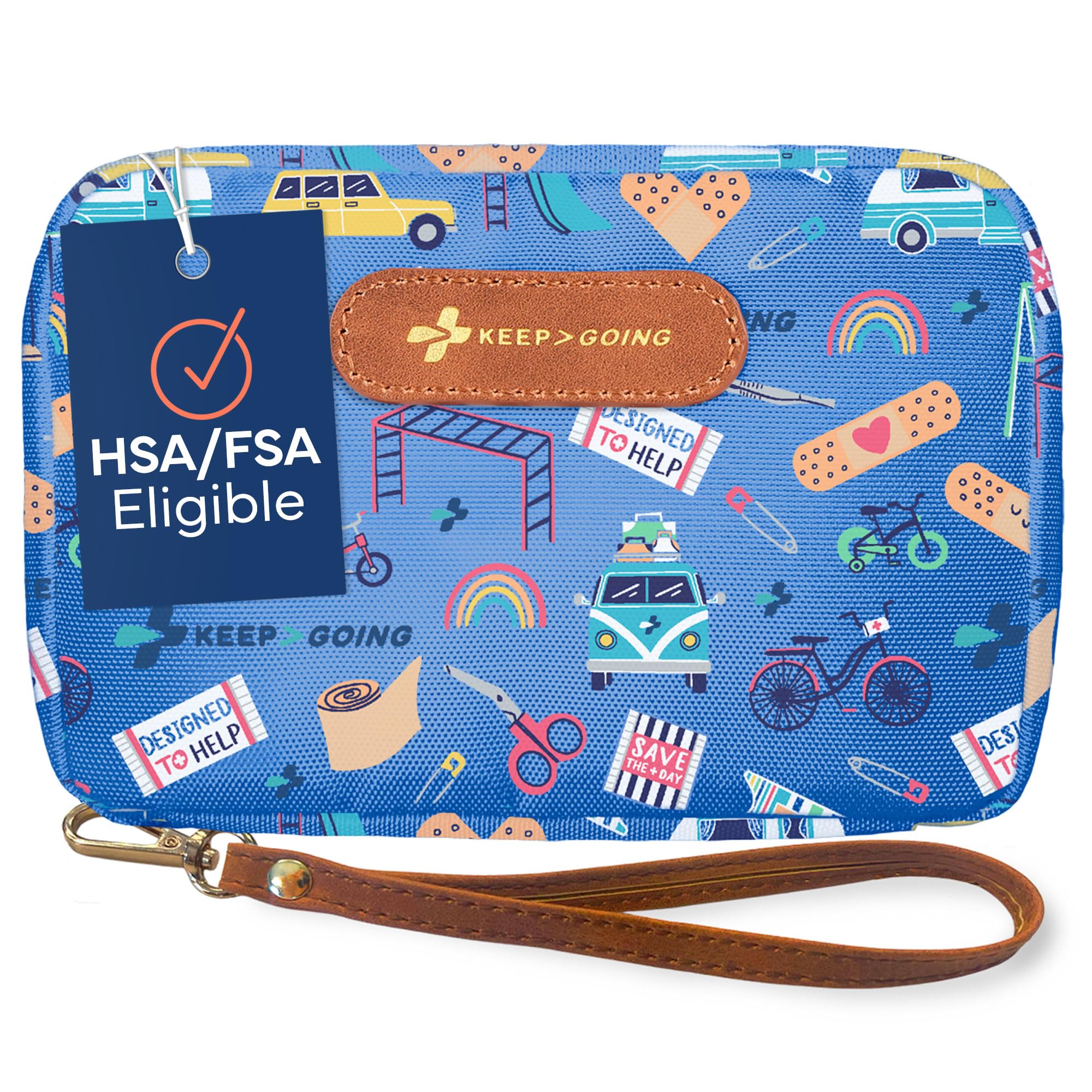
The KeepGoing kit is not an anti-choking device — it is a stylish, 130-piece general first aid kit designed for the cuts, scrapes, and burns of family life. Designed by a mom for family use, the water-resistant case fits discreetly in a diaper bag, purse, or car door pocket, making it the go-to for roadside boo-boos rather than airway emergencies.
Contents include latex-free bandages in multiple sizes, burn relief ointment, antiseptic wipes, tweezers, and a first aid guide — all organized in internal compartments with labeled slots. The kit is HSA- and FSA-eligible and includes a coupon for refills, reinforcing its role as a replenishable household staple rather than a single-use kit.
What the KeepGoing kit does not contain: suction pistons, one-way rescue valves, oropharyngeal airways, or any airway clearance tool. It belongs in this guide as the complementary companion — the everyday first aid base you carry alongside your dedicated choking rescue device. For families who already own a LifeVac, this is the perfect second kit to grab for minor emergencies.
Why it’s great
- Extremely compact yet stocked with 130 essential items
- Stylish, water-resistant case encourages daily carry
- Refillable with coupon — reduces long-term waste
Good to know
- Contains no airway or choking rescue equipment whatsoever
- Not intended as a substitute for a dedicated anti-choking device
- Burn relief and bandage supplies primarily for minor wounds
FAQ
Can a suction-based anti-choking device be used on an infant?
Do I still need CPR training if I own a LifeVac?
How long does a LifeVac mask last before it needs replacement?
What is the difference between an OPA and an NPA airway?
Final Thoughts: The Verdict
For most users, the best anti-choking device winner is the LifeVac Home Kit because it combines field-proven suction power with dual adult and child masks in a single, battery-free unit. If you want a device you can carry daily without bag bulk, grab the LifeVac Yellow Travel Kit. And for a family with multiple floors or cars where seconds matter, nothing beats the LifeVac Home Kit 2-Pack.