Choosing the wrong face wash can undo your entire skincare routine. A harsh or poorly formulated cleanser strips your moisture barrier, triggers breakouts, and leaves skin looking duller than when you started. The smart alternative uses alpha-hydroxy acids (AHAs) to chemically exfoliate dead cells while respecting your skin’s pH and natural defenses.
I’m Emma — the founder and writer behind Baby Bangs. I’ve spent years dissecting ingredient labels, comparing pH levels, and analyzing formulation delivery systems to separate true exfoliating cleansers from marketing spin.
After evaluating dozens of options based on AHA concentration, pH balance, ingredient quality, and real user results, these selections represent the best aha face wash choices for every skin concern and budget tier.
How To Choose The Best AHA Face Wash
Not all AHA cleansers are created equal. Three factors determine whether a product truly exfoliates without damaging your skin barrier: the specific AHA type used, its concentration, and the formula’s final pH level. An AHA needs a pH between 3.0 and 4.5 to effectively dissolve the intercellular glue holding dead skin cells together — anything above that range is just an expensive moisturizer.
AHA Type and Molecular Size
Glycolic acid has the smallest molecular weight, penetrating deepest for rapid resurfacing but also carrying the highest irritation potential. Lactic acid sits in the middle — slightly larger molecules that hydrate while they exfoliate, making it friendlier for dry or sensitive skin. Mandelic acid, derived from bitter almonds, has the largest molecular structure, offering the gentlest exfoliation path that’s well-suited for rosacea-prone or reactive complexions. Some premium formulations blend two AHA types to balance efficacy with comfort.
Concentration Windows
An AHA face wash should never exceed 10% total concentration in a rinse-off product. Formulas below 5% may deliver minimal visible results unless the pH is precisely optimized. The sweet spot for weekly-use glycolic cleansers sits around 5-8%, while lactic and mandelic acids can perform well at 8-10% without over-stripping. Always check whether the brand lists the percentage openly — opaque labeling usually means sub-therapeutic levels.
Skin Barrier Compatibility
A truly effective AHA face wash should leave skin feeling clean but not tight, squeaky, or stripped. Added barrier-supporting ingredients — ceramides, niacinamide, glycerin, or prebiotic thermal water — make the difference between a product that exfoliates sustainably versus one that damages over time. Sulfate-free bases and non-comedogenic certifications further reduce the risk of irritation, especially for users with combination or acne-prone skin.
Quick Comparison
On smaller screens, swipe sideways to see the full table.
| Model | Category | Best For | Key Spec | Amazon |
|---|---|---|---|---|
| NAELI AHA/BHA Exfoliating Face Wash | Premium | Deep resurfacing & pore minimization | 10% Glycolic + Salicylic + Lactic | Amazon |
| Paula’s Choice 6% Mandelic + 2% Lactic | Mid-Range | Sensitive skin & discoloration | Time-released lactic acid delivery | Amazon |
| La Roche-Posay Toleriane Purifying Foaming | Premium | Daily gentle cleansing + barrier support | Niacinamide + Ceramide-3 | Amazon |
| Acure Resurfacing 1% Glycolic & Unicorn Root | Budget-Friendly | Entry-level glycolic exfoliation | 1% Glycolic, cream-to-foam texture | Amazon |
| The Ordinary Glycolipid Cream Cleanser | Budget-Friendly | Ultra-gentle maintenance & makeup removal | Plant-derived glycolipids, pH-balanced | Amazon |
In‑Depth Reviews
1. NAELI AHA/BHA Exfoliating Face Wash
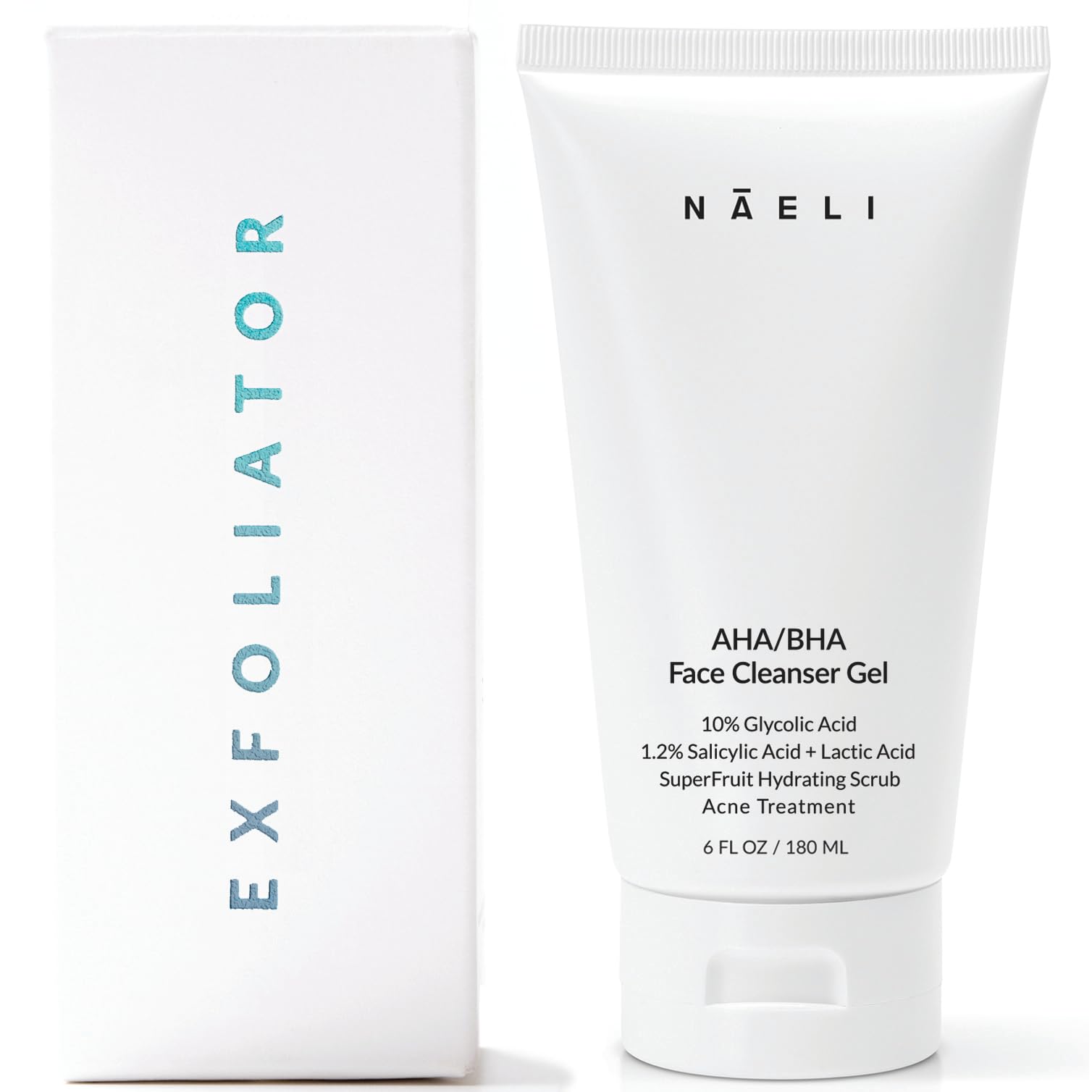
NAELI delivers the most aggressive yet controlled chemical exfoliation in a rinse-off format, combining 10% glycolic acid with salicylic acid (BHA) and lactic acid in a single gel. This triple-acid approach tackles surface texture, pore congestion, and fine lines simultaneously — a rare combination that most single-acid cleansers cannot match. The formula is pH-balanced to maintain efficacy without the stinging that often accompanies 10% glycolic concentrations in other brands.
The gel texture is thick enough to spread without dripping, and the inclusion of ten superfruit extracts (acai, goji, pomegranate, maqui berry) provides antioxidant support that helps offset the exfoliation stress. Users consistently report visible pore refinement after the first use and significant improvement in overall skin brightness within two weeks. The leaping bunny certification and vegan formulation add confidence for clean-beauty shoppers.
The heavy glass bottle feels premium but makes travel awkward, and the pump mechanism requires deliberate pressure — some users find it easier to unscrew the top and pour. The subtle blueberry scent from natural extracts is pleasant but may cause a mild sting if applied immediately after shaving. This product is best suited for normal to oily skin types already familiar with chemical exfoliation.
Why it’s great
- Triple-acid formulation (glycolic, salicylic, lactic) provides full-surface resurfacing
- Visible pore minimization and brightness after 1-2 uses
- Superfruit antioxidant complex supports skin during exfoliation
Good to know
- Heavy glass bottle is fragile for bathroom use
- May sting on recently shaved or compromised skin
- Pump mechanism can be difficult to depress consistently
2. Paula’s Choice 6% Mandelic + 2% Lactic Exfoliant
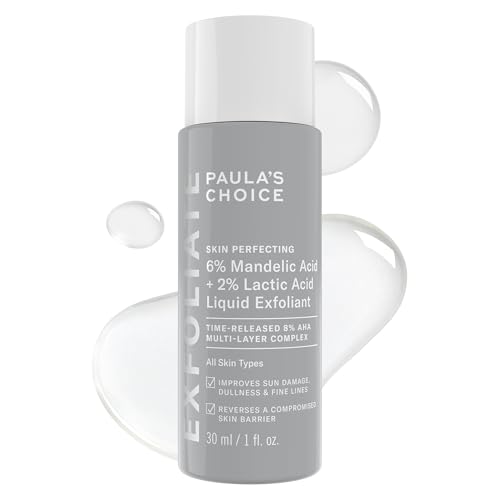
Paula’s Choice pairs 6% mandelic acid with 2% time-released lactic acid to create an exfoliant that delivers resurfacing power comparable to a 10% conventional AHA but with significantly less irritation. Mandelic acid’s larger molecular weight means it penetrates more slowly — ideal for sensitive, rosacea-prone, or easily inflamed skin types that cannot tolerate glycolic. The time-release encapsulation on the lactic acid component prevents the sudden pH drop that causes stinging in standard formulas.
The formula includes yarrow extract and a fermented antioxidant complex from cherry blossom and yumberry, which support microbiome health while protecting against environmental stressors. Users with hyperpigmentation, sun damage, and bumpy texture report steady improvement without the redness or peeling common with stronger AHAs. The texture is lightweight and absorbs quickly without leaving stickiness.
The main drawback is the cost per ounce relative to drugstore options — this is a premium-priced product for a relatively small bottle. A few Amazon reviews mention counterfeit concerns, so purchasing directly from the brand or an authorized seller is recommended. Some users with very oily skin may find the dual-AHA effect insufficient for deep pore clearing compared to a glycolic-heavy formula.
Why it’s great
- Time-released lactic acid mimics 10% potency without irritation
- Mandelic acid is ideal for rosacea and reactive skin
- Fermented antioxidant complex supports microbiome balance
Good to know
- Higher cost per ounce than most AHA cleansers
- Counterfeit risk on third-party Amazon listings
- May not provide enough exfoliation for very oily skin
3. La Roche-Posay Toleriane Purifying Foaming Cleanser

La Roche-Posay’s Toleriane Purifying Foaming Cleanser diverges from the exfoliation-first approach and instead focuses on barrier preservation while providing gentle daily cleansing. The formula uses ceramide-3 and niacinamide to reinforce the skin’s natural protective layer, making it an ideal companion product for nights when you’re not using a dedicated AHA treatment. It effectively removes excess oil and sunscreen without the tight, stripped feeling that foaming cleansers often leave behind.
The inclusion of La Roche-Posay Prebiotic Thermal Water soothes reactive skin and supports the microbiome, while the sulfate-free, fragrance-free, and non-comedogenic profile ensures zero disruption even during active exfoliation routines. Clinical testing showed 94% of users reported healthier-looking skin after four weeks. The pump bottle delivers consistent doses and lasts approximately two to three months with twice-daily use.
This cleanser contains no active AHA concentration, so it won’t provide direct exfoliation. Users looking for a single product that both cleanses and chemically exfoliates will need to pair it with a separate treatment step. The refill bag system reduces plastic waste but the bag’s floppy design makes pouring awkward — many users prefer transferring the liquid into the original bottle.
Why it’s great
- Ceramide-3 and niacinamide actively support barrier health during cleansing
- Prebiotic thermal water soothes reactive and sensitized skin
- Refill option reduces plastic waste (though bag design is finicky)
Good to know
- Contains no active AHA — does not exfoliate on its own
- May be too gentle for heavy makeup or waterproof sunscreen removal
- Refill bag pouring can be messy without careful handling
4. Acure Resurfacing 1% Glycolic Acid & Unicorn Root Cleanser
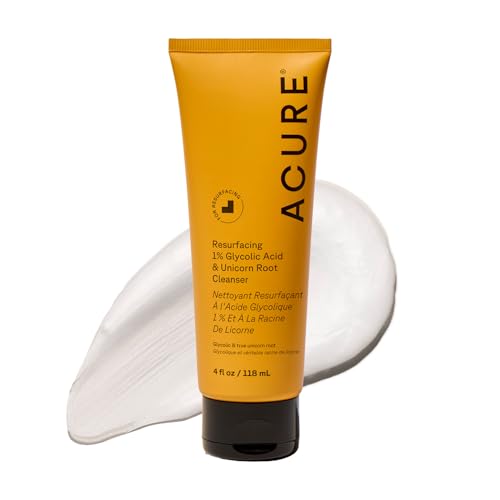
Acure’s Resurfacing Cleanser provides an accessible introduction to glycolic acid at a 1% concentration, making it suitable for AHA beginners or those with mild texture concerns. The cream-to-foam transition is pleasant — it starts as a thick cream and develops into a light foam that rinses clean without residue. Unicorn root (also known as echinacea angustifolia) adds a gentle soothing element that helps offset the exfoliation.
The formula is free from parabens, sulfates, mineral oil, and petrolatum, aligning with clean-beauty standards at a budget-friendly price point. Users with aging, breakout-prone skin report noticeable improvements in texture and clarity with consistent use 2-3 times per week. The product is also vegan, which broadens its appeal for ethically-conscious buyers.
The 1% glycolic concentration is on the lower end of therapeutic effectiveness — users with significant hyperpigmentation or deep texture issues may need a stronger product. The bottle is noticeably smaller than the image suggests (4 fl oz versus the expected 6+ oz), and some reviewers note an unusual smell they describe as pickle-like, likely from the natural ingredient blend. The recommended frequency of 2-3 times per week means a single bottle can still last several months.
Why it’s great
- Low 1% glycolic concentration is ideal for first-time AHA users
- Cream-to-foam texture cleanses without stripping
- Vegan, paraben-free, sulfate-free formulation at a low entry cost
Good to know
- 1% glycolic may be too weak for advanced exfoliation needs
- Some users report an unpleasant natural smell
- Smaller bottle size than expected from product photos
5. The Ordinary Glycolipid Cream Cleanser
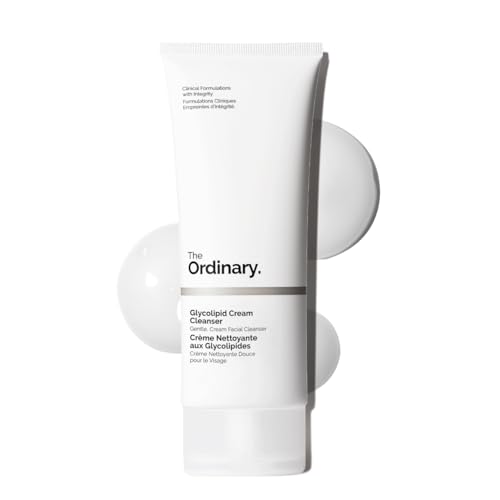
The Ordinary’s Glycolipid Cream Cleanser takes a fundamentally different approach by using plant-derived glycolipid cleansing agents instead of traditional AHAs to gently dissolve impurities while maintaining hydration. This product does not contain classic AHA exfoliants (glycolic, lactic, or mandelic acid), but it earns its place as a companion cleanser for AHA users who need a non-stripping option for mornings or sensitive days. The cream consistency does not lather, which takes adjustment for foam-trained users.
Accepted by the National Eczema Association, this cleanser respects the skin’s natural pH and is formulated without fragrance, alcohol, or essential oils — making it one of the safest options for compromised or reactive barriers. Reviews consistently highlight its effectiveness at removing foundation and mascara without requiring a separate makeup remover, simplifying the evening routine. Users transitioning from traditional foaming cleansers often report noticeably less tightness and improved hydration levels.
Because this product relies on glycolipids rather than AHAs, it will not provide chemical exfoliation. Users expecting resurfacing or texture improvement will be disappointed. The non-foaming cream texture can feel strange for those accustomed to bubbly cleansers, and application to dry skin (the manufacturer’s recommended method for makeup removal) feels unusual for many first-time users. This is purely a maintenance cleanser, not an exfoliator.
Why it’s great
- National Eczema Association acceptance confirms extreme gentleness
- Plant-derived glycolipids effectively remove makeup without stripping
- pH-balanced formula supports barrier function during cleansing
Good to know
- No AHA content — provides zero chemical exfoliation
- Non-foaming cream texture may feel unusual for foam users
- Dry application method for makeup removal can feel awkward initially
FAQ
Can I use an AHA face wash every day?
Should I apply an AHA face wash to dry or wet skin?
What is the difference between glycolic and mandelic acid?
Do I need to wear sunscreen after using an AHA face wash?
Can I use an AHA face wash with retinol or vitamin C?
Final Thoughts: The Verdict
For most users, the best aha face wash winner is the NAELI AHA/BHA Exfoliating Face Wash because its triple-acid formulation delivers visible resurfacing, pore refinement, and brightness in a single gel texture. If you want gentle exfoliation that won’t aggravate sensitivity, grab the Paula’s Choice 6% Mandelic + 2% Lactic Exfoliant. And for a daily barrier-supporting cleanse that won’t interfere with your active treatment routine, nothing beats the La Roche-Posay Toleriane Purifying Foaming Cleanser.