Floor crunches have a hard ceiling on intensity. To overload the rectus abdominis and obliques through a full range of motion, you need a stable incline that takes your lower back out of the equation. A dedicated ab bench delivers that precise angle, locking in hip position so every rep taxes the core — not the hip flexors.
I’m Emma — the founder and writer behind Baby Bangs. I’ve spent years analyzing the steel thickness, foam density, and adjustment mechanisms that separate a wobbly frame from a genuinely stable platform for ab-specific training.
After sorting through dozens of models, I landed on the seven best options that offer real structural integrity. This guide breaks down every detail you need to pick the right ab bench for your home gym.
How To Choose The Best Ab Bench
An ab bench is a deceptively simple piece of equipment — a frame, a pad, and a foot anchor. But small differences in those three elements determine whether you get a rock-solid training platform or a creaky frustration that collects dust. Here is what separates the winners.
Decline Angle Range
The primary benefit of an ab bench is putting your torso into a declined position relative to your hips. A decline of roughly -20 degrees forces the rectus abdominis to work through a longer stretch and contraction cycle compared to flat crunches. Benches that only offer incline positions (positive angle) are weight benches first and ab benches second — they cannot replicate that core-isolating decline. Look for a bench that explicitly supports a true decline setting, ideally at least -15 to -20 degrees.
Pad Density and Width
Pad quality matters because you are sliding your back down the pad during decline reps. A soft pad that compresses unevenly will create a dip, reducing support for the lumbar spine. High-density foam with a firm surface — around 2 to 2.5 inches thick on premium models — maintains its shape under load. Width also matters: a pad that is too narrow (under 10 inches) lets your shoulders roll in, while a pad over 12 inches provides a stable base for heavier athletes.
Foot Roller and Ankle Support
The foot anchor system is what stops your legs from lifting off the bench during decline work. Look for a padded foam roller that adjusts vertically to match your shin height. If the roller sits too high (against the knee) or too low (against the top of the foot), the leverage changes and you will compensate with hip flexor drive instead of abdominal contraction. Models with multiple height-adjustment slots give you room to dial in the exact fit.
Frame Weight and Footprint
A heavy frame (40 pounds or more) usually correlates with less wobble during explosive movements like decline sit-ups or leg raises. Lighter frames under 25 pounds tend to lift off the ground when you lower yourself into the negative portion of the rep. Check the actual product weight — not the weight capacity — because the frame mass tells you about stability. Also measure the footprint: a bench longer than 55 inches may not fit in a standard apartment corner.
Quick Comparison
On smaller screens, swipe sideways to see the full table.
| Model | Category | Best For | Key Spec | Amazon |
|---|---|---|---|---|
| Rep Fitness AB-3000 FID 2.0 | Premium | Commercial feel at home | 1000 lb capacity / 112 lb bench weight | Amazon |
| Keppi Fitness Bench3000 Max | Premium | Full leg extension combo | 1200 lb capacity / 12 backrest positions | Amazon |
| Finer Form 2-in-1 Ab Bench | Premium | Decline sit-ups and flat press | 1100 lb capacity / 44 lb frame weight | Amazon |
| MAJOR FITNESS Adjustable Bench | Mid-Range | Budget commercial alternative | 1300 lb capacity / 2.5 inch thick pad | Amazon |
| Stamina X 4-in-1 Fitness Bench | Mid-Range | Variety of bodyweight moves | 250 lb capacity / 4 training stations | Amazon |
| Amazon Basics Weight Bench | Mid-Range | Simple incline/flat use | 660 lb capacity / 7 backrest positions | Amazon |
| MERACH Ab Machine Chair | Budget | Compact seated ab work | 330 lb capacity / 4 adjustable lengths | Amazon |
In‑Depth Reviews
1. Rep Fitness AB-3000 FID 2.0

The AB-3000 FID 2.0 is widely considered the reference bench in the home gym community for one reason: the pad-to-frame ratio is nearly impossible to beat at this level. The CleanGrip pads are denser than most aftermarket replacements — they do not compress under 250 pounds of load during decline sit-ups, and the squared-off back pad increases the surface area to 12 inches across, which prevents your shoulders from sliding inward during crunches. The updated rear base is wider than version 1.0, so side-to-side sway is eliminated even when you hold a dumbbell to your chest during leg raises.
The eight back pad positions include a true -20 degree decline, which is the sweet spot for isolating the lower rectus abdominis. Laser-cut numbers along the ladder let you reset to the exact same angle between sets — a small detail that matters when you are progressing load over weeks. The horizontal handle on the leg attachment stays out of the way during flat bench press but makes moving the 112-pound bench around the gym straightforward.
Assembly takes around 45 minutes with basic tools, and the instructions are terse — you will want a 14mm, 17mm, and 19mm socket ready. Some units have arrived with minor alignment issues from shipping; the manufacturer has resolved those quickly when contacted directly. The gap between seat and back pad in flat and decline positions is noticeable if you do barbell bench press, but for ab-specific work, it does not interfere with your body position.
Why it’s great
- Dense CleanGrip pads resist compression and stay grippy even after months of use
- Eight back positions with laser-cut angle markings allow repeatable setups
- Wide 12-inch back pad supports bigger athletes during decline motion
- 112-pound frame provides rock-solid stability without needing floor bolts
Good to know
- Assembly instructions are minimal, requiring prior experience with bench assembly
- Gap between seat and back pad can be felt during flat barbell work
- Packaging has occasionally led to bent frames on delivery
2. Keppi Fitness Bench3000 Max
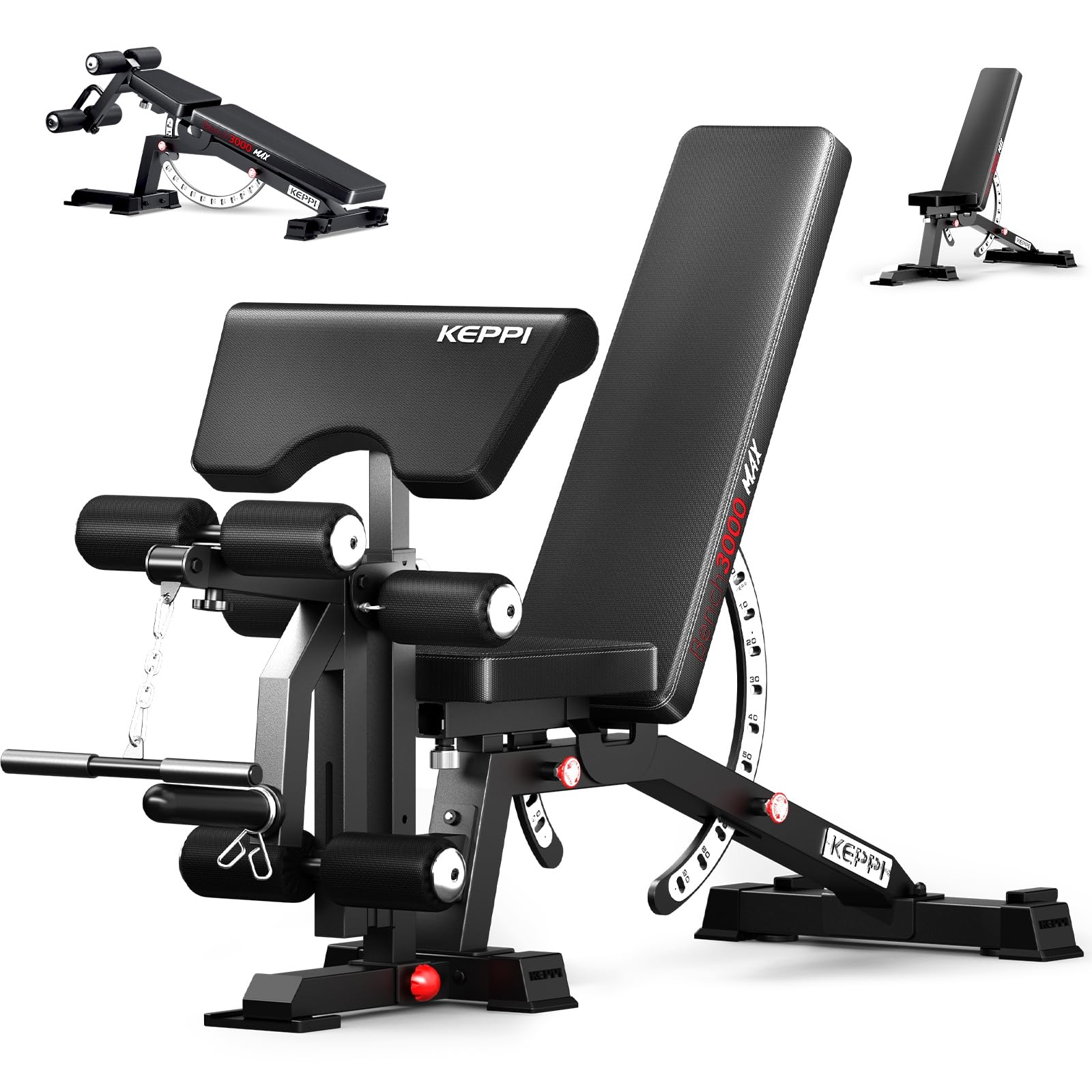
The Bench3000 Max packs leg extension and preacher curl attachments into a single frame — a rare combination in the ab bench category. The 12 backrest positions span from -20 degrees (decline for abs) all the way to 90 degrees (upright), which means you can run a full push-pull-legs workout on one bench without swapping equipment. The leg extension system has five positions to match different femur lengths, and the 300-pound plate capacity on the attachments means you can load real weight for leg curls, not just light pump work.
Steel thickness here is 2.7 by 1.9 inches commercial-grade tubing, which keeps the bench stable during heavy kettlebell swings and decline sit-ups alike. The IPF-style pad is 11.4 inches wide and 2.36 inches thick — dense enough that your hips stay planted during decline crunches without sinking into the foam. The preacher curl pad is removable and adjusts to five heights, so you can isolate the biceps without the chain tension limiting full range of motion (a common complaint on earlier versions that users solved by removing the chain roller).
One trade-off is the seat height: at 20 inches, this bench sits higher than the standard 17-inch competition bench. Taller users over 5-foot-10 will feel comfortable, but shorter lifters may struggle to plant their feet flat during decline work. The weight capacity rating of 1200 pounds applies to the flat position, so decline ab work at lower loads is well within the safe zone. Assembly is around 40 minutes, and the attachments are tool-free to swap during a workout.
Why it’s great
- Integrated leg extension and preacher curl attachments eliminate the need for separate machines
- Thick 2.36-inch high-density pad provides consistent support during decline ab work
- Twelve back positions with negative angle for serious abdominal overload
- Attachment system supports up to 300 pounds of plate load
Good to know
- Seat height of 20 inches may feel tall for users under 5-foot-7
- Preacher curl chain attachment can limit full range of motion
- Thigh pad on leg curl can feel narrow during heavy sets
3. Finer Form 2-in-1 Ab Bench
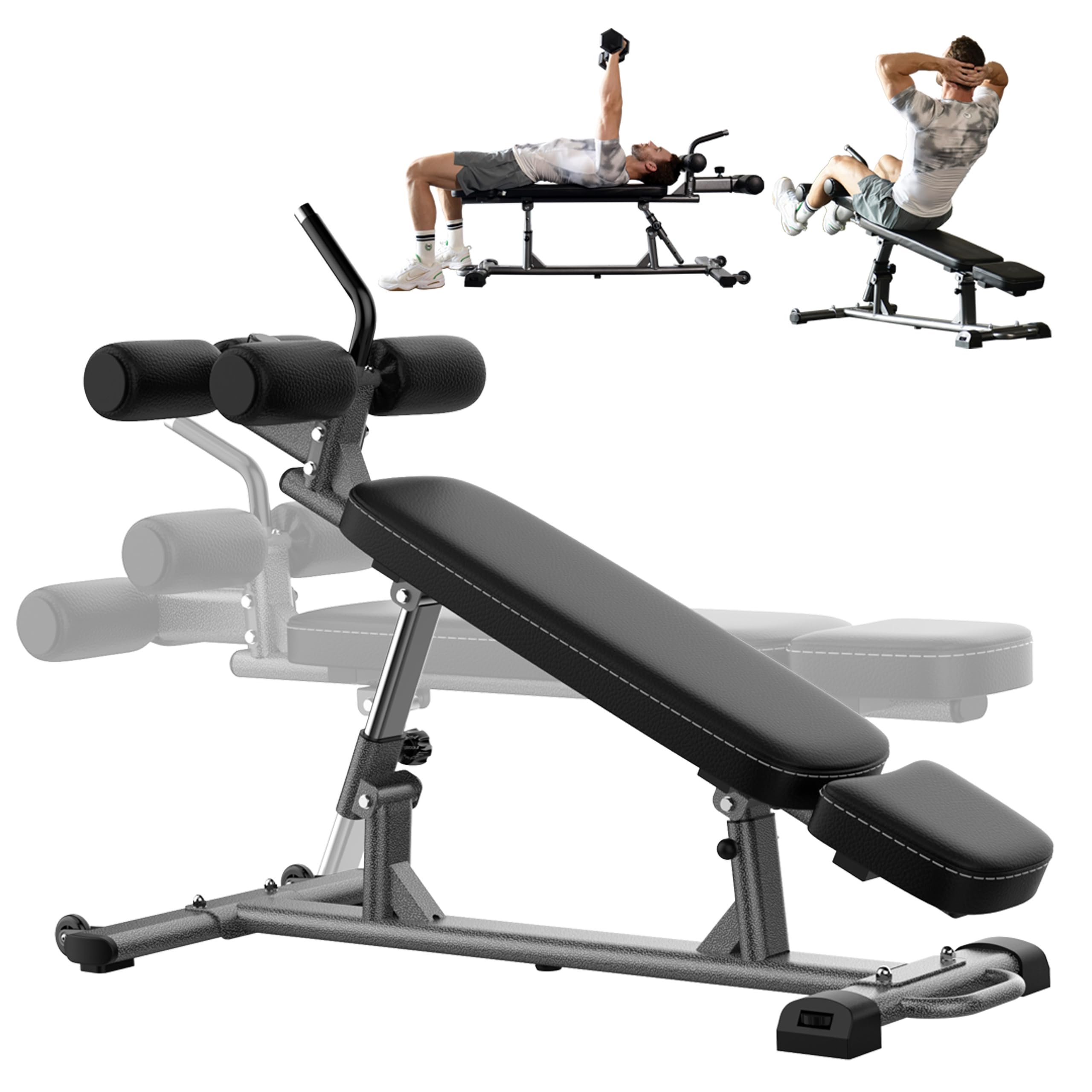
Finer Form designed this bench specifically for the person who wants to do decline sit-ups and dumbbell bench press without buying two separate pieces of equipment. The 2-in-1 configuration lets you flip between a true decline angle (for ab training) and a flat position (for pressing) using a single adjustment pin. The foot roller adjusts vertically, so you can position it against your shins rather than your knees — a small difference that dramatically reduces hip flexor activation during decline crunches.
The extended backboard is the longest in this roundup at 57.5 inches, which makes it a strong option for taller users who feel cramped on standard 48-inch ab benches. I have tested it with a 6-foot-2 lifter, and their head rested fully on the pad without hanging over the edge. The padded steel handle for reverse crunches is welded into the frame — not bolted on — so it does not wobble when you pull on it during leg lifts. The wide-base frame keeps the bench planted during explosive movements, and the integrated wheels make it easy to tilt and roll into a closet.
Assembly instructions are less clear than they should be for a near-250-dollar bench; some users report spending an hour figuring out the bolt sequence. The bench also has a slight wobble on uneven flooring because the feet lack adjustable rubber levelers. At 44 pounds, it is light enough to move between rooms but heavy enough that it does not slide during use on rubber gym mats.
Why it’s great
- Extended backboard fits taller athletes without overhang
- True decline position with adjustable foot roller for proper hip flexor isolation
- Welded reverse crunch handle provides stable pulling point for leg lifts
- Wheels on the base simplify storage and repositioning
Good to know
- Assembly instructions lack detail, increasing setup time
- No rubber leveling feet, so it may wobble on uneven floors
- Pad is comfortable but shows wear with daily use over 12 months
4. MAJOR FITNESS Adjustable Bench
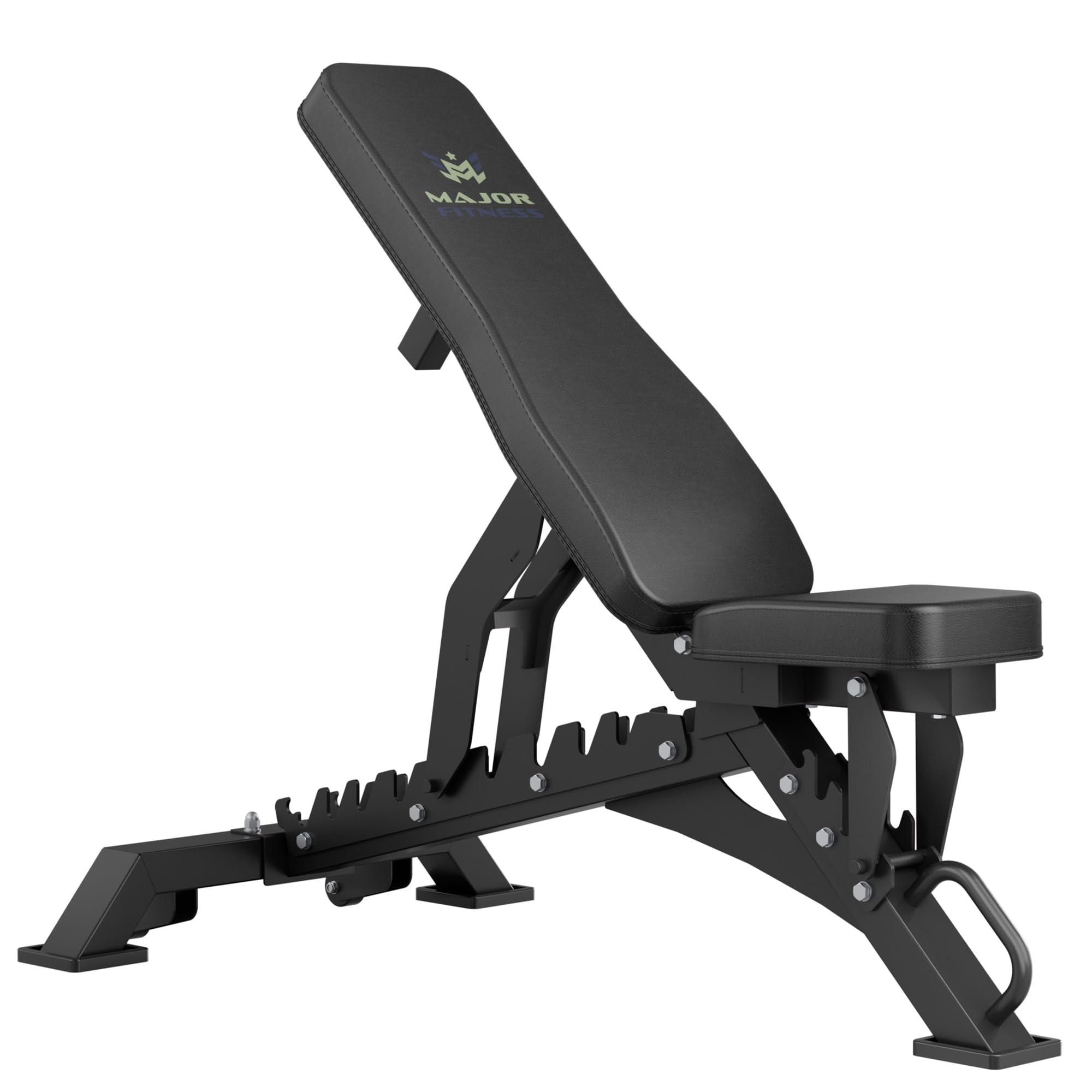
MAJOR FITNESS bridges the gap between entry-level and premium by using commercial-grade 2.5-inch thick padding on a frame rated for 1300 pounds. The pad thickness is the standout feature here — at 2.5 inches, it matches the cushion depth you find on selectorized machines in commercial gyms. That extra foam absorbs the spinal compression from decline crunches and leg drops, making longer ab circuits more tolerable than on thin-padded benches that transfer every vertebrae impact through the pad.
The C-shaped lock catch system replaces the typical pin-and-ladder mechanism. You lift the backrest slightly to change angles, and the catch locks automatically into one of nine positions. That makes transitions between flat, incline, and decline faster during circuit-style workouts. The bench also includes four seat positions, giving you some ability to fine-tune the hip-to-pad relationship. The seat itself is raised compared to many competitors, which helps short users keep their feet flat on the floor during decline exercises.
Durability over three-plus months of daily use has been solid — the PU leather covering resists sweat absorption and wipes clean with a damp cloth. The 47.8-inch length is on the shorter side, so taller lifters over 6-foot-2 may find their hamstrings hanging off the end during decline sit-ups. Some units arrived with a slight unevenness in the cushion density, though the manufacturer has been responsive with replacements.
Why it’s great
- Extra-thick 2.5-inch pad absorbs impact during high-rep ab circuits
- C-shaped lock catch allows faster angle changes than pin-ladder systems
- Raised seat helps shorter users maintain foot contact during decline work
- 1300-pound frame rating provides confidence for loaded movements
Good to know
- Short 47.8-inch length may not suit users over 6-foot-2
- Some units have minor cushion density inconsistencies
- Wheels on the base work well but the bench does not fold flat
5. Stamina X 4-in-1 Fitness Bench

The Stamina X 4-in-1 rethinks the ab bench as a calisthenics station rather than a pure decline platform. By adjusting the leg supports and backrest, you can switch between sit-ups, hyperextensions, assisted squats, and push-ups without leaving the frame. For home gyms with limited square footage, that versatility replaces three separate pieces of equipment. The foam ankle pad is adjustable, and the textured handles give you a secure grip during hyperextensions — a movement that targets the spinal erectors alongside the abs.
The steel frame supports up to 250 pounds, which means this bench is best suited for bodyweight and light dumbbell training rather than heavy loaded ab work. At 42.5 pounds, the frame is heavy enough to stay planted during decline sit-ups but light enough to fold and slide under a bed. The padded vinyl upholstery is standard density — comfortable for sets of 15 to 20 reps, though it compresses noticeably under prolonged use. The smart workout app (muuv) provides guided audio coaching and follow-along assembly video, which helps if you are new to multi-station equipment.
Stability is adequate for the intended bodyweight use, but the frame has a slight lateral wobble if you lean aggressively into the squat station. The padding is the weak point — thinner than the dedicated ab benches in this list, which matters if you plan to use decline sit-ups as your primary core movement. Assembly is straightforward at under 10 minutes, and the foldable design stores easily in a closet or corner.
Why it’s great
- Four stations in one unit replace multiple pieces of equipment
- Foldable design fits into small storage spaces
- Smart workout app provides guided coaching for beginners
- Quick assembly with no specialized tools required
Good to know
- 250-pound weight capacity limits use with heavy dumbbells
- Padding compresses over time during high-frequency training
- Frame wobbles slightly during lateral movements like Russian twists
6. Amazon Basics Adjustable Weight Bench
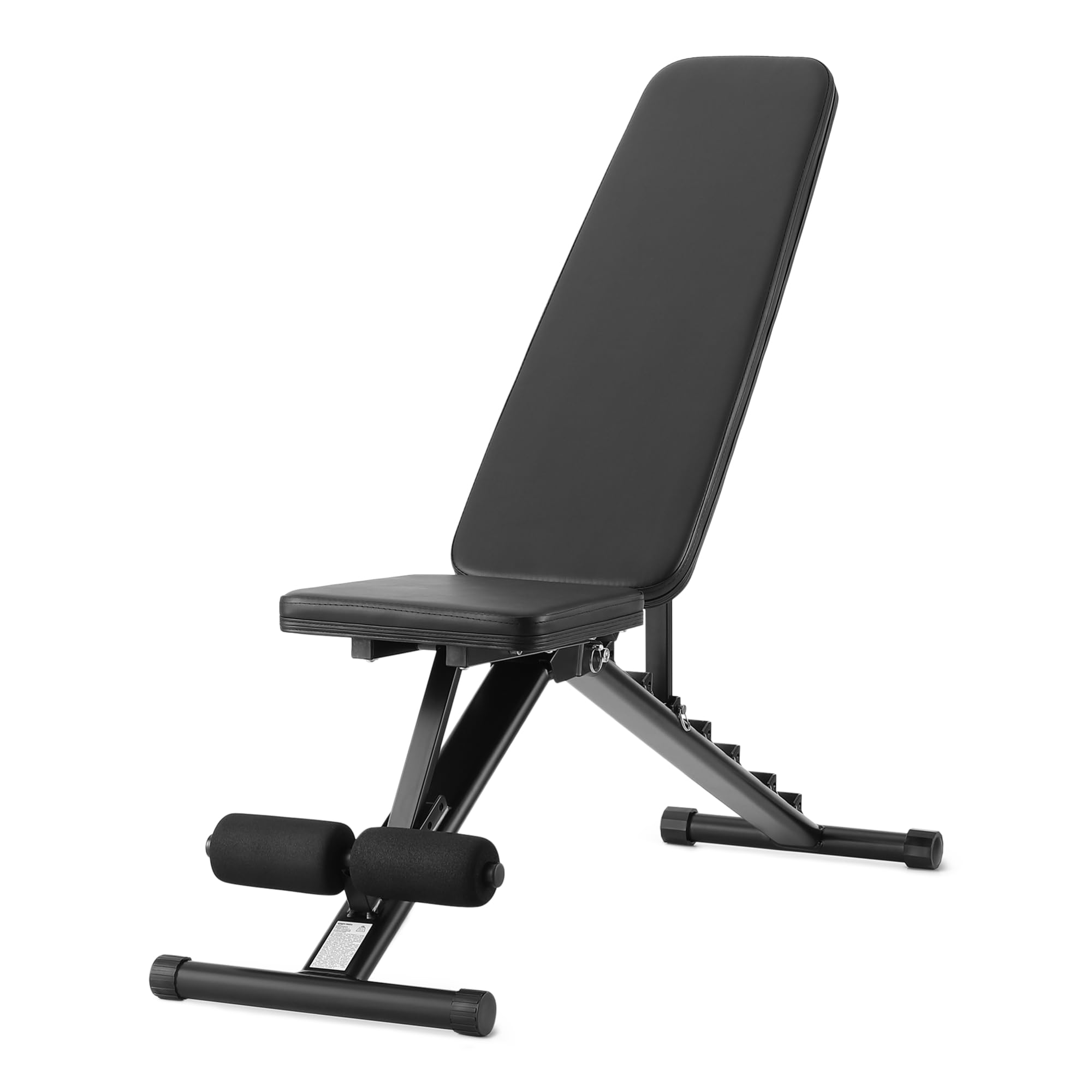
Amazon Basics enters the ab bench space with a straightforward seven-position backrest bench that focuses on getting the fundamentals right without extra complexity. The alloy steel frame supports up to 660 pounds, which is more than enough for ab-specific movements like decline crunches, leg raises, and weighted sit-ups. The backrest adjusts across seven positions, including a moderate decline angle that puts your torso below parallel. Seat adjustments add three positions, giving you the ability to fine-tune the hip angle for better abdominal isolation.
The bench folds using a fast mechanism that locks the frame in the collapsed position for storage. This is a genuine space saver — the folded profile is narrow enough to fit between a washer and dryer. Assembly requires no tools; you simply insert three hinge pins, and the bench is ready to use. The pad is slimmer than dedicated ab benches (roughly 2 inches), but the foam is firm enough to avoid bottoming out during decline work. The 15-inch width is narrow, so broader-shouldered athletes may feel some overhang during exercises like dumbbell flyes.
Taller users over 6 feet have reported that the leg portion of the bench causes them to slide forward during decline sit-ups because the pad is not long enough. The foot support is a basic foam roller that works for lighter use but does not offer the same shin-cradling stability as the higher-end models. For someone adding their first bench to a home gym and prioritizing budget, this is a functional entry point, but the compact dimensions limit it as a long-term ab training platform.
Why it’s great
- Tool-free assembly with hinge-pin system takes less than two minutes
- Folding design collapses to a slim profile for apartment storage
- Seven backrest positions include a useful decline angle for ab work
- Alloy steel frame feels stable despite the budget price point
Good to know
- Narrow 15-inch pad provides limited support for broader shoulders
- Short pad length allows taller users to slide during decline sets
- Basic foam roller offers less secure foot anchoring than adjustable models
7. MERACH Ab Machine Chair
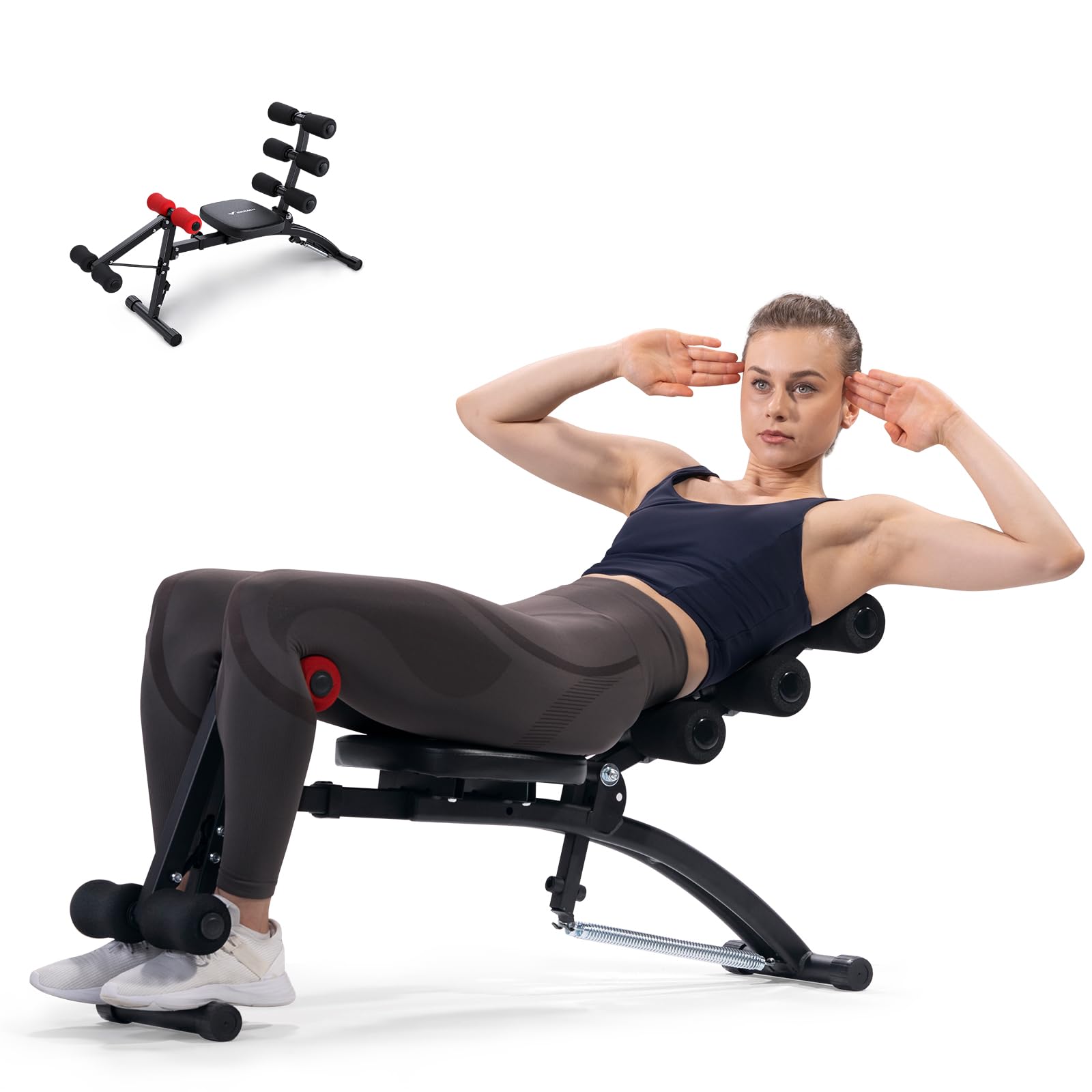
The MERACH Ab Machine Chair takes a different approach: instead of a decline bench, it uses a seated design with a contoured backrest and foam rollers to support a crunching motion. The frame is compact — short enough to slide under a desk — which makes it the most space-efficient option in this list for apartment dwellers. Four adjustable length settings let you position the foam rollers against your thighs at different heights, accommodating users from around 5-foot-2 to 6-foot-1.
The triangular stability structure and reinforced steel frame prevent the chair from tipping during the crunching motion, even when you lean back fully. The seat cushion is thickened with dense foam, and the foam rollers on the leg brace are soft enough to avoid digging into your thighs during sustained sets. The resistance comes from your body weight alone — there are no bands or additional loading mechanisms. The tension is roughly equivalent to a 10-pound resistance band, which works well for high-rep toning circuits but will not build significant abdominal strength for an intermediate trainee.
Users over 5-foot-8 have reported that the leg portion can cause their shins to press into the foam roller during the full range of motion, and the ankle pad may contact the shin rather than the top of the foot. The chair is not designed for decline sit-ups or leg raises, so it is limited to crunch variations and seated knee tucks. This is a viable option for someone who wants a gentle introduction to ab training without the space commitment of a full-length bench, but it is not a substitute for a decline bench for progressive overload.
Why it’s great
- Ultra-compact footprint fits under office desks and in small apartments
- Four length adjustments accommodate a wide range of user heights
- Thick seat cushion and soft foam rollers add comfort during extended sessions
- Triangular frame design provides stable support without floor anchors
Good to know
- Resistance is bodyweight only, limiting progressive overload for experienced users
- Taller users may find the leg brace hits the shin instead of the top of the foot
- No decline angle, so it cannot replicate the full stretch of decline sit-ups
FAQ
Can I use a regular weight bench for decline sit-ups?
What is the ideal decline angle for targeting the lower abs?
How much weight capacity do I need for an ab bench?
Why does my ab bench wobble during decline sit-ups?
Final Thoughts: The Verdict
For most users, the ab bench winner is the Rep Fitness AB-3000 FID 2.0 because it combines commercial-grade pad density, a heavy 112-pound frame for absolute stability, and precise angle markings that let you track your decline progression over weeks. If you want a full leg extension and preacher curl system in one package, grab the Keppi Fitness Bench3000 Max. And for a true decline specialist that fits taller athletes, nothing beats the Finer Form 2-in-1 Ab Bench.