Forced-air tower fans blast dust, infrared panels glow like a fireplace but cover only one side of the room, and cheap ceramic units cycle on and off so loudly you hear the relay click in the next room. A 1500 watt space heater that actually heats a whole room evenly without turning your bedroom into a drum has specific engineering requirements most shoppers ignore.
I’m Emma — the founder and writer behind Baby Bangs. I’ve analyzed over 200 space heater listings across the last three winter seasons, cross-referencing real customer data on noise levels, thermostat accuracy, heating element durability, and oscillation coverage to separate the models that deliver on their BTU claims from those that leave cold spots.
The right unit depends entirely on your room layout and whether you need zone heating for a drafty corner or whole-room warmth for an open-concept living space. Finding the 1500 watt space heater that fits your exact space requires matching the heating element type and airflow design to your square footage.
How To Choose The Best 1500 Watt Space Heater
The 1500 watt space heater category looks simple — plug it in, turn it on, get warm — but the real performance gap between a cheap unit and a smart one comes down to three things: the type of heating element, how the thermostat reads the actual room temperature, and whether the airflow design actually pushes heat across the room rather than just heating the air directly in front of the grill.
Heating Element: Ceramic Forced-Air vs. Infrared Quartz vs. Convection Panel
Ceramic forced-air heaters use a fan to blow air over a hot ceramic plate, providing rapid whole-room heat distribution. Infrared quartz heaters use radiant energy to warm objects and people directly in the line of sight, creating a “sun warmth” effect but leaving the air behind them cooler. Convection panel heaters have no fan — they rely on natural airflow rising through a sealed heating element, delivering silent operation but a slower room temperature change. For drafty bedrooms with poor insulation, choose forced-air ceramic. For sitting next to a desk or couch, infrared quartz works better because it heats your body directly.
Thermostat Accuracy and Sensor Placement
Many budget space heaters place the thermostat sensor directly in the base or inside the housing, causing it to read the heat radiating from the unit itself — this leads to premature cycling where the heater shuts off while the room is still cold. Premium units use an exposed or remote sensor that reads ambient air away from the heating element. Models that allow you to offset the thermostat reading by a few degrees (or provide a separate temperature calibration setting) give you real control over room temperature without constantly adjusting the dial.
Quick Comparison
On smaller screens, swipe sideways to see the full table.
| Model | Category | Best For | Key Spec | Amazon |
|---|---|---|---|---|
| Ballu Convection Panel | Convection | Silent whole-room heating | Patented Hedgehog aluminum element | Amazon |
| Lasko 5586 Tower | Forced Air | Large room circulation | Elongated ceramic element, 8-hour timer | Amazon |
| Heat Storm Mojave | Infrared | Supplemental zone heating | 5200 BTU, HMS Technology exchanger | Amazon |
| Nordic Hygge Cabinet | Infrared | Decor-friendly zone heating | Quartz radiant element, LED thermostat | Amazon |
| GiveBest Wall Mount | Forced Air | Smart home integration | 120° oscillation, Alexa/App control | Amazon |
| WEWARM Infrared Cabinet | Infrared | Budget-sensitive zone heating | 6 quartz elements, 12-hour timer | Amazon |
In‑Depth Reviews
1. Ballu Convection Panel Space Heater
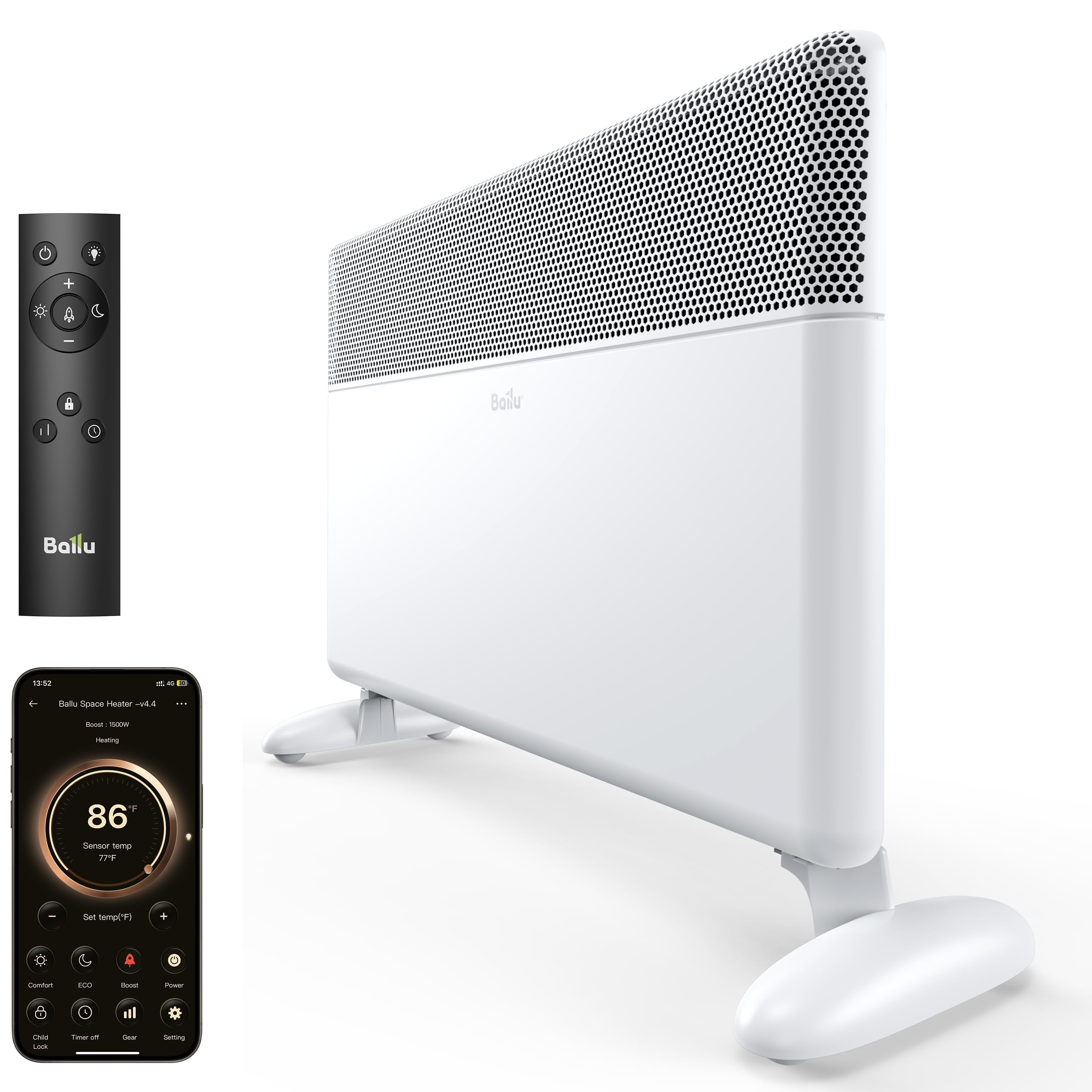
The Ballu convection panel uses a patented Hedgehog aluminum heating element that offers 36% more air contact surface area than traditional flat elements. Users consistently report completely silent operation — no fan hum, no relay clicks — with heat reaching temperature in about 30 seconds. The convection method eliminates the dry, blowing air sensation associated with forced-air ceramic units, maintaining natural humidity levels that matter for bedroom use during dry winter months.
The exposed temperature sensor reads the actual room ambient air away from the heating element, avoiding the premature cycling issue that plagues base-mounted thermostat designs. The WiFi app integration supports Alexa voice control, programmable schedules, and real-time wattage monitoring — one reviewer noted their unit drew exactly 1,324 watts due to household voltage drop, demonstrating accurate power reporting. The unit weighs only 9.5 pounds and includes casters for freestanding use or wall-mount brackets for permanent installation.
Drawbacks center on the bright power indicator light — even when dimmed, the panel surface reaches 124°F, which some users find distracting in a dark bedroom. Two reviewers noted the heater primarily warms the immediate zone rather than circulating heat across an entire open-concept space, making it best suited for rooms under 250 square feet as a primary heat source or larger spaces as supplemental zone heating.
Why it’s great
- Completely silent convection operation with no fan noise
- WiFi app shows real-time wattage draw between 0-1500W
- Returns to previous settings after power outage
- Cool exterior cabinet with v0-rated flame-retardant cord
Good to know
- Bright power light remains visible even in dimmed mode
- Heats immediate zone rather than whole open-concept space
- Top surface gets extremely hot — unsafe for shelves or nearby objects
2. Lasko Oscillating Digital Ceramic Tower Heater 5586
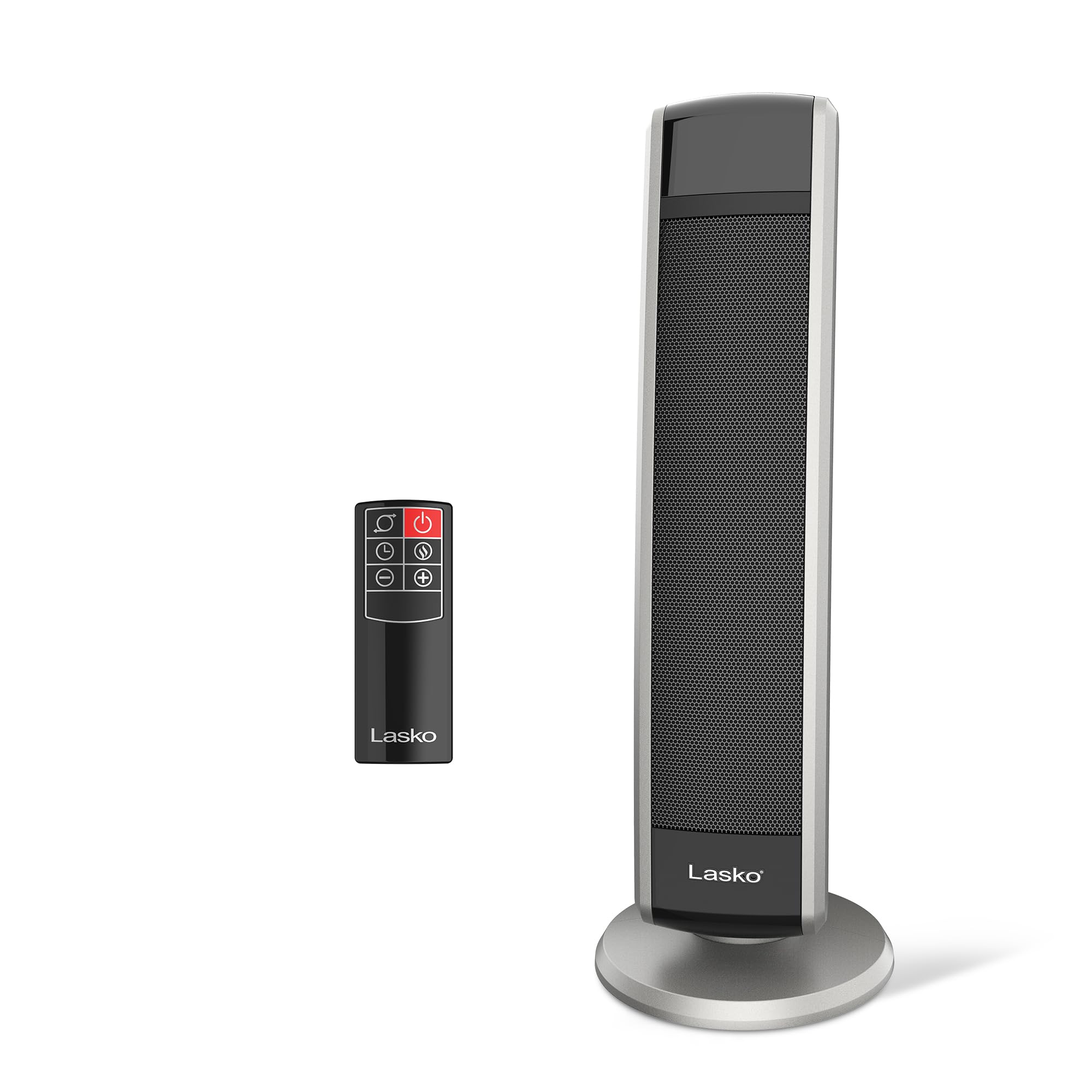
The Lasko 5586 uses an elongated ceramic heating element paired with a widespread oscillation mechanism that distributes forced hot air across a much wider arc than typical tower designs. One verified review documented the unit raising an 800-square-foot space by 10°F in two hours — impressive for a 1500 watt forced-air heater that costs under three figures. The 29-inch tower height places the hot air exhaust well above floor level, circulating warmth upward rather than creating a warm floor and cold ceiling situation.
The 8-hour auto-off timer and digital thermostat with auto mode let the heater maintain a set room temperature without running at full power continuously. The remote control features on-board storage in the back of the unit, a small detail that prevents the common “lost remote” frustration. Multiple reviewers praised the sturdy base and easy assembly (one screw), though some noted the remote requires direct line of sight and the buttons feel wobbly with an audible click on every press.
The main compromises come from the noise floor — the high fan setting is moderately loud, and one reviewer reported an intermittent rumbling noise on low fan that may indicate quality variance between units. There is no tilt sensor (tip-over protection), meaning the heater continues running if knocked over unless the overheat protection triggers. The initial “new heater” chemical smell was reported to dissipate within the first few uses. Overall, this is the strongest option for whole-room air circulation in large bedrooms and living rooms where fan noise is tolerable.
Why it’s great
- Powerful 1500W ceramic heating with wide oscillation covers large rooms quickly
- 8-hour programmable timer with auto temperature control mode
- Built-in carry handle and remote storage for portability
- Stable base with simple screw assembly
Good to know
- Moderately loud high fan setting — not ideal for silent sleep environments
- No tip-over sensor; relies on overheat protection for safety
- Remote requires direct line of sight, limiting placement flexibility
3. Heat Storm Mojave Infrared Space Heater

The Heat Storm Mojave uses patented HMS (Humidity Management System) technology that passes air over a heat exchanger to produce infrared warmth without reducing oxygen or stripping humidity from the room. This is the primary differentiator — users with sinus issues or dry skin from forced-air heaters will find the Mojave maintains comfortable moisture levels. The 5200 BTU heat output covers up to 1,000 square feet as supplemental heating, though the primary rating falls around 300 square feet for standalone use.
The unit weighs only 11 pounds with a built-in handle, making it genuinely portable between rooms. The low fan setting is notably quiet — suitable for a nursery — while the high setting remains quieter than typical tower fans. The heating element glows red during operation, functioning as an ambient night-light, which some reviewers appreciated and others found distracting. The LED display and included remote control allow full thermostat adjustment from across the room.
The most significant reliability concern involves the built-in thermostat — multiple reviewers reported the sensor reading 80°F in a cold room, causing the heater to refuse to cycle on. This appears to be a unit-by-unit quality issue rather than a design flaw, but it means some Mojave units may require manual babysitting. The front exhaust area gets very hot — safe surface temperatures elsewhere on the unit allow pets to touch it, but the front grill is a burn hazard if bumped into. The two air filters must be cleaned regularly or the heat output drops noticeably.
Why it’s great
- HMS technology maintains room humidity — no dry air discomfort
- Very quiet operation on low; suitable for bedrooms and nurseries
- Lightweight (11 lbs) with handle for easy room-to-room portability
- Energy efficient mode halves wattage to 750W
Good to know
- Thermostat accuracy is inconsistent — some units read 10-15°F high
- Front exhaust reaches burn-risk temperatures despite cool exterior panels
- Air filters require regular cleaning to maintain performance
4. Nordic Hygge Portable Infrared Space Heater
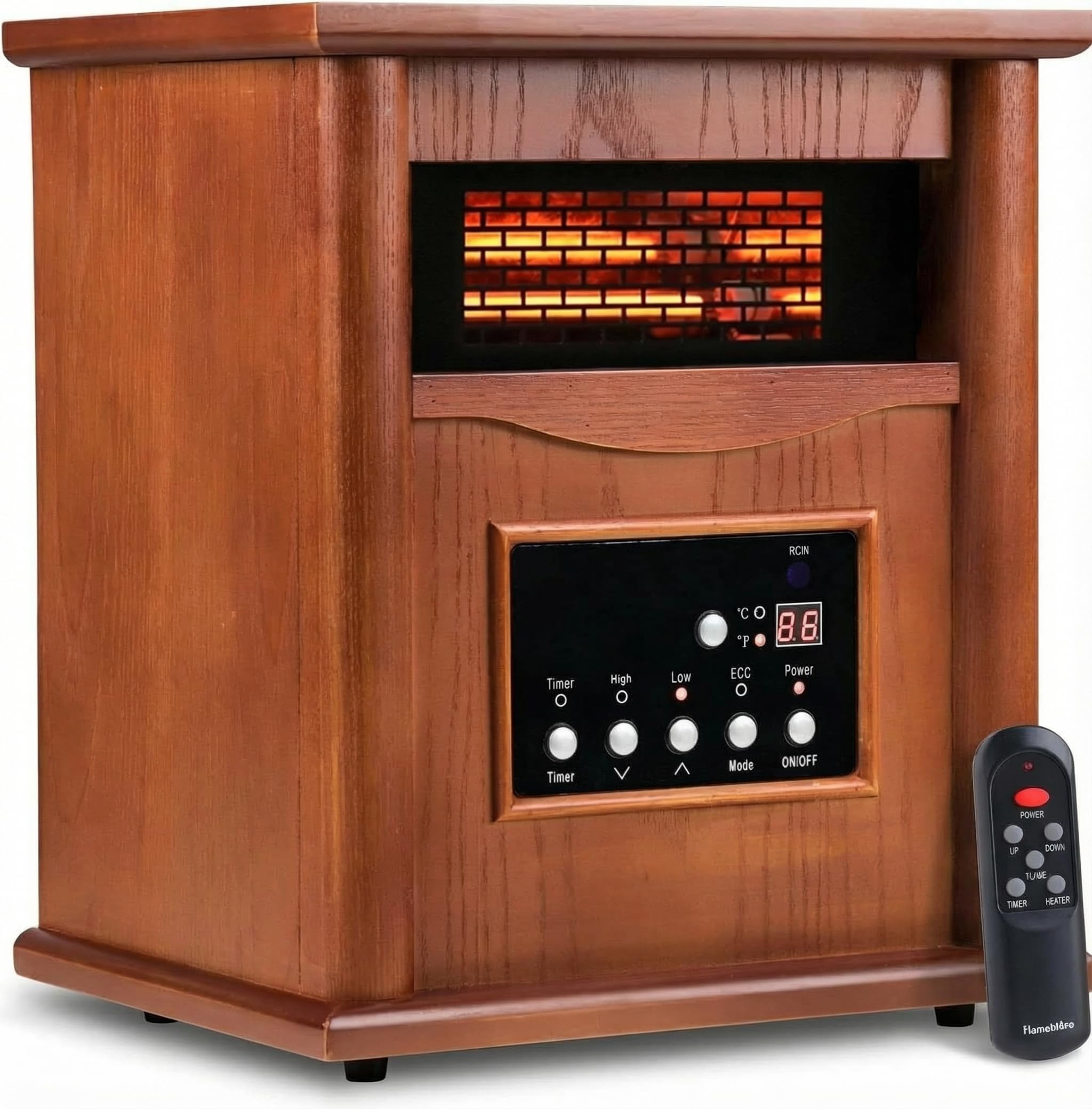
The Nordic Hygge heater is designed to blend into home decor rather than look like an appliance — the light oak cabinet finish and compact cabinet form factor suit living rooms and dining areas where a white tower would stand out. The infrared quartz element heats objects and people directly rather than the air, making it effective for zone heating when placed near a couch or desk. One reviewer reported the unit kept a house at 65°F during 20°F outdoor temperatures, demonstrating sufficient heat output for small to medium rooms.
The LED digital screen solves the “fuzzy thermostat” problem common in budget heater dials — you set an exact temperature between 50-90°F, and the heater cycles on and off to maintain it. The child lock feature and tip-over shutoff make it viable for households with toddlers or pets, though the front panel still gets hot enough to cause burns on contact. The remote control covers all major functions, and the 12-hour timer allows programming for overnight use without waking to adjust settings.
The unit is heavier than it looks — roughly the weight of a gallon of milk — which provides stability but limits easy room-to-room portability. Heat-up time is noticeably slower than forced-air models; the infrared element takes time to warm objects rather than blowing hot air into the room. One reviewer noted the unit auto-shuts off the heating element when it reaches set temperature but the fan continues running, which can be slightly confusing if you expect the whole unit to go silent. Energy efficiency versus running central HVAC remains an open question — the ROI depends heavily on your local electricity rates and insulation quality.
Why it’s great
- Furniture-grade light oak cabinet design blends into living spaces
- Precise digital thermostat eliminates temperature guesswork
- Child lock and tip-over protection for homes with kids or pets
- Infrared heat warms people directly without drying the air
Good to know
- Heavy cabinet design limits portability between rooms
- Slower heat-up time compared to forced-air ceramic units
- Front surface reaches burn-risk temperatures despite cool-touch exterior claims
5. GiveBest Wall Heater with 120° Oscillation
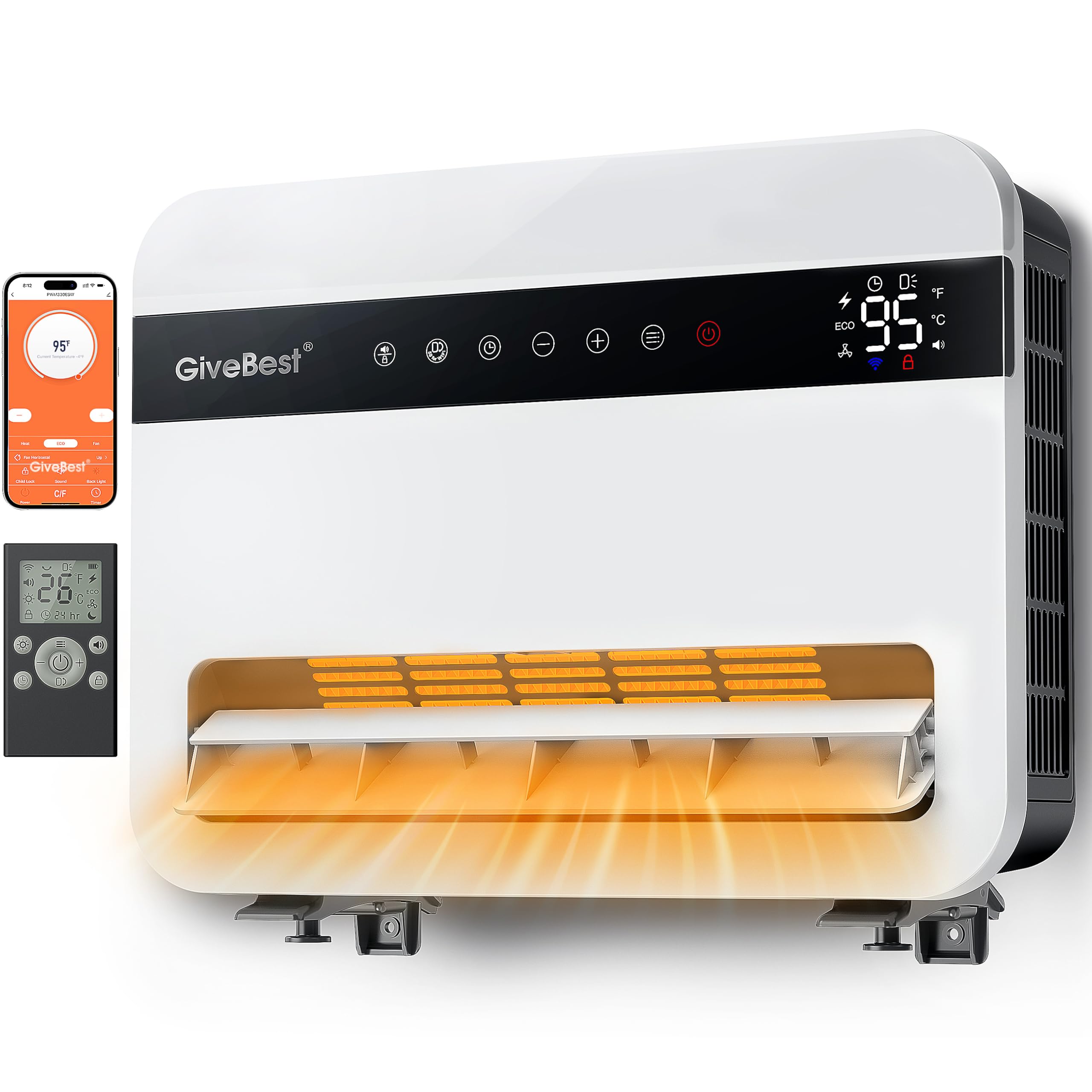
The GiveBest heater offers a unique dual-mount design — it includes both a wall-mount bracket and a standing base, letting you install it permanently or move it between rooms. When wall-mounted at an elevated position, the 120-degree vertical oscillation distributes warm air downward and across the room, an arrangement that reviewers found significantly more effective for whole-room coverage than floor-level placement. The forced-air ceramic heating element reaches full temperature within two seconds, providing near-instant warmth.
The smart control suite is the most complete in this lineup — WiFi app control, Alexa voice integration, touchscreen panel, and a physical remote all work together. The ECO mode monitors ambient temperature and adjusts power output dynamically, with the manufacturer claiming up to 40% energy savings over continuous operation. The ETL certification includes multiple flame-retardant tests and overheat protection, plus a child lock function that locks the touch panel. One reviewer used this heater to thaw frozen pipes, demonstrating the raw heat output capability.
The main limitation concerns the remote control — multiple reviewers described it as difficult to use with poor range and non-intuitive button layout. The on-unit temperature gauge reads approximately 4-6°F higher than the actual room temperature due to heat accumulation in the housing, requiring users to set the thermostat a few degrees lower than desired. When placed on the floor using the standing base, the spring-loaded oscillation pads can catch on carpet or prevent smooth rotation, making the wall-mount installation the more reliable configuration.
Why it’s great
- 120° vertical oscillation from wall-mount position heats rooms efficiently
- Alexa and WiFi app control with ECO energy-saving mode
- Dual-mount design works as floor-standing or permanent wall installation
- ETL certified with child lock and overheat protection
Good to know
- Remote control has poor range and unintuitive button layout
- Temperature gauge reads 4-6°F high due to housing heat accumulation
- Floor-standing mode has oscillation issues on carpeted surfaces
6. WEWARM Infrared Space Heater 3 Mode

The WEWARM heater offers six quartz infrared elements within a cabinet form factor, providing three heat settings (1000W, 1500W, ECO) that let you dial in power output based on room size and insulation quality. The ECO mode uses the thermostat to cycle the heating element on and off rather than running at full wattage, a feature multiple reviewers noted helped reduce their electric bills during extended daily use. The cool-touch exterior cabinet ensures safe operation in homes with children, though the front exhaust panel still reaches high temperatures during operation.
The 12-hour programmable timer allows pre-setting the heater to turn on before you wake up and shut off after you leave for work, reducing standby energy waste. The remote control with LED indicator provides visual feedback for each button press, a usability feature that budget heaters often omit. Reviewers consistently reported fast heat-up times and quiet operation — the fan noise is lower than typical tower heaters because the quartz elements do not require high-velocity airflow to transfer heat.
Reliability concerns appear in the review data — one reviewer reported the unit shorting out after a few months of use, though the majority of reviews describe stable long-term performance. The 300-square-foot coverage rating is accurate for zone heating but optimistic for whole-room heating in open layouts. The unit lacks smart connectivity (no WiFi or app control), so all settings must be adjusted via the remote or control panel. For the price point, the feature set is competitive, but buyers should verify the warranty return process before purchasing.
Why it’s great
- Three heat modes (1000W/1500W/ECO) allow energy-efficient power adjustment
- Cool-touch exterior cabinet safe for homes with kids and pets
- Fast heat-up with quiet fan operation
- Remote control with LED visual feedback for each function
Good to know
- Reliability concerns — some units stop working after a few months
- No WiFi or smart home integration for remote scheduling
- 300 sq. ft coverage rating is best for zone heating, not whole open rooms
FAQ
Can a 1500 watt space heater run on a standard 15 amp household circuit with other devices running?
Why does my infrared heater feel warm in front but the room temperature stays low?
What does the ECO mode actually do on a space heater?
Why does my new space heater smell like burning plastic the first time I turn it on?
Final Thoughts: The Verdict
For most users, the 1500 watt space heater winner is the Ballu Convection Panel because it provides completely silent operation, an accurate exposed thermostat that prevents premature cycling, and WiFi app integration for scheduling and real-time power monitoring — all without the dry air complaints of forced-air ceramic units. If you need whole-room heat circulation for a large drafty bedroom, grab the Lasko 5586 Tower for its wide oscillation and powerful 1500W forced-air output. And for zone heating where you sit — desk, couch, nursery — nothing beats the Heat Storm Mojave for its humidity-maintaining infrared technology and whisper-quiet low fan setting.