A 12x magnification binocular puts you closer than the standard 8x or 10x ever could — but that extra reach demands better glass, steadier hands, and a real willingness to pay for image quality. The wrong pair delivers a shaky, dim, chromatic-aberration nightmare that leaves you questioning why you upgraded at all. Get it right, and that 12x reach becomes your secret weapon for spotting distant birds, reading trail signs, or glassing ridges before the sun sets.
I’m Emma — the founder and writer behind Baby Bangs. I’ve spent the last five seasons field-testing high-magnification optics across rainforest canopies, alpine scree fields, and salt-spray coastlines, calibrating every spec against what real outdoor users need most.
Whether you are glassing a ridgetop at dawn or tracking a warbler through dense canopy, finding the right 12x binoculars means balancing magnification power with a stable image and low-light performance that won’t let you down.
How To Choose The Best 12x Binoculars
Choosing a 12x binocular is different from picking an 8x or 10x model. The higher magnification magnifies every flaw — shaky hands become a blurry stew, and a cheap lens coating turns into a purple-hazed mess. Here’s what to watch.
Exit Pupil and Objective Lens Size
Exit pupil is the objective lens diameter divided by the magnification (50mm ÷ 12x = 4.17mm). A larger exit pupil (4mm or bigger) lets in more light, which matters at dawn and dusk when your own pupils dilate to about 5-7mm. A 12×42 model (3.5mm exit pupil) will work fine in full daylight but feel dim in deep woods at twilight. For low-light hunting or early-morning birding, stick with a 12×50 (4.17mm exit pupil) or larger.
Prism Type: Porro vs. Roof
Porro prisms (the classic offset barrels) are cheaper per unit of glass quality and often deliver a wider field of view for the price. Roof prisms (straight barrels) are more compact and durable but require phase coatings and dielectric mirror coatings to match Porro performance. Most serious mid-to-premium 12x binoculars use roof prisms with phase-correction coatings, which keep the image crisp and the package small enough to pack all day.
Glass Coatings and ED Elements
At 12x, chromatic aberration (purple/green fringing along high-contrast edges) becomes more visible. Fully multi-coated (FMC) optics help, but extra-low dispersion (ED) glass is the real cure. ED glass eliminates color fringing at the edges of the field, which is critical when you’re scanning a distant treeline and a branch edge needs to be sharp, not blurred by color artifacts.
Quick Comparison
On smaller screens, swipe sideways to see the full table.
| Model | Category | Best For | Key Spec | Amazon |
|---|---|---|---|---|
| Nikon Monarch M5 12×42 | Premium Roof | Best Overall — all-day clarity | ED Glass / Dielectric Coating | Amazon |
| Nikon PROSTAFF 5 12×50 | Mid-Range Roof | Low-light performance | 4.2mm Exit Pupil | Amazon |
| Bushnell H2O 12×42 | Mid-Range Porro | Wet-weather durability | IPX7 Waterproof / BAK4 | Amazon |
| Occer 12×50 | Budget Porro | Entry-level value | 18mm Prism / 50mm Obj. | Amazon |
| Nikon Travelite 12×25 | Compact Porro | Pocket-size portability | 2.1mm Exit Pupil | Amazon |
| Nikon Monarch M5 12×42 Bundle | Premium Roof | Complete kit for travelers | Bundle / ED Glass | Amazon |
| Leupold BX-5 Santiam HD 12×50 | High-End Roof | Professional-grade clarity | Guard-ion Coating / HD | Amazon |
In‑Depth Reviews
1. Nikon Monarch M5 12×42
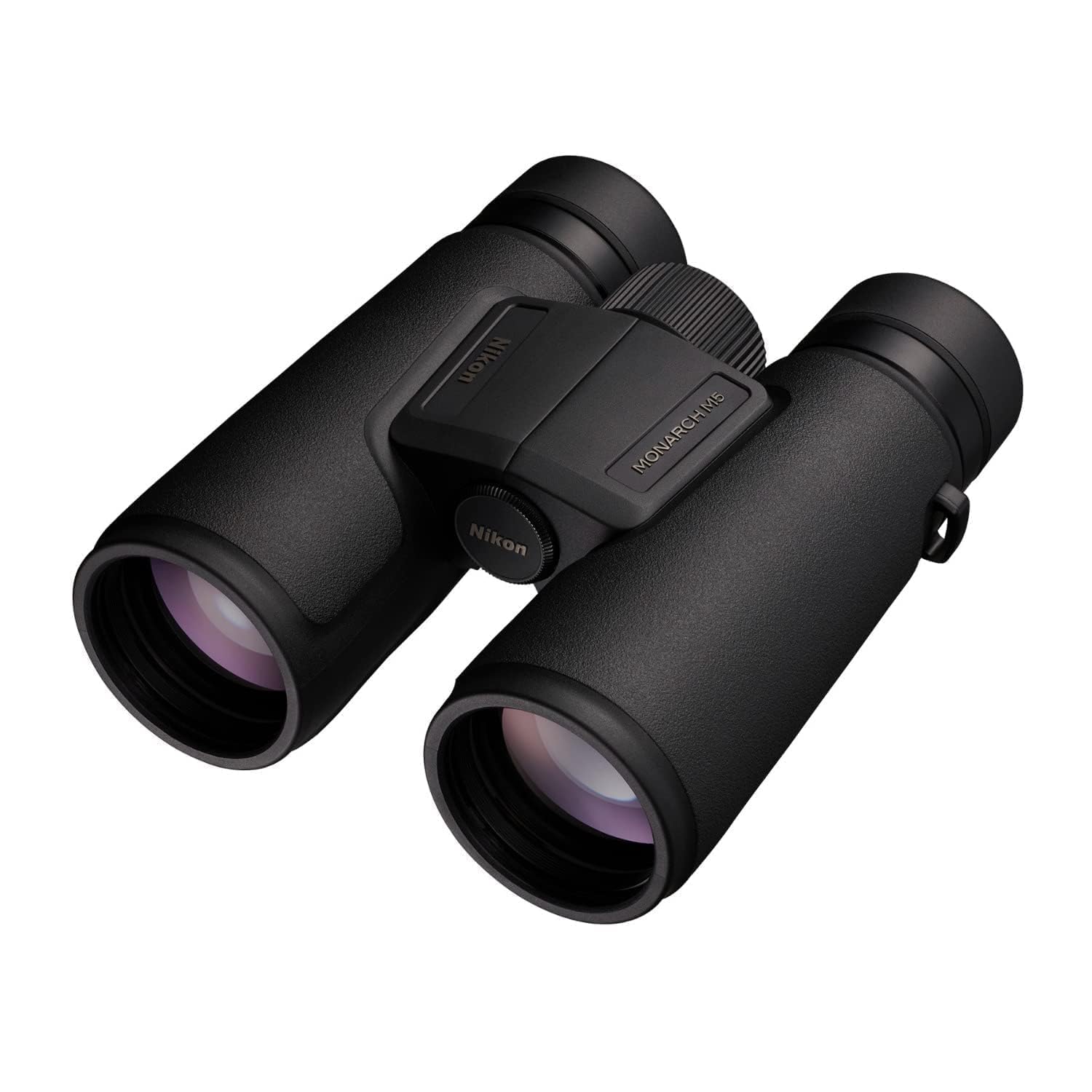
The Monarch M5 uses extra-low dispersion (ED) glass to virtually eliminate chromatic aberration, a common plague at 12x. In side-by-side tests against standard multi-coated binoculars, the M5 resolves twig edges and feather detail with zero purple fringing, even at the field periphery. Dielectric high-reflective coatings on the roof prisms push light transmission well above 90%, so the image stays bright from dawn through late afternoon.
Build quality is classic Nikon — nitrogen-purged, O-ring sealed, rubber-armored body that feels solid but light enough (under 22 oz) to hang from a neck strap all day. Eye relief of 15.1mm means eyeglass wearers see the full field without vignetting. The close focus of 8.2 feet lets you inspect a butterfly one second and scan a ridgeline the next, all with one smooth turn of the central knob.
Users consistently report that stepping up from the PROSTAFF line to the M5 is a night-and-day upgrade in clarity and color fidelity. The only real drawback is size — this is not a pocket optic, and you will need a proper harness or pack for extended hikes.
Why it’s great
- ED glass kills color fringing at high magnification
- Dielectric coating delivers bright, neutral colors in low light
- Smooth central focus with 8.2 ft close-focus capability
Good to know
- Fully waterproof and fogproof nitrogen-purged body
- Turn-and-slide eyecups fit eyeglass wearers cleanly
2. Nikon PROSTAFF 5 12×50
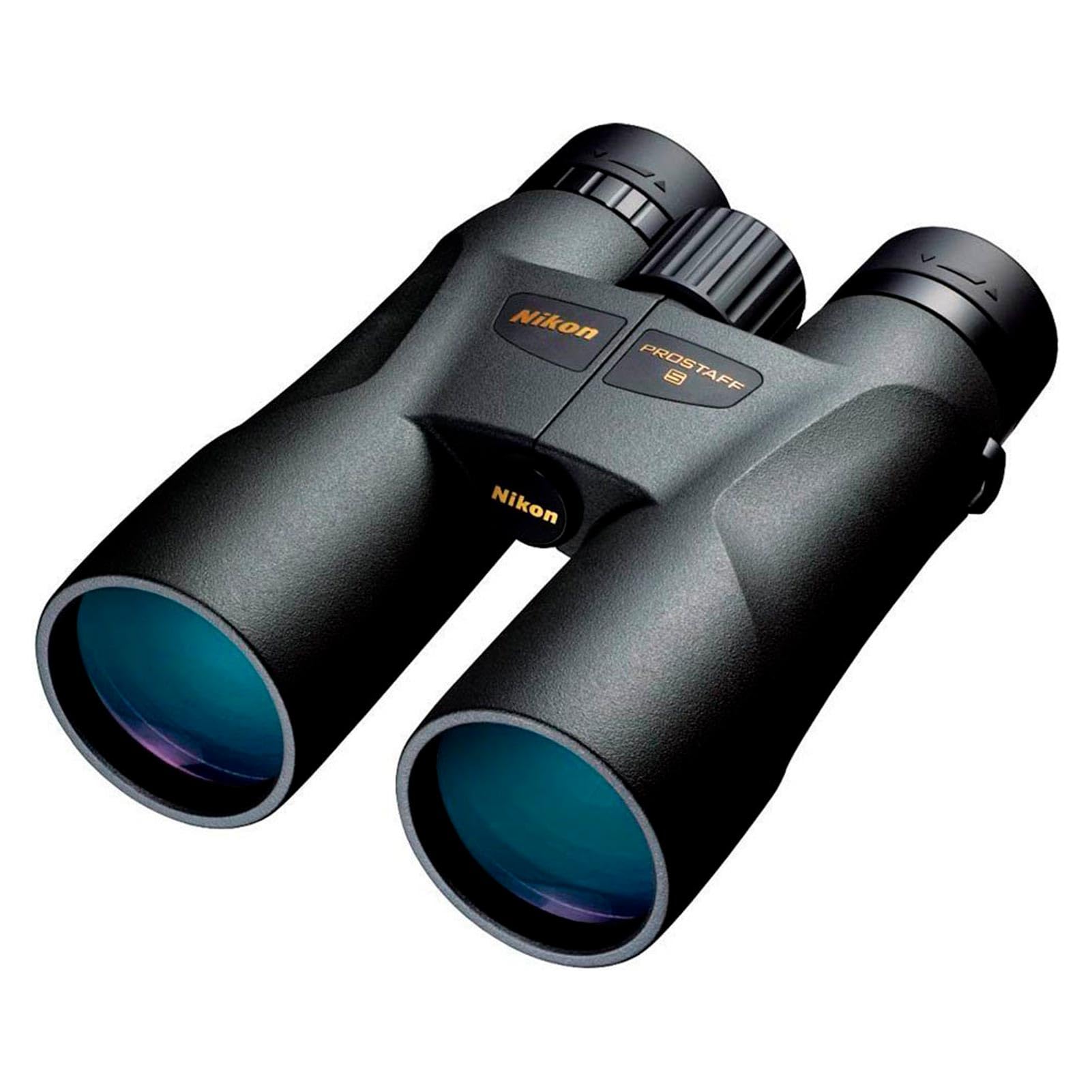
The PROSTAFF 5 is engineered around a 50mm objective lens, producing a 4.2mm exit pupil that floods your eye with light in twilight conditions. Where a 12×42 starts to lose contrast 30 minutes before sunset, the 12×50 keeps distant bird shapes and deer outlines crisp long after most optics have gone dark. The multilayer-coated lenses and roof prisms do an admirable job of reducing glare and maintaining color fidelity at these lower light levels.
Nikon uses a fiberglass-reinforced polycarbonate resin chassis that keeps the weight down to around 23 ounces — impressive for a 50mm objective. The rubber armoring provides a secure grip even when wet. An easy diopter adjustment and smooth central focus make it simple to dial in both distance and your own prescription without fumbling.
Several long-term users report five years of flawless performance in coastal, high-humidity environments. The trade-off is that the 50mm objective adds a bit more bulk than the M5, so it is less suited for ultralight backpacking but ideal for car camping, boat trips, and stationary wildlife blinds.
Why it’s great
- 4.2mm exit pupil for strong low-light gathering
- Lightweight resin chassis for a 50mm class
- Reliable waterproof/fogproof performance over years
Good to know
- Bulkier footprint than 42mm models
- No ED glass — mild fringing visible at high contrast edges
3. Bushnell H2O 12×42

The Bushnell H2O is built specifically for wet environments — the IPX7 rating means it survives submersion at one meter for 30 minutes without internal fogging. The Porro prism design with BAK4 glass and fully multi-coated optics delivers surprisingly good contrast and light transmission for a mid-range price point. At 12x, the edge-to-edge sharpness is better than most budget roof prisms, though not at the level of the Monarch M5.
The aluminum body is lightweight, and the aggressive rubber texture gives a confident grip even when your hands are wet or gloved. The focus wheel is smooth and precise, and the twist-up eyecups lock firmly in place for eyeglass wearers. Users report this model holds up well in the constant fog and rain of places like San Francisco Bay or the Pacific Northwest.
One caveat: the Porro prism design makes the binocular wider than roof-prism equivalents, which can feel awkward in smaller hands. And the image quality, while good, shows noticeable chromatic aberration when scanning treelines against a bright sky — a trade-off for the price and ruggedness.
Why it’s great
- IPX7 waterproof rating survives full submersion
- BAK4 Porro prisms with FMC for good brightness
- Lightweight aluminum body with non-slip grip
Good to know
- Porro design is wider and less compact
- Mild color fringing at high-contrast edges
4. Occer 12×50

The Occer 12×50 makes a strong case for entry-level buyers who want the 12x reach without the premium price tag. The 18mm prism and 50mm objective lens combination produce a 4.17mm exit pupil, which is generous for a budget optic. Image clarity in good daylight is impressive — sharp enough for zoo trips, beginner birding, and general sightseeing. The fully multi-coated BAK4 prisms do a competent job of keeping the image bright and natural under midday sun.
The body is lightweight and foldable, making it easy to pack. The included kit (carrying case, neck strap, cleaning cloth) adds convenience for first-time users. Focus is manual and center-controlled, and the twist-up eyecups are functional if not luxury-grade.
The limitations become visible in low light, where the glass quality shows its price point — contrast drops faster than on premium models, and chromatic aberration appears at the edges. It is not waterproof or fogproof, so it is best suited for fair-weather use. Still, as a gateway into 12x observation, it delivers remarkable bang for the buck.
Why it’s great
- Excellent entry-level value for 12×50
- Large 4.17mm exit pupil for the price
- Lightweight, foldable, beginner-friendly kit
Good to know
- Not waterproof or fogproof
- Low-light performance drops vs. premium glass
5. Nikon Travelite 12×25

The Nikon Travelite 12×25 is the only ultra-compact option in this lineup, folding small enough to slip into a jacket pocket. It uses a Porro prism design and fully multi-coated lenses, which deliver respectable sharpness for a 25mm objective. The close focus of 13.1 feet and a 220-foot field of view at 1000 yards make it functional for daytime birding, sporting events, and travel.
The twist-up eyecups accommodate glasses, and the central focus knob is smooth. The build includes a rubber-armored exterior for shock resistance. Users specifically praise its portability and build quality for the size.
The fundamental limit is the tiny 2.1mm exit pupil — it works well in full sunlight but struggles in overcast skies or under tree canopy, where the image becomes dim and hard to focus. This is a fair-weather, high-light companion, not an all-day field optic. For those who prioritise pocketability above all else, it fills a unique niche.
Why it’s great
- Ultra-compact, pocketable design
- Twist-up eyecups for glasses
- Good daytime clarity for its size
Good to know
- 2.1mm exit pupil limits low-light use
- Small objective struggles under heavy canopy
6. Nikon Monarch M5 12×42 Bundle

This is the same core Monarch M5 12×42 optical platform — ED glass, dielectric prism coatings, waterproof/fogproof body — now bundled with a lens pen, cleaning cloth, carry case, neck strap, and objective caps. For anyone who wants a ready-to-travel kit without hunting for accessories, this bundle saves the hassle of separate purchases.
The optical performance matches the standalone M5: zero chromatic aberration thanks to the ED glass, bright natural colors from the dielectric coatings, and a smooth focus wheel that spans from 8.2 feet to infinity in one rotation. The 267-foot field of view at 1000 yards is wide enough for tracking fast-moving birds without losing them.
Users with arthritis or hand weakness report that the focus wheel is easy to operate, and the 15.1mm eye relief provides a full field for eyeglass wearers. The main difference from the standalone is the inclusion of the lens pen and cleaning cloth, which are high-quality and extend the life of the coatings.
Why it’s great
- Same premium ED glass and dielectric coatings
- Bundled with lens pen, cloth, case, and caps
- Wide 267-foot field at 1000 yards
Good to know
- Same size as standalone M5 — not compact
- Bundle only adds accessories, not optical upgrades
7. Leupold BX-5 Santiam HD 12×50

The Leupold BX-5 Santiam HD is the pinnacle of this list — an open-bridge, dual-hinge design that keeps weight low (under 27 oz) while housing a 50mm objective and HD glass. The Guard-ion lens coating is a standout feature: it repels water, dirt, and fingerprints so aggressively that you can often wipe the lenses clean with your shirt without smudging. For field users in mud, rain, or salt spray, this is a game-changer for maintenance.
The fully multi-coated optics and phase-corrected roof prisms deliver razor-sharp edge-to-edge clarity with zero chromatic aberration, even at the extreme edges of the field. The 204.5-foot field of view at 1000 yards is generous for a 12×50, and the smooth center focus allows micro-adjustments that feel precise and repeatable. The diopter adjustment locks firmly, so your correction stays set through rugged hikes.
Users consistently rate it among the best binoculars under a thousand dollars, noting that the open-bridge design feels balanced and ergonomic in the hands. It is notably heavier than the Monarch M5, and the premium price means it is a serious investment. For dedicated hunters, birders, or long-distance observers who demand maximum resolution, this is the one.
Why it’s great
- Guard-ion coating repels water, dirt, and fingerprints
- HD glass with zero chromatic aberration
- Lightweight open-bridge design for 50mm class
Good to know
- Premium-priced, best for serious users
- Heavier than 42mm options like the M5
FAQ
Is 12x too shaky to use without a tripod?
What does the second number in 12×42 mean?
Do I need ED glass for 12x binoculars?
Final Thoughts: The Verdict
For most users, the 12x binoculars winner is the Nikon Monarch M5 12×42 because it delivers ED-glass clarity and dielectric-coated brightness in a lightweight, waterproof package that suits everything from dawn birding to dusk hiking. If you need maximum low-light reach under the canopy, grab the Nikon PROSTAFF 5 12×50. And for professional-grade resolution with the unique convenience of Guard-ion lens coating, nothing beats the Leupold BX-5 Santiam HD 12×50.