Sticking your fingertip multiple times a day is already a hassle. Blood glucose testing shouldn’t feel like a punishment, and the tool you use makes all the difference between a barely-there poke and a wince-worthy jab. Your lancet selection directly affects blood draw speed, pain level, and even the risk of callousing over time — it’s the single most underrated variable in home monitoring.
I’m Emma — the founder and writer behind Baby Bangs. I dig into the engineering and ergonomics of medical home‑use consumables to help you skip the trial‑and‑error phase.
Whether you manage diabetes, test INR, or run routine panels, this guide cuts through confusion to reveal the best blood lancet for your specific routine and comfort level.
How To Choose The Best Blood Lancet
Buying the wrong lancet means more pain, wasted sticks, and unnecessary expense. Focus on three concrete specs — gauge, depth, and activation type — and you eliminate 90 percent of the guesswork.
Gauge Size: The Thinner the Number, the Smoother the Stick
Medical needle gauges are counter‑intuitive: a higher number means a thinner needle. A 33G lancet (like the OneTouch Delica) is significantly finer than a 26G model (like the McKesson). Thinner needles cause less tissue trauma, heal faster, and produce less pain per stick. The trade‑off is blood volume — if you need a large drop for certain INR meters, a 26G or 28G might be necessary.
Penetration Depth: One Size Does Not Fit All Fingers
Depth settings range roughly from 1.0 mm to 2.0 mm. Shallow depths (1.6 mm or less) are ideal for children, thin‑skinned adults, or anyone who bruises easily. Deeper penetrations (1.8 mm or 2.0 mm) yield more blood for multi‑strip meters but increase callous formation over months of daily use. Always match depth to your skin thickness — no single depth works for every person.
Activation and Safety Design
Push‑button lancets let you control the stick moment, while pressure‑activated models fire automatically when pressed against the skin — useful for shaky hands or quick routines. Safety lancets retract the needle immediately after use, eliminating the risk of accidental needle‑stick injury. This matters especially if children or pets are present during testing.
Quick Comparison
On smaller screens, swipe sideways to see the full table.
| Model | Category | Best For | Key Spec | Amazon |
|---|---|---|---|---|
| OneTouch Delica 33G | Premium | Pain‑minimized daily glucose testing | 33G ultra‑thin needle | Amazon |
| McKesson 26G Safety Lancets | Premium | Multi‑test blood draws & safety | Pressure‑activated safety | Amazon |
| Medline 28G Safety Lancets | Mid‑Range | Reliable daily use with controlled depth | Push‑button retraction | Amazon |
| MediCore 30G Pressure Lancets | Mid‑Range | Easy one‑hand pressure activation | 30G with 1.8 mm depth | Amazon |
| ReliOn 30G Ultra Thin | Budget | High‑volume testing on a tight budget | 200‑count pack value | Amazon |
In‑Depth Reviews
1. OneTouch Delica Lancet 33G (100 Count)

The OneTouch Delica 33G sits at the sweet spot of comfort and reliability. At 33 gauge, this is among the thinnest lancets available for home use, meaning the puncture heals faster and the stick itself is barely perceptible — a major win for anyone testing three or more times daily. Customers consistently report less pain and less residual soreness compared to 28G or 30G alternatives they’ve tried.
OneTouch designed this lancet specifically to work with the Delica lancing device, which offers adjustable depth settings from 1 to 5. This pairing allows you to dial in the exact penetration for your skin thickness. Users who switched from higher‑gauge or generic lancets noted more consistent blood drops and fewer repeat sticks. The sterile single‑use packaging also keeps cross‑contamination risk near zero.
The trade‑off is compatibility: the Delica lancet is shaped to snap into the Delica pen and may not fit universal lancing devices. If you already own a different brand’s lancing tool, you’ll need to either switch pens or look elsewhere. For those starting fresh or willing to adopt the OneTouch ecosystem, the reduced discomfort alone justifies the slight premium.
Why it’s great
- 33G needle produces the least painful stick in this guide
- Adjustable depth dial prevents over‑penetration on thin skin
- Sterile, single‑use design eliminates cross‑contamination
Good to know
- Only compatible with the OneTouch Delica lancing device
- Premiums per‑stick vs. generic safety lancets
2. McKesson Lancets for Diabetes Testing (26G, Pressure‑Activated)
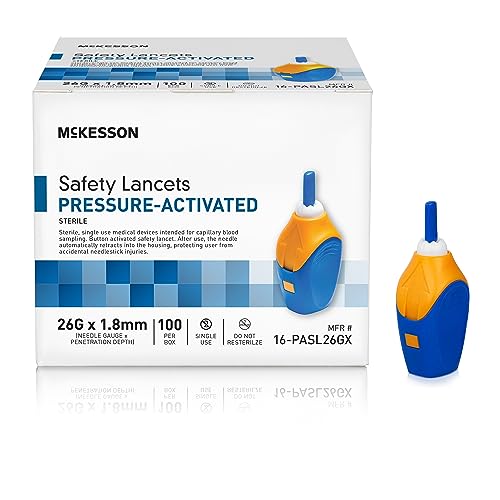
The McKesson 26G lancet uses a 1.8 mm depth and a pressure‑activated trigger, meaning you simply press the flat end against your fingertip and it fires automatically. This design is especially useful for users with reduced hand dexterity or those who are nervous about the stick — no button to fumble, no timing to judge. The 26G gauge is thicker than the Delica, so the blood drop forms quickly and generously, ideal for multi‑strip meters or INR testers.
Every lancet is individually sterile and latex‑free, which matters for allergy‑prone users. The safety mechanism retracts the needle the instant the puncture is made, and the tip locks permanently — there’s no chance of a used needle sticking out. Medical professionals frequently recommend McKesson for home INR monitoring because the blood volume is consistent enough for warfarin management.
The higher gauge does result in a more noticeable pinch compared to 30G or 33G lancets. Several users reported slightly more lingering tenderness, especially if they test more than five times a day. If your priority is maximum comfort over raw blood volume, a thinner gauge will serve you better. Stick with this model if you need reliable volume for specialized testing or if safety‑first pressure activation gives you peace of mind.
Why it’s great
- Pressure activation removes any timing guesswork
- 26G needle produces ample blood for multi‑strip or INR meters
- Permanent retraction eliminates accidental needle sticks
Good to know
- Thicker needle causes slightly more discomfort than finer gauges
- Pre‑loaded design means you cannot replace the cap after use
3. Medline Sterile Safety Lancets (28G, Push‑Button)

Medline’s 28G lancet occupies the comfortable middle ground between the ultra‑thin Delica and the heavy‑duty McKesson. The 1.6 mm depth and controlled spring‑loaded action deliver a quick, gentle puncture that most users describe as “barely noticeable.” The spring‑loaded mechanism provides a consistent stick every time — no variation in speed or force across the 100‑count box. This predictability matters when you’re trying to establish a pain‑free routine.
Safety is another strong point: after the puncture, the needle retracts automatically and the tip locks inside the plastic housing. The covered tip stays shielded post‑use, minimizing the risk of accidental cuts during disposal. Medline packages these as individually sterile units, and the lancets are compatible with the Medline EvenCare G2 monitor as well as other universal lancing pens. The unisex adult sizing fits all lancing devices that accept standard safety‑lancet shapes.
A few users mentioned that the 28G still leaves a visible dot on the fingertip and draws slightly more blood than necessary for a basic glucose test, which can waste strips if you over‑drop. If your meter requires a very small sample, you might prefer a 30G or 33G option. For the majority of mainstream glucose monitors, however, this is a reliable, budget‑conscious workhorse that doesn’t compromise on safety.
Why it’s great
- Consistent spring‑loaded stick eliminates hand‑shaking variation
- 1.6 mm depth is shallow enough for most adult fingertips
- Post‑use tip lock prevents accidental needle sticks
Good to know
- Draws more blood than ultra‑thin alternatives
- Not as gentle as 33G for daily multiple sticks
4. Pressure Activated Safety Lancets (30G, Pressure‑Activated)

These MediCore pressure‑activated lancets use a 30G needle with a 1.8 mm depth — a solid middle ground for users who want a thinner needle than 26G but need the convenience of pressure firing. Simply press the flat end against your fingertip and it fires on contact, no button pressing required. This design is especially helpful for older adults with arthritis or for people who test on the go and can’t spare both hands.
Because the lancet is self‑contained and pre‑loaded, there’s no lancing device to load or carry — just open the sterile seal, use it, and throw it away. Users switching from traditional reusable pens reported a dramatically smoother experience, with blood drawn successfully 99 percent of the time on the first try. The all‑in‑one form factor also makes it easy to keep a few in a purse or glove compartment for travel testing.
The main drawback is cost per stick: pressure‑activated safety lancets run significantly higher per unit than reusable pen lancets. If you test only once or twice daily, the convenience is worth it — but heavy testers (five or more times per day) will feel the expense. Also, the cap cannot be replaced once removed, so you have to use the lancet immediately after opening. For occasional testing or travel, the trade‑off is a no‑brainer.
Why it’s great
- No lancing device needed — truly one‑hand operation
- 30G gauge is noticeably gentler than 26G safety lancets
- Great for travel or on‑the‑go use
Good to know
- Per‑unit cost is higher than refill lancets
- Cap cannot be resealed once opened
5. ReliOn 30G Ultra Thin Lancets (200‑Count)

The ReliOn 30G Ultra Thin lancets deliver the lowest per‑unit cost in this roundup without sacrificing core safety. At 30 gauge, they are substantially thinner than entry‑level 26G options and produce a noticeably milder stick. Customers consistently praise the low failure rate — hundreds of sticks with almost no duds, which is critical when you rely on consistent draws for accurate glucose numbers.
These lancets are designed for the ReliOn lancing pen but also fit most universal lancing devices that accept standard‑shaped lancets. The 200‑count pack (two boxes of 100) is a smart choice for families or frequent testers who want to stock up without re‑ordering every few weeks. The ultra‑thin needle also reduces callus formation over time, a problem that plagues users who stick with thick gauges for months.
The main limitation is the lack of a built‑in safety retraction — these are standard lancets that require a separate lancing device. Without the device, they are useless, and loading them into the pen takes a little practice. A few users noted the plastic cap can be tricky to remove. For anyone who already owns a ReliOn or universal pen, these are the most cost‑effective way to maintain a low‑pain routine.
Why it’s great
- Best per‑unit economy among all reviewed options
- 30G ultra‑thin needle is gentle for daily multi‑use
- Low failure rate across hundreds of sticks
Good to know
- Requires a separate lancing device to function
- Plastic cap removal can be fiddly for some users
FAQ
How often should I change my lancet?
Does a higher gauge always mean less pain?
Are pressure‑activated lancets worth the extra cost?
Final Thoughts: The Verdict
For most users, the best blood lancet winner is the OneTouch Delica 33G because it pairs the thinnest needle in this guide with an adjustable depth pen, producing the least painful daily testing experience available. If you want the convenience of pressure‑activated, no‑device sticks, grab the McKesson 26G Safety Lancets. And for maximal value with reliable 30G performance, nothing beats the ReliOn 30G Ultra Thin 200‑Count for families or high‑volume testers on a budget.